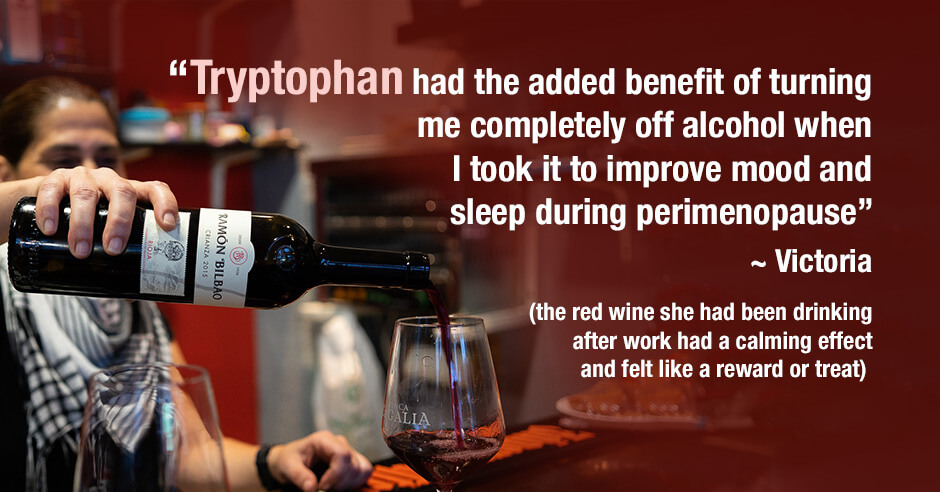
I started taking tryptophan 3 years ago to improve mood and sleep (not recognizing I was in perimenopause which it helped), but had the added benefit of turning me completely off alcohol! Lol. What serendipitous timing! I use amino therapy with pretty much all my perimenopause patients now. Thanks to you and Julia Ross’s work. Forever grateful.
Victoria shared this wonderful feedback about the benefits she experienced with tryptophan on a recent Facebook thread and kindly gave me permission to share.
Self-medicating with wine (and other alcoholic beverages) is common when we are anxious or stressed and typically we use it to wind down at the end of the day and to fit in socially. This is common when GABA levels are low and also happens due to low serotonin which declines from mid-afternoon into the evening.
I asked what she had been drinking and how often? And if it was calming for her? This was her response:
Red wine the minute I walked in the door in the evening. I guess it was calming… maybe more reward driven? It would be my reward for getting home from work via picking kids up from sport and doing a grocery shop and … (fill in the blank) that we working mums do and then having to walk straight into the kitchen to start on dinner.
The wine was like my little treat or reward to motivate me to just keep moving with my chores. No time to sit and unwind, just pour the wine and start chopping! Lol… I had tried to stop before but just couldn’t pick up a knife without the wine glass!
Within days, the tryptophan made the wine taste like cat’s pee! Haven’t touched it since. No desire at all. Almost hypnosis like?
How much tryptophan Victoria used and how did it help her quit?
Victoria used the Now Tryptophan 1000 mg at 3pm and 9pm for about a year, eventually stopping it and saying: “Alcohol still does not interest me at all.”
What wonderful results! A typical starting dose for tryptophan is 500 mg midafternoon and evening and she increased this to find her ideal dose of 1000 mg twice a day. She did report that 5-HTP didn’t work for her the way tryptophan did. This is not unusual as some folks do better with one versus the other.
She has a great explanation regarding how tryptophan helped her quit without having to use willpower. She had no time to sit and unwind ….. so she was experiencing some of the calming aspects of getting serotonin support with the amino acid tryptophan. This is a very common benefit.
Serotonin appears to regulate the secretion of beta-endorphins
It is interesting that Victoria mentions a reward/treat benefit which is often due to low endorphins rather than low serotonin. This paper, Roles of β-Endorphin in Stress, Behavior, Neuroinflammation, and Brain Energy Metabolism, states that β-endorphins, in addition to their “potent analgesic effects” i.e. pain relief (both physical and emotional pain), are also involved in “reward-centric and homeostasis-restoring behaviors.”
However, as stated in this same paper, beta-endorphins play a role in stress-relief (common with working moms like Victoria) and are closely connected with serotonin. In fact “serotonin appears to regulate the secretion of β-endorphins” and vice versa. The body is fascinating and so smart.
Amino acids for alcohol addiction: 5-HTP, DLPA and glutamine
We know that amino acids help with alcohol cravings and addiction and have even been used in inpatient settings. This blog illustrates this well – An amino acid supplement with DLPA, glutamine and 5-HTP (and a few other nutrients) eases alcohol withdrawal symptoms at an inpatient detoxification program.
The study authors state that: “the physiological craving for alcohol may be the result of a deficiency of the naturally occurring opiate like substances as well as other neurochemical deficits (i.e., dopaminergic, GABAergic, and serotonergic).
Both tryptophan and 5-HTP support low serotonin worry-type anxiety, low mood and insomnia. Victoria happened to benefit from tryptophan. Someone else may benefit more from 5-HTP or DLPA or glutamine or a combination as illustrated in the above study. And even GABA, which can help with stress-drinking or stress-eating, as well as physical anxiety.
DPA and DLPA support endorphins and provide the reward/treat benefits from red wine that Victoria mentions. You can read about the difference between DPA and DLPA here.
What if you have afternoon and evening sugar cravings instead of wine?
You may self-medicate with sugar, carbs, gluten, dairy instead of wine. Late afternoon/evening cravings are typically related to low serotonin when there are other low serotonin symptoms like low mood, anxiety, ruminations, worry, insomnia, PMS etc. You can see all the low serotonin symptoms here.
In this case, tryptophan or 5-HTP can be used in a similar way to stop the cravings with no willpower required and no feelings of being deprived. You’ll also experience reduced anxiety, improved mood and better sleep. Read more about this on this blog: Would using 5-HTP or tryptophan help when you crave sugar (as a sort of antidepressant) late afternoon/evening?
Other changes Victoria made and how is she doing now?
Victoria did also share that hot flushes “got me in the end though and I gave in to body identical progesterone for the final year of peri” and takes estradiol transdermally now that she is in menopause. Based on seeing these benefits while in perimenopause, she is now trialing tryptophan again for increased irritability. That is a huge plus with amino acids: once we’ve experienced the benefits, you have them at our disposal again and again in the future as your hormones or situation starts to change.
I love that she now uses tryptophan with her patients. She is a physio/physical therapist and exercise scientist turned Functional Health Practitioner having studied with IFM during the pandemic.
Of course, I thanked her for the kind words and shared how fortunate I was to work in Julia Ross’ clinic for 2 years. I also appreciate her for sharing this feedback and allowing me to share it here as a blog post so you get to learn, be inspired and have hope.
And finally, all this illustrates that there is no one-size-fits-all and we often get unexpected side-benefits when using amino acids.
Tryptophan and 5-HTP product options
Victoria happens to respond well to tryptophan and yet some folks do better with 5-HTP so it’s a matter of doing a trial of each.
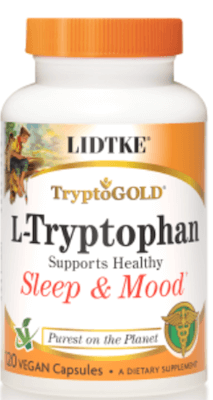
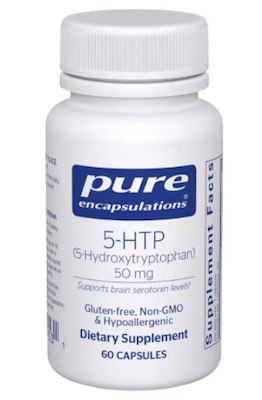
Products I recommend include Lidtke 500 mg Tryptophan, and Pure Encapsulations 50 mg 5-HTP. You can purchase these from my online store (Fullscript – only available to US customers – use this link to set up an account).
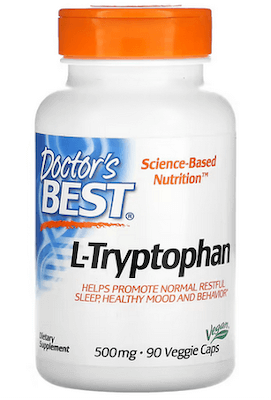
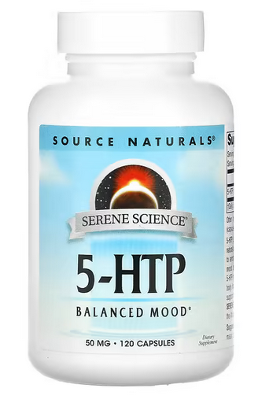
If you’re not in the US, Doctor’s Best L-Tryptophan 500mg and Source Naturals 50 mg 5-HTP are products I recommend on iherb (use this link to save 5%).
Resources if you are new to using amino acids as supplements
If you are new to using amino acids as supplements, here is the Amino Acids Mood Questionnaire from The Antianxiety Food Solution (you can see all the symptoms of neurotransmitter imbalances, including low GABA, low serotonin and low endorphins).
If you suspect low levels of any of the neurotransmitters and do not yet have my book, The Antianxiety Food Solution – How the Foods You Eat Can Help You Calm Your Anxious Mind, Improve Your Mood, and End Cravings, I highly recommend getting it and reading it before jumping in and using amino acids on your own so you are knowledgeable. And be sure to share it with the practitioner/health team you or your loved one is working with.
There is an entire chapter on the amino acids and they are discussed throughout the book in the sections on gut health, gluten, blood sugar control, sugar cravings, anxiety and mood issues.
The book doesn’t include product names (per the publisher’s request) so this blog, The Antianxiety Food Solution Amino Acid and Pyroluria Supplements, lists the amino acids that I use with my individual clients and those in my group programs. You can find them all in my online store.
If, after reading this blog and my book, you don’t feel comfortable figuring things out on your own (i.e. doing the symptoms questionnaire and respective amino acids trials), if you need serotonin support, the Serotonin QuickStart Program is a good place to start. This is a paid online/virtual group program where you get my guidance on using tryptophan and 5-HTP safely, and community support during 5 LIVE Q&A calls. You can sign up to be notified when the next live launch of this program is happening. We take a deep dive into product options including Lidtke products and others if you’re not able to access Lidtke.
Low GABA can also affect sleep and cause stress eating. If you also have low GABA symptoms, the next step to get help is the GABA QuickStart Program. This is also a paid online/virtual group program where you get my guidance and community support. Another option is the budget-friendly GABA QuickStart Homestudy Program.
If you are a practitioner, join us in The Balancing Neurotransmitters: the Fundamentals program. This is also a paid online/virtual program with an opportunity to interact with me and other practitioners who are also using the amino acids.
Wrapping up
Now I’d love to hear from you ….
Has tryptophan helped you quit alcohol easily when you could not do so with willpower alone?
Does tryptophan also help with your low mood, anxiety and sleep issues?
What about 5-HTP (some folks do better on one versus the other)?
And has either tryptophan or 5-HTP helped with other afternoon/evening cravings like sugar and other carbs?
If you have questions and other feedback please share it here too.

God, I wish I could take tryptophan, for several reasons, but it gives me horrendous migraines. I can take 200 mg one night for sleep and wake with a small headache in the morning. If I take it again within about a week, I’ll get a crippling migraine.
I don’t tolerate alcohol well either. It sometimes gives me terrible migraines, so I almost never drink anymore. But I still crave it so much sometimes!!! It’s a struggle for me, especially when I’m cooking good food w/good friends. I’ve limited my social interactions a lot just because of that.
I wish I craved amino acids instead!!!
Ava
I’m sorry to hear. This is unusual especially because low serotonin can be a factor when it comes to migraines and tryptophan helps in some cases. We make sure to use Lidtke tryptophan or switch to 5-HTP in cases like this. And consider that it may possibly be a histamine reaction especially with the alcohol/migraines too.
We also look into other neurotransmitter imbalances as they all can drive addictions – as mentioned in the blog post.
When you are new to the amino acids, I highly recommend my book, The Antianxiety Food Solution. It has an entire chapter on the amino acids. More here https://www.everywomanover29.com/blog/the-antianxiety-food-solution-by-trudy-scott/ You don’t mention what dietary changes you have made – migraines can often be triggered by gluten, high histamine foods etc
Tryptophan and the smallest dose I can manage of P-5-P B6 have helped me so much if I preemptively take at the right times to stave off extreme low and agitated moods that occur cyclically for me due to PMDD. I occasionally use it for sleep instead of straight melatonin and I usually wake up feeling generally calmer. Unfortunately, I find if I take it too regularly, I don’t seem to feel the same benefits as saving for as needed (particularly for sleep–seems to have a counterproductive effect on restful sleep if I take more than 2 nights in a row). I’ve tried 5-HTP and it’s harder to notice a positive effect and sometimes I think it is actually stimulating in a negative way for me.
I’ve seen some references to links between tryptophan and bladder cancer and cataracts. Do you have any thoughts or concerns about potential downsides of using tryptophan? I try to take very modestly at only 500mg of Lidtke 3-4 times a month before bed only when most needed when I have or sense oncoming low mood/high anxiety/difficulty sleeping because I’m concerned about possible downsides of taking high doses regularly and for prolonged periods.
Emily
So pleased to hear tryptophan helps with PMDD and sleep. The variable need you describe is unusual and not something I see very often unless it’s cyclical and related to sex hormone fluctuations and a changing need for serotonin because of changes in estrogen.
I don’t have concerns about the potential downsides you mention but will add this to my list to address in a future blog post.
Briefly, this 1979 paper, Tryptophan metabolism in bladder cancer patients from Copenhagen https://pubmed.ncbi.nlm.nih.gov/482865/, concludes “abnormal tryptophan metabolism only plays a minor role for bladder cancer.” But states kynurenine i.e aromatic degradation product of tryptophan being a possible issue. They also mention low vitamin B6: “decreased availability of vitamin B6 or decreased formation of pyridoxal phosphate from vitamin B6”
This 2020 paper, Tryptophan–kynurenine ratio as a biomarker of bladder cancer https://bjui-journals.onlinelibrary.wiley.com/doi/abs/10.1111/bju.15205 mentions low plasma tryptophan in bladder cancer, but elevated kynurenine and increased inflammation. We know vitamin B6 is key for reducing inflammation and preventing elevated kynurenine.
May I ask where you have been reading about this?
Hi Trudy–thank you for your response! I first came across mention of concerns/risks on the Mayo Clinic listing for tryptophan (https://www.mayoclinic.org/drugs-supplements/tryptophan-oral-route/before-using/drg-20064453).
So I then search tryptophan and bladder cancer as key words, I returned several studies about possible excess tryptophan and cancer link including those you mentioned and others (https://pubmed.ncbi.nlm.nih.gov/20839220/, https://academic.oup.com/jnci/article-abstract/43/1/295/883713?redirectedFrom=fulltext, etc. ).
I should note I have a very neurotic type of anxiety (diagnosed with moderate OCD) and have a hard time committing to things unless they are nearly perfectly safe and effective, so often stuck in analysis paralysis when I come across anything that is possibly concerning.
Emily
Thanks for sharing these. It’s good to question what you’re reading.
I’m assuming the Mayo article is making reference to these and other similar studies. It’s annoying they don’t provide research links. This medication-style article for an amino acid supplement such as tryptophan is very pharma-centric too!
The other 2 references (and everything else I’ve seen) refer to urinary tryptophan metabolites. The former study “Uptake of an excess amount of tryptophan accompanied with vitamin B6 deficiency may result in the accumulation of higher concentrations of metabolites mainly from the KN pathways in the bladder.” The latter study also mentions urban pollutants.
With neurotic anxiety and OCD, analysis paralysis is common. Ironically serotonin support helps.
I have avoided tryptophan because I have histamine issues, and I understand that tryptophan can make those symptoms worse. What does the research say about that?
Thanks, Sue Crawford
Sue
I have not seen issues with either tryptophan or 5-HTP in MCAS/histamine intolerance clients and there is not much in the research or info from histamine/MCAS experts. I’m going to do some digging but did find this – Tryptophan Negatively Regulates IgE-mediated Mast Cell Activation https://www.koreamed.org/SearchBasic.php?RID=2385297 It’s an animal study and using an injection but it’s all I was able to find.
As you probably know anything is possible and histamine/MCAS reactions run the gamut so if someone did have a reaction (and you’d know very quickly) they would simply stop using the respective amino acid.
I’m curious what you have observed personally with tryptophan and/or 5-HTP? And who led you to believe tryptophan would be an issue?
I can’t recall where I got this idea, and this is a little complicated for me to understand (which is why I appreciate you!) but I found these:
https://www.ncbi.nlm.nih.gov/pmc/articles/PMC5433561/
https://www.researchgate.net/publication/7462086_A_heretofore_undisclosed_crux_of_Eosinophilia-Myalgia_Syndrome_Compromised_histamine_degradation
Sue
Thanks for sharing these. I will be digging deeper into this and looking at it in the context of this research which contradicts this: 5-HTP and/or tryptophan to help with increased anxiety, panic attacks and depression caused by spring allergies https://www.everywomanover29.com/blog/5-htp-and-or-tryptophan-to-help-with-increased-anxiety-panic-attacks-and-depression-caused-by-spring-allergies/ “Cytokines may lead to a mood disturbance via the expression of the enzyme indoleamine-2,3-dioxygenase, which shifts the synthesis of tryptophan from serotonin to kynurenine. The resultant acute tryptophan depletion results in decreased brain serotonin, which may contribute to both depression and anxiety.”
It’s not unusual to have conflicting results with histamine intolerance/MCAS. And for some individuals to react to something and others not react.
I’m curious what you have observed personally with tryptophan and/or 5-HTP?
Hi there! Thank you for this. Can you take tryptophan with SSRI’s? I’m currently on the lowest dose of Paxil but am weaning down because it’s caused massive weight gain for me. :/
Haley
There are precautions with tryptophan/5-HTP having a risk for serotonin syndrome with SSRIs so it’s best to discuss with the prescribing doctor. I have clients share this information https://www.everywomanover29.com/blog/taper-from-antidepressant-tryptophan-amino-acids/
When you are new to the amino acids, I highly recommend my book, The Antianxiety Food Solution. It has an entire chapter on the amino acids. More here https://www.everywomanover29.com/blog/the-antianxiety-food-solution-by-trudy-scott/ You don’t mention what dietary changes you have made – diet is powerful for depression and anxiety and covered extensively in my book. I have my clients get nutritionally stable before they start to taper.
hi Trudy,can you take tryptopan or 5htp when taking dothiepin which is a tricyclic?Have been on same antidepressants for nearly 30 years as nothing else helped and tried every group and possibility.in the end had ect treatment to see if it would help the deep clinical depression and generalised anxiety disorder.It didn’t work so put back on dothiepin.Have tried gaba for the anxiety but need 3 lozenges of Gaba calm to work and they take too long to dissolve.Any advise
Sami
There are similar precautions with tryptophan/5-HTP having a risk for serotonin syndrome with tricyclic antidepressants so it’s best to discuss with the prescribing doctor. I have clients share this information https://www.everywomanover29.com/blog/taper-from-antidepressant-tryptophan-amino-acids/
I will add that if GABA Calm helps we continue it and find a product that does work for the person – like GABA powder.
When you are new to the amino acids, I highly recommend my book, The Antianxiety Food Solution. It has an entire chapter on the amino acids. More here https://www.everywomanover29.com/blog/the-antianxiety-food-solution-by-trudy-scott/ You don’t mention what dietary changes you have made – diet is powerful for depression and anxiety and covered extensively in my book.
There are also many GABA blog posts so feel free to search the blog to learn more
Victoria’s experience of tryptophan turning the previously wonderful taste of wine into “cat piss” reminded me of myself and magnesium and chocolate. Before I started supplementing with magnesium, I was a chocoholic. I craved and adored chocolate and used it both as a reward and for energy to do the next thing (much like Victoria used wine). When I take magnesium regularly I notice that chocolate doesn’t taste that good anymore, especially dark chocolate, bitter and nothing else. I wonder if many chocoholics are simply low on magnesium.
Amanda
Wonderful to hear your results. And yes this is a common factor when it comes to chocolate
I am curious, would the strategies discussed above for alcohol also support those with drug addiction? Meaning, would it have a similar impact on beta-endorphins and reduce chronic pain?
Pat
All the amino acids, including tryptophan help with all addictions including drugs. Tryptophan does help with chronic pain to some extent and is known to help with TMJ. Depending on the drug addiction – like for pain medications – we often find the amino acid DPA to be more effective for chronic pain because it has direct impacts on increasing beta-endorphins.
When you are new to the amino acids, I highly recommend my book, The Antianxiety Food Solution. It has an entire chapter on the amino acids. More here https://www.everywomanover29.com/blog/the-antianxiety-food-solution-by-trudy-scott/
There are also many endorphin blog posts so feel free to search the blog to learn more
It’s possible that I was already in the middle of my daily, mid-afternoon chocolate chip binge when I saw your Facebook post asking if anyone had questions before you wrote this blog. So I asked if tryptophan would also be helpful if you binge on sugar instead of turning to alcohol, and you said yes. I took a 50 mg 5-HTP along with my mid-afternoon Endorphigen capsule, and within just a few minutes I felt the sadness and despair that I often feel in the late afternoon start to lift. I was astonished at how quickly it worked! I didn’t open the capsule, or chew it, I just swallowed with with water and had a snack afterwards. I really can’t thank you enough for asking that question on Facebook, because I was really struggling with low mood and sadness almost every day.
Up until January I had taken 5-HTP in the mid-afternoon and then Tryptophan at bedtime, but I wanted to try a program to support my thyroid. That program told me that too much serotonin is often at the root of gut damage, so I weaned myself off of the tryptophan. I didn’t really notice much difference, except the daily sugar cravings. I’m not sure how I could so easily forget the symptoms of low serotonin, but I did. Your question on Facebook really was a God-send for me, Trudy. It reminded me that there was an option for feeling better ( in fact, MUCH better than sugar makes me feel) that didn’t involve something that’s not good for me. And I really did feel remarkably better the same day, and those results have continued. I decided to also try adding 500 mg of tryptophan at bedtime to see if that is also helpful, but the jury is still out on that. I’m finding myself more tired during the day and have also had a headache for the last few days. But with my system it’s sometimes hard to determine what causes my symptoms. I will give it a little more time to see if the tryptophan will be helpful or not. The 5-HTP is a little more activating for me, so I worry about taking it at night; meanwhile, the tryptophan puts me to sleep and I worry about taking it during the day!
Thanks again, Trudy, for continuing to bring these topics up. Some of us are forgetful and need reminding. Usually, when you have symptoms of low serotonin there are enough other issues going on in your life that it’s easy to overlook the obvious. So I’m very grateful that you asked the question, because I feel so much better able to deal with my circumstances now that I’m back on the 5-HTP. Blessings to you!
Kim
Thanks so much for taking the time to come and post on this blog. I enjoyed our Facebook chat and love these results you’ve experienced with sugar cravings midafternoon. Confirming it was bingeing on choc chips and not choc chip cookies? How many are we talking about? A bag? As mentioned I plan to share this and some of our facebook discussion as a new blog so thanks for giving me permission to do so. I’ll share that link when it’s ready.
You do mention mid-afternoon Endorphigen too – how has that been helping?
I am curious about this …”program told me that too much serotonin is often at the root of gut damage.” May I ask what program and if they suggested stopping 5-HTP and tryptophan?
Do keep us posted on how the tryptophan goes. With this “I’m finding myself more tired during the day and have also had a headache for the last few days” I would suspect chocolate withdrawal.
Kim
Here is the new blog post – Would using 5-HTP or tryptophan help when you crave sugar (as a sort of antidepressant) late afternoon/evening? https://www.everywomanover29.com/blog/would-using-5-htp-or-tryptophan-help-when-you-crave-sugar-as-a-sort-of-antidepressant-late-afternoon-evening/
Thanks again for sharing
Hi Trudy! I wanted to reach out and get your thoughts…a little backstory about me:
I am 33 years old, six months postpartum with my first baby. We did IVF due to blocked Fallopian tubes, pregnancy and delivery were uneventful.
I have been on an SSRI (mostly prozac 10-20mg) since June of 2016. In October of 2015 I was in a car accident, I started nursing school on January 4, 2016 and then was in another car accident on January 11, 2016. The second car accident someone rear ended me on the freeway going about 55mph while I was nearly stopped. I was physically alright but I developed a lot of physical anxiety shortly after that accident. The accident in combination with my accelerated nursing school nearly drove me crazy. I started the Prozac in June and have been on since. I tried weaning on two times over the years and experienced extreme return of anxiety. Xanax helped, but ultimately went back on SSRI.
When my husband and I decided to get pregnant I tried weaning off again in January of 2022, in hopes that an extended slow wean would make it attainable. I still had a return of anxiety, but this time I had found your blog and tried 100-200mg PharmaGABA, and it worked! Unfortunately my OBGYN did not feel comfortable with me taking it during pregnancy and I restarted zoloft in June of 2022. I got pregnant in august and am still on zoloft while breast feeding.
After I had my son I started drinking again. I’ve always drank, but not to the degree that I am now. I am regularly consuming a bottle of wine a night, sometimes a bottle and a half. Usually about 3pm I start thinking about my wine, and sometimes will start drinking as early as 3:30 – it’s hard to say if it’s a craving feeling or reward, but I definitely think about it leading up. Then in the middle of the night when I’m up with the little one I always think that this is ridiculous that I’m drinking so much. I don’t know what to do. I wish I could go back to enjoying a glass or two instead of a bottle.
I bought the DPA and tryptophan that you recommend on your site and I haven’t noticed much of a difference. Should I try gaba?
Thank you so much for all that you do
N
Self-medicating with alcohol can be caused by any of the neurotransmitter imbalances. I can’t give specific feedbcak via the blog but if we were working together I would review the symptoms questionnaire and make sure the DPA and tryptophan doses have been increased to find the idea dose. I’d also consider low GABA to be a driving force – it very often is and you say pharmaGABA worked in the past. I’d also focus on eating for blood sugar stability.
You can find dosing and timing of each amino acid in the amino acid chapter and blood sugar chapter of my book “The Antianxiety Food Solution” https://www.everywomanover29.com/blog/the-antianxiety-food-solution-by-trudy-scott/ All the other dietary info in my book is very relevant too.
Keep in mind that excessive alcohol consumption damages the gut, liver and leads to low B1 (and other nutrients because of leaky gut) so I’d want to do a full nutritional assessment. And for the baby if you’re still breastfeeding.
I’m not entirely sure how to use the questionnaire appropriately because the SSRI is masking my underlying anxiety symptoms. I feel like it’s a shot in the dark to try and figure out which will work for the alcohol self medicating. Maybe I should try and wean off the SSRI? I’m lost
N
As I mention, I’d make sure the DPA and tryptophan doses have been increased to find the ideal dose.
Then I’d consider low GABA to be a driving force – it very often is with self-medicating with alcohol and you say pharmaGABA worked in the past. I’d also focus on eating for blood sugar stability.
I’d do the above and not worry about the questionnaire
Hi Trudy,
I was interested in this comment/reply from you. I have a family member that suffers with severe untreated chronic alcoholism. Her health has deteriorated because of the decades of alcoholism. She says that she cannot give up her Klonopin and alcohol due to the fact that she has severe panic/anxiety and has seizures if she stops her benzo. Her doctors say just stay on benzos. As you can imagine, it has been years long unimaginable and devastating heartbreak for her family. I am gravely concerned about the long term consequences. Do you have any specific articles on the long term affects of taking benzos and alcohol on the body/brain? (ps- recently a new doctor also recommend gabapentin, which has can also negatively impact cognitive/memory. Each time I witness her taking a new addictive med it’s even more heartbreaking. It seems she is just piling on more and more harmful medications that will have detrimental consequences in the long term).
Also, do you have any articles on how alcoholism affects the brain and anxiety long term? This site is new to me and I’m trying to digest all of the information. I see that you offer different types of programs. Do you work with those in severe addiction? You seem so kind, compassionate and knowledgeable.
ps- I am going to order your book for myself. Thank you for the work that you do and the time it must take to personally respond to each person asking questions in the comments.
C
I’m sorry to hear about your family member. As I posted on the benzo blog – research results are mixed but there is enough evidence, in my opinion, to be concerned ” Investigations of the association between benzodiazepine therapy and cognitive decline in elderly patients have yielded mixed findings. Stronger links have emerged from studies examining longer- rather than shorter-acting benzodiazepines, longer rather than shorter durations of use, or earlier rather than later exposure. Questions remain about causality and the impact of confounders on study interpretation. ” https://pubmed.ncbi.nlm.nih.gov/29273607/
One serious issue (one of many) with alcoholism is severe thiamine deficiency https://www.everywomanover29.com/blog/fatigue-sleep-disorders-depression-anxiety-fibromyalgia-and-cardiac-troubles-as-the-expression-of-a-classic-mild-thiamine-deficiency/
With severe addiction and multiple medications, working with a functional medicine psychiatrist is her best option – but she has to want to do it.
My book is a great start for you to start to understand the role of neurotransmitters and other biochemical imbalances in anxiety and addiction. Also, check out Joan Mathews Larson’s book “Seven Weeks to Sobriety” https://amzn.to/3PEul76 (my Amazon link)
Trudy,
Thank for your kind and helpful replies on both this thread and the benzo thread.
I am really going to attempt to dive into your book and the many articles on your site.
Sadly, I know that I can’t make my loved seek help, but maybe I can find some bit of peace for myself in this journey by reading your book. The years of caregiving for a loved with dementia coupled with the years of emotional trauma from dealing with this loved one’s addiction has most definitely affected my own emotional and physical health. I believe that I can benefit from your book in many ways. So, even if my loved one will not ever want to seek help- I need to accept that reality. (It is difficult to do so because I know that we will have to be the ones to bear the burden of caregiving if she continues to choose to destroy her health)
I also need to start to finally care for my own well being and health. My whole family does. (Often times, the never-ending crisis of the addict take priority over caring for our own mental and physical health. I am very interested in seeing more research about the lasting trauma and the lasting health issues on family members from dealing with years of chronic addiction with a loved one.)
Thank you again for your helpful replies. They have provided a ray of hope.
C
Yes to self-care – the trauma of being a caretaker is very real. I do hope your loved one comes around – just keep planting seeds and if they are open have them work with someone who can share about the power of amino acids – it’s often hard for them to hear it from a family member.
Hi Trudy,
My loved one…just passed away 3 days ago. It doesn’t even seem real. She had a severe panic attack and drank one last time. My family and I are in so much anguish. I had a seed of hope starting by reading your blog and I prayed that maybe we were going to find help. I’m in profound shock mixed with crippling… traumatic grief.
This is not how I wanted her story to end. She had an MD and was so talented. However, she had severe trauma that occurred and began to have constant panic attacks and started self-medicating. It developed into addiction and it was years of chronic alcoholism and heartbreak.
My family is now left shattered. Utterly shattered.
I know that she is now at peace and she is set free from her turmoil.
But….we are not at peace….I wish I would’ve found you earlier. Just gutted with grief.
-C
C
Oh my gosh I am so so sorry to hear this. Sending my deepest sympathies to you and your family.
I do hope you find the amino acids helpful at this time – this blog may give you some ideas for using GABA – Her mum just passed away and although she is sad, GABA allows her to sit with a feeling of peace and calm most of the time https://www.everywomanover29.com/blog/her-mum-just-passed-away-and-although-she-is-sad-gaba-allows-her-to-sit-with-a-feeling-of-peace-and-calm-most-of-the-time/
When my mom passed away last year I was devastated and used GABA Calm initially (it helped with all the crying with triggered throat spasms) and later found DPA and tryptophan helpful. Theanine has been more helpful recently (for calm focus) and I continue with Seriphos for high cortisol (common during bereavement). I’m planning to write a blog on what has helped me but haven’t been quite ready yet.
It seems like most people talk about craving alcohol in the evening so they use tryptophan in the afternoon and evening but what if the craving starts in the morning or noonish, should they use it right away in the morning or use something different in the morning and the tryptophan later in the day?
Diane
Low serotonin causes afternoon/evening cravings for carbs and/or alcohol so we use tryptophan to help stop these cravings. If there are cravings at other times we need to figure out what the neurotransmitter imbalance is and use the correct amino acid eg GABA for stress-related, DPA for comfort-related, tyrosine for low mood/poor focus and glutamine when it’s due to low blood sugar