• Skip to primary navigation
  • Skip to main content
  • Skip to primary sidebar

everywomanover29 blog

Food, Mood and Women's Health – Be your healthiest, look and feel great!

  • Blog
  • About
  • Services
  • Store
  • Resources
  • Testimonials
  • The Book
  • Contact
  • Search this site

Valium

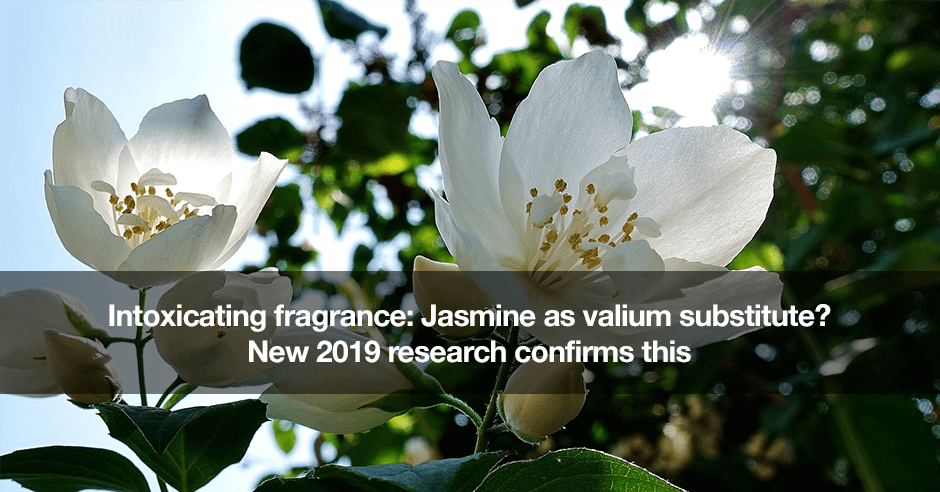
Intoxicating fragrance: Jasmine as valium substitute? New 2019 research confirms this

March 29, 2019 By Trudy Scott 11 Comments

A study from the University of the Ruhr, in Bochum, Germany, resulted in a press-release with a very provocative and enticing title – Intoxicating fragrance: Jasmine as valium substitute and a slew of articles which generated much interest. When I came across this 2010 press release recently, I was of course, intrigued and started digging deeper. Despite the fact that some folks felt it was a long stretch to extrapolate to humans, new research published this year confirms this headline may well have some merit.

Here are some highlights from the 2010 press release:

Instead of a sleeping pill or a mood enhancer, a nose full of jasmine from Gardenia jasminoides could also help, according to researchers in Germany. They have discovered that the two fragrances Vertacetal-coeur (VC) and the chemical variation (PI24513) have the same molecular mechanism of action and are as strong as the commonly prescribed barbiturates or propofol. They soothe, relieve anxiety and promote sleep.

The press release also shares that sedatives, sleeping pills and relaxants which increase the effect of GABA, are the most frequently prescribed psychotropic drugs. Also, “the benzodiazepines, which are now among the world’s most widely prescribed drugs” are “not only potentially addictive, but can also cause serious side effects, e.g. depression, dizziness, hypotension, muscle weakness and impaired coordination.” Valium, Xanax, Ativan and Klonopin are all benzodiazepines and I write more about these medications and why they are so problematic here.

Here are some really interesting facts from the press release/study:

  • The two fragrances vertacetal-coeur (VC) and the chemical variation (PI24513) were … able to increase the GABA effect by more than five times and thus act as strongly as the known drugs.
  • Injected or inhaled, the fragrances generated a calming effect.
  • Applications in sedation, anxiety, excitement and aggression relieving treatment and sleep induction therapy are all imaginable. The results can also be seen as evidence of a scientific basis for aromatherapy.

Here is a link to the 2010 paper: Fragrant dioxane derivatives identify beta1-subunit-containing GABAA receptors. I’ll be honest, it was challenging read for me and when I read the press release and actual paper at first, I wasn’t even sure they were talking about the same thing. You won’t find any mention of jasmine in the study, but instead will find vertacetal-coeur.

As I mentioned above, some organizations felt it was a long stretch to extrapolate to humans. The NHS in the UK was one example, publishing this:

Although some anti-anxiety medications are also known to interact with GABA receptors, it is far too soon to suggest that the effects of jasmine are similar to a recognised treatment for anxiety such as valium. People taking prescribed medication for anxiety should not change their treatment based on this study.

New 2019 research on jasmine for labor anxiety

However, a paper published just this month, A Systematic Review on the Anxiolytic Effect of Aromatherapy during the First Stage of Labor confirms the use of jasmine for reducing anxiety during the first stage of labor (in humans):

It is recommended that aromatherapy could be applied as a complementary therapy for reducing anxiety during the first stage of labor, but methodologically rigorous studies should be conducted in this area.

A total of 14 published papers and 2 unpublished papers were part of the review and other essential oils identified in the review for easing anxiety during labor include: rose, clary sage, geranium and frankincense, chamomile, bitter orange, sweet orange, peppermint, mandarin orange and clove.

Hopefully the NHS in the UK will update their article to include this new review.

Jasmine for other anxiety situations and feedback from real people

I feel very comfortable extrapolating this anxiety-reducing effect of jasmine during labor to other anxiety situations until we have more research.

I also asked folks on Facebook: “Do you use jasmine essential oil and love it? I’m working on a blog post on how jasmine impacts GABA levels and helps ease anxiety and I’d love to include some feedback (good or bad) in the blog. Care to share?” Here is some of the feedback –

Debra: “Never knew there was a Jasmine essential oil… love the smell of fresh Jasmine…will have to look out for it on days when I just need a bit more than what my antidepressant can do…”

Trish: “I use a blend from one of the companies called Joy that has Jasmine in it. It’s awesome, lightens the spirit, makes the day go happier. I use it as a perfume.”

Jessica: “I just started using it.. I really love it! I was using for facial purposes and then read it was good for anxiety and I do feel calm when using and just smelling it really.”

How to get some of the calming benefits of jasmine

There are many ways to enjoy the calming effects of jasmine. Here are some ideas for you:

  • Diffuse the jasmine essential oil alone in combination with other calming essential oils like lavender and one of the citrus oils like neroli or lemon. The Joy blend that Trish mentions above has bergamot, ylang ylang, geranium, lemon, coriander, tangerine, jasmine, roman chamomile, palmarosa and rose. Dr. Mariza, suggests this “Simply Soothing Diffuser Blend” in her new book The Essential Oils Hormone Solution (my review here)– 2 drops neroli, 2 drops jasmine and 2 drops ylang ylang essential oil
  • Use it topically with a carrier oil for a massage, alone or in a blend as above
  • Do what Trish suggests and use it as a perfume (I currently do this with neroli and am now going to try some jasmine)
  • Bring fresh jasmine flowers into your home or get a jasmine pot plant
  • Enjoy it in a tea. Organic India has a lovely tulsi tea that contains chamomile and jasmine. If you recall, tulsi or holy basil is an adaptogenic herb which has anti-stress effects
  • If you can tolerate caffeine, enjoy some Jasmine Oolong tea. Research suggests that the fragrant compounds in the tea “were absorbed by the brain and thereby potentiated the GABAA receptor response…and may therefore have a tranquillizing effect on the brain.”

Next steps: jasmine and GABA or jasmine alone?

It’s hard to know if jasmine used in any of the above ways will be enough to boost your GABA levels and ease your anxiety completely. The best way to find out is to try and see how you feel. It’s all very promising given that the 2010 study found that the compounds they used were able to increase the GABA effect by more than five times.

Until I’ve had clients use jasmine alone for this purpose, I’m still going to recommend the amino acid GABA (based on the questionnaire and a trial) and will suggest concurrent use of jasmine in some way. Once GABA levels have been boosted and all the other changes have been made (diet, blood sugar control, gut health, adrenals, low zinc, low vitamin B6 etc.), jasmine alone may be enough to keep GABA levels on an even keel.

However, right now I do see jasmine as a viable approach that is worth considering if you’re in the midst of tapering from a benzodiazepine and are not able to tolerate GABA and other oral supplements.

I’d love to get your feedback on jasmine and GABA and how you feel both help you (or have helped) with anxiety, depression, sleep or aggression? And if either has helped you taper off your benzodiazepine?

Please also share your favorite ways to use jasmine.

Feel free to post your questions here too.
Filed Under: Essential oils Tagged With: aggression, anxiety, anxiolytic, aromatherapy, benzodiazepine, calming, depression, essential oil, GABA, jasmine, labor, sleep, tulsi, Valium

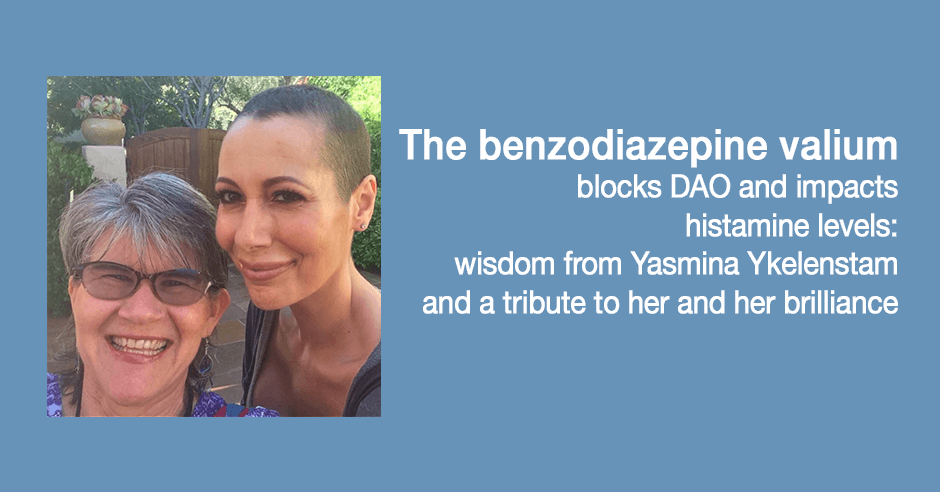
The benzodiazepine valium blocks DAO and impacts histamine levels: wisdom from Yasmina Ykelenstam and a tribute to her brilliance

September 14, 2018 By Trudy Scott 72 Comments

The benzodiazepine valium blocks DAO and impacts histamine levels and may actually increase anxiety via this mechanism. I learned all this in an interview I conducted with my amazing colleague Yasmina Ykelenstam.

Sadly Yasmina lost her battle to a rare and aggressive type of breast cancer this week. She had triple negative breast cancer which has a minimal survival rate of no longer than just a few months. She lived with it for over 2 years, outliving all odds. She had just turned 43.

It is with great sadness and reflection that I write this post as tribute to Yasmina who was as bold as she was brilliant.

Yasmina is well known as the Low Histamine Chef and for an abundance of histamine intolerance resources and recipes on Healing Histamine.

We only met in person on one occasion in 2017 and spent an evening and wonderful lunch together. Her warmth, passion and caring shone through and I felt I already knew this kind and smart woman. I had been following her work online after an interview with Dr. Ben Lynch on season 2 of the Anxiety Summit – Biochemical and genetic predispositions: COMT, GAD & MAOA – where he raved about her work.

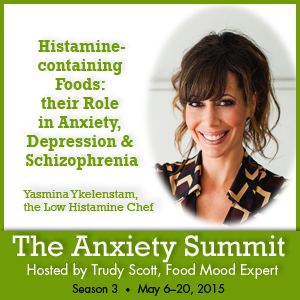
I reached out to Yasmina and was so thrilled to have the opportunity to interview her for season 3 of the Anxiety Summit – Histamine-containing Foods: their Role in Anxiety, Depression and Schizophrenia

As a tribute to Yasmina and so her brilliance continues to shine I’m sharing some of the highlights from our interview, where she shared that:

  • Histamine is the gluten of the intolerance world
  • Histamine is a neurotransmitter and plays a role in mood disorders
  • Histamine can cause symptoms of anxiety: Increased heart rate and blood pressure, shortness of breath and gasping for air, pounding heart, dizziness and feeling faint

In case you’re new to histamine intolerance this paper provides a quick overview: Histamine and histamine intolerance

Histamine intolerance results from a disequilibrium of accumulated histamine and the capacity for histamine degradation. Histamine is a biogenic amine that occurs to various degrees in many foods. In healthy persons, dietary histamine can be rapidly detoxified by amine oxidases, whereas persons with low amine oxidase activity are at risk of histamine toxicity. Diamine oxidase (DAO) is the main enzyme for the metabolism of ingested histamine.

This new research shows how a low histamine diet has benefits: Histamine-reduced diet and increase of serum diamine oxidase correlating to diet compliance in histamine intolerance

In our interview we had a lengthy discussion on benzodiazapines and the histamine connection. It was both fascinating and very concerning:

Many people doing a benzodiazepine taper are often switched to Valium which is a DAO [diamine oxidase blocker (or histamine liberator)] and this further prevents histamine from being removed from the body.

Dye are also triggers…the pink Xanax can be problematic 

Here is the transcript from the benzodiazepine section of our interview, with a few tweaks to give it context. I start by asking Yasmina to talk about histamine interactions with psychiatric medications.

* * * * * * * * * * * * * * * * * * *

Yasmina Ykelenstam: Well, I recommend that people go to a wonderful website and it is called histaminintoleranz.ch. It’s German, but it’s translated into English. That’s H‑I‑S‑T‑A‑M‑I‑N‑I‑N‑T‑O‑L‑E‑R‑A‑N‑Z.ch. And they have a very, very long list of medications on there that interact with diamine oxidase or histamine liberators. The one that I just wanted to mention very quickly because it’s relevant to anxiety – and that one is diazepam [you can find this listed on the above site on this page.]

Diazepam (or Valium) is a medicine, as I said, that I used when I was a child – for a couple of days. And it’s a tranquilizer, a benzodiazepine. One of the most commonly prescribed benzodiazepines in the world is Valium.

I don’t know if it still is, but when the UN would send out emergency packs to people, Valium was included in there. That’s how widespread its use is. It’s a diamine oxidase blocker. So it blocks the enzyme responsible for degrading histamine in the body. So people who are dealing with anxiety symptoms that are perhaps caused by histamine issues would not do very well potentially with Valium / diazepam because it would further prevent histamine from being removed from the body.

I was on Valium / diazepam for many, many years after it was first prescribed to me and I did not know that. And it was the medicine, it was the tranquilizer that I chose to use to taper from another benzo. I was on Xanax at the time and I had been told that Xanax is harder to withdraw from than crack. So I should switch to another benzodiazepine that had a longer half-life – how long it stays in the body – so that it would make it easier for me to withdraw. And Valium / diazepam was the one that I chose and I think that’s when my body started giving me the message of “Hurry up; just finish this; just cut, cut, cut; get this out of the body because it’s not doing you any good.”

But there is a very, very long list of medications on that German site and interestingly, there are a number of antihistamines in the list of medications that block diamine oxidase and also the other histamine-degrading enzyme. Cimetidine, C‑I‑M‑E‑T‑I‑D‑I‑N-E – I think it is a second-generation antihistamine. It is still prescribed today. It was being prescribed to many people by a doctor in London.

I have another doctor: Dr. Seneviratne in London. He is an immunologist with mast cell focus. He’s excellent. But there was another doctor who was supposedly a mast cell person who was prescribing cimetidine to people. I had to send a message to him saying please stop doing this because it’s probably not very good for them. Also, we were talking about diphenhydramine and that is an HNMT blocker, which is the other histamine‑degrading enzyme.

Trudy Scott: Okay. So I want to just recap here. So we’ve got these meds that block the DAO enzyme, which in turn prevents you from releasing histamine and preventing histamine from being removed from the body.

Yasmina Ykelenstam: Exactly. Yeah, and what’s odd is diphenhydramine is obviously Benadryl, which is one of the most commonly prescribed antihistamines in the United States.

Trudy Scott: A lot of people are on diphenhydramine. You’re right, yeah.

Yasmina Ykelenstam: There are many different mechanisms of action for degrading histamine and for getting it out of the body. So it might not be the end of the world if you’re taking one medication that affects the DAO enzyme but doesn’t affect the HNMT enzyme. And obviously, there’s the liver and there’s different methods of dealing with things in the body. So it’s not the end of the world, but still it’s something you might not want to do and should definitely discuss with your doctor.

Trudy Scott: Yes, and being aware of this. Now I wanted to just go back to the benzodiazepines because I was not aware of this connection to Valium diazepam, and that being a DAO blocker. So is it only the Valium and the other benzodiazepines are not, or is it all benzodiazepines?

Yasmina Ykelenstam: Okay, let me try to remember. Haloperidol is an antipsychotic, isn’t it? (It’s on the list)

Trudy Scott: Yes, that’s correct.

Yasmina Ykelenstam: I am not aware of any others offhand and I’m just trying to take a quick look at the list now that I have it in front of me. But no, I don’t believe so because I looked them up because having taken all of them, and I mean, really all of them, I have taken every benzodiazepine ever made in the last 30 years. And no, I think it was just the diazepam, but as I said, it is one of the most commonly prescribed.

Trudy Scott: And it’s really important for me to mention this because I am dead against all benzodiazepines because of their addictive/dependent nature and the side effects and when you’re trying to taper off they cause all these problems. I’ve interviewed a number of people on this topic. In Season 1 of the Anxiety Summit, I interviewed Dr. Catherine Pittman who talked about the Benzobuddies.org group and how so many individuals battle getting off benzodiazepines.

Yasmina Ykelenstam: Oh, I was a member.

Trudy Scott: You were?

Yasmina Ykelenstam: I was a member there (at benzobuddies.org) at one point.

Trudy Scott: Oh, you were? Yeah, it’s a very big issue and problematic drug. But why I’m saying this is because Professor Ashton, who’s an expert on tapering, talks about switching to Valium. So this could be problematic.

Yasmina Ykelenstam: Well, if you could reach out to these communities, that would be fantastic because I did spend some time after, figuring out what was going on, trying to contact people and trying to let them know of this link because there were a lot of people that were in these communities that were suffering from protracted withdrawals. And by this point, I had my suspicions that the protracted withdrawals were actually a histamine response and that the reason that they were experiencing this was just that the original issue was never dealt with. And that was that it might be an underlying histamine issue that initially had them diagnosed with the anxiety disorder and then they were taking these meds. And so when you take the medication away, you’re still left with the existing condition but it isn’t being addressed.

Trudy Scott: Yes, and maybe some of them had done the switch to Valium, which was making things worse.

Yasmina Ykelenstam: Exactly.

Trudy Scott: Very interesting.

Yasmina Ykelenstam: The reason I switched to Valium was because I was following Dr. Ashton’s protocol from benzo.org.uk. I was advised against coming off my medication and I was told that there was no safe withdrawal protocol. I brought them a copy of the Ashton protocol and I was laughed out of the office, but I chose to do it on my own anyway and I’m very grateful to her research.

Trudy Scott: Yes, she’s done amazing research. I’m so appreciative to learn of this component and I’m on a mission to educate people about the benzodiazepines and this is just another aspect that we need to be considering. I will certainly reach out to some of these groups and people hearing this on this Summit, is going to bring awareness to this aspect. All of this is fantastic.

Yasmina Ykelenstam: The other brief thing is that, of course, the dyes are also triggers. And this is why a lot of us, when we’re prescribed psychiatric meds, end up with a new set of symptoms because of the coloring that is actually on the tablets. I was unable to take the pink Xanax, but I was able to take the white Xanax, and my doctor never understood it. He said, “I don’t understand how higher doses of Xanax make you feel worse, but the lower ones works for you.” And I kept telling him, “But I’m taking the same dose at the end of the day, so I don’t understand either.”

* * * * * * * * * * * * * * * * * * *

Here is the link to the entire audio so you can get a better understanding of histamine intolerance.

I’d love to hear your benzodiazepine and histamine intolerance experiences – both good and bad

It would remiss of me to omit something that is seldom discussed: the link between benzodiazepine use and increased cancer risk. In our interview Yasmina shared this “I have taken every benzodiazepine ever made in the last 30 years.”

Yasmina was always very open about her healing journey and I suspect she asked herself this question and would be ok with me making this possible connection in the hope it may help someone who is considering a starting a benzodiazepine prescription or someone contemplating doing a benzodiazepine taper.

I hope this has been helpful if you’re currently taking a benzodiazepine, are considering taking one, have taken one in the past, have issues with high histamine foods, are taking one of the other medications on the list, and/or have had issues with the colors in medications.

With much appreciation to Yasmina! We loved her and thank her for sharing so freely and wisely and we love that her wisdom will live on! Rest in peace.  My deepest sympathies to her family and others who were close to her.

Note added later on 9/14/18 after this blog was published:

As soon as I heard the sad news about Yasmina I wrote this blog as a tribute to her. Then a few hours before it was due to be published I heard her family had not yet made the announcement public and hadn’t yet shared the news with her community.  At the last minute I removed the tribute sections out of respect for them. When I woke I saw the announcement on her Facebook page and reinstated my tribute.

I’ll be doing further updates to share some of what was said about continuing her legacy and anything more I learn.

Filed Under: benzodiazapines Tagged With: benzodiazepine, cancer, DAO, diazepam, histamine, Valium, Yasmina Ykelenstam

World Benzodiazepine Awareness Day – say NO to Benzodiazepines for anxiety!

July 11, 2016 By Trudy Scott 17 Comments

world benzo awareness day july 11 2016

Today, July 11th, is  World Benzodiazepine Awareness Day

This date was designated in recognition of Prof. Heather Ashton’s significant contributions to the benzodiazepine cause over so many decades; together with all of the help she has given to so many people around the world.

In honor of World Benzodiazepine Awareness Day, also called W-BAD I’ve decided to re-release a webinar I did last year: Say NO to Benzodiazepines for anxiety  [CLICK THIS LINK TO FIND THE WEBINAR]

say no-to-benzo

Here is an excerpt of the overview from: Say NO to benzodiazepines for anxiety! 

Benzodiazepines are a class of psychoactive drugs that work by enhancing the effect of the calming neurotransmitter GABA, and are used to treat anxiety, insomnia, pain, muscle spasms and a range of other conditions. They are widely prescribed, particularly among elderly patients and may even be used off-label with children with autism.

Use of this medication is very controversial.  We know long term use leads to tolerance, dependence, and many adverse psychological effects and even physical effects. Short term use is generally considered safe but even using them for 2 – 4 weeks can lead to problems for certain individuals.

This presentation provides an overview of benzodiazepines; when they are used; who they are prescribed to; details about tolerance, dependence, and the many adverse effects; how to taper, including nutritional support during the taper; what to do instead of saying yes to a benzodiazepine prescription in the first place; and additional resources.

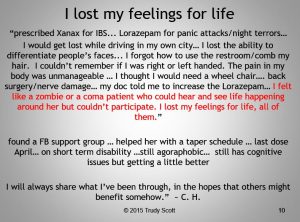
Here is one of the benzo stories I share in the webinar:

world benzo awareness day story


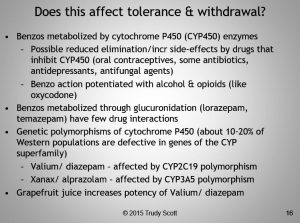
We know that some individuals are much more affected than others when it comes to tolerance and withdrawal.  Here are some other possible factors that may affect tolerance and withdrawal:

world benzo awareness day liver enzymes

During season 4 of the Anxiety Summit, Lisa Bloomquist talked about Antibiotic Induced Anxiety – How Fluoroquinolone Antibiotics Induce Psychiatric Illness Symptoms.   During this interview she shared how:

People who have gone through benzodiazepine withdrawal before should never take a fluoroquinolone because essentially it can throw people right back into the benzo withdrawal – because it has very similar effects on people’s GABA’s receptors as what happens when people go through benzodiazepine withdrawal. 

I would love to see a survey of people who have experienced adverse effects when using benzodiazepines as prescribed or when tapering. Could these be some of the contributing factors?

  • Taking Valium/ diazepam and have the CYP2C19 polymorphism (about 10-20% of Western populations are defective in genes of the CYP liver enzyme superfamily)
  • Taking Xanax/ alprazolam and have CYP3A5 polymorphism (about 10-20% of Western populations are defective in genes of the CYP liver enzyme superfamily)
  • Taking any benzodiazepine and also
    • Taking oral contraceptives
    • Taking a course of antibiotics
    • Taking a course of one of the fluoroquinolone antibiotics
    • On an SSRI prescription
    • Taking a course of antifungal medications
    • Drinking alcohol on a regular basis
    • On an opioid such as oxycodone
    • Drinking grapefruit juice on a regular basis

For withdrawal/tapering, the best resource I know of is Benzo.org.uk which contains the Ashton Manual. You will need to educate yourself and your doctor and/or find a doctor willing to help you with the adjusted prescription. It does need to be done very very very slowly.

Finding a good support group like Benzobuddies.org  is very helpful for many of my clients. Just be aware that this group and some of the other support groups say no to any supplements during the taper process. I find it to be very individualized and have many clients that see great benefit by using GABA, tryptophan, zinc, magnesium and other nutrients. (You can read more about this here: Anxiety and the amino acids overview)

That being said some people tapering can only tolerate very low amounts of the amino acids (like a dab or pinch from a capsule) and some can’t tolerate any supplements and do better with essential oils, yoga, light therapy and dietary changes.

You can find more information on World Benzodiazepine Awareness Day on Benzo Case: Raising Awareness about Benzodiazepine Drugs  (widely prescribed for anxiety, stress, sleep, pain and much more…) and additional stories on the World Benzo Awareness facebook page.

World Benzodiazepine Awareness Day was conceived by the acting Chair Barry Halsam, former Chair of Oldham TRANX, and jointly organized by Wayne Douglas, founder of benzo.case.com / benzo-case-japan.com

Please read share so your loved ones are informed and can say NO to benzos!  

If you have experienced adverse effects when taking or tapering from benzodiazepines I’d love some feedback on the above possible contributing factors.


Filed Under: Anxiety and panic, benzodiazapines, GABA, Gene polymorphisms Tagged With: benzodiazepine, benzodiazepines, CYP enzymes, fluoroquinolone antibiotics, GABA, Heather Ashton, Valium, World Benzodiazepine Awareness Day, Xanax

Primary Sidebar

NEW! GABA QuickStart Homestudy (with special intro pricing)

gaba quickstart homestudy

Free Report

9 Great Questions Women Ask about Food, Mood and their Health

You'll also receive a complimentary subscription to my ezine "Food, Mood and Gal Stuff"


Connect with me

Popular Posts

  • Amino Acids Mood Questionnaire from The Antianxiety Food Solution
  • The Antianxiety Food Solution Amino Acid and Pyroluria Supplements
  • Pyroluria Questionnaire from The Antianxiety Food Solution
  • Collagen and gelatin lower serotonin: does this increase your anxiety and depression?
  • Tryptophan for the worry-in-your-head and ruminating type of anxiety
  • GABA for the physical-tension and stiff-and-tense-muscles type of anxiety
  • The Antianxiety Food Solution by Trudy Scott
  • Seriphos Original Formula is back: the best product for anxiety and insomnia caused by high cortisol
  • Am I an anxious introvert because of low zinc and vitamin B6? My response to Huffington Post blog
  • Vagus nerve rehab with GABA, breathing, humming, gargling and key nutrients

Recent Posts

  • What do I use instead of Seriphos to help lower high cortisol that is affecting my sleep and making me anxious at night?
  • BeSerene™ GABA/theanine cream eases severe muscle tension in her neck/shoulders, prevents her bad headaches and quells her anxiety
  • How the correct approach, dose and sublingual use of GABA can be calming and not cause a flushed and itchy face and neck
  • The amino acid glutamine improves low mood by addressing gut health, and it has calming effects too
  • Flight anxiety with heightened breath, physical tension and also fearing the worst (the role of low GABA and low serotonin)

Categories

  • 5-HTP
  • AB575
  • Addiction
  • ADHD
  • Adrenals
  • Alcohol
  • Allergies
  • Alzheimer's disease
  • Amino Acids
  • Anger
  • Antianxiety
  • Antianxiety Food Solution
  • Antidepressants
  • Anxiety
  • Anxiety and panic
  • Autism
  • Autoimmunity
  • benzodiazapines
  • Bipolar disorder
  • Books
  • Caffeine
  • Cancer
  • Candida
  • Children/Teens
  • Collagen
  • Cooking equipment
  • Coronavirus/COVID-19
  • Cravings
  • Depression
  • Detoxification
  • Diabetes
  • Diet
  • DPA/DLPA
  • Drugs
  • EFT/Tapping
  • EMF
  • EMFs
  • Emotional Eating
  • Endorphins
  • Environment
  • Essential oils
  • Events
  • Exercise
  • Fear
  • Fear of public speaking
  • Fertility and Pregnancy
  • Fish
  • Food
  • Food and mood
  • Functional neurology
  • GABA
  • Gene polymorphisms
  • General Health
  • Giving
  • Giving back
  • Glutamine
  • Gluten
  • GMOs
  • Gratitude
  • Gut health
  • Heart health/hypertension
  • Histamine
  • Hormone
  • Hyperparathyroidism
  • Hypoglycemia
  • Immune system
  • Inflammation
  • Insomnia
  • Inspiration
  • Introversion
  • Joy and happiness
  • Ketogenic diet
  • Lithium orotate
  • Looking awesome
  • Lyme disease and co-infections
  • MCAS/histamine
  • Medication
  • Men's health
  • Mental health
  • Mercury
  • Migraine
  • Mold
  • Movie
  • MTHFR
  • Multiple sclerosis
  • Music
  • NANP
  • Nature
  • Nutritional Psychiatry
  • OCD
  • Osteoporosis
  • Oxalates
  • Oxytocin
  • Pain
  • Paleo
  • Parasites
  • Parkinson’s disease
  • PCOS
  • People
  • PMS
  • Postpartum
  • PTSD/Trauma
  • Pyroluria
  • Questionnaires
  • Real whole food
  • Recipes
  • Research
  • Schizophrenia
  • serotonin
  • SIBO
  • Sleep
  • Special diets
  • Sports nutrition
  • Stress
  • Sugar addiction
  • Sugar and mood
  • Supplements
  • Teens
  • Testimonials
  • Testing
  • The Anxiety Summit
  • The Anxiety Summit 2
  • The Anxiety Summit 3
  • The Anxiety Summit 4
  • The Anxiety Summit 5
  • The Anxiety Summit 6
  • Thyroid
  • Thyroid health
  • Toxins
  • Tryptophan
  • Tyrosine
  • Uncategorized
  • Vegan/vegetarian
  • Women's health
  • Yoga

Archives

  • October 2025
  • September 2025
  • August 2025
  • July 2025
  • June 2025
  • May 2025
  • April 2025
  • March 2025
  • February 2025
  • January 2025
  • November 2024
  • October 2024
  • September 2024
  • August 2024
  • July 2024
  • June 2024
  • May 2024
  • April 2024
  • March 2024
  • February 2024
  • January 2024
  • December 2023
  • November 2023
  • October 2023
  • September 2023
  • August 2023
  • July 2023
  • June 2023
  • May 2023
  • April 2023
  • March 2023
  • February 2023
  • January 2023
  • December 2022
  • November 2022
  • October 2022
  • September 2022
  • August 2022
  • July 2022
  • June 2022
  • May 2022
  • April 2022
  • March 2022
  • February 2022
  • January 2022
  • December 2021
  • November 2021
  • October 2021
  • September 2021
  • August 2021
  • July 2021
  • June 2021
  • May 2021
  • April 2021
  • March 2021
  • February 2021
  • January 2021
  • December 2020
  • November 2020
  • October 2020
  • September 2020
  • August 2020
  • July 2020
  • June 2020
  • May 2020
  • April 2020
  • March 2020
  • February 2020
  • January 2020
  • December 2019
  • November 2019
  • October 2019
  • September 2019
  • August 2019
  • July 2019
  • June 2019
  • May 2019
  • April 2019
  • March 2019
  • February 2019
  • January 2019
  • December 2018
  • November 2018
  • October 2018
  • September 2018
  • August 2018
  • July 2018
  • June 2018
  • May 2018
  • April 2018
  • March 2018
  • February 2018
  • January 2018
  • December 2017
  • November 2017
  • October 2017
  • September 2017
  • August 2017
  • July 2017
  • June 2017
  • May 2017
  • April 2017
  • March 2017
  • February 2017
  • January 2017
  • December 2016
  • November 2016
  • October 2016
  • September 2016
  • August 2016
  • July 2016
  • June 2016
  • May 2016
  • April 2016
  • March 2016
  • February 2016
  • January 2016
  • December 2015
  • November 2015
  • October 2015
  • September 2015
  • August 2015
  • July 2015
  • June 2015
  • May 2015
  • April 2015
  • March 2015
  • February 2015
  • January 2015
  • December 2014
  • November 2014
  • October 2014
  • September 2014
  • August 2014
  • July 2014
  • June 2014
  • May 2014
  • April 2014
  • March 2014
  • February 2014
  • January 2014
  • December 2013
  • November 2013
  • October 2013
  • September 2013
  • August 2013
  • July 2013
  • June 2013
  • May 2013
  • April 2013
  • March 2013
  • February 2013
  • January 2013
  • December 2012
  • November 2012
  • October 2012
  • August 2012
  • July 2012
  • June 2012
  • May 2012
  • April 2012
  • March 2012
  • February 2012
  • January 2012
  • December 2011
  • November 2011
  • October 2011
  • September 2011
  • August 2011
  • July 2011
  • June 2011
  • May 2011
  • April 2011
  • March 2011
  • February 2011
  • January 2011
  • December 2010
  • October 2010
  • September 2010
  • July 2010
  • May 2010
  • April 2010
  • March 2010
  • February 2010
  • January 2010
  • November 2009

Share the knowledge!

The above statements have not been evaluated by the Food and Drug Administration. Products listed in this website are not intended to diagnose, treat, cure or prevent any disease.

The information provided on this site is for informational and educational purposes only and is not intended as a substitute for advice from your physician or other health care professional. You should consult with a healthcare professional before starting or modifying any diet, exercise, or supplementation program, before taking or stopping any medication, or if you have or suspect you may have a health problem.


Copyright © 2026 Trudy Scott. All Rights Reserved. | Privacy | Terms and Conditions | Refund Policy | Medical Disclaimer

Free Report

9 Great Questions Women Ask about Food, Mood and their Health

You’ll also receive a complimentary subscription to my ezine “Food, Mood and Gal Stuff”