• Skip to primary navigation
  • Skip to main content
  • Skip to primary sidebar

everywomanover29 blog

Food, Mood and Women's Health – Be your healthiest, look and feel great!

  • Blog
  • About
  • Services
  • Store
  • Resources
  • Testimonials
  • The Book
  • Contact
  • Search this site

skin

The correlation between terrible anxiety/panic attacks and collagen

July 25, 2025 By Trudy Scott 14 Comments

collagen and anxiety

Bea shared her collagen experience and insights on one of the collagen blogs:

I discovered the correlation between terrible anxiety and collagen myself several years ago! Couldn’t find any data about it then so just assumed I was a weirdo. But then my 26 yr old daughter started having terrible panic attacks. And bam! She too had started a collagen supplement! So I realized at least 2 ladies have this trouble! Got me to think about how many women seek anti-aging help with collagen and then also end up on prescriptions to help calm terrible anxiety without seeing the connection. Practitioners don’t seem to know about this. But every vitamin shop I visit hears from me on the anxiety/collagen connection. Perhaps grassroots word of mouth will help others eventually.

And yesssss… for me, bone broth is equally horrible!! Even if it is simmered for only 30 mins.

Thank you for explaining, Trudy!! How fascinating to learn it’s the drop in serotonin! I’ve never tried Tryptophan… just a bit nervous. But I think it’s time. I sure need the bone broth for my waning gut health. And I’m weary of ruminating thoughts lately! Thank you immensely for shining a needed light on how these amino acids help! I only wish I could share lunch with you and pass along my grateful hug!

God bless you, Trudy!

I’m so glad Dea found this correlation for herself and her daughter! Collagen use is on the rise and there is little awareness about these effects on serotonin levels in susceptible individuals. Read on for many of the anti-aging benefits of collagen, more information about tryptophan depletion studies, another similar story, other possible causes, and other blog resources on this topic.

Collagen use as we age: for skin, joints and bone health

Her comment about an increase in collagen use for anti-aging is so true. This 2023 paper, Collagen supplementation in skin and orthopedic diseases: A review of the literature, discusses the many age-related benefits of collagen:

hydrolyzed collagen supplementation promotes skin changes, such as decreased wrinkle formation; increased skin elasticity; increased hydration; increased collagen content, density, and synthesis, which are factors closely associated with aging-related skin damage.

Regarding orthopedic changes, collagen supplementation increases bone strength, density, and mass; improves joint stiffness/mobility, and functionality; and reduces pain. These aspects are associated with bone loss due to aging and damage caused by strenuous physical activity.

This paper mentions these aspects about collagen, that it’s low in tryptophan and that it is not a complete protein i.e. it’s a low biological value protein:

  • Notably, collagen is a low-tryptophan protein, an essential amino acid for humans.
  • Collagen is a source of conditionally essential amino acids (glycine and proline), which are important in some physiological situations.
  • Collagen is a low biological value protein, since its amino acid composition is poor in essential amino acids. However, it has a positive intrinsic value because its amino acid composition is equivalent to that of human connective tissue.

This supports what we have learned from acute tryptophan depletion studies causing low serotonin.

Tryptophan-depletion studies to study the relationship between low serotonin and depression

Here is my first blog explaining acute tryptophan depletion studies (published in 2017) – Collagen and gelatin lower serotonin: does this increase your anxiety and depression?.

Tryptophan-depletion studies have been done for years, as a way to study the relationship between low serotonin and depression.  Often a tryptophan-deficient amino acid mixture is used for this purpose.  More recently, collagen and gelatin are being used.

Collagen and gelatin are an excellent source of these amino acids: proline, glycine, glutamine and arginine, but they do not contain the amino acid tryptophan.

This paper, Pharmacokinetics of acute tryptophan depletion using a gelatin-based protein in male and female Wistar rats summarizes what we find in a number of studies that use gelatin for the purpose of lowering serotonin levels, in order to study the relationship between serotonin and behavior:

The essential amino acid tryptophan is the precursor of the neurotransmitter serotonin. By depleting the body of tryptophan, brain tryptophan and serotonin levels are temporarily reduced. In this paper, several experiments are described in which dose and treatment effects of acute tryptophan depletion (ATD) using a gelatin-based protein-carbohydrate mixture were studied in male and female Wistar rats.

I encourage you to read the above blog to learn about who may be more susceptible to these effects.

I also share my personal experience with collagen consumption and can totally relate to Bea’s story and what clients and those in my community have shared.

Toni used collagen for 8 months – anxiety and panic attacks are off the charts

Toni experienced something similar:

I’ve been using Organic collagen for about 8 months now… love the hair and skin results. My tummy felt better at first but not currently. My anxiety and panic attacks are off the charts: panic attacks, heart racing, sweating, brain fog. I want to escape – like fight or flight. Definitely obsessing and fears. Memory difficulty. I have an upcoming GI appointment to check for Candida /SIBO… but I had no idea this could add to my anxiety. I’ll be looking forward to more information, Seriously.

And a few weeks after stopping the collagen she shared this:

I stopped using collagen. Since then, my anxiety and panic have decreased by less than half. Mild in comparison. I’m definitely taking a long break.

Instead of stopping collagen altogether, my advice is to figure out if low serotonin is the cause and address this with tryptophan or 5-HTP so collagen can be used for its many anti-aging and health benefits.

Is their anxiety due to reduced serotonin or histamine, glutamate or oxalate issues

Keep in mind tryptophan will help and allow collagen, gelatin and broth to be consumed without the increase in anxiety and panic attacks (and sleep issues) only if it is due to low serotonin.

Presumably both Dea and her daughter have other low serotonin symptoms – in addition to anxiety and panic attacks – such as sleep issues, worry, fears, afternoon/evening cravings etc (here is the list of symptoms).  As you can see from Toni’s feedback (above), she does have many low serotonin symptoms.

A trial of tryptophan and symptom reduction (initially until the ideal dose is found) will confirm symptoms are related to low serotonin very quickly. This will also help Dea with her nervousness and ruminating thoughts, help her daughter ease the feelings of panic and help Toni too.

It’s also often helpful to also rule out histamine, glutamate and oxalate issues from collagen, gelatin and broth intake – as all of these factors can contribute to an increase in anxiousness too.

Additional blog posts on the topic of collagen

In case you are new to these potential issues, here are additional blog posts on the topic:

  • Collagen causes anxiety and sleep problems for some people. I would never have connected the dots but apparently I am one of those people
  • I have osteoporosis – within a week of starting collagen I experienced profound insomnia, was much more anxious and had tons of worrying thoughts
  • Collagen causes increased anxiety, low mood, irritability, insomnia, gut issues and an itchy skin: some questions and my answers
  • Gelatin triggers Enid’s anxiety in 2 weeks but also lowers her high blood sugar
  • Collagen Can Cause Anxiety and Insomnia with Trudy Scott: The Anxiety Summit 5

If you are new to this topic and are still skeptical about all this, do read the many comments and stories on these blogs. It’s a way more common issue than you’d think!

Additional resources when you are new to using tryptophan and other amino acids as supplements

As always, I use the symptoms questionnaire to figure out if low serotonin or other neurotransmitter imbalances may be an issue.

If you suspect low levels of any of the neurotransmitters and do not yet have my book, The Antianxiety Food Solution – How the Foods You Eat Can Help You Calm Your Anxious Mind, Improve Your Mood, and End Cravings, I highly recommend getting it and reading it before jumping in and using amino acids on your own so you are knowledgeable. And be sure to share it with the practitioner/health team you or your loved one is working with.

There is an entire chapter on the amino acids and they are discussed throughout the book in the sections on gut health, gluten, blood sugar control (this is covered in an entire chapter too), sugar cravings, anxiety and mood issues.

The book doesn’t include product names (per the publisher’s request) so this blog, The Antianxiety Food Solution Amino Acid and Pyroluria Supplements, lists the amino acids that I use with my individual clients and those in my group programs.

If, after reading this blog and my book, you don’t feel comfortable figuring things out on your own (i.e. doing the symptoms questionnaire and respective amino acids trials), a good place to get help is the GABA QuickStart Program (if you have low GABA symptoms). This is a paid online/virtual group program where you get my guidance and community support. You can sign up to be notified when the next live launch is happening.

If you need serotonin support, the Serotonin QuickStart Program is a good place to get help. This is also a paid online/virtual group program where you get my guidance on using tryptophan and 5-HTP safely, and community support during 5 LIVE Q&A calls. You can sign up to be notified when the next live launch of this program is happening.

If you are a practitioner, join us in The Balancing Neurotransmitters: the Fundamentals program. This is also a paid online/virtual program with an opportunity to interact with me and other practitioners who are also using the amino acids.

Wrapping up and your feedback

I appreciate Dea for sharing her story on the blog and for sharing this information at vitamin stores – we do need more awareness, hence this new blog on the topic to further help create awareness.

It’s very likely that this is one big contributing factor to the rise in anxiety and sleep issues in perimenopause and menopause. And this is probably made worse because so many practitioners are still not aware.

I thanked her for her kind words, and said I’ll take a virtual lunch and a virtual hug from her.

Have you experienced any adverse effects from collagen, gelatin or bone broth?

Have you been able to continue using them by adding tryptophan?

And why do you use collagen/how is it helping?

If you’re a practitioner are you aware of this issue for certain susceptible individuals?

Feel free to share and ask your questions below.
Filed Under: Anxiety, Collagen, Depression, Insomnia, serotonin Tagged With: amino acids, anti-aging, anxiety, brain fog, collagen, fears, GABA Quickstart, gut health, hair, heart racing, nervous, obsessing, panic, panic attacks, practitioners, ruminating thoughts, serotonin, Serotonin Quickstart, skin, sweating, tryptophan, tryptophan depletion studies

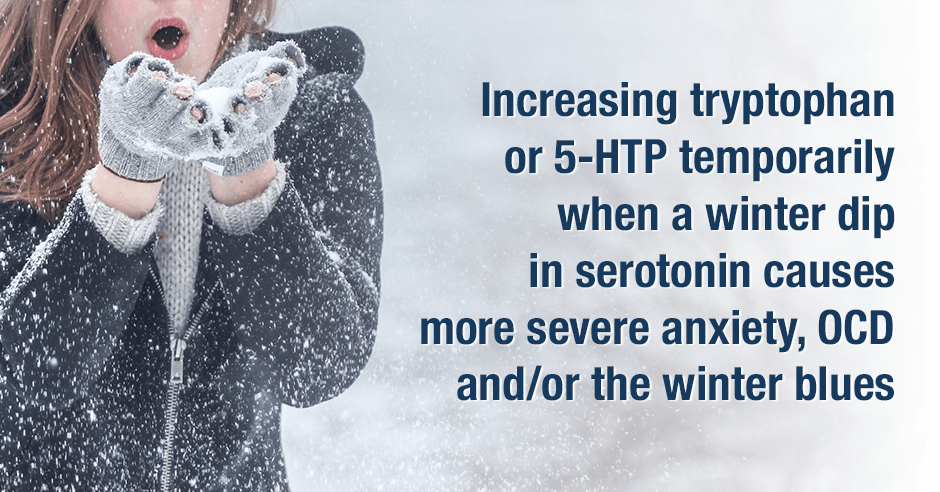
Increasing tryptophan or 5-HTP temporarily when a winter dip in serotonin causes more severe anxiety, OCD and/or the winter blues

December 24, 2021 By Trudy Scott 30 Comments

tryptophan and 5htp during winter

Don’t forget that serotonin takes a dip in winter when the days are shorter and there is less light. If you’re currently using tryptophan or 5-HTP to boost low serotonin and ease low serotonin symptoms – worry-type anxiety, panic attacks, insomnia, ruminations, PMS, irritability, negativity, perfectionism, obsessiveness, lack of confidence, anger/rage, afternoon/evening cravings – you may find you need to increase your dose for a few months.

This will especially be the case if you check off winter blues or more severe winter anxiety (yes it’s a thing and published in the research) on the low serotonin symptoms list.

I shared this on Facebook last week and the feedback ranged from surprised to curious to confirmatory.

In this blog I’m sharing some of the feedback and some of the supporting evidence, as well as other factors to consider.

The addition of 5-HTP in the morning and a light box

Kathy thanked me for the reminder and shared the changes she makes in the winter months:

Thanks for the reminder! I need to increase my dose this time of year… I can feel myself feeling “down”. I take 500 mg Tryptophan before bed and 100 mg 5-HTP in the morning before breakfast. I also use a light box in the morning while eating breakfast, which helps.

This is an increase from her typical dosing in the spring and summer when she only takes tryptophan at night before bed.

She also only uses her light box or SAD (seasonal affective disorder) lamp in winter. You can read more about SAD/full spectrum lamps here. They are also a wonderful way to boost serotonin and mood in the winter.

My daughter’s anxiety and OCD goes through the roof

Mark shared about his daughter’s anxiety and OCD (obsessive compulsive disorder):

Every year from October – March, my daughter’s anxiety and OCD goes through the roof. At first we thought it was the transition from summer to school, then the craziness of the winter holidays and suspected mold allergy. Now, based on this information, a winter/less light induced dip in serotonin may be an additional factor we hadn’t considered. We’ll try adjusting her 5-HTP dose and see if we gain some improvement. Thanks for the tip.

It’s really common for families to attribute the more severe anxiety and OCD to the stress and craziness of the winter holidays. And of course suspected mold issues do need to be looked into and addressed. But even then, the dip in serotonin can compound all these factors.

Planned tryptophan bump for Christmas sugar cravings and holiday family stress

Carol shared this about her plans to temporarily boost serotonin:

I am one of those light weights that was able to do one 500 mg pill a day of tryptophan. But I do think that it would help to bump it up to two a day to get me through the Christmas sugar cravings AND holiday family stressful get togethers! I’m all about taking the minimum effective dose but this is helpful to know that there could be a temporary boost just to get you through this time!

It’s wonderful that 500mg tryptophan is enough for her and I’m all for a minimum effective dose! However the winter dip in serotonin – and increased sugar cravings and family stress – is a common reason many folks bump up the dose for a month or more.

You may also find you made the change intuitively. Linda shared this: “I had made the adjustment. I just did not realize the reason why.”

A question about timing of 5-HTP and what to do in Spring

Suzanne shared that she uses a SAD light (also called a light box) and finds that it helps. She asks:

Can I just take the 5-HTP on days with no sun or is it better to have it build up in my system? When spring rolls around, do I taper off or can I just stop taking it?

This is my feedback: I haven’t had anyone just use 5-HTP on cloudy days but it’s worth a trial.  If you are noticing increased anxiety and mood changes only on cloudy days and using the SAD lamp on those days helps, then using 5-HTP on those days may be enough. If not, use 5-HTP consistently/daily through the winter months.

Amino acids do not need to be tapered but I find my clients do better when they are reduced over a few weeks. Some folks also choose to just stop taking them and do fine.

I appreciate all the feedback and the great questions. I’ll report back when I hear how Mark’s daughter does with the adjusted 5-HTP and how Carol does with the bump in tryptophan (and any other feedback I get from these folks).

Some of the research and possible mechanisms

There are many studies that support serotonin changes and seasonal variations in mood. Here are just two of them:

  • Effect of sunlight and season on serotonin turnover in the brain “Alterations in monoaminergic neurotransmission in the brain are thought to underlie seasonal variations in mood, behaviour, and affective disorders… turnover of serotonin by the brain was lowest in winter. Moreover, the rate of production of serotonin by the brain was directly related to the prevailing duration of bright sunlight… Our findings are further evidence for the notion that changes in release of serotonin by the brain underlie mood seasonality and seasonal affective disorder.”
  • Sunshine, Serotonin, and Skin: A Partial Explanation for Seasonal Patterns in Psychopathology? “one contributory facet may be the role of sunshine on human skin. Human skin has an inherent serotonergic system that appears capable of generating serotonin.”

Other factors to consider: low vitamin D, sugar, pyroluria and phenols

There are other low-serotonin related factors to consider too:

  • Low vitamin D is common in the winter and sufficient levels are needed for making serotonin. This paper, Vitamin D and the omega-3 fatty acids control serotonin synthesis and action, part 2: relevance for ADHD, bipolar disorder, schizophrenia, and impulsive behavior describes how“Brain serotonin is synthesized from tryptophan by tryptophan hydroxylase 2, which is transcriptionally activated by vitamin D hormone. Inadequate levels of vitamin D (∼70% of the population) and omega-3 fatty acids are common, suggesting that brain serotonin synthesis is not optimal.”
  • The increased consumption of sugar at this time can lead to reduced zinc, magnesium and B vitamins (like vitamin B6 and thiamine) and this can further reduce serotonin levels, which relies on these nutrients as cofactors for production. By boosting serotonin with additional tryptophan or 5-HTP you can actually reduce some of the cravings.
  • If you have the social anxiety condition called pyroluria, the added stress of family and holiday gatherings can also contribute to zinc and vitamin B6 being dumped, and further impacting serotonin production.
  • Christmas tree phenols can be a trigger for anger, meltdowns, anxiety, hyperactivity, insomnia, aggression, self-injury and autistic symptoms in susceptible individuals

Resources if you are new to using tryptophan and 5-HTP as supplements

If you are new to using the amino acids as supplements, here is the Amino Acids Mood Questionnaire from The Antianxiety Food Solution (you can see the low serotonin symptoms here) and a brief overview here, Anxiety and targeted individual amino acid supplements: a summary.

If you suspect low serotonin or low levels of any of the neurotransmitters and do not yet have my book, The Antianxiety Food Solution – How the Foods You Eat Can Help You Calm Your Anxious Mind, Improve Your Mood, and End Cravings, I highly recommend getting it and reading it before jumping in and using amino acids so you are knowledgeable. And be sure to share it with the team you or your loved one is working with.

The book doesn’t include product names (per the publisher’s request) so this blog, The Antianxiety Food Solution Amino Acid and Pyroluria Supplements, lists the amino acid products that I use with my individual clients and those in my group programs.

If, after reading this blog and my book, you don’t feel comfortable figuring things out on your own (i.e. doing the symptoms questionnaire and respective amino acids trials), a good place to get help is the GABA QuickStart Program (if you have low GABA symptoms). This is a paid online/virtual group program where you get my guidance and community support. 

Another option is the budget-friendly GABA QuickStart Homestudy program.

If you also need serotonin support, the Serotonin QuickStart Program is a good place to get help. This is also a paid online/virtual group program where you get my guidance on using tryptophan and 5-HTP safely, and community support during 5 LIVE Q&A calls. You can sign up to be notified when the next live launch of this program is happening.

If you are a practitioner, join us in The Balancing Neurotransmitters: the Fundamentals program. This is also a paid online/virtual program with an opportunity to interact with me and other practitioners who are also using the amino acids.

Wrapping up and your feedback

Have you noticed this winter dip in serotonin and made adjustments to your 5-HTP or tryptophan? And do you feel less anxious, less obsessive, not as low and with fewer sugar cravings?

Do you find that using a SAD lamp/full spectrum light at this time helps even further?

Were you aware that serotonin dipped in winter and could be playing a role for you? Or did you think it was just the stress and overwhelm of the holidays (and /or some of the emotional upheaval some of us face at this time)?

If you’re a practitioner, have you seen this with clients or patients?

Have you also noticed you need to adjust your GABA and other amino acids at this time too (both GABA and dopamine show seasonality)?

Feel free to ask your questions here too.

Filed Under: 5-HTP, Anxiety, Depression, serotonin, Tryptophan Tagged With: 5-HTP, anger, anxiety, dip in serotonin, holiday family stress, insomnia, irritability, lack of confidence, less light, light box, low vitamin D, negativity, obsessiveness, OCD, panic attacks, perfectionism, Phenols, PMS, pyroluria, rage, ruminations, serotonin, shorter days, skin, sugar, sugar cravings, tryptophan, winter, winter blues, worry-type anxiety

DIY moisturizer recipes to lower inflammation and reduce anxiety, panic, PTSD, phobias and social anxiety?

May 3, 2019 By Trudy Scott 16 Comments

Could daily use of a good quality moisturizer help to reduce anxiety, panic, PTSD, phobias and social anxiety by reducing inflammation? Last week I blogged about a new pilot study on how a skin moisturizer reduced inflammation in older adults and extrapolated these results suggesting this may well be applicable for you if you suffer from anxiety because of the reduced inflammation. The benefits of touch, the oxytocin boost and slowing down for some self-care most likely play a role too. I promised to share some DIY home-made moisturizer recipes so here goes. You’ll see that many of these include ingredients that are helpful for anxiety when used stand-alone, so you get that benefit too.

Dr. Mariza shares Lavender-Cocoa Body Lotion Bars and a Soothing Skin Roller Blend

Dr. Mariza Snyder, author of The Essential Oils Hormone Solution (my Amazon link) and Smart Mom’s Guide to Essential Oils (my Amazon link), has a lovely recipe for DIY lotion bars on her site which she gave me permission to share here. She describes these bars as a “luxurious chocolaty-lavender post-shave moisturizer.” She adds that “Lavender and Geranium essential oils are the perfect combination when it comes to softening the skin while helping you to relax in the process.”

Lavender-Cocoa Body Lotion Bars

Ingredients:

1 cup beeswax pastilles
1 cup cocoa butter
1 cup coconut oil
2 teaspoons vitamin E
10 drops lavender essential oil
10 drops geranium essential oil

Directions: Combine all ingredients except essential oils in a double boiler or a glass bowl over a smaller sauce pan with 1 inch of water in it. Bring to a boil. Stir ingredients until they are completely melted and smooth. Remove from heat and then add essential oils and stir. Pour mixture into silicone bake cup molds for the lotion to solidify, allowing them to completely dry before removing them from the molds. Store lotion bars in a clean container and apply to body after a shower. The heat from your body will melt the lotion! Yield: 10-12 bars (depending on molds).

Check out her blog for other self-care recipes like a salt scrub, a cooling peppermint shaving cream and a razor burn serum (with versions for both women and men).

When I reached out to her for recipes, Dr. Mariza also shared a soothing skin healing blend recipe saying: “I’ve used this blend to reduce inflammation and redness on irritated skin with incredible success! I’ve treated a lot of acute eczema and psoriasis with this blend flare ups.” 

Soothing Skin Roller Blend 

Ingredients:

5 drops Melaleuca/Tea Tree essential oil
5 drops Geranium essential oil
6 drops Rose essential oil (optional)
6 drops Lavender essential oil
6 drops Frankincense essential oil
Fractionated Coconut Oil or Carrier Oil of choice

Directions:  Add essential oils to 10ml roller bottle and top off with Fractionated Coconut oil, or carrier oil of your choice.  Apply directly over the area of concern to reduce red, irritated skin.  Use as needed.

You can read my review of her book here): The Essential Oils Hormone Solution.

Dr. Z and Mama Z share their most used recipe: DIY Healing Skin Serum

Dr. Eric Zielinski, author of The Healing Power of Essential Oils (my Amazon link), and known affectionately as Dr. Z, and his wonderful wife, Mama Z, gave me permission to share this DIY Healing Skin Serum recipe. They run the Natural Living Family site.

Mama Z’s DIY Healing Skin Serum

Ingredients:

1 tablespoon cold fresh frozen aloe, or aloe vera gel
1 tablespoon organic coconut oil (softened or melted)
5 drops lavender essential oil
2 drops frankincense essential oil

Directions:

  1. Blend the aloe gel, coconut oil and essential oils in a Magic Bullet or food processor until smooth.
  2. Once well mixed, store in a class jar or glass salve container in a cool place so the coconut oil remains hardened.
  3. Store in fridge or cool place and enjoy at least once per day. Make fresh each week.

Notes: No matter what allergies you may have, there’s a carrier oil that’s right for you. You can use any, or a combination of these: Avocado, Fractionated Coconut, Grapeseed, Jojoba, Sweet Almond.

Be sure to read the entire blog post to get the back story on how Mama Z used this to heal her face after experiencing some chemical burns from store bought facial cleansers and creams when she was a teen, how it helped her dad with some skin cancer on his hands, some tips on aloe and some recipe variations.

Dr. Z gives it this glowing endorsement: “This is by far the most proven and most used DIY recipe that we have. It helps people with everything with skin cancer to sun burn, eczema to acne to psoriasis to you name it.”

Here is my review of Dr. Z’s book: The Healing Power of Essential Oils. You’ll find additional recipes here.

If you’re looking to learn how to use essential oils, I highly recommend their Essential Oils for Abundant Living 10-Part Video Masterclass.

Rachael, herbal skincare formulator, shares a lovely Skin Repair Souffle recipe

Rachael Pontillo, Licensed Aesthetician, herbal skincare formulator, educator and author of Love Your Skin, Love Yourself (my Amazon link) shares this lovely Skin Repair Souffle recipe.

Skin Repair Souffle Recipe

Supplies needed:

A glass jar–4 oz is preferred
A small double boiler/bain marie
Heat element (stove, cooktop, hot plate)
Kitchen scale
A small whisk
Small hand mixer, milk frother, or immersion blender

Ingredients:

30 g shea butter
30 g jojoba oil
15 drops total essential oils (Frankincense, Helichrysum, Geranium, and Lavender are the essential oils Rachael likes best for barrier support. She says either choose one or create a blend).

Instructions:

  1. Heat your double boiler until the water is boiling, then reduce to a simmer.
  2. Add the shea and jojoba and whisk gently until completely melted.
  3. Remove the vessel from the heat (careful not to get water into the mixture), and cool to room temperature in an ice bath while stirring gently.
  4. Add your essential oils, one by one, stirring gently.
  5. Blend gently with your milk frother or blender until the mixture begins to rise with a meringue-like texture (usually about 60 seconds)
  6. Pour into your jar. Close the jar immediately. Refrigerate overnight.

Dr. Keira, The Skin Whisperer, shares Lavender Bath Oil and Rejuvenating Serum

Dr. Keira L. Barr, MD, Founder and Chief Wellness Officer of Resilient Health Institute and author of The Skin Whisperer: A Dermatologist Reveals How to Look Younger, Radiate Beauty and Create the Life you Crave (my Amazon link), shares two wonderful recipes.

Lavender Bath Oil

Ingredients:

30 ml Almond Oil (or other carrier oil)
3 drops lavender essential oil
1 drop jasmine essential oil
1 drop myrrh essential oil

Instructions:

Mix all oils together in a bottle and shake well. This oil can be applied to skin in the shower, added to bath water or used after bathing or showering (while skin is damp but not completely dry to aid in absorption). Note: essential oil is 1% dilution.

Rejuvenating Serum 

Ingredients:

4ml Rosehip Seed Oil
3 ml Argan Oil
1 ml Pomegranate seed Oil
1 ml Sea Buckthorn Oil
1 drop carrot seed essential oil
Pour into 10 ml amber or dark colored glass bottle and label

Instructions:

Blend all the oils together adding the carrot seed essential oil last. Shake thoroughly and store in the refrigerator. Apply 3 to 5 drops after cleansing the skin nightly. Can be used on the face, neck and back of hands.

Calming essential oils and the original blog

As I mentioned above many of these recipes include ingredients that are calming and helpful for anxiety when used stand-alone, so you get that benefit too:

  • Intoxicating fragrance: Jasmine as valium substitute? New 2019 research confirms this
  • Blend of lavender, ylang-ylang, marjoram, and neroli reduces stress and lowers cortisol
  • Essential oils to help alleviate anxiety and improve sleep

If you missed the original blog with the research or would like a recap here it is: Could a daily moisturizer help to lower markers of inflammation and reduce anxiety, panic, PTSD, phobias and social anxiety?

You can learn more about the study; why poor skin health leads to inflammation; the role of inflammation on anxiety and other mental health conditions; the many nutritional approaches for reducing cytokines and inflammation; some studies on the benefit of touch and a boost of oxytocin; and tips for adding skin moisturizing to your daily self-care routine.

Skin moisturizing, diet and calming nutrients

As I said in the original blog, I feel very comfortable saying you now have a new tool – daily skin moisturizing – to add to your toolbox to help lower inflammation and reduce anxiety, panic, PTSD, phobias and social anxiety. Let’s use this – together with dietary changes and key calming nutrients – to eliminate anxiety and feel your absolute best.

These recipes provide safe and fun options for you to try. Have fun with these recipes and be sure to share which ones you try and like or if you have your own favorite. Also share what your moisturizing self-care routine is like.

I have more to share – all the feedback from a recent Facebook post on favorite home-made and store-bought moisturizers and will share this in the next installment. Do let me know what else you’d like me to cover.

Filed Under: Inflammation Tagged With: anxiety, coconut oil, diet, essential oils, geranium, Inflammation, lavender, moisturizer, panic, phobias and social anxiety, PTSD, skin

Could a daily moisturizer help to lower markers of inflammation and reduce anxiety, panic, PTSD, phobias and social anxiety?

April 26, 2019 By Trudy Scott 43 Comments

Could using a good quality moisturizer on a daily basis help to lower markers of inflammation (proinflammatory markers) and actually help reduce anxiety, panic, PTSD, phobias, social anxiety and other mental health symptoms, plus other chronic health conditions at the same time? Based on a new pilot study, I’m going out on a limb and saying this may well pan out to be true. And there is certainly no harm in making this a daily self-care routine until further research confirms this, certainly because of the other benefits of using a moisturizer.

New study: a skin moisturizer reduces markers of inflammation

Let’s take a look at this new study which reports how using a skin moisturizer actually reduces markers of inflammation in the body: Topical Applications of an Emollient Reduce Circulating Pro-Inflammatory Cytokine Levels in Chronically Aged Humans: A Pilot Clinical Study

Emollients are moisturizers that help keep the skin moist and supple by reducing water loss from the epidermis, the outer layer of the skin.

The study set out to mirror an animal study where skin problems in older/aged mice was tied to elevated markers of inflammation called cytokines. When epidermal function/skin health in the mice was improved, the circulating cytokine levels were reduced:

Thirty‐three aged humans were treated twice‐daily for 30 days, with ≈3 ml of an emollient, previously shown to improve epidermal [i.e. skin] function

Changes in epidermal function and levels of three key, age‐related, plasma cytokines (IL‐1β, IL‐6 and TNFα) were measured at baseline and after treatment.

Circulating levels of proinflammatory cytokines in the body, IL‐1β, IL‐6 and TNFα, were higher in the older adults before the use of the emollient. After topical use, i.e, using the cream on their skin twice a day for 30 days:

circulating levels of IL‐1β and IL‐6 normalized, while TNFα levels declined substantially.

The authors suggest larger clinical trials to confirm this connection between high levels of proinflammatory cytokines and chronic inflammatory disorders and to show how improving skin health by moisturizing may prevent chronic inflammatory disorders such as heart disease, type II diabetes, osteoporosis and Alzheimer’s disease in older adults.

The University of California explains the mechanism:

Our skin starts to deteriorate around age 50 with changes to epidermal pH, hydration, and the permeability barrier, which keeps water in and bacteria and other potential pathogens out. A loss of moisture and breaks in the permeability barrier cause the skin to release inflammatory cytokines. Ordinarily, these cytokines help to repair defects in the barrier, but in aging skin the barrier can’t be fixed as easily, so the inflammatory signals continue to be released, eventually reaching the blood.

This article and the study authors are suggesting this is an issue to be addressed with older adults and with respect to the above chronic diseases, but there is enough research on the role of inflammation on anxiety and other mental health conditions at any age, that this study had me perk up and take notice. Also, if you’re young and not moisturizing or living in a dry climate or have other factors contributing to inflammation (more on that below), could this be happening too? I believe it’s highly likely.

The role of inflammation on anxiety and other mental health conditions

Here is one of the many anxiety-inflammation studies: Inflammation in Fear- and Anxiety-Based Disorders: PTSD, GAD, and Beyond, reporting that:

heightened concentrations of inflammatory signals, including cytokines and C-reactive protein, have been described in posttraumatic stress disorder (PTSD), generalized anxiety disorder (GAD), panic disorder (PD), and phobias (agoraphobia, social phobia), etc.

And concludes that:

targeting inflammation may serve as a potential therapeutic target for treating these fear- and anxiety-based disorders in the future

Inflammation plays a role in depression too. This paper, Role of Inflammation in Depression and Treatment Implications reports that:

Numerous studies (including meta-analyses) have found elevated peripheral and central inflammatory cytokines and acute phase proteins in depression.

The ongoing inflammation affects neurotransmitters and makes antidepressants less effective:

Chronic exposure to increased inflammation is thought to drive changes in neurotransmitters and neurocircuits that lead to depressive symptoms and that may also interfere with or circumvent the efficacy of antidepressants.

Many approaches for reducing cytokines and inflammation

I do want to address the one statement in the emollient study where they say that “approaches that reduce circulating cytokines are not yet available.” There are, in fact, many approaches for reducing cytokines and inflammation.

In one study vitamin D supplementation improved mood, reduced anxiety and lowered markers of inflammation (CRP and IL-10) in female diabetics who had low levels of vitamin D.

In another study looking at anxiety in women with PCOS (polycystic ovary syndrome), probiotics and selenium improved their mental health and hormonal profiles, lowered markers of inflammation and reduced oxidative stress.

This paper lists a number of underling root causes that cause systemic inflammation and depression: psychosocial or life stressors, poor diet, physical inactivity, obesity, smoking, altered gut permeability (i.e. leaky gut), atopy (a genetic tendency to allergies – this could include gluten sensitivity), poor dental health, sleep issues and vitamin D deficiency.

Of course, these factors may also play a role in anxiety and using a functional medicine and nutritional approach, you can reduce the inflammation and eliminate the anxiety/depression. It’s a matter of finding your root cause/s and addressing them.

Research is also finding that GABA, one of the main calming neurotransmitters, may also have a possible role in “neuroimmune interaction, being involved in the modulation of immune cell activity associated with different systemic and enteric inflammatory conditions.”

Low zinc and low vitamin B6 are also factors in inflammation, and addressing low levels reduces inflammation and eases anxiety such as pyroluria (a social anxiety condition) and low GABA and low serotonin anxiety because zinc and vitamin B6 are co-factors for making these brain chemicals.

The benefit of touch and a boost of oxytocin

I’d like to mention other benefits of using a daily moisturizer – the benefits of touch, massage and a boost of oxytocin:

  • Hand massage and therapeutic touch has been shown to decrease anxiety and make the elderly in a nursing home feel more comforted. If you’re a caregiver to a parent, make daily moisturizing part of your routine.
  • Swedish massage reduces anxiety in ICU patients and improves vital signs.
  • Touch increases the release of oxytocin improving well-being and may also have “applications in neuropsychiatric disorders especially those characterized by persistent fear, repetitive behavior, reduced trust and avoidance of social interactions.”

Adding skin moisturizing to your daily self-care routine

I feel very comfortable saying you now we have a new tool – daily skin moisturizing – to add to your toolbox to help lower your markers of inflammation and reduce anxiety, panic, PTSD, phobias and social anxiety. Let’s use everything at your disposal to heal and feel your absolute best.

It’s something most women (and a few men) are already doing, and this information can give you more reason to continue to do it.

It’s a lovely self-care routine if you’ve not been doing it for some time or have never regularly used a moisturizer. This information can be an incentive to add it back to your daily routine or start doing it.

The biggest problem I see with moisturizing is using toxic chemicals and less than ideal creams on your skin so I reached out to colleagues and my community on Facebook to get input on their favorite home-made and store-bought moisturizers:

  • Here are the DIY recipes: DIY moisturizer recipes to lower inflammation and reduce anxiety, panic, PTSD, phobias and social anxiety?
  • Stay tuned for a new blog on favorite good quality store-bought moisturizers

In the meanwhile, feel free to share your favorites and what your moisturizing self-care routine is like, and if you get regular massages and use moisturizing creams with love ones. Simply comment below.

Filed Under: Inflammation Tagged With: anxiety, diet, gluten, Inflammation, massage, moisturizer, oxytocin, panic, phobias and social anxiety, PTSD, skin, touch, vitamin D

EMFs from computers, phones, smart meters and circuit breakers: insomnia, anxiety, depression, IBS, numb hands and skin issues

November 9, 2018 By Trudy Scott 4 Comments

EMFs from computers, phones, smart meters and circuit breakers can cause insomnia, anxiety, depression, IBS, numb hands and skin issues, and even play a role in the severity of autism and other chronic health conditions.

Investigative health journalist, Nick Pineault, also known as “The EMF Guy” is on a mission to create awareness and provide practical and research-based resources for practitioners via his ElectrosmogRX training. He kindly offered to answer questions from some of you in my community. Thank you if you submitted a question and if you didn’t hopefully you get to learn from these great questions that were submitted.

Sarah ask about smart meters, cell phone in the bedroom and a CPAP machine, and depression, IBS, insomnia, pain and sinus problems

PART 1: I’d like to know Nick’s thoughts on what to do about a smart meter outside a bedroom wall almost directly behind my husband’s side of the bed. He suffers from many things… depression IBS, diarrhea during stressful events, painful joints and muscles, fatigue, insomnia at times, sinus problems.

Here is Nick’s feedback for Sarah:

Smart utility meters have often been linked with an increase in a slew of symptoms. One 2013 survey conducted in Maine has shown that 98% of respondents were “fairly sure” or “very sure” that their meter had made them sicker.

Depression, digestive issues, joint pain, fatigue, insomnia are all possible EMF-related symptoms.

The best thing you can do is to call your utility company and have your smart meter replaced by an analog meter. In certain states they will charge you a monthly penalty for that, and in other states the utility company won’t let you do it.

If you can’t remove the smart meter, then your next best choice is to shield it. A cheap solution to dampen the signal is to install a Smart Meter Guard, but in the case of your husband there’s a chance this would not be enough.

You could install special shielding materials between your bedroom wall and the meter, with the help of a certified Building Biologist (find one in your state)

PART 2: I’ve just put our WiFi on a timer to turn off at night. He still charges his phone next to him at night and sleeps with a CPAP machine. My main question is, in the whole scheme of EMF exposure where does the smart meter stand? And how serious is this compared to having the phone charging at night and the CPAP machine?  Thanks very much for all that you do!

Here is Nick’s additional feedback for Sarah H:

Turning off the wifi at night is an extremely important step. In the case of your husband, again I’m not sure that will be sufficient.

I would try the following for 3 nights:

  • Make sure the CPAP machine is 3 or more feet away.
  • Charge the phones in another room
  • No wireless device in the room whatsoever
  • Unplug everything from the walls — lamps, alarm clocks, etc. Phones in Airplane Mode can act as an alarm clock, but don’t charge it on the bed stand.

See how his symptoms change. If there are improvements in his sleep and reduction in symptoms, it’ll be easier for him to get on board too.

I’d like to add to this and suggest also getting a meter to get your husband on board – seeing is often believing.

Nicole is concerned about numb hands, hypersensitivity to smells and skin issues

Can EMFs cause numb hands, hypersensitivity to smells, skin issues?

Here is Nick’s feedback for Nicole:

Numb hands is a very common symptom. A lot of people feel itchy, tingling or other weird sensations when they hold a cell phone.

Hypersensitivity to smells might be linked with multiple chemical sensitivity (MCS), which often comes with his cousin electro hypersensitivity (EHS).

EMFs can definitely be linked with skin issues as well. For starters, EMF cause oxidative stress in cells, which will lead to premature aging of the skin.

Many EHS sufferers have reported skin-related symptoms. The work of Dr. Dominique Belpomme from France has shown that 40% of EHS people have high histamine levels in their blood, and the work of Olle Johansson has shown that exposure to screens and TV monitors (sources of magnetic and electrical fields) causes mast cells to migrate to the top dermis and release more histamine.

Basically, this means that a lot of us could be having a type of low-level allergic reaction on the skin when exposed to various types of EMFs.

Dilia is concerned about the circuit breaker and EMFs

How can I deal with EMF? I live in a small apartment where the breaker of the house is located. Is there something I can do about this?

Here is Nick’s feedback for Dilia:

Make sure that this circuit breaker panel is at least several feet away from an area where you spend a lot of time. It is unfortunately very hard to shield against the magnetic fields emitted by a breaker panel — I would suggest hiring a Building Biologist if the breaker panel was right next to your bed, for example.

That being said, generally speaking, you can deal with EMFs by turning off your wireless devices when not in use.

This includes:

  • Hitting Airplane Mode on your phone unless you need it
  • Turning off the wifi at night when not in use and at night, or using wired ethernet (best)
  • “Unsmarting” the home by getting rid of cordless phones and other wireless gadgets if you can

Sarah J asks about EMF mitigating devices and harmonizers for anxiety, sleep issues and more

My family is experiencing a plethora of serious health issues including anxiety, major sleep issues, autism, multiple brain injuries, etc.

There are many EMF mitigating devices and harmonizers on the market.  Which products really make a difference? How can one know? Are there any specific brands you can recommend that really work?

How does one cut through the pretenders and find the products that really help? Thank you for the opportunity ask Nick!! I’ve struggling with these questions for a long time

Here is Nick’s feedback for Sarah J:

A lot of devices (chips you’d out on your cell phone or computer, pendants, etc.) claim to “harmonize” EMFs, but there is very little scientific validation to back up these claims.

I cannot deny that some of these devices have been shown to alleviate some symptoms: less frequent headaches, less blood clumping and better blood circulation, better HRV (a sign of lowered stress), etc.

That being said, there are a few problems with these devices:

a) They are often marketed as “protective” (prevents harm), but the manufacturers offer tests which demonstrate that they are “supportive” (reduces symptoms).

In other words, I have no seen a single manufacturer of these devices who could show me the scientific proof that if I installed one of these devices on my phone, my body would experience ZERO biological effects from it. No DNA damage, no oxidative stress.

b) As these devices reduce symptoms related to EMF exposure, some people use them as an excuse to increase their EMF exposure now that they don’t feel as sensitive to EMFs anymore.

If you keep all of the above in mind, using these pendant or “chips” isn’t a bad idea to reduce symptoms and support the body during times of inevitable exposure outside the home.

May I add that considering the plethora of symptoms that your family is experiencing — all of which have been linked in medical literature with EMF exposure — I suggest hiring a Building Biologist and having them do a thorough home survey in order to identify how you could minimize EMFs inside the home, and shield against outside exposures (cell phone towers, smart meters, etc.), if the need be.

I’d like to add that I am convinced my Qlink helps me, especially with sleep, but I also follow Nick’s advice and have no WiFi and very seldom use my smart phone. I also recently had someone share this with me: “I shut off my WiFi at night and wear a Qlink. I have tested the Qlink with looking at blood cells under a dark field microscope and when it’s removed there is definitely clumping of red blood cells. They move fine with it on.”

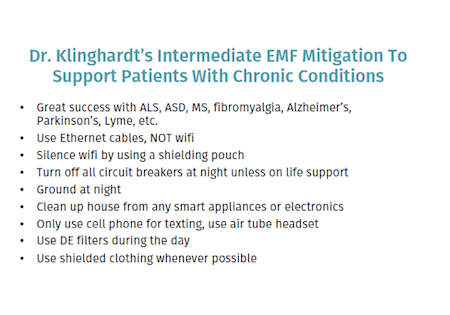
This question about EMF mitigating devices and harmonizers is the most common question I get related to EMFs so I’d like to reiterate Nick’s advice and share how Dr. Klinghardt supports his patients who have chronic health conditions – notice he makes no mention of devices or harmonizers.

The above slide is shared with permission from Nick Pineault’s ElectrosmogRX training (more details below).

Adriana asks this question about EMFs and sleep

My boyfriend cannot sleep for years now. We are in the outskirts of [a big city], close to the international airport. We lived in the city and there we had a lot of EMF (3 GSM antennas on the neighboring block, WiFi with every neighbor in the block – 10 stories high and 4 apartments/floor + intelligent meters for heating on every heater in the house. That was a lot for him and after we moved outside the city, to a house and in a low-density housing area, then it was better for him. But he sits at the laptop for 6-8 hours every day. You think that may be affecting him that much?

Here is Nick’s feedback for Adriana:

Your boyfriend might be feeling symptoms related to EMF exposure, and sleep disturbance is one of the most common ones.

If he exposes himself to a laptop connected via WiFi, then his symptoms might persist.

In his case, especially if he works at the computer all day, every day — I’d recommend cutting off the WiFi anytime it’s not in use and using his computer via an ethernet cable instead of WiFi.

Turn off the WiFi at night, unplug everything from the walls and even turn off the circuit breaker to the bedroom at night for at least 3 days and sees if this helps him.

In order to alleviate EMF sensitivity, it’s critical that he takes extra step to reduce his exposure as much as possible.

If you’re a practitioner, are you looking at the impact EMFs have on the health of your clients/patients and do you feel comfortable answering questions like these ones? If not, Nick Pineault is on a mission to create awareness and provide practical and research-based resources for practitioners via his ElectrosmogRX training (it’s 33% off for a limited time).

Nick is also offering these non-cost resources so you can be as informed as possible:

  • Downloadable Guide: How EMFs Affect Your Patients/Clients
  • EMF case studies video (teaching you how to identify EMF-related symptoms)
  • Here is the link to register for a replay of the webinar: 3 Essential Steps to Know Which of Your Patients/Clients Are Suffering From EMF-Related Symptoms

This blog is strictly about EMFs – which cannot be ignored – but we must not forget how the amino acids like GABA and tryptophan can help with anxiety and depression, and even pain and IBS. They can both also help with insomnia as can melatonin which has been shown to be disrupted by EMF exposure. This is just the tip of the iceberg in terms of nutritional support for EMF-related issues for both healing and resilience – Nick covers it all in the ElectrosmogRX training (which I’ve done and wholeheartedly endorse).

Are you seeing improvements in your health once you address EMFs? What changes have you made? Have nutritional changes helped too?

Filed Under: EMF, EMFs Tagged With: anxiety, depression, electrosmog, EMF harmonizer, EMF mitigating device, EMFs, IBS, insomnia, Nick Pineault, Qlink, sinus, skin, sleep

Primary Sidebar

NEW! GABA QuickStart Homestudy (with special intro pricing)

gaba quickstart homestudy

Free Report

9 Great Questions Women Ask about Food, Mood and their Health

You'll also receive a complimentary subscription to my ezine "Food, Mood and Gal Stuff"


Connect with me

Popular Posts

  • Amino Acids Mood Questionnaire from The Antianxiety Food Solution
  • The Antianxiety Food Solution Amino Acid and Pyroluria Supplements
  • Pyroluria Questionnaire from The Antianxiety Food Solution
  • Collagen and gelatin lower serotonin: does this increase your anxiety and depression?
  • Tryptophan for the worry-in-your-head and ruminating type of anxiety
  • GABA for the physical-tension and stiff-and-tense-muscles type of anxiety
  • The Antianxiety Food Solution by Trudy Scott
  • Seriphos Original Formula is back: the best product for anxiety and insomnia caused by high cortisol
  • Am I an anxious introvert because of low zinc and vitamin B6? My response to Huffington Post blog
  • Vagus nerve rehab with GABA, breathing, humming, gargling and key nutrients

Recent Posts

  • What do I use instead of Seriphos to help lower high cortisol that is affecting my sleep and making me anxious at night?
  • BeSerene™ GABA/theanine cream eases severe muscle tension in her neck/shoulders, prevents her bad headaches and quells her anxiety
  • How the correct approach, dose and sublingual use of GABA can be calming and not cause a flushed and itchy face and neck
  • The amino acid glutamine improves low mood by addressing gut health, and it has calming effects too
  • Flight anxiety with heightened breath, physical tension and also fearing the worst (the role of low GABA and low serotonin)

Categories

  • 5-HTP
  • AB575
  • Addiction
  • ADHD
  • Adrenals
  • Alcohol
  • Allergies
  • Alzheimer's disease
  • Amino Acids
  • Anger
  • Antianxiety
  • Antianxiety Food Solution
  • Antidepressants
  • Anxiety
  • Anxiety and panic
  • Autism
  • Autoimmunity
  • benzodiazapines
  • Bipolar disorder
  • Books
  • Caffeine
  • Cancer
  • Candida
  • Children/Teens
  • Collagen
  • Cooking equipment
  • Coronavirus/COVID-19
  • Cravings
  • Depression
  • Detoxification
  • Diabetes
  • Diet
  • DPA/DLPA
  • Drugs
  • EFT/Tapping
  • EMF
  • EMFs
  • Emotional Eating
  • Endorphins
  • Environment
  • Essential oils
  • Events
  • Exercise
  • Fear
  • Fear of public speaking
  • Fertility and Pregnancy
  • Fish
  • Food
  • Food and mood
  • Functional neurology
  • GABA
  • Gene polymorphisms
  • General Health
  • Giving
  • Giving back
  • Glutamine
  • Gluten
  • GMOs
  • Gratitude
  • Gut health
  • Heart health/hypertension
  • Histamine
  • Hormone
  • Hyperparathyroidism
  • Hypoglycemia
  • Immune system
  • Inflammation
  • Insomnia
  • Inspiration
  • Introversion
  • Joy and happiness
  • Ketogenic diet
  • Lithium orotate
  • Looking awesome
  • Lyme disease and co-infections
  • MCAS/histamine
  • Medication
  • Men's health
  • Mental health
  • Mercury
  • Migraine
  • Mold
  • Movie
  • MTHFR
  • Multiple sclerosis
  • Music
  • NANP
  • Nature
  • Nutritional Psychiatry
  • OCD
  • Osteoporosis
  • Oxalates
  • Oxytocin
  • Pain
  • Paleo
  • Parasites
  • Parkinson’s disease
  • PCOS
  • People
  • PMS
  • Postpartum
  • PTSD/Trauma
  • Pyroluria
  • Questionnaires
  • Real whole food
  • Recipes
  • Research
  • Schizophrenia
  • serotonin
  • SIBO
  • Sleep
  • Special diets
  • Sports nutrition
  • Stress
  • Sugar addiction
  • Sugar and mood
  • Supplements
  • Teens
  • Testimonials
  • Testing
  • The Anxiety Summit
  • The Anxiety Summit 2
  • The Anxiety Summit 3
  • The Anxiety Summit 4
  • The Anxiety Summit 5
  • The Anxiety Summit 6
  • Thyroid
  • Thyroid health
  • Toxins
  • Tryptophan
  • Tyrosine
  • Uncategorized
  • Vegan/vegetarian
  • Women's health
  • Yoga

Archives

  • October 2025
  • September 2025
  • August 2025
  • July 2025
  • June 2025
  • May 2025
  • April 2025
  • March 2025
  • February 2025
  • January 2025
  • November 2024
  • October 2024
  • September 2024
  • August 2024
  • July 2024
  • June 2024
  • May 2024
  • April 2024
  • March 2024
  • February 2024
  • January 2024
  • December 2023
  • November 2023
  • October 2023
  • September 2023
  • August 2023
  • July 2023
  • June 2023
  • May 2023
  • April 2023
  • March 2023
  • February 2023
  • January 2023
  • December 2022
  • November 2022
  • October 2022
  • September 2022
  • August 2022
  • July 2022
  • June 2022
  • May 2022
  • April 2022
  • March 2022
  • February 2022
  • January 2022
  • December 2021
  • November 2021
  • October 2021
  • September 2021
  • August 2021
  • July 2021
  • June 2021
  • May 2021
  • April 2021
  • March 2021
  • February 2021
  • January 2021
  • December 2020
  • November 2020
  • October 2020
  • September 2020
  • August 2020
  • July 2020
  • June 2020
  • May 2020
  • April 2020
  • March 2020
  • February 2020
  • January 2020
  • December 2019
  • November 2019
  • October 2019
  • September 2019
  • August 2019
  • July 2019
  • June 2019
  • May 2019
  • April 2019
  • March 2019
  • February 2019
  • January 2019
  • December 2018
  • November 2018
  • October 2018
  • September 2018
  • August 2018
  • July 2018
  • June 2018
  • May 2018
  • April 2018
  • March 2018
  • February 2018
  • January 2018
  • December 2017
  • November 2017
  • October 2017
  • September 2017
  • August 2017
  • July 2017
  • June 2017
  • May 2017
  • April 2017
  • March 2017
  • February 2017
  • January 2017
  • December 2016
  • November 2016
  • October 2016
  • September 2016
  • August 2016
  • July 2016
  • June 2016
  • May 2016
  • April 2016
  • March 2016
  • February 2016
  • January 2016
  • December 2015
  • November 2015
  • October 2015
  • September 2015
  • August 2015
  • July 2015
  • June 2015
  • May 2015
  • April 2015
  • March 2015
  • February 2015
  • January 2015
  • December 2014
  • November 2014
  • October 2014
  • September 2014
  • August 2014
  • July 2014
  • June 2014
  • May 2014
  • April 2014
  • March 2014
  • February 2014
  • January 2014
  • December 2013
  • November 2013
  • October 2013
  • September 2013
  • August 2013
  • July 2013
  • June 2013
  • May 2013
  • April 2013
  • March 2013
  • February 2013
  • January 2013
  • December 2012
  • November 2012
  • October 2012
  • August 2012
  • July 2012
  • June 2012
  • May 2012
  • April 2012
  • March 2012
  • February 2012
  • January 2012
  • December 2011
  • November 2011
  • October 2011
  • September 2011
  • August 2011
  • July 2011
  • June 2011
  • May 2011
  • April 2011
  • March 2011
  • February 2011
  • January 2011
  • December 2010
  • October 2010
  • September 2010
  • July 2010
  • May 2010
  • April 2010
  • March 2010
  • February 2010
  • January 2010
  • November 2009

Share the knowledge!

The above statements have not been evaluated by the Food and Drug Administration. Products listed in this website are not intended to diagnose, treat, cure or prevent any disease.

The information provided on this site is for informational and educational purposes only and is not intended as a substitute for advice from your physician or other health care professional. You should consult with a healthcare professional before starting or modifying any diet, exercise, or supplementation program, before taking or stopping any medication, or if you have or suspect you may have a health problem.


Copyright © 2026 Trudy Scott. All Rights Reserved. | Privacy | Terms and Conditions | Refund Policy | Medical Disclaimer

Free Report

9 Great Questions Women Ask about Food, Mood and their Health

You’ll also receive a complimentary subscription to my ezine “Food, Mood and Gal Stuff”