• Skip to primary navigation
  • Skip to main content
  • Skip to primary sidebar

everywomanover29 blog

Food, Mood and Women's Health – Be your healthiest, look and feel great!

  • Blog
  • About
  • Services
  • Store
  • Resources
  • Testimonials
  • The Book
  • Contact
  • Search this site

protein

How can I help my anxious daughter withdraw from vaping? She wants to quit but gets more anxious when she tries to quit!

September 5, 2025 By Trudy Scott 2 Comments

withdraw from vaping

I have been trying to help my daughter withdraw from vaping but it is proving such a vicious cycle.

She wants to quit but has anxiety and gets health anxiety when she doesn’t use the vape within a certain period – the physical withdrawal signs come thru very quickly for her – rapid heart beat, pain inside etc. which freaks her out and then she vapes…

It’s a hopeless cycle of withdrawals with horrible physical symptoms and then the emotional frustration of using vaping to manage the symptoms and feeling so frustrated with herself.

We tried 5-HTP which did not help. I make sure she gets a great protein, veg, good fat and some carbs for breakfast and she takes home made food to work but she works in hospitality and has really late night / early morning finishes and I feel like we are dealing with a lot more than the addiction here. I’d love to try and find a way to get her use down and hopefully kicked to the kerb.

If we could put her into a deep deep sleep for a few days till the toxin is washed out of her system and have a way to deal with the emotional aspect of withdrawal I think myself and so many other parents in Australia would be grateful.

Vaping is a huge problem in our young people – it’s all thru the schools too. It doesn’t smell, tastes like lollies and parents can’t detect it easily.

Louise is a mom in the community who posted this question on one of the blogs. I feel for her and her daughter and hear her concerns – vaping is a huge problem. However, there is a solution that doesn’t involve putting her daughter into a deep deep sleep – addressing neurotransmitter imbalances as a root cause.

Read on below for information on vaping and the very harmful effects (on the lungs and even bones); how to figure out which emotions are driving the need to use vaping to self-medicate and which amino acids to trial (including my insights for Louise’s daughter); why the amino acids are so powerful when it comes to vaping and other addictions; dietary aspects are foundational and important too, as are really late nights; and additional amino acid resources.

What is vaping and why is it so harmful?

This 2023 Harvard Health Publishing article, Can vaping damage your lungs? What we do (and don’t) know, provides an overview of vaping if you’re not exactly sure what is involved:

Vaping involves heating a liquid and inhaling the aerosol into the lungs. With vaping, a device such as an e-cigarette is used that heats up a liquid (called vape juice or e-liquid) until it turns into a vapor that is inhaled. These devices are commonly called vapes, mods, e-hookahs, sub-ohms, tank systems, and vape pens. They may all look a bit different, but work in similar ways.

These devices heat up various flavorings, nicotine, marijuana, or other potentially harmful substances.

The authors list the potentially harmful substances found in vapes:

  • nicotine
  • ultrafine particles that can be inhaled deep into the lungs
  • flavorings such as diacetyl, a chemical linked to a serious lung disease
  • volatile organic compounds
  • cancer-causing chemicals
  • heavy metals such as nickel, tin, and lead.

And they explain some of the serious lung problems that occur in those who vape: EVALI (e-cigarette, or vaping, product use-associated lung injury) and “popcorn lung” or bronchiolitis obliterans (BO).

One adverse effect that I seldom see mentioned is the potential harms to bone health, including “accelerating bone associated disease progression, impacting skeletal development in younger users and to advise patients following orthopaedic surgery, dental surgery, or injury to maximise bone healing.”

Unfortunately it’s the flavors in nicotine and cannabis vape products – candy/dessert, fruit, and fruit-ice combination vs tobacco flavor – that increased adolescents’ willingness to try them. “Comprehensive bans on flavored vapes would likely reduce adolescent use.”

There is growing awareness of these issues and fortunately rates of vaping are declining, however we do have to address why teens and young adults are seeking something calming or soothing such as vaping (or smoking or drinking) i.e. neurotransmitter imbalances.

How to figure out which emotions are driving the need to use vaping to self-medicate and which amino acids to trial?

This is how I would suggest this mom works with her daughter to help them figure out which emotions are driving the need to use vaping to self-medicate and which amino acids to trial:

How do you feel before vaping? How do you feel after vaping? Likely brain chemistry imbalance Amino acid/s to supplement
Anxious or stressed (physical anxiety) Calm or relaxed Low GABA GABA, pharmaGABA or theanine
Low mood, worried, fearful? (mental anxiety) Happy or content Low serotonin Tryptophan or 5-HTP
Tired, unfocused, low motivation Energetic, alert, or focused Low catecholamines, low dopamine Tyrosine
Desire for a reward or treat, sad (weepy), emotional Rewarded or comforted Low endorphins DPA (d-phenylalanine) or DLPA
Irritable and shaky Grounded or stable Low blood sugar Glutamine

We use this in conjunction with the symptoms questionnaire for each neurotransmitter and trial the respective amino acids one at a time.

I often see low GABA to be a driving reason for vaping, smoking cigarettes and drinking alcohol – they are all ways of self-medicating in order to calm down and reduce stress. And research supports this connection with “disturbances to GABA dynamics” “found to play a key role in … substance dependence and addiction.”

Louise mentions her daughter notices “physical withdrawal signs” of “rapid heart beat, pain inside” when trying to quit so it’s very possible there is a low GABA aspect to her addiction. I would consider a trial of GABA to start if she also has other low GABA symptoms.

She also shares that her daughter has “health anxiety” and freaks out when she starts to get withdrawal symptoms. If she resonates with being fearful and worried then it’s possible there is also a low serotonin aspect for her. Louise mentions that 5-HTP didn’t help but not how much they trialed or if they increased to try and find the ideal amount. If her daughter has other low serotonin symptoms I’d revisit this and also consider a trial of tryptophan as some individuals do better on one vs the other. I’d also use both as powder on the tongue in case that makes a difference.

And when I hear “hopeless” and “emotional” I would also be considering low endorphins and a trial of DPA (d-phenylalanine).

Why the amino acids are so powerful when it comes to vaping and other addictions

The amino acids play many roles in addressing a vaping addiction:

  • They address the root cause of the addiction i.e. the neurotransmitter imbalance/s
  • They help you to quit vaping with no willpower and without feeling deprived
  • They help to mitigate many of the adverse effects (like worse sleep issues and feeling more anxious)
  • They address the emotional aspect so mood and anxiety is improved
  • They prevent the need to find a replacement like sugar, coffee, Diet soda and alcohol and cigarettes (intake of any of these may increase when vaping is stopped, unless the neurotransmitter imbalances are addressed)

Many individuals with addiction issues have imbalances in all areas. We use a similar approach for vaping as we use for addictions to alcohol, cigarettes and sugar/carb/junk food i.e. we tackle one imbalance at a time so we know which amino acid is helping and how much is needed.

Dietary aspects are foundational and important too, as are really late nights and detox

I love that mom makes sure her daughter is well-nourished with real whole food – it’s foundational, as I explain in my book “The Antianxiety Food Solution.”

Louise mentions she gets a good breakfast. I’d be making sure she has good quality animal protein at breakfast in order to help with blood sugar stability as this helps with addictions too. And I’d want to make sure she takes healthy protein snacks to work too – like a boiled egg, beef jerky/biltong, a grass-fed beef stick etc.

With really late night / early morning finishes we always consider adrenal issues and address that as needed, after doing salivary testing.

And once Louise’s daughter has quit I would be focusing on detoxification of the toxins using sauna, red light, dry skin brushing and other detox approaches. And making a concerted effort to focus on improving antioxidants and other nutritional deficiencies, and assessing and working to improve her bone health.

Additional resources when you are new to using GABA, tryptophan and other amino acids as supplements

As always, I use the symptoms questionnaire to figure out if low GABA or low serotonin or other neurotransmitter imbalances may be an issue.

If you suspect low levels of any of the neurotransmitters and do not yet have my book, The Antianxiety Food Solution – How the Foods You Eat Can Help You Calm Your Anxious Mind, Improve Your Mood, and End Cravings, I highly recommend getting it and reading it before jumping in and using amino acids on your own so you are knowledgeable. And be sure to share it with the practitioner/health team you or your loved one is working with.

There is an entire chapter on the amino acids and they are discussed throughout the book in the sections on gut health, gluten, blood sugar control (this is covered in an entire chapter too), sugar cravings, anxiety and mood issues.

The book doesn’t include product names (per the publisher’s request) so this blog, The Antianxiety Food Solution Amino Acid and Pyroluria Supplements, lists the amino acids that I use with my individual clients and those in my group programs.

If, after reading this blog and my book, you don’t feel comfortable figuring things out on your own (i.e. doing the symptoms questionnaire and respective amino acids trials), a good place to get help is the GABA QuickStart Program (if you have low GABA symptoms). This is a paid online/virtual group program where you get my guidance and community support. You can sign up to be notified when the next live launch is happening.

If you need serotonin support, the Serotonin QuickStart Program is a good place to get help. This is also a paid online/virtual group program where you get my guidance on using tryptophan and 5-HTP safely, and community support during 5 LIVE Q&A calls. You can sign up to be notified when the next live launch of this program is happening.

If you are a practitioner, join us in The Balancing Neurotransmitters: the Fundamentals program. This is also a paid online/virtual program with an opportunity to interact with me and other practitioners who are also using the amino acids.

Wrapping up and your feedback

I appreciate Louise for asking this question so I could share on this blog and enlighten her and other parents whose teen and young adult children are struggling with vaping.

Does your teen or young adult child struggle with quitting vaping? And have the amino acids helped – if yes, which ones?

Have you personally had a similar issue?

And are you aware how harmful vaping is – for the lungs and even the bones?

Feel free to share and ask your questions below.
Filed Under: Addiction, Amino Acids, Anxiety, GABA, serotonin, Teens Tagged With: 5-HTP, amino acids, anxious, anxious daughter, bones, detox, DPA, emotional, endorphins, flavorings, GABA, late nights, lung damage, lungs, neurotransmitter imbalances, nicotine, protein, rapid heart beat, self-medicate, serotonin, teens, tryptophan, vaping, wants to quit, withdraw from vaping, young adults

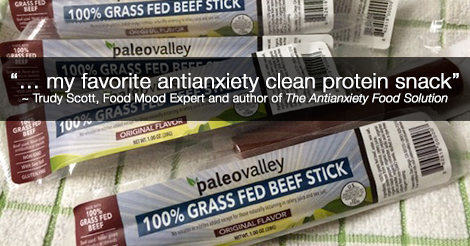
Paleovalley’s 100% Grass-Fed Beef Sticks: my favorite antianxiety clean protein snack

January 23, 2017 By Trudy Scott 13 Comments

I’ve got something great to share with you today… Paleovalley’s 100% Grass-Fed Beef Sticks!

Have you ever been stuck somewhere without a nutrient-dense healthy snack option: in traffic? At an airport? In a work meeting? At your child’s baseball game? At a conference? At the gym?

A healthy snack, gluten-free, quality protein and helps with blood sugar stability

When life gets busy, if we’re not prepared with healthy snacks it’s not very pretty – we can feel irritable and cranky, our focus and energy can take a dip and we can very often feel more anxious. These are all signs of low blood sugar. Low blood sugar can even trigger a panic attack and cause depression!

In fact, for many of my clients these are some of the main ways to keep anxiety and panic attacks at bay:

  • Avoiding gluten
  • Keeping blood sugar steady
  • Eating quality animal protein

Unfortunately, as you know, doing all this is often far harder in the real world than doing this in the comfort of your own kitchen. This is why having high quality snacks on hand are incredibly important. And if you’re like me and are always prepared and take healthy snacks with you, having something that is delicious and healthy is a top priority!  

I have finally found a healthy snack I approve of and so, of course, I want to share them with you!

They are Paleovalley’s 100% Grass-Fed Beef Sticks!

Grass-fed, grass-finished, organic spices, free of dyes, GMOs and gluten

These are not your average beef sticks. These beef sticks:

  • Are made from 100% grass-fed AND grass-finished beef (which is very rare!)
  • Contain all organic spices
  • Are free of all dyes (most casings contain artificial dyes)
  • Are also GMO-free, gluten-free, dairy-free, soy-free, carb-free, and contain 0 grams of sugar

AND they also help with blood sugar stability!

They are also fermented and free of trans fats!

But the main reason I really want to share these beef sticks with you (other than the yum-factor!) is because they are FERMENTED just like vegetables. Each beef stick contains 1 billion naturally-occurring, gut-healing probiotics! And we know how important good bacteria and the microbiome is when it comes to anxiety and depression.

Chas and Autumn, the founders of Paleovalley, shared this with me:

Most (if not all) other beef stick companies on the market utilize GMO corn and hydrogenated oils (trans fats) to preserve their sticks. It’s often labeled as “encapsulated citric acid” but can also be deceptively labeled as just “citric acid” or “lactic acid.” When the beef sticks are heated, the encapsulated oil coating melts into the beef stick and the citric acid is released for preservation purposes. Which means you’re getting an unhealthy dose of GMOs and hydrogenated oils with every bite.

Instead of using this process, Paleovalley uses natural fermentation to make their beef sticks shelf stable. From what they tell me, the reason that other companies don’t also use fermentation is that it takes about 4-5 times longer and isn’t as profitable.

So, these Paleovalley 100% Grass Fed Beef Sticks are not only free of questionable additives and GMOs, but they’re also nutrient dense AND support gut and brain health due to the fermentation process.

According to the research, high quality, grass fed red meat is strongly correlated with good mental health!

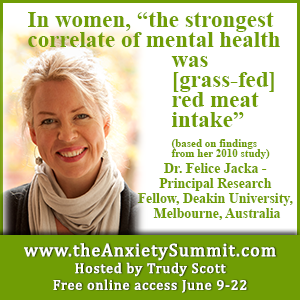
Another reason I love these beef sticks is that Dr. Felice Jacka, nutritional psychiatry researcher and founder of the International Society for Nutritional Psychiatry Research, has found that grass-fed red meat lowers the risk of anxiety and depression. In fact, Dr. Jacka went into her research thesis hypothesizing that red meat would be unhealthy, but was surprised to find the opposite. I interviewed Dr. Jacka in season 1 of the Anxiety Summit and she shared this about her research:

In our study, out of every single dietary food grouping that I looked at including vegetables, fruits, salads, beans, etc., the strongest correlate of mental health was red meat intake [grass-fed quality red meat of course]

Dr. Felice Jacka_2

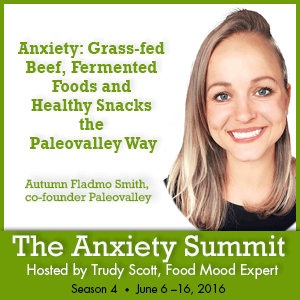
You may also recall my wonderful interview with Autumn on season 4 of the Anxiety Summit. She actually wrote her master’s thesis on dietary strategies for anxiety and shared this (and much more):

I am extremely passionate about mental health and nutrition and have set out to create food products that make it easy for people to eat well on-the-go. Because Dr. Jacka found that grass-fed beef was the most anxiolytic food, we crafted a 100% grass-fed beef stick!

So these nutrient dense 100% grass fed beef sticks not only allow you to avoid substances that are problematic for mental health like gluten, dairy, soy, trans fats, GMOs and sugar but also help you with blood sugar stability (such a big factor when it comes to anxiety). They also provide important key nutrients for mental health such as amino acids, B vitamins, iron and zinc – all needed to make calming neurotransmitters like GABA and serotonin.

Moist, tender, convenient and delicious!

They are moist, tender and have a little snap to them? They are also shelf stable for up to 4 months (much longer if refrigerated or frozen). They are so convenient AND oh so delicious!

And these beef sticks were actually voted #2 best paleo snack of 2014 by Paleo Magazine!

I bumped into Chas and Autumn at a recent conference and they kindly offered to give my community 30% off for a limited time. You’ll also be given first dibs on their brand new, really delicious Garlic Summer Sausage & Summer Sausage flavors (just like healthy, mini hickory smoked sausages)!

Click here to get your fermented, 100% Grass-Fed Beef Sticks for 30% off!… and taste the gut-friendly, fermented, grass-fed goodness for yourself.

Grab some today so that you can stay calm, cool and collected no matter what life throws your way.

ps. Right now these are only available in the USA but I’m looking into options for similar products in Australia, Canada and the UK.  I’ll share once I have sourced something. If you happen to have a great resource please share in the comments.


Filed Under: Antianxiety Tagged With: grass-fed beef, paleovalley, protein

Anxiety and Hypoglycemia Symptoms Improve with Diet Modification

August 12, 2016 By Trudy Scott 15 Comments

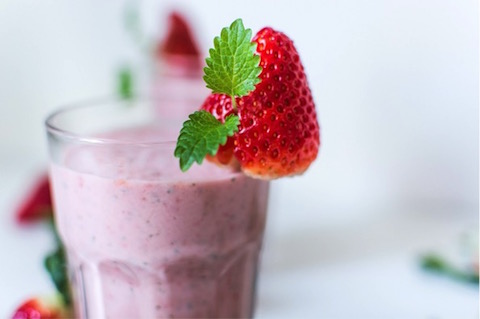
strawberry-smoothie

A paper published by the Canadian College of Naturopathic Medicine last month supports what I see with my clients on a daily basis: when it comes to anxiety caused by low blood sugar (or hypoglycemia) the correct diet can have a huge impact. And this means is the inclusion of enough protein, fats and fiber, especially at breakfast.

Here is the abstract from the paper: Generalized Anxiety Disorder and Hypoglycemia Symptoms Improved with Diet Modification

Observational evidence suggests that a relationship may exist between high glycemic index diets and the development of anxiety and depression symptoms; however, as no interventional studies assessing this relationship in a psychiatric population have been completed, the possibility of a causal link is unclear.

AB is a 15-year-old female who presented with concerns of generalized anxiety disorder and hypoglycemia symptoms. Her diet consisted primarily of refined carbohydrates. The addition of protein, fat, and fiber to her diet resulted in a substantial decrease in anxiety symptoms as well as a decrease in the frequency and severity of hypoglycemia symptoms.

A brief return to her previous diet caused a return of her anxiety symptoms, followed by improvement when she restarted the prescribed diet.

This case strengthens the hypothesis that dietary glycemic index may play a role in the pathogenesis or progression of mental illnesses such as generalized anxiety disorder and subsequently that dietary modification as a therapeutic intervention in the treatment of mental illness warrants further study.

Here are some details about this case report for AB, who was a 15-year-old female student of south-Asian descent:

  • she had anxiety (rated as 8/10 with 10 being the highest level of anxiety), worried excessively, experienced heart palpitations, shakiness, discomfort in her stomach, and muscle tension and often missed school because of how she felt
  • she experienced symptoms of hypoglycemia/low blood sugar and when her blood sugar dipped too low she experienced muscle weakness, headaches, nausea, anxiety, and poor concentration
  • when she felt anxious she would eat she would eat chocolate, chips, fruit and when her blood sugar dipped she would eat a granola bar

As you can see from her typical daily diet she was eating mostly carbohydrates, with very little protein, fat or fiber:

  1. Breakfast: fruit smoothie containing fruit, fruit juice, and water.
  2. Morning snack: bagel with margarine.
  3. Lunch: pasta or white rice with vegetables.
  4. Afternoon snack: granola bar or cookies or gummy candies.
  5. After school meal: white pasta; it may include meat.
  6. Dinner: white rice or spaghetti; it may include meat.
  7. Evening snack: cookies and toast.
  8. Beverages: 2 liters of water, 1 cup of juice, 1 cup of lactose-free milk, and 1 cup of tea.

She made the following changes in her diet adding protein at breakfast, lunch, dinner and at snack time, and adding healthy fats like flax seeds, olive oil and nut butters:

  1. Breakfast: includes a smoothie containing fruit, water, 1 scoop of protein powder, and 1 tablespoon of flax seeds or olive oil.
  2. Lunch and dinner: include a serving of protein (meat, legume, and soy) and a serving of vegetables.
  3. Snacks: include protein when possible (e.g., apple with sunflower seed butter, vegetable sticks with hummus, and pumpkin seeds).
  4. Continue to eat carbohydrate-containing snacks as needed for the management of hypoglycemia symptoms.

Over a 4-week period she made a few simple dietary changes and saw profound results: her anxiety decreased significantly from 8/10 to 4 or 5/10, she had more energy, she had fewer headaches, better concentration and improved mood.

The interesting factor is that when she slipped up for a week and went back to her old diet she felt more anxious within a day, but felt better within 2 days of adding back protein, fats and fiber.

These results are very typical with my clients and getting a handle on stabilizing blood sugar is the first thing I do with all my clients. Believe it or not, for some people this is ALL they need to do. I would add that I recommend making these changes in conjunction with the removal of gluten and caffeine.

I also like to see animal protein (and fat) as part of the snacks: like grass-fed beef jerky, grass-fed beef sticks, boiled eggs or pemmican. AB was allergic to eggs, nuts, and fish so these were not an option for her. Soy is often as issue so would need to be watched.

So this case study supports the fact that we must not forget the basics like blood sugar control. It’s very common for me to get questions like this on my blog: “I’m anxious, which amino acid should I use?” I always reply: focus first on real whole food and eating to balance blood sugar, remove sugar, gluten and caffeine, and then look at doing a trial of one or more of the amino acids

I do like to make things easier for my clients and this is where an amino acid like glutamine is very helpful in terms of providing added blood sugar stability, a calming effect and help with gut healing

Adding the glutamine and also doing a trial of an amino acid like GABA Calm may get the anxiety down a few more notches because we are always aiming for zero.

Addressing adrenal issues (which are closely related to blood sugar issues), and of course addressing all the other possible factors like thyroid health, gut health, other food sensitivities and so on would be the next step.

Have you see the positive impacts of keeping your blood sugar stable? What makes the most impact for you?

If you are a practitioner, how do you help your clients or patients address blood sugar issues?

Filed Under: Antianxiety Tagged With: anxiety, Carbohydrate, fat, fatigue, GABA, glutamine, Headaches, Hypoglycemia, low blood sugar, protein

The Anxiety Summit – How Changing My Breakfast Cut My Anxiety in Half

November 13, 2014 By Trudy Scott 8 Comments

Angela Savitri, OTR/L, Freedom from Chronic Stress Coach was interviewed by host of the Anxiety Summit, Trudy Scott, Food Mood Expert and Nutritionist, author of The Antianxiety Food Solution.

How Changing My Breakfast Cut My Anxiety in Half

  • How amino acids helped (5-HTP, and GABA)
  • How yoga and mindfulness meditation helped her anxiety
  • The research supporting yoga and mindfulness meditation for anxiety
  • How changing to a 90% whole foods diet helped her anxiety
  • What the biggest game-changer was for her anxiety?

It warmed my heart when I read this in a recent newsletter that Angela sent to her community. I contacted her right away and asked if she would come and share this on the summit and she said yes!

If you’ve been part of this community for a while, you’ve heard some of my personal struggles with anxiety.

When Lexapro, Buspar, and Doral were not helping, I sought alternatives.

I got some relief with taking amino acids, 5-HTP, and GABA.

I found some relief in yoga and mindfulness meditation.

I found some relief from eating a 90% whole foods diet.

I received the most relief from eating animal protein within one hour of waking.

Seriously…my anxiety went from a daily 6 to a 2 with this one nutrition adjustment.

And I learned it from Trudy!

This is going back to basics! This is simple and yet so powerful!

Here is a great blog post from Angela: 5 Tips to Avoid Depression and Anxiety

And an audio gift from Angela 3 Secrets to Self-Care Without Feeling Guilty

If you are not already registered for the Anxiety Summit you can get live access to the speakers of the day here www.theAnxietySummit.com

Filed Under: Anxiety and panic, Food and mood, Real whole food, The Anxiety Summit 2 Tagged With: 5-HTP, Angela Savitri, anxiety, breakfast, GABA, mindfulness meditation, protein, the anxiety summit, Trudy Scott, whole foods, yoga

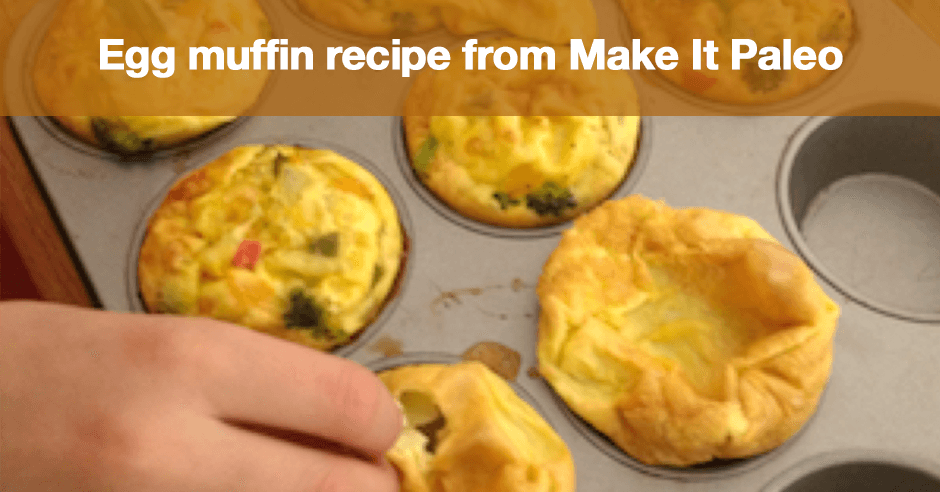
Egg muffin recipe from Make It Paleo

October 17, 2014 By Trudy Scott 2 Comments


Low blood sugar can result in anxiety, mood swings, irritability and feeling easily overwhelmed, so it’s really important to get a good start to the day with good quality protein like eggs. And we’re seeing more and more research showing that eggs are ok, even the yolk!

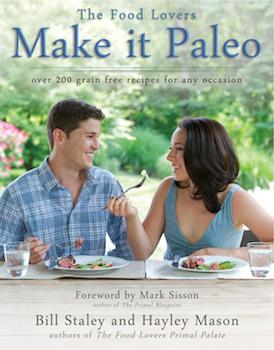
Here is a deliciously simple and quick recipe from one of my new favorite recipe books called Make It Paleo: Over 200 Grain-Free Recipes for Any Occasion, shared here with permission from one of the authors, Hayley Mason.

If you’re on the go you will appreciate the simplicity of this recipe. These delicious little quiche-like muffins are easy to make ahead of time and grab at a moment’s notice. If you’re doing intermittent fasting, this delicious source of protein and veggies can be paired with a healthy fat like avocado and be eaten midday or later. When I travel I always make them ahead of time and take them with me for “padkos” (South African slang/Afrikaans for “food for the road”).

Egg Muffins

Ingredients:

½ tsp coconut oil
½ medium onion chopped
1 cup broccoli, chopped
¼ green pepper, chopped
¼ red pepper, chopped
8 eggs
Salt and pepper to taste

Prep time: 10 minutes; Cook time: 18-20 minutes
Makes 4 large muffins or 8 small ones

Process:

  1. Preheat oven to 400 deg F
  2. Grease muffin tin with coconut oil
  3. Rinse and chop vegetables into ¼ inch pieces
  4. Divide vegetables evenly between muffin tins
  5. Whisk the eggs, then pour into the tins, dividing it evenly
  6. Sprinkle with salt and pepper, then stir the vegetable and egg mixture briefly to evenly disperse the vegetables throughout the egg
  7. Bake the egg muffins in the oven for 18-20 minutes

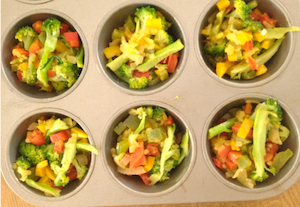
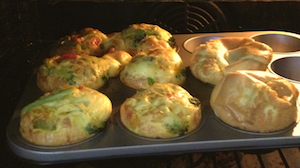
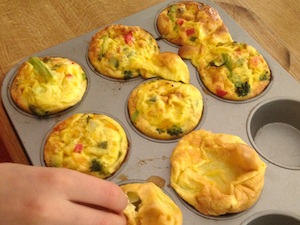
Here are some pictures of my attempt at these while on my recent trip to South Africa. We were getting ready to head to the Natal midlands for an overnight trip to the cheetah breeding project and needed some healthy “padkos” (South African slang for “food for the road”) so my niece Tamara and I whipped up a few muffins just before we left for the trip.

Since raw onions were not a favorite in my sister’s family, I pre-cooked the onions in a little coconut oil. I think you could lightly steam the other veggies too if you don’t like them crunchy. It’s going to add to your prep time unless you use left-over veggies from the night before.

In our case, we didn’t have quite enough veggies so we ended up with two egg-only muffins! They were all delicious!


Muffin pan ready to go with an assortment of veggies: broccoli, peppers and pre-cooked onions
My niece Tamara helps to pour the beaten eggs into the muffin pan


egg muffin 3
A quick peek shows the egg muffins rising nicely in the oven


Tamara sampling one of the egg-only muffins right out the oven

Make It Paleo is a wonderful recipe book with many simple and basic recipes as well as some pretty fancy ones too. One quick caution – I do think there are rather too many desserts and baked goods featured – so be warned and keep to recipes in the front! Enjoy!

make-it-paleo

Authors Hayley and her husband Bill Staley are the dynamic cooking duo behind Primal Palate. Their lifelong passion for food and cooking has led them to write an internationally recognized blog, three bestselling Paleo cookbooks, as well as create a widely popular app and website.

Filed Under: Real whole food, Recipes Tagged With: blood sugar, egg muffin, eggs, healthy fats, make it paleo, paleo egg muffin recipe, protein, recipe, vegetables

Primary Sidebar

NEW! GABA QuickStart Homestudy (with special intro pricing)

gaba quickstart homestudy

Free Report

9 Great Questions Women Ask about Food, Mood and their Health

You'll also receive a complimentary subscription to my ezine "Food, Mood and Gal Stuff"


Connect with me

Popular Posts

  • Amino Acids Mood Questionnaire from The Antianxiety Food Solution
  • The Antianxiety Food Solution Amino Acid and Pyroluria Supplements
  • Pyroluria Questionnaire from The Antianxiety Food Solution
  • Collagen and gelatin lower serotonin: does this increase your anxiety and depression?
  • Tryptophan for the worry-in-your-head and ruminating type of anxiety
  • GABA for the physical-tension and stiff-and-tense-muscles type of anxiety
  • The Antianxiety Food Solution by Trudy Scott
  • Seriphos Original Formula is back: the best product for anxiety and insomnia caused by high cortisol
  • Am I an anxious introvert because of low zinc and vitamin B6? My response to Huffington Post blog
  • Vagus nerve rehab with GABA, breathing, humming, gargling and key nutrients

Recent Posts

  • What do I use instead of Seriphos to help lower high cortisol that is affecting my sleep and making me anxious at night?
  • BeSerene™ GABA/theanine cream eases severe muscle tension in her neck/shoulders, prevents her bad headaches and quells her anxiety
  • How the correct approach, dose and sublingual use of GABA can be calming and not cause a flushed and itchy face and neck
  • The amino acid glutamine improves low mood by addressing gut health, and it has calming effects too
  • Flight anxiety with heightened breath, physical tension and also fearing the worst (the role of low GABA and low serotonin)

Categories

  • 5-HTP
  • AB575
  • Addiction
  • ADHD
  • Adrenals
  • Alcohol
  • Allergies
  • Alzheimer's disease
  • Amino Acids
  • Anger
  • Antianxiety
  • Antianxiety Food Solution
  • Antidepressants
  • Anxiety
  • Anxiety and panic
  • Autism
  • Autoimmunity
  • benzodiazapines
  • Bipolar disorder
  • Books
  • Caffeine
  • Cancer
  • Candida
  • Children/Teens
  • Collagen
  • Cooking equipment
  • Coronavirus/COVID-19
  • Cravings
  • Depression
  • Detoxification
  • Diabetes
  • Diet
  • DPA/DLPA
  • Drugs
  • EFT/Tapping
  • EMF
  • EMFs
  • Emotional Eating
  • Endorphins
  • Environment
  • Essential oils
  • Events
  • Exercise
  • Fear
  • Fear of public speaking
  • Fertility and Pregnancy
  • Fish
  • Food
  • Food and mood
  • Functional neurology
  • GABA
  • Gene polymorphisms
  • General Health
  • Giving
  • Giving back
  • Glutamine
  • Gluten
  • GMOs
  • Gratitude
  • Gut health
  • Heart health/hypertension
  • Histamine
  • Hormone
  • Hyperparathyroidism
  • Hypoglycemia
  • Immune system
  • Inflammation
  • Insomnia
  • Inspiration
  • Introversion
  • Joy and happiness
  • Ketogenic diet
  • Lithium orotate
  • Looking awesome
  • Lyme disease and co-infections
  • MCAS/histamine
  • Medication
  • Men's health
  • Mental health
  • Mercury
  • Migraine
  • Mold
  • Movie
  • MTHFR
  • Multiple sclerosis
  • Music
  • NANP
  • Nature
  • Nutritional Psychiatry
  • OCD
  • Osteoporosis
  • Oxalates
  • Oxytocin
  • Pain
  • Paleo
  • Parasites
  • Parkinson’s disease
  • PCOS
  • People
  • PMS
  • Postpartum
  • PTSD/Trauma
  • Pyroluria
  • Questionnaires
  • Real whole food
  • Recipes
  • Research
  • Schizophrenia
  • serotonin
  • SIBO
  • Sleep
  • Special diets
  • Sports nutrition
  • Stress
  • Sugar addiction
  • Sugar and mood
  • Supplements
  • Teens
  • Testimonials
  • Testing
  • The Anxiety Summit
  • The Anxiety Summit 2
  • The Anxiety Summit 3
  • The Anxiety Summit 4
  • The Anxiety Summit 5
  • The Anxiety Summit 6
  • Thyroid
  • Thyroid health
  • Toxins
  • Tryptophan
  • Tyrosine
  • Uncategorized
  • Vegan/vegetarian
  • Women's health
  • Yoga

Archives

  • October 2025
  • September 2025
  • August 2025
  • July 2025
  • June 2025
  • May 2025
  • April 2025
  • March 2025
  • February 2025
  • January 2025
  • November 2024
  • October 2024
  • September 2024
  • August 2024
  • July 2024
  • June 2024
  • May 2024
  • April 2024
  • March 2024
  • February 2024
  • January 2024
  • December 2023
  • November 2023
  • October 2023
  • September 2023
  • August 2023
  • July 2023
  • June 2023
  • May 2023
  • April 2023
  • March 2023
  • February 2023
  • January 2023
  • December 2022
  • November 2022
  • October 2022
  • September 2022
  • August 2022
  • July 2022
  • June 2022
  • May 2022
  • April 2022
  • March 2022
  • February 2022
  • January 2022
  • December 2021
  • November 2021
  • October 2021
  • September 2021
  • August 2021
  • July 2021
  • June 2021
  • May 2021
  • April 2021
  • March 2021
  • February 2021
  • January 2021
  • December 2020
  • November 2020
  • October 2020
  • September 2020
  • August 2020
  • July 2020
  • June 2020
  • May 2020
  • April 2020
  • March 2020
  • February 2020
  • January 2020
  • December 2019
  • November 2019
  • October 2019
  • September 2019
  • August 2019
  • July 2019
  • June 2019
  • May 2019
  • April 2019
  • March 2019
  • February 2019
  • January 2019
  • December 2018
  • November 2018
  • October 2018
  • September 2018
  • August 2018
  • July 2018
  • June 2018
  • May 2018
  • April 2018
  • March 2018
  • February 2018
  • January 2018
  • December 2017
  • November 2017
  • October 2017
  • September 2017
  • August 2017
  • July 2017
  • June 2017
  • May 2017
  • April 2017
  • March 2017
  • February 2017
  • January 2017
  • December 2016
  • November 2016
  • October 2016
  • September 2016
  • August 2016
  • July 2016
  • June 2016
  • May 2016
  • April 2016
  • March 2016
  • February 2016
  • January 2016
  • December 2015
  • November 2015
  • October 2015
  • September 2015
  • August 2015
  • July 2015
  • June 2015
  • May 2015
  • April 2015
  • March 2015
  • February 2015
  • January 2015
  • December 2014
  • November 2014
  • October 2014
  • September 2014
  • August 2014
  • July 2014
  • June 2014
  • May 2014
  • April 2014
  • March 2014
  • February 2014
  • January 2014
  • December 2013
  • November 2013
  • October 2013
  • September 2013
  • August 2013
  • July 2013
  • June 2013
  • May 2013
  • April 2013
  • March 2013
  • February 2013
  • January 2013
  • December 2012
  • November 2012
  • October 2012
  • August 2012
  • July 2012
  • June 2012
  • May 2012
  • April 2012
  • March 2012
  • February 2012
  • January 2012
  • December 2011
  • November 2011
  • October 2011
  • September 2011
  • August 2011
  • July 2011
  • June 2011
  • May 2011
  • April 2011
  • March 2011
  • February 2011
  • January 2011
  • December 2010
  • October 2010
  • September 2010
  • July 2010
  • May 2010
  • April 2010
  • March 2010
  • February 2010
  • January 2010
  • November 2009

Share the knowledge!

The above statements have not been evaluated by the Food and Drug Administration. Products listed in this website are not intended to diagnose, treat, cure or prevent any disease.

The information provided on this site is for informational and educational purposes only and is not intended as a substitute for advice from your physician or other health care professional. You should consult with a healthcare professional before starting or modifying any diet, exercise, or supplementation program, before taking or stopping any medication, or if you have or suspect you may have a health problem.


Copyright © 2026 Trudy Scott. All Rights Reserved. | Privacy | Terms and Conditions | Refund Policy | Medical Disclaimer

Free Report

9 Great Questions Women Ask about Food, Mood and their Health

You’ll also receive a complimentary subscription to my ezine “Food, Mood and Gal Stuff”