• Skip to primary navigation
  • Skip to main content
  • Skip to primary sidebar

everywomanover29 blog

Food, Mood and Women's Health – Be your healthiest, look and feel great!

  • Blog
  • About
  • Services
  • Store
  • Resources
  • Testimonials
  • The Book
  • Contact
  • Search this site

niacin

Depression as a black dog that comes in and lays down beside you at night

May 26, 2017 By Trudy Scott 18 Comments

Trevor King’s interview about his journey with depression – on That Vitamin Summit – is not to be missed if you are depressed, have ever suffered with depression or if you have a loved one or friend with depression. He shares how he feels a sense of complete hopelessness at times:

It descends like a black cloud that makes me almost sort of retreat into myself. And my eyes will know and I don’t want to take the world in. I don’t want to get out of bed at times. Actually, that’s one of the things that … one of the only things that actually helps me, is going to bed and lying down.

Winston Churchill famously described it as this black dog who’d come in and lay beside him at night.

“From the moment my eyes opened in the morning, I am engaged in a battle. I must protect myself with armor against ongoing, negative, intrusive thoughts that flood into my brain, while sending my prefrontal cortex, which is the home of logical thought, the green light to make decisions and take charge of my brain’s limbic system. That is, before the fear center completely spazzes out. I spend more time and energy chasing and maintaining good health than I do in any other aspect of my life. My marriage, family or work. Because I know that everything meaningful and good around me depends on a stable base. And I hope and pray that one day, I don’t have to fight so hard for my sanity.”

He talks about how he is affected by sugar and low blood sugar, and how he’s found some benefits with niacin, chromium, magnesium and tryptophan (when he’s consistent with taking them!).

Trevor actually talks about the GABA interview I did with him a few days earlier and how he’s very interested in what he learned. He is planning to do a trial of GABA to see if it can help him further.

Here is a snippet from my interview on GABA (so do tune in to this interview if you’re new to my work and the targeted amino acids):

GABA is really quite profound. When I had my anxiety, GABA was my lifesaver. It completely turned my life around. Within three days of using GABA, the panic attacks stopped and the anxiety started to go down, and then I had to look for all the other root causes. It worked immediately so I’m a complete believer, just because I’ve experienced it myself. You’ll hear a lot of people say GABA won’t work. It doesn’t cross the blood/brain barrier so it’s not going to have an impact.

We’ve now got research showing that there may be ways that it crosses the blood/brain barrier. We’ve also got research showing that we have GABA receptors in various parts of our body. We’ve got a lot in our muscles, and with low GABA symptoms you’ll have physical tension.

The beautiful thing is it works. It works quickly, and if you have these low GABA symptoms, which is the physical anxiety, which could be panic attacks. It could be stress eating, it could be drinking to calm down. If you are the kind of person who needs wine to wind down at the end of the day, that’s a big sign that you may need GABA. You take the GABA and you just feel this physical tension release from you, you know you’re onto something good.

I just wish I’d known about his struggles with depression at the time of our interview – I would have talked more about tyrosine for dopamine support (for curl up in bed depression) and DPA for endorphin boosting (for low endorphins weepy depression). 

I did discuss gluten and would consider this especially since his daughter has issues with it. I talked about low serotonin and mentioned Lidtke tryptophan.  If someone doesn’t do well on another brand I’d have them trial the Lidtke brand.  I’d also look into SIBO – I have SIBO and rice and grains make me feel flat and low and I see this often with clients.  Finally I’d look into lithium orotate for keeping an even mood. 

Trevor shares these wise words at the end of his interview:

You do find that when you actually bite the bullet and share it with people,

people are very, very understanding. And actually, you’re amazed that many people have been there themselves.

I could not agree more which is why I’ve always shared my journey with anxiety. I appreciate him for being willing to share his story with depression!

If you’re not already registered here is the registration link for That Vitamin Summit

Feel free to post questions or feedback below – and share your story with anxiety or depression if you feel drawn to do so


Filed Under: Bipolar disorder, Depression, Events, GABA, Mental health, People Tagged With: anxiety, depression, GABA, low blood sugar, niacin, sugar, That Vitamin Summit, Trevor King, tryptophan

Niacin for anxiety and insomnia: Andrew W. Saul on That Vitamin Summit

May 16, 2017 By Trudy Scott 57 Comments

If you have trouble calming down or maybe difficulty sleeping at night, niacin may be worth investigating and trialing. Andrew W. Saul addresses this B vitamin on That Vitamin Summit which starts later this week and runs May 18 – 24 2017. (Note that it starts on a Thursday and not the usual Monday)

He covers the four types of niacin:

Niacin or plain old niacin, niacinamide, a no flush form that works just right for all mental and emotional issues but does not work for cholesterol issues. Inositol hexanicotinate which works well for everything but you have to use more it costs a little more money and it doesn’t work as well and then sustained release niacin which is prescription, expensive and has the most side effects.

Andrew discusses how to experiment and what you can expect in the way of flushing:

First of all you personally can experiment by trying some niacin and seeing how you feel. An example of this would be a healthy person who has a little trouble calming down maybe difficulty sleeping at night. Maybe they’re a little more anxious than they think they should be and perhaps taking some niacin would be a good thing to try. You could open up with 500 milligrams of niacin, breakfast lunch and dinner.

Now you’re probably going to flush and by the way if you have it with a meal you don’t flush as much. You don’t flush as quickly as you do if you take it on an empty stomach but you are still going to flush. The weird thing is you’re not going to flush for a couple of hours because you’re going to have the niacin with all that food and if you take the niacin in the middle of the meal or at the end of the meal there could be quite a delay before you have your flush.

Andrew does share what he calls “my wimpy way of taking niacin” where you slowly but surely increase from a low dose to avoid the flush.

He laughs about how Dr. Abram Hoffer was so fond of using niacin that he would tell people look just tough it out: “Tolerate the flush, it’s going to take a couple of weeks.”

And he also shares that Dr. Hoffer was his mentor and how Dr. Hoffer saw dramatic results with schizophrenia patients:

Now Dr. Abram Hoffer the world’s expert on niacin who started studying niacin in the early 1950’s and he was my personal mentor many decades later. Dr. Hoffer was a psychiatrist, a PhD as well as an MD and he treated over five thousand patients with niacin in his medical career.

The amount of niacin that you need for schizophrenia tends to be very high. Dr. Hoffer’s standard prescription was three thousand milligrams a day, divided into three doses of one thousand milligrams each.

It’s a fascinating interview and the most detailed one I’ve yet to hear on the topic of niacin. It’s not to be missed!

He goes on to cover the following

  • niacin for the treatment of alcoholic depression
  • other B vitamins like thiamine, vitamin B12, vitamin B6 and folate
  • plus multivitamins and whole food vitamins

I hope you can join us on That Vitamin Summit brought to you by makers of That Vitamin Movie which has been watched online by over one million people since its release in January 2016.

There are over 80 years of documented evidence that show how humble vitamins, minerals and other nutrients (such as amino acids – the topic of my interview) can prevent, and even cure major diseases like diabetes, arthritis heart disease and anxiety and depression. That Vitamin Summit 2 has assembled over 20 top experts to show YOU how to use these nutrients to increase your health and well-being almost immediately.

Here is the registration link for the summit which starts later this week on Thursday May 18 (note the Thursday start date)

Filed Under: Events Tagged With: Andrew W. Saul, anxiety, calming, inositol hexanicotinate, insomnia, niacin, niacinamide, That Vitamin Summit

The Anxiety Summit – Tapering off psychiatric drugs so they don’t ruin your life

November 13, 2014 By Trudy Scott 53 Comments

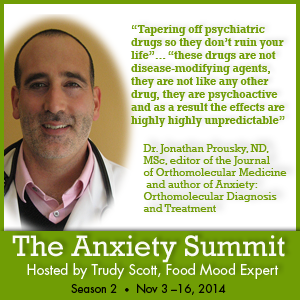
Dr. Jonathan ProuskyQuote_Anxiety2

Dr. Jonathan Prousky, MSc, ND, editor of the Journal of Orthomolecular Medicine and author of Anxiety: Orthomolecular Diagnosis and Treatment was interviewed by host of the Anxiety Summit, Trudy Scott, Food Mood Expert and Nutritionist, author of The Antianxiety Food Solution.

Tapering off psychiatric drugs so they don’t ruin your life

  • The process of reducing or discontinuing psychotropic medications
  • Difficulties patients have in overcoming pharmacological dependence
  • Reactions when someone discontinues SSRIs and benzodiazapines
  • Tapering approach, duration and improving outcomes
  • The importance of diet and lifestyle
  • Melatonin and niacinamide during benzodiazepine withdrawal
  • Using Neurapas Balance, rhodiola and GABA during a taper protocol
  • A tapering schedule case report

Here are a few snippets from our interview:

prescribed psychiatric drugs…. They are not like any other medication. These drugs are not disease-modifying agents, so they’re not like taking a drug for diabetes. These drugs are psychoactive.

That’s exactly how they work. They influence, basically, how one thinks, feels and behaves and, of course, physiology and, as a result, their effects are highly, highly unpredictable and what I constantly see in my own practice is how doctors are failing our patients and not really discussing all of what is necessary when prescribing these drugs because these drugs tend to have some significant effects. and I don’t consider any of the effects of these psychoactive drug’s effects and they can be either positive, negative or neutral

I think what’s important for people to realize is there’s no specific clinical manifestation that would be appropriate for all patients that are on SSRI drugs, whether that’s something like Paxil or Prozac or Celexa. It doesn’t matter. There’s no one manifestation that all patients coming off those drugs are going to experience. Essentially, because these drugs have very, I would say, unpredictable psychoactive effects then, when somebody is coming off of them, the effects from tapering are also rather unpredictable. So, people can experience either regression of their symptoms that brought them to a physician in the first place and one of the reasons why they were prescribed the drug in the first place, so patients can certainly regress and start having a return of their previous symptoms. Patients can have incredible sleep issues where they just cannot sleep, and they literally are feeling so concerned and they start worrying about not being able to fall asleep even before they sleep because it becomes such an issue.

Patients can feel very restless and they can get an inner restlessness that sometimes can drive them, literally almost like, as if, they’re going crazy, it’s called agathusia. There’s like this inner restlessness that torments people. Sometimes that can even happen as they taper down. Sometimes people can develop some weird, neurological manifestations whether it’s ticks or just strange or abnormal body movements, which we call dyskinesias. Patients can start having the sweats or feelings of derealization where they don’t feel grounded in reality.

They can have brain zaps where their brain just feels like it’s being zapped or as if someone’s electrocuting them. They can feel their whole body shaking and sort of becoming very jittery or even they can have cold sweats and shiver a lot. Essentially, there’s not a manifestation that you and I couldn’t think of that couldn’t happen to somebody coming off of these drugs because, as I said, they’re so unpredictable.

During the interview we discussed a number of papers written by Dr. Prousky. Here is a link to his publications.

Here is the Harm Reduction Guide to Coming Off Psychiatric Drugs by Will Hall

Dr. Prousky discussed this paper about pharmaGABA: Relaxation and immunity enhancement effects of gamma-aminobutyric acid (GABA) administration in humans.

GABA could work effectively as a natural relaxant and its effects could be seen within 1 hour of its administration to induce relaxation and diminish anxiety.

I talked more about GABA in my interview: Targeted individual amino acids for eliminating anxiety: practical applications

Dr. Prousky shared a case study of an SSRI and rhodiola taken together leading to tachyarrhythmia: Herbal medicine–sets the heart racing!

We report the case of a young previously healthy woman who had a significant tachyarrhythmia whilst taking a combination of escitalopram and the over the counter herbal medicine Rhodiola. Escitalopram, a SSRI, increases serotonin levels in the brain by selectively inhibiting re-uptake of serotonin. It is metabolised by the cytochrome P450 (CYP) isoenzymes CYP2C19, CYP2D6 and CYP3A4. Rhodiola also increases serotonin levels by inhibiting monoamine oxidase. It is a potent inhibitor of CYP3A4 and P-Glycoprotein. Consequently both agents taken by a patient can augment serotonin levels.

Dr. Prousky discussed the risks of SSRIs during pregnancy and shared this paper: The risks of selective serotonin reuptake inhibitor use in infertile women: a review of the impact on fertility, pregnancy, neonatal health and beyond

Antidepressant use during pregnancy is associated with increased risks of miscarriage, birth defects, preterm birth, newborn behavioral syndrome, persistent pulmonary hypertension of the newborn and possible longer term neurobehavioral effects.

Dr. Prousky is the editor of the Journal of Orthomolecular medicine.

The CSOM/Canadian Society for Orthomolecular Medicine holds an annual conference in Toronto and you can learn more here. The 2015 conference will be April 24-26.

If you are not already registered for the Anxiety Summit you can get live access to the speakers of the day here www.theAnxietySummit.com

Filed Under: Anxiety and panic, benzodiazapines, Drugs, The Anxiety Summit 2 Tagged With: anxiety, Dr Jonathan Prousky, GABA, niacin, pharmaGABA, psychiatric drugs, rhodiola, SSRIs, the anxiety summit, Trudy Scott

Primary Sidebar

NEW! GABA QuickStart Homestudy (with special intro pricing)

gaba quickstart homestudy

Free Report

9 Great Questions Women Ask about Food, Mood and their Health

You'll also receive a complimentary subscription to my ezine "Food, Mood and Gal Stuff"


Connect with me

Popular Posts

  • Amino Acids Mood Questionnaire from The Antianxiety Food Solution
  • The Antianxiety Food Solution Amino Acid and Pyroluria Supplements
  • Pyroluria Questionnaire from The Antianxiety Food Solution
  • Collagen and gelatin lower serotonin: does this increase your anxiety and depression?
  • Tryptophan for the worry-in-your-head and ruminating type of anxiety
  • GABA for the physical-tension and stiff-and-tense-muscles type of anxiety
  • The Antianxiety Food Solution by Trudy Scott
  • Seriphos Original Formula is back: the best product for anxiety and insomnia caused by high cortisol
  • Am I an anxious introvert because of low zinc and vitamin B6? My response to Huffington Post blog
  • Vagus nerve rehab with GABA, breathing, humming, gargling and key nutrients

Recent Posts

  • What do I use instead of Seriphos to help lower high cortisol that is affecting my sleep and making me anxious at night?
  • BeSerene™ GABA/theanine cream eases severe muscle tension in her neck/shoulders, prevents her bad headaches and quells her anxiety
  • How the correct approach, dose and sublingual use of GABA can be calming and not cause a flushed and itchy face and neck
  • The amino acid glutamine improves low mood by addressing gut health, and it has calming effects too
  • Flight anxiety with heightened breath, physical tension and also fearing the worst (the role of low GABA and low serotonin)

Categories

  • 5-HTP
  • AB575
  • Addiction
  • ADHD
  • Adrenals
  • Alcohol
  • Allergies
  • Alzheimer's disease
  • Amino Acids
  • Anger
  • Antianxiety
  • Antianxiety Food Solution
  • Antidepressants
  • Anxiety
  • Anxiety and panic
  • Autism
  • Autoimmunity
  • benzodiazapines
  • Bipolar disorder
  • Books
  • Caffeine
  • Cancer
  • Candida
  • Children/Teens
  • Collagen
  • Cooking equipment
  • Coronavirus/COVID-19
  • Cravings
  • Depression
  • Detoxification
  • Diabetes
  • Diet
  • DPA/DLPA
  • Drugs
  • EFT/Tapping
  • EMF
  • EMFs
  • Emotional Eating
  • Endorphins
  • Environment
  • Essential oils
  • Events
  • Exercise
  • Fear
  • Fear of public speaking
  • Fertility and Pregnancy
  • Fish
  • Food
  • Food and mood
  • Functional neurology
  • GABA
  • Gene polymorphisms
  • General Health
  • Giving
  • Giving back
  • Glutamine
  • Gluten
  • GMOs
  • Gratitude
  • Gut health
  • Heart health/hypertension
  • Histamine
  • Hormone
  • Hyperparathyroidism
  • Hypoglycemia
  • Immune system
  • Inflammation
  • Insomnia
  • Inspiration
  • Introversion
  • Joy and happiness
  • Ketogenic diet
  • Lithium orotate
  • Looking awesome
  • Lyme disease and co-infections
  • MCAS/histamine
  • Medication
  • Men's health
  • Mental health
  • Mercury
  • Migraine
  • Mold
  • Movie
  • MTHFR
  • Multiple sclerosis
  • Music
  • NANP
  • Nature
  • Nutritional Psychiatry
  • OCD
  • Osteoporosis
  • Oxalates
  • Oxytocin
  • Pain
  • Paleo
  • Parasites
  • Parkinson’s disease
  • PCOS
  • People
  • PMS
  • Postpartum
  • PTSD/Trauma
  • Pyroluria
  • Questionnaires
  • Real whole food
  • Recipes
  • Research
  • Schizophrenia
  • serotonin
  • SIBO
  • Sleep
  • Special diets
  • Sports nutrition
  • Stress
  • Sugar addiction
  • Sugar and mood
  • Supplements
  • Teens
  • Testimonials
  • Testing
  • The Anxiety Summit
  • The Anxiety Summit 2
  • The Anxiety Summit 3
  • The Anxiety Summit 4
  • The Anxiety Summit 5
  • The Anxiety Summit 6
  • Thyroid
  • Thyroid health
  • Toxins
  • Tryptophan
  • Tyrosine
  • Uncategorized
  • Vegan/vegetarian
  • Women's health
  • Yoga

Archives

  • October 2025
  • September 2025
  • August 2025
  • July 2025
  • June 2025
  • May 2025
  • April 2025
  • March 2025
  • February 2025
  • January 2025
  • November 2024
  • October 2024
  • September 2024
  • August 2024
  • July 2024
  • June 2024
  • May 2024
  • April 2024
  • March 2024
  • February 2024
  • January 2024
  • December 2023
  • November 2023
  • October 2023
  • September 2023
  • August 2023
  • July 2023
  • June 2023
  • May 2023
  • April 2023
  • March 2023
  • February 2023
  • January 2023
  • December 2022
  • November 2022
  • October 2022
  • September 2022
  • August 2022
  • July 2022
  • June 2022
  • May 2022
  • April 2022
  • March 2022
  • February 2022
  • January 2022
  • December 2021
  • November 2021
  • October 2021
  • September 2021
  • August 2021
  • July 2021
  • June 2021
  • May 2021
  • April 2021
  • March 2021
  • February 2021
  • January 2021
  • December 2020
  • November 2020
  • October 2020
  • September 2020
  • August 2020
  • July 2020
  • June 2020
  • May 2020
  • April 2020
  • March 2020
  • February 2020
  • January 2020
  • December 2019
  • November 2019
  • October 2019
  • September 2019
  • August 2019
  • July 2019
  • June 2019
  • May 2019
  • April 2019
  • March 2019
  • February 2019
  • January 2019
  • December 2018
  • November 2018
  • October 2018
  • September 2018
  • August 2018
  • July 2018
  • June 2018
  • May 2018
  • April 2018
  • March 2018
  • February 2018
  • January 2018
  • December 2017
  • November 2017
  • October 2017
  • September 2017
  • August 2017
  • July 2017
  • June 2017
  • May 2017
  • April 2017
  • March 2017
  • February 2017
  • January 2017
  • December 2016
  • November 2016
  • October 2016
  • September 2016
  • August 2016
  • July 2016
  • June 2016
  • May 2016
  • April 2016
  • March 2016
  • February 2016
  • January 2016
  • December 2015
  • November 2015
  • October 2015
  • September 2015
  • August 2015
  • July 2015
  • June 2015
  • May 2015
  • April 2015
  • March 2015
  • February 2015
  • January 2015
  • December 2014
  • November 2014
  • October 2014
  • September 2014
  • August 2014
  • July 2014
  • June 2014
  • May 2014
  • April 2014
  • March 2014
  • February 2014
  • January 2014
  • December 2013
  • November 2013
  • October 2013
  • September 2013
  • August 2013
  • July 2013
  • June 2013
  • May 2013
  • April 2013
  • March 2013
  • February 2013
  • January 2013
  • December 2012
  • November 2012
  • October 2012
  • August 2012
  • July 2012
  • June 2012
  • May 2012
  • April 2012
  • March 2012
  • February 2012
  • January 2012
  • December 2011
  • November 2011
  • October 2011
  • September 2011
  • August 2011
  • July 2011
  • June 2011
  • May 2011
  • April 2011
  • March 2011
  • February 2011
  • January 2011
  • December 2010
  • October 2010
  • September 2010
  • July 2010
  • May 2010
  • April 2010
  • March 2010
  • February 2010
  • January 2010
  • November 2009

Share the knowledge!

The above statements have not been evaluated by the Food and Drug Administration. Products listed in this website are not intended to diagnose, treat, cure or prevent any disease.

The information provided on this site is for informational and educational purposes only and is not intended as a substitute for advice from your physician or other health care professional. You should consult with a healthcare professional before starting or modifying any diet, exercise, or supplementation program, before taking or stopping any medication, or if you have or suspect you may have a health problem.


Copyright © 2026 Trudy Scott. All Rights Reserved. | Privacy | Terms and Conditions | Refund Policy | Medical Disclaimer

Free Report

9 Great Questions Women Ask about Food, Mood and their Health

You’ll also receive a complimentary subscription to my ezine “Food, Mood and Gal Stuff”