• Skip to primary navigation
  • Skip to main content
  • Skip to primary sidebar

everywomanover29 blog

Food, Mood and Women's Health – Be your healthiest, look and feel great!

  • Blog
  • About
  • Services
  • Store
  • Resources
  • Testimonials
  • The Book
  • Contact
  • Search this site

cream

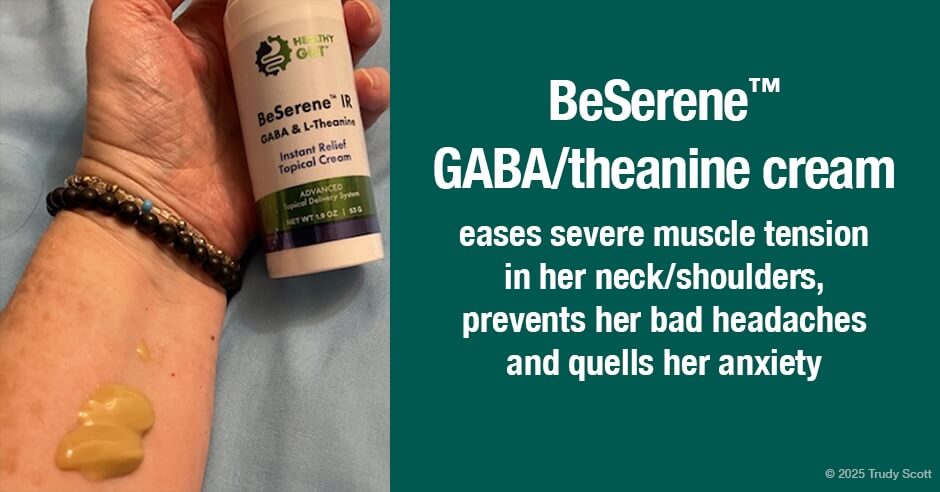
BeSerene™ GABA/theanine cream eases severe muscle tension in her neck/shoulders, prevents her bad headaches and quells her anxiety

October 24, 2025 By Trudy Scott 9 Comments

beserene

Hi there… I wanted to add my ‘two cents’ to the discussion about the BeSerene™ GABA/theanine product that you recommend. I LOVE it! I suffer from low GABA levels, which result in my having severe muscle tension in my neck and shoulders. Often, that resulted in bad muscle tension headaches, for which I couldn’t find anything to bring relief. The BeSerene™ GABA/theanine cream has been a real game changer.

If I wake up with one of those headaches in the middle of the night or in the morning, I use two pumps and rub it on my tight neck and shoulder muscles and within 15 minutes, I can feel the tension melting away! It literally goes away! I have  even been able to prevent a headache from occurring by using it on my neck muscles before I go to bed at night.

Insofar as anxiety, I get relief from that as well, because generally I start to get anxiety once the headaches start, as I never know if it is going to be manageable with just an ibuprofen or two, or if it is going to be one of ‘those’ headaches, i.e. a migraine that lasts for a day or more! Unfortunately, once the anxiety starts, it makes the muscle tension headache worse, which makes the anxiety worse, and it’s just a horrible vicious cycle!

So, since the BeSerene™ cream works so efficiently on the muscle tension, it quells the anxiety that usually follows!

It has changed my life, and I don’t know of any other product I can say that about. I can honestly say that I will not allow myself to ever be without it now!

Thank you so much Trudy, for recommending this product!

Lisa is a woman in the community who reached out to me via email with this message raving about how life-changing this cream has been for her. I am thrilled for her and never get tired of hearing results like this. I’m not surprised either and love to share these kinds of results! She kindly gave me permission to share, saying “I want others to experience what I have with this product!”

Read on below for more about why she gravitated towards using a cream, other benefits you may expect to see (like a reduction in stress-eating and/or drinking too much wine), my insights into when to consider using a GABA/theanine cream like this and how to use it, where to purchase this exact cream and additional resources if you are new to using GABA.

Why did Lisa gravitate to using a GABA/theanine cream?

Lisa shared that she just couldn’t seem to tolerate the sublingual or oral GABA:

I have tried sublingual GABA products but haven’t had much success, as I haven’t been able to find any without alcohol sugars (xylitol, sorbitol, etc.) Those ingredients give me a terrible taste in my mouth and I just can’t tolerate them. (Why can’t they make one with just real sugar from nature?)

Plus, I haven’t had a lot of success with the oral products as they just take too long to work on the headaches/muscle tension.

I’m really glad she recognized her symptoms were due to low GABA – muscle tension and pain, in conjunction with feeling physically anxious are common. And that she didn’t give up on GABA and persevered until she found what works for her symptoms.

What about other forms of GABA?

However, my advice for someone in Lisa’s situation is not to give up on other GABA products if she finds she needs additional support in the future or finds herself without the cream. With regards to taste and time to work, I recommend a GABA-only (or GABA/theanine) capsule opened on to the tongue or a GABA (and/or theanine) powder – both held on the tongue for 1-2 minutes for quick results.

Stress-eating and self-medication with wine are classic signs of low GABA

Interestingly, stress eating is not an issue for her but wine may be:

I’ve never really had any issues with stress-eating. In fact, I usually have no appetite when I’m stressed out! (That’s where the wine comes in…lol!)

We may self-medicate with wine when GABA is low because it relaxes us physically, helps us fit in socially and feels calming and pleasant. It’s mistakenly used to try and improve sleep but typically makes things worse.

Alcohol consumption damages the gut, depletes B vitamins (especially thiamine/vitamin B1) and zinc – and it’s addicting.

GABA can stop that addiction in its tracks so there are no feelings of deprivation. The reasons we are drawn to GABA are addressed too. And amazingly there is research that GABA may actually heal the gut after alcohol consumption.

Bumping up the GABA/theanine cream may help or considering one of the other GABA products mentioned above may be better.

Low GABA symptoms

As a reminder, if you are new to GABA, it’s an amino acid that helps to address low GABA levels and the associated symptoms: physical tension and feeling anxious, feeling worried or fearful, panic attacks, stiff or tense muscles, insomnia, feeling stressed and burned-out, craving carbs/alcohol for relaxation and calming, intrusive thoughts, spinning/poor focus, fear of heights, rectal spasms, burning mouth, and visceral pain/belly pain with IBS. See the most current list of low GABA symptoms here.

When to consider using a GABA/theanine cream like this?

These are some of the applications I consider

  • When other GABA products haven’t worked (like in Lisa’s situation)
  • When looking for something in addition to other GABA products, for example, GABA powder in the day while at work or play, and GABA/theanine cream at night for tension and sleep issues
  • When there is a specific need for a topical application – like with neck and shoulder tension or belly pain or period pain or leg spasms etc
  • For an aging parent with Alzheimer’s disease (and sundowning agitation/anxiety)
  • For a person with ARFID (avoidant-restrictive food intake disorder)
  • For a person with anorexia or other eating disorder
  • When a child or young adult has autism (with anxiety and sensorimotor issues), a child/adult who struggles with taking supplements and other special needs children/adults
  • For someone with multiple sclerosis (for anxiety and muscle spasms/spasticity)
  • When a person has severe digestive issues and prefers a cream
  • When someone just wants to take a break from sublingual/oral/powder GABA
  • For presurgery anxiety since supplements are typically not permitted (even though there is research showing both help)

Where to purchase BeSerene™ IR GABA and theanine cream and how to use it?

This cream can be purchased online with this link (this has my 15% discount built in – you’ll see the discount applied on the checkout page after you add it to the cart).

Purchase BeSerene™ IR

They recommend applying 1-2 pumps to your temples or wrists.

You could also use 1-2 pumps/squirts on your neck and shoulder (like Lisa did), the forearm or inner thigh (before bed for helping improve sleep), and/or belly (especially if belly pain or IBS/SIBO or PMS pain keeps you awake at night). It can also easily be applied if you wake in the night.

Personally, it’s a product I love at bedtime. I apply 2 pumps on my forearm and then rub my belly with any that is left over. It’s calming, improves my sleep and helps with belly pain at night.

I’m sure you can tell by now that this is a product I endorse. I recommend it to clients and to participants in my GABA Quickstart program. In fact, it’s one of the top ten GABA products I recommend and it’s even included in the training materials/handouts of the program!

Additional resources when you are new to using GABA or other amino acids as supplements

We use the symptoms questionnaire to figure out if low GABA (indicating a possible need for GABA or theanine) or low serotonin (indicating a need for tryptophan or 5-HTP) or low endorphins (indicating a possible need for DPA) or other neurotransmitter imbalances may be an issue for you.

If you suspect low levels of any of the neurotransmitters and do not yet have my book, The Antianxiety Food Solution – How the Foods You Eat Can Help You Calm Your Anxious Mind, Improve Your Mood, and End Cravings. I highly recommend getting it and reading it before jumping in and using amino acids on your own so you are knowledgeable. And be sure to share it with the practitioner/health team you or your loved one is working with.

There is an entire chapter on the amino acids and they are discussed throughout the book in the sections on gut health, gluten, blood sugar control, sugar cravings, anxiety and mood issues. The importance of quality animal protein and healthy fats is also covered.

The book doesn’t include product names (per the publisher’s request) so this blog, The Antianxiety Food Solution Amino Acid and Pyroluria Supplements, lists the amino acids that I use with my individual clients and those in my group programs.

If, after reading this blog and my book, you don’t feel comfortable figuring things out on your own (i.e. doing the symptoms questionnaire and respective amino acids trials), a good place to get help is the GABA QuickStart Program (if you have low GABA symptoms). This is a paid online/virtual group program where you get my guidance and community support. We’ll be launching a budget-friendly homestudy version in a few weeks – sign up for the wait list here (the live version with Q&A is offered only a few times a year).

If you also need serotonin support, the Serotonin QuickStart Program is a good place to get help. This is also a paid online/virtual group program where you get my guidance on using tryptophan and 5-HTP safely, and community support during 5 LIVE Q&A calls. You can sign up to be notified when the next live launch of this program is happening.

If you are a practitioner, join us in The Balancing Neurotransmitters: the Fundamentals program. This is also a paid online/virtual program with an opportunity to interact with me and other practitioners who are also using the amino acids.

Now I’d love to hear from you…

I appreciate Lisa’s willingness to share her wonderful results. Now I’d love to hear from you.

Have you used BeSerene™ GABA and theanine cream and how has it helped you?

How does using a GABA/theanine cream compare with other GABA products you have used (feel free to share specific brands and how you used them – sublingual, capsule-opened, liposomal or powder or even another brand of GABA cream)?

As  I shared above, some folks prefer a cream only and many use a combination of cream and sublingual.

Feel free to post your questions here too.

Filed Under: Anxiety, GABA, Pain, Stress Tagged With: anxiety, anxious, BeSerene, BeSerene™ GABA/theanine cream, cream, GABA, GABA cream, GABA Quickstart, Headaches, how to use a GABA cream, low GABA, migraine, muscle tension, neck, pain, shoulders, sleep issues, stress, stress-eating, wine

I ran out of GABA and was so irritable and quick to rage (impacting my relationship with my son.) Back on it and feel so much calmer.

April 18, 2025 By Trudy Scott 5 Comments

gaba for rage

Kaurie shared this feedback in the Facebook community:

I haven’t been taking my GABA for awhile (I ran out and forgot to order) and was soooo irritable and quick to rage. Back on it and feel sooo much calmer. Hopefully that’s the trick or I’m not sure what to do as it’s impacting my relationship with my son.

It’s not a good thing when it starts to impact your relationships. I was curious what this looked like for her and when I asked she shared this:

Any little thing will trigger me i.e. I couldn’t log onto my booktopia account- I ended up throwing my phone so hard it smashed (I had to buy a new phone which I couldn’t afford at the time). I get irritable at the tiniest things.

The good news is that a few days later she shared this: “GABA definitely seems to be helping!” 

I’m thrilled for her and these great results, and appreciate her sharing and allowing me to share! I hope this continues to improve her relationship with her son and in other areas of her life too.

And in case you’re wondering, once you know your ideal dose of GABA it does work that quickly, provided it’s used sublingually, capsule opened, in powder or liposomal form or as a cream.

What we typically see with low GABA levels and some less-recognized signs

Low GABA is typically associated with feeling anxious with physical-tension and stiff-and-tense-muscles. The other common symptoms we see with low GABA are overwhelm, feelings of panic, and the need to self-medicate to calm down, often with alcohol but sometimes with carbs and sugary foods.

Sleep problems can also be caused by low GABA and you’ll experience physical tension with this (rather than the ruminating thoughts and worry which is the low serotonin type of insomnia). It’s not uncommon to experience both low GABA and low serotonin.

You can also experience anger, rage and agitation when GABA levels are low – this is not as recognized as the more common anxiety-related low GABA signs. You can read the entire list of low GABA signs and symptoms here.

This list includes other less-recognized signs of low GABA such as: inability to prioritize planned actions, poor focus/ADHD and spinning, intrusive thoughts/overactive brain, fear of heights, rectal spasms, visceral pain/belly pain with IBS, bladder pain/interstitial cystitis and urgency, Lyme-induced anxiety, globus pharyngeus (lump in the throat) and laryngospasms/“choking” episodes/swallowing problems, poor sensorimotor skills and sound and tactile hypersensitivity

Some possible GABA/glutamate mechanisms that may trigger rage and irritability

A letter, Tiagabine for Rage, Aggression, and Anxiety, published in the Journal of Neuropsychiatry and Clinical Neurosciences in 2015, offers some indirect support for this GABA rage observation. They are discussing patients with treatment-resistant rage and aggression and they propose that:

Gamma-aminobutyric acid (GABA), the primary inhibitory neurotransmitter, may be critical in the neurochemical control of aggressive behavior.

They share that the prescription medication called Tiagabine, a selective GABA reuptake inhibitor (SGRI), increases synaptic GABA availability. They report that 20 out of 36 patients aged 15-54 years (69%):

with symptoms of rage, aggression, or anxiety in association with one or more of the following disorders: bipolar, intermittent explosive, major depression, panic disorder, attention deficit hyperactivity disorder, or substance abuse …demonstrated a good or excellent response to tiagabine, with reduction or elimination of the symptoms of rage, aggression, or anxiety.

This paper, looks at females with bipolar disorder and ADHD and discusses the role of glutamate and GABA in impulsivity and aggression: “On a neurochemical level, glutamate and γ-aminobutyric acid (GABA) are considered important regulatory metabolites.”

GABA likely also helps quickly because of reduced anxiety, improved sleep, and being easily able to quit or eat less sugar, and quit alcohol too.

Based on some research I’ve found and my experience with GABA, I suspect GABA may also help in these ways over a longer period: countering a histamine reaction, reducing inflammation and impacting cytokines, improving progesterone levels, beneficial impacts on the microbiome, supporting the liver and toxin removal (such as fluorides), gut healing and reducing high blood pressure.

Low serotonin and low dopamine, as well as low GABA

Rage and anger has always been associated with low serotonin but we now know other neurotransmitters are involved too. The authors of Aggressive behavior and three neurotransmitters: dopamine, GABA, and serotonin–a review of the last 10 years state this:

The regulation of aggression by a wide spectrum of neurotransmitters is well known.

Serotonin has shown both inhibitory and stimulating effects on aggressive behavior, depending on the brain region measured and specific receptors where it acts.

Dopamine and the mesocorticolimbic system associated with reward seeking behavior are also associated with aggression. Dopamine can sometimes enhance aggression and sometimes reduce the impulsivity that might lead to abnormal aggression.

γ-Aminobutyric acid (GABA) is the main inhibitory neurotransmitter, and its relationship with aggressive behavior is extremely complex and highly associated with serotonin.

We use tryptophan and/or 5-HTP when there is rage, anger, irritability and other low serotonin symptoms of worry, fears, ruminations, obsessing, feelings of panic, perfectionism and lack of confidence. I have seen these amino acids change lives.

We use tyrosine for low dopamine symptoms of low mood, low motivation, poor focus and low energy. I have yet to see tyrosine help with anger, anger and irritability but it makes sense that it would reduce the impulsivity that may lead to an anger outburst or “abnormal aggression.”  Interestingly I have seen tyrosine actually be calming for a few individuals. It’s highly unusual but it does happen from time to time, as this gentleman experienced.

GABA for rage, dark moods, OCD and histamine flares

Here are some additional blog posts on similar topics:

  • GABA helps ease symptoms of anger, rage, and dark moods (symptoms we typically associate with low serotonin)

My son who is 19 and on the autism spectrum was having issues with outbursts of anger and stuttering.  These issues seemed to worsen during his senior year of high school. Since starting GABA and tailoring his dosage from Trudy’s instruction and feedback, we have seen a 90% reduction in stuttering and 80% reduction in anger and outbursts.  We have done many supplemental protocols over the years and this is one of the few we have seen have an impact.

  • GABA worked amazingly for 18-year-old during a MCAS/histamine flare, helping with OCD, anxiety, rage and skin issues

GABA worked amazingly for us during a flare! Flares began with OCD [obsessive compulsive disorder]and anxiety increasing before our eyes and then the rage followed.

Additional resources when you are new to using GABA and other amino acids as supplements

As always, I use the symptoms questionnaire to figure out if low serotonin or low GABA or other neurotransmitter imbalances may be an issue.

If you suspect low levels of any of the neurotransmitters and do not yet have my book, The Antianxiety Food Solution – How the Foods You Eat Can Help You Calm Your Anxious Mind, Improve Your Mood, and End Cravings, I highly recommend getting it and reading it before jumping in and using amino acids on your own so you are knowledgeable. And be sure to share it with the practitioner/health team you or your loved one is working with.

There is an entire chapter on the amino acids and they are discussed throughout the book in the sections on gut health, gluten, blood sugar control (this is covered in an entire chapter too), sugar cravings, anxiety and mood issues.

The book doesn’t include product names (per the publisher’s request) so this blog, The Antianxiety Food Solution Amino Acid and Pyroluria Supplements, lists the amino acids that I use with my individual clients and those in my group programs.

If, after reading this blog and my book, you don’t feel comfortable figuring things out on your own (i.e. doing the symptoms questionnaire and respective amino acids trials), a good place to get help is the GABA QuickStart Program (if you have low GABA symptoms). This is a paid online/virtual group program where you get my guidance and community support.

If you are a practitioner, join us in The Balancing Neurotransmitters: the Fundamentals program. This is also a paid online/virtual program with an opportunity to interact with me and other practitioners who are also using the amino acids.

Wrapping up and your feedback

Have you found that GABA helps your rage and irritability issues? How do they show up for you and does this also impact your relationships?

Or do you find serotonin support with tryptophan or 5-HTP help more?

Or have you found tyrosine (to support low dopamine) works best for you?
Or is it a combination of the above?

Feel free to share your feedback and ask your questions below in the comments section.

Filed Under: Anger, Anxiety, GABA, serotonin Tagged With: calmer, capsule opened, cream, dopamine, fears, GABA, GABA Quickstart, irritable, liposomal, neurotransmitter, overwhelm, physical-tension, powder, rage, relationship, serotonin, sublingually

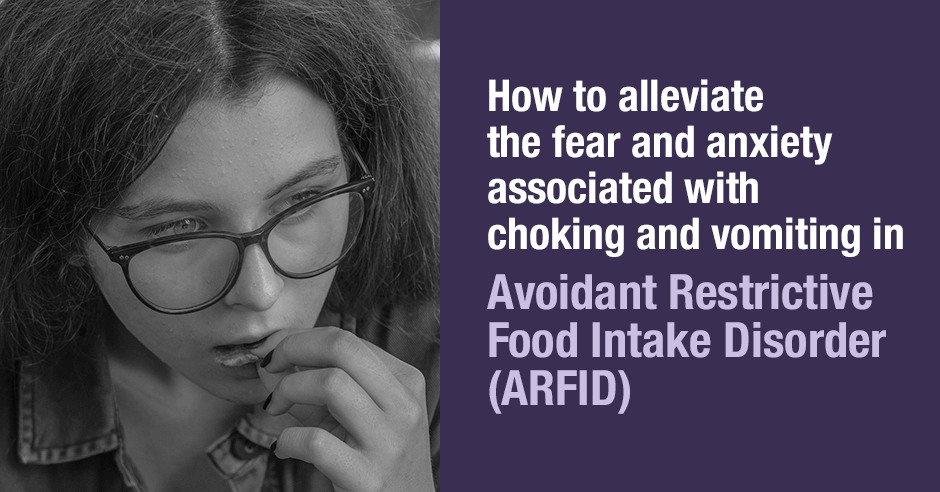
How to alleviate the fear and anxiety associated with choking and vomiting in Avoidant Restrictive Food Intake Disorder (ARFID)

May 27, 2022 By Trudy Scott 14 Comments

arfid and anxiety

According to The National Eating Disorders Association /NEDA, “Avoidant Restrictive Food Intake Disorder (ARFID) is a new diagnosis in the DSM-5, and was previously referred to as “Selective Eating Disorder.” ARFID is similar to anorexia in that both disorders involve limitations in the amount and/or types of food consumed, but unlike anorexia, ARFID does not involve any distress about body shape or size, or fears of fatness.”

As you can read on this page:

  • “Many children with ARFID also have a co-occurring anxiety disorder, and they are also at high risk for other psychiatric disorders”
  • There are also “fears of choking or vomiting” and
  • There is a “dramatic restriction in types or amount of food eaten” and they will often “only eat certain textures of food”

What we seldom see addressed is the biochemical causes of anxiety and fears which can show up as phobias and ongoing worrying and obsessing about ingesting certain foods. These are all typical low serotonin symptoms.

With low serotonin (you can see all the symptoms here) we use the amino acids tryptophan or 5-HTP to raise serotonin and alleviate these symptoms (often within a few minutes).

However, what do we do when a child (or adult) with ARFID has low serotonin and is too terrified to even consider a trial of tryptophan or 5-HTP? This may be because of fear of choking or vomiting and/or because of an aversion to the taste/texture and/or the fact that they are being offered something new that is not on their “safe foods” list.

There is a similar issue with low GABA which can show up as physical anxiety and tummy issues like “constipation, abdominal pain, upset stomach.” Intrusive thoughts are a common sign of low GABA too and this can manifest as a debilitating fear of choking and dying.

There is the same issue with not being able to have the individual use sublingual GABA as a supplement in order to alleviate these symptoms.

It’s for this reason, we have to be creative and find other ways to support serotonin and GABA.

Other ways to boost serotonin and GABA

The traditional ways that tryptophan/5-HTP and GABA are used is opened onto the tongue or swallowed or chewed. However, there are other ways to boost serotonin and GABA in these kids with ARFID, without further adding to their distress:

  • Experiment with using tryptophan or 5-HTP topically. I’m not aware of a commercial topical product but I recently mixed 500mg tryptophan powder (only tryptophan with no fillers) into a base cream (I used Primal Derma beef tallow) and used it topically with success.
  • Experiment in a similar way with using GABA topically. It could be made at home too (with a GABA only powder) or a product such as Somnium GABA cream is an excellent option (I have used this product with success). I suspect the liposomal GABA/theanine products may also work topically (but have yet to experiment with this option).
  • If tolerated, GABA powder swished in the mouth but not swallowed, may be an option once some of the anxiety and fears have been reduced. GABA powder doesn’t taste bad (it’s slightly sweet) and mixes well in water. By swishing some in the mouth it can help reduce the fear of choking and esophageal spasms (if they are present). It may also help with the sensation of a lump-in-the-throat (called globus pharyngeus) that some kids with ARFID describe.
  • Liquid zinc (zinc sulfate) tastes like water when zinc levels are low and may be tolerated. This 2021 paper, Macro- and Micronutrient Intake in Children with Avoidant/Restrictive Food Intake Disorder, lists low vitamin B1, vitamin B2, vitamin C, vitamin K, zinc, iron, and potassium in kids with ARFID. Zinc, iron and the B vitamins are all needed to make serotonin and GABA, and low zinc can reduce appetite. It’s also possible these children had low levels of some of these nutrients beforehand and that this contributed to their fears and restrictive eating.
  • Magnesium spray or other forms of topical magnesium creams can be used. Magnesium itself is calming and is a cofactor for making serotonin and GABA. An Epsom salts bath also provides magnesium and a warm bath with Epsom salts and an essential oil such as lavender is very calming.

Other less direct but equally effective approaches to include are:

  • gentle yoga (it supports GABA production and is calming)
  • swinging on an outdoor swing (reduces stress, cortisol and anxiety)
  • full spectrum light therapy (boosts serotonin)
  • vagus nerve support “This modern world can lead to overstimulation of the nervous system and you can become desensitized to chronic stress. Over time, this can lead to low vagal tone, which has been linked to a variety of mental and physical health issues.”
  • full spectrum infrared sauna (low heat and of short duration to simulate light exercise)
  • a weighted blanket is calming and improves mood and sleep and
  • essential oils such as orange (topically or diffused) can help with fear and anxiety.

Once serotonin and GABA levels have improved with some of the above measures, and more and more of the fear of choking and vomiting dissipates and food texture and taste aversion is reduced, the amino acids can then hopefully be introduced in the ways they are typically used (more on that below). This will further speed up the anxiety and fear reduction, allowing more and more foods to be slowly introduced.

If you are new to Avoidant Restrictive Food Intake Disorder (ARFID)

Be sure to read more about ARFID on The National Eating Disorders Association /NEDA site: diagnostic criteria, risk factors, warning signs and symptoms (behavioral and psychological, and physical).

As with all eating disorders, the risk factors for ARFID involve a range of biological, psychological, and sociocultural issues. These factors may interact differently in different people, which means two people with the same eating disorder can have very diverse perspectives, experiences, and symptoms.

Resources if you are new to using tryptophan/5-HTP and GABA as  supplements

If you are new to using the amino acids as supplements, here is the Amino Acids Mood Questionnaire from The Antianxiety Food Solution (you can see all the low serotonin and low GABA symptoms).

If you suspect low levels of GABA or any of the neurotransmitters and do not yet have my book, The Antianxiety Food Solution – How the Foods You Eat Can Help You Calm Your Anxious Mind, Improve Your Mood, and End Cravings, I highly recommend getting it and reading it before jumping in and using amino acids on your own so you are knowledgeable. And be sure to share it with the team you or your loved one is working with.

There is an entire chapter on the amino acids and they are discussed throughout the book in the sections on gut health, blood sugar control, sugar cravings, self-medicating with alcohol and more.

The book doesn’t include product names (per the publisher’s request) so this blog, The Antianxiety Food Solution Amino Acid and Pyroluria Supplements, lists the amino acids that I use with my individual clients and those in my group programs.

If, after reading this blog and my book, you don’t feel comfortable figuring things out on your own (i.e. doing the symptoms questionnaire and respective amino acids trials), a good place to get help is the GABA QuickStart Program. This is a paid online/virtual group program where you get my guidance and community support. There are many moms in the program who are having much success with their kids.

If you are a practitioner, join us in The Balancing Neurotransmitters: the Fundamentals program. This is also a paid online/virtual program with an opportunity to interact with me and other practitioners who are also using the amino acids.

If you feel comfortable doing so, please share more about the ARFID struggles of your son or daughter in order to help more parents understand this disorder  – their age, how long they have struggled, their fears and their safe food list.

Do let us know if you have found success with any of these approaches with your loved one with ARFID (or yourself)? And what other approaches have also helped?

If you are a practitioner are you seeing results with approaches like these with your ARFID clients/patients?

If you have questions please share them here too.

Filed Under: 5-HTP, Anxiety, GABA, serotonin, Tryptophan Tagged With: anxiety, ARFID, Avoidant Restrictive Food Intake Disorder, choking, cream, Epsom salts, esophageal spasms, fear, GABA, globus pharyngeus, intrusive thoughts, liposomal, liquid zinc, lump in the throat, magnesium spray, NEDA, obsessing, phobias, serotonin, textures, The National Eating Disorders Association, topical, tryptophan/5-HTP, types of food eaten, vomiting, worrying

Primary Sidebar

NEW! GABA QuickStart Homestudy (with special intro pricing)

gaba quickstart homestudy

Free Report

9 Great Questions Women Ask about Food, Mood and their Health

You'll also receive a complimentary subscription to my ezine "Food, Mood and Gal Stuff"


Connect with me

Popular Posts

  • Amino Acids Mood Questionnaire from The Antianxiety Food Solution
  • The Antianxiety Food Solution Amino Acid and Pyroluria Supplements
  • Pyroluria Questionnaire from The Antianxiety Food Solution
  • Collagen and gelatin lower serotonin: does this increase your anxiety and depression?
  • Tryptophan for the worry-in-your-head and ruminating type of anxiety
  • GABA for the physical-tension and stiff-and-tense-muscles type of anxiety
  • The Antianxiety Food Solution by Trudy Scott
  • Seriphos Original Formula is back: the best product for anxiety and insomnia caused by high cortisol
  • Am I an anxious introvert because of low zinc and vitamin B6? My response to Huffington Post blog
  • Vagus nerve rehab with GABA, breathing, humming, gargling and key nutrients

Recent Posts

  • What do I use instead of Seriphos to help lower high cortisol that is affecting my sleep and making me anxious at night?
  • BeSerene™ GABA/theanine cream eases severe muscle tension in her neck/shoulders, prevents her bad headaches and quells her anxiety
  • How the correct approach, dose and sublingual use of GABA can be calming and not cause a flushed and itchy face and neck
  • The amino acid glutamine improves low mood by addressing gut health, and it has calming effects too
  • Flight anxiety with heightened breath, physical tension and also fearing the worst (the role of low GABA and low serotonin)

Categories

  • 5-HTP
  • AB575
  • Addiction
  • ADHD
  • Adrenals
  • Alcohol
  • Allergies
  • Alzheimer's disease
  • Amino Acids
  • Anger
  • Antianxiety
  • Antianxiety Food Solution
  • Antidepressants
  • Anxiety
  • Anxiety and panic
  • Autism
  • Autoimmunity
  • benzodiazapines
  • Bipolar disorder
  • Books
  • Caffeine
  • Cancer
  • Candida
  • Children/Teens
  • Collagen
  • Cooking equipment
  • Coronavirus/COVID-19
  • Cravings
  • Depression
  • Detoxification
  • Diabetes
  • Diet
  • DPA/DLPA
  • Drugs
  • EFT/Tapping
  • EMF
  • EMFs
  • Emotional Eating
  • Endorphins
  • Environment
  • Essential oils
  • Events
  • Exercise
  • Fear
  • Fear of public speaking
  • Fertility and Pregnancy
  • Fish
  • Food
  • Food and mood
  • Functional neurology
  • GABA
  • Gene polymorphisms
  • General Health
  • Giving
  • Giving back
  • Glutamine
  • Gluten
  • GMOs
  • Gratitude
  • Gut health
  • Heart health/hypertension
  • Histamine
  • Hormone
  • Hyperparathyroidism
  • Hypoglycemia
  • Immune system
  • Inflammation
  • Insomnia
  • Inspiration
  • Introversion
  • Joy and happiness
  • Ketogenic diet
  • Lithium orotate
  • Looking awesome
  • Lyme disease and co-infections
  • MCAS/histamine
  • Medication
  • Men's health
  • Mental health
  • Mercury
  • Migraine
  • Mold
  • Movie
  • MTHFR
  • Multiple sclerosis
  • Music
  • NANP
  • Nature
  • Nutritional Psychiatry
  • OCD
  • Osteoporosis
  • Oxalates
  • Oxytocin
  • Pain
  • Paleo
  • Parasites
  • Parkinson’s disease
  • PCOS
  • People
  • PMS
  • Postpartum
  • PTSD/Trauma
  • Pyroluria
  • Questionnaires
  • Real whole food
  • Recipes
  • Research
  • Schizophrenia
  • serotonin
  • SIBO
  • Sleep
  • Special diets
  • Sports nutrition
  • Stress
  • Sugar addiction
  • Sugar and mood
  • Supplements
  • Teens
  • Testimonials
  • Testing
  • The Anxiety Summit
  • The Anxiety Summit 2
  • The Anxiety Summit 3
  • The Anxiety Summit 4
  • The Anxiety Summit 5
  • The Anxiety Summit 6
  • Thyroid
  • Thyroid health
  • Toxins
  • Tryptophan
  • Tyrosine
  • Uncategorized
  • Vegan/vegetarian
  • Women's health
  • Yoga

Archives

  • October 2025
  • September 2025
  • August 2025
  • July 2025
  • June 2025
  • May 2025
  • April 2025
  • March 2025
  • February 2025
  • January 2025
  • November 2024
  • October 2024
  • September 2024
  • August 2024
  • July 2024
  • June 2024
  • May 2024
  • April 2024
  • March 2024
  • February 2024
  • January 2024
  • December 2023
  • November 2023
  • October 2023
  • September 2023
  • August 2023
  • July 2023
  • June 2023
  • May 2023
  • April 2023
  • March 2023
  • February 2023
  • January 2023
  • December 2022
  • November 2022
  • October 2022
  • September 2022
  • August 2022
  • July 2022
  • June 2022
  • May 2022
  • April 2022
  • March 2022
  • February 2022
  • January 2022
  • December 2021
  • November 2021
  • October 2021
  • September 2021
  • August 2021
  • July 2021
  • June 2021
  • May 2021
  • April 2021
  • March 2021
  • February 2021
  • January 2021
  • December 2020
  • November 2020
  • October 2020
  • September 2020
  • August 2020
  • July 2020
  • June 2020
  • May 2020
  • April 2020
  • March 2020
  • February 2020
  • January 2020
  • December 2019
  • November 2019
  • October 2019
  • September 2019
  • August 2019
  • July 2019
  • June 2019
  • May 2019
  • April 2019
  • March 2019
  • February 2019
  • January 2019
  • December 2018
  • November 2018
  • October 2018
  • September 2018
  • August 2018
  • July 2018
  • June 2018
  • May 2018
  • April 2018
  • March 2018
  • February 2018
  • January 2018
  • December 2017
  • November 2017
  • October 2017
  • September 2017
  • August 2017
  • July 2017
  • June 2017
  • May 2017
  • April 2017
  • March 2017
  • February 2017
  • January 2017
  • December 2016
  • November 2016
  • October 2016
  • September 2016
  • August 2016
  • July 2016
  • June 2016
  • May 2016
  • April 2016
  • March 2016
  • February 2016
  • January 2016
  • December 2015
  • November 2015
  • October 2015
  • September 2015
  • August 2015
  • July 2015
  • June 2015
  • May 2015
  • April 2015
  • March 2015
  • February 2015
  • January 2015
  • December 2014
  • November 2014
  • October 2014
  • September 2014
  • August 2014
  • July 2014
  • June 2014
  • May 2014
  • April 2014
  • March 2014
  • February 2014
  • January 2014
  • December 2013
  • November 2013
  • October 2013
  • September 2013
  • August 2013
  • July 2013
  • June 2013
  • May 2013
  • April 2013
  • March 2013
  • February 2013
  • January 2013
  • December 2012
  • November 2012
  • October 2012
  • August 2012
  • July 2012
  • June 2012
  • May 2012
  • April 2012
  • March 2012
  • February 2012
  • January 2012
  • December 2011
  • November 2011
  • October 2011
  • September 2011
  • August 2011
  • July 2011
  • June 2011
  • May 2011
  • April 2011
  • March 2011
  • February 2011
  • January 2011
  • December 2010
  • October 2010
  • September 2010
  • July 2010
  • May 2010
  • April 2010
  • March 2010
  • February 2010
  • January 2010
  • November 2009

Share the knowledge!

The above statements have not been evaluated by the Food and Drug Administration. Products listed in this website are not intended to diagnose, treat, cure or prevent any disease.

The information provided on this site is for informational and educational purposes only and is not intended as a substitute for advice from your physician or other health care professional. You should consult with a healthcare professional before starting or modifying any diet, exercise, or supplementation program, before taking or stopping any medication, or if you have or suspect you may have a health problem.


Copyright © 2026 Trudy Scott. All Rights Reserved. | Privacy | Terms and Conditions | Refund Policy | Medical Disclaimer

Free Report

9 Great Questions Women Ask about Food, Mood and their Health

You’ll also receive a complimentary subscription to my ezine “Food, Mood and Gal Stuff”