• Skip to primary navigation
  • Skip to main content
  • Skip to primary sidebar

everywomanover29 blog

Food, Mood and Women's Health – Be your healthiest, look and feel great!

  • Blog
  • About
  • Services
  • Store
  • Resources
  • Testimonials
  • The Book
  • Contact
  • Search this site

Archives for January 2025

Exploring the Therapeutic Potential of Gamma-Aminobutyric Acid (GABA) in Stress and Depressive Disorders through the Gut–Brain Axis

January 31, 2025 By Trudy Scott 4 Comments

gaba and stress disorder

Research conducted on individuals with depression reveals that major depressive disorders (MDDs) coincide with diminished levels of the inhibitory neurotransmitter γ-aminobutyric acid (GABA) in the brain, as well as modifications in the subunit composition of the primary receptors (GABAA receptors) responsible for mediating GABAergic inhibition.

Furthermore, there is substantial evidence supporting the significant role of GABA in regulating stress within the brain, which is a pivotal vulnerability factor in mood disorders. GABA is readily available and approved as a food supplement in many countries.

Although there is substantial evidence indicating that orally ingested GABA may affect GABA receptors in peripheral tissues, there is comparatively less evidence supporting its direct action within the brain.

Emerging evidence highlights that oral GABA intake may exert beneficial effects on the brain and psyche through the gut–brain axis. While GABA enjoys wide consumer acceptance in Eastern Asian markets, with many consumers reporting favorable effects on stress regulation, mood, and sleep, rigorous independent research is still largely lacking.

Basic research, coupled with initial clinical findings, makes GABA an intriguing neuro-nutritional compound deserving of clinical studies in individuals with depression and other psychological problems.

This is the abstract from a recently published review paper: Exploring the Therapeutic Potential of Gamma-Aminobutyric Acid in Stress and Depressive Disorders through the Gut–Brain Axis

Does GABA exert calming and mood benefits via the gut-brain axis or is it really just a placebo effect? This paper discusses both possibilities. I’m excited by the former (and share more about this below) but I do not agree with the latter. Based on my clinical and personal experience, the calming effects of the amino acid GABA, used as a supplement (when you have low GABA symptoms/levels and used in a very specific way), is not a placebo effect. I also discuss this and share some cases that clearly confirm there is no placebo effect. Read on to be enlightened and encouraged about the power of GABA.

GABA and the microbiota-gut-brain axis

The authors describe the microbiome-gut-brain axis as “the bidirectional communication between the gastrointestinal tract, including its resident microbiota and the brain, linking emotional and cognitive centers of the brain with peripheral intestinal functions.”

They acknowledge that while we don’t quite understand the exact mechanisms of this bidirectional communication, “the vagus nerve, the endocrine and immune system, and the synthesis and metabolism of metabolites and neurotransmitters in the gut are critically involved.” This is exciting given what we know about the blood brain barrier.

If you are new to this concept of the gut-brain axis or want to read some of the latest updates, I encourage you to read the paper and learn about the benefits of probiotics (such as Lactobacillus and Bifidobacterium, and Lactococcus, Enterococcus, Streptococcus, and Leuconostoc) and prebiotics i.e. psychobiotics; and fermented foods – for mood improvement and stress reduction.

You’ll read this about GABA (both as a metabolite produced by the microbiome and as a supplement):

  • found in the enteric nervous system it contributes significantly to gut-brain axis functions and related disorders, including depression, anxiety, inflammatory, and cardiovascular disorders (they refer to GABA as a crucial ‘postbiotic’ i.e. a metabolite produced by the microbiome)
  • while GABA may not directly cross the blood-brain barrier in humans, an indirect influence through the enteric nervous system could potentially provide a viable pathway for the impact of GABA dietary supplements
  • although the connection between oral GABA administration i.e. GABA supplementation, the vagal nerve, and GABA levels in the brain has not been firmly established, considering the existing evidence, it represents a promising avenue for future research.

The last two bullets are worth emphasizing because one of the most common myths is that “GABA supplements don’t work because GABA is too big a molecule to get across the blood brain barrier.”  It really doesn’t need to get through the blood brain barrier in order to be calming.

I share more about this in a blog I published in 2023 – you can read it here.

GABA is a lifesaver and helps with mycotoxin-induced anxiety

Joie has Sjogren’s, Hashimoto’s, fibromyalgia & collagenous colitis (all diagnosed after severe mold exposure) and shares how GABA

has been a life saver for me (for my anxiety), and I share this with all I know who experience anxiety. I also use L-theanine at night because of insomnia. The 5-HTP has helped somewhat for sleep. L-tryptophan didn’t seem to make a difference. However the 5-HTP has made a significant difference in lessening my daily pain levels, which I am most grateful for.

Micki Contini, MS CNC, a board-certified holistic health and nutrition consultant, is a friend and colleague whose life was hugely impacted by mold toxicity. She shares this about how GABA helped her:

As they started tearing my house apart for remediation, I started eating GABA Calm like candy. At the beginning I had to have a lot more than I do now. GABA Calm takes me down a notch and I feel my shoulder coming away from my ears and I get closer to relaxing.

Here are a few other blogs that illustrate just how calming GABA can be when used as a supplement:

  • GABA Calm is a game changer for husband’s sound and tactile hypersensitivity, significant coordination problems and his anxiety
  • Her mum just passed away and although she is sad, GABA allows her to sit with a feeling of peace and calm most of the time
  • GABA worked amazingly for 18-year-old during a MCAS/histamine flare, helping with OCD, anxiety, rage and skin issues

If GABA works it’s a placebo effect?!

I find this statement in the conclusion of the review to be confusing given all that the authors share about the gut-brain axis, vagus nerve and bidirectional communication:

The dietary supplement form of GABA is readily accessible to consumers. While many individuals assert that they derive advantages from using these products, it remains uncertain whether these supplements provide benefits beyond what could be attributed to a placebo effect.

Their argument about conflict of interest and small sample sizes when it comes to studies doesn’t hold water with me.

As I mentioned above, based on my clinical experience, the calming effects of the amino acid GABA, used as a supplement when you have low GABA levels (and used in a very specific way), is not a placebo effect.

The following two cases clearly confirm there is no placebo effect (and these are just a few of many which I plan to share with the authors).

My 6 year old was having panic attacks getting out of the car for Kindergarten

My 6 year old son was having panic attacks getting out of the car going to Kindergarten and taking two GABA Calm has completely relieved him of his fears. He has been going for 3 straight weeks in a row.

I thought it may be low serotonin since this happened last winter as well but I gave him 5-HTP for a couple months and it didn’t seem to affect him and his anxiety. We had to have him repeat Kinder this year.

But wow, the GABA has been fabulous and Kindergarten is in full swing because of your help.

Lisa, a mom in the community, shared these wonderful results about her son. This is most definitely not a placebo effect.

You can read the entire story on the blog here. The school is actually in shock at how well carpooling is going for him.

GABA lessens anxiety, agitation and defiance in 98 year old mother who has been “sundowning” for a couple of years

My mother is 98 and has been “sundowning” for a couple of years. It starts around 3pm, sometimes earlier. Some days it’s no big deal. It is on those other days when she starts and then it goes to anxiety, agitation, then she can get sort of defiant which is so not her. She is a gentle soul, friendly, and kind so this is difficult on her as well as our family.

I just started to use my pestle and mortar to crush up a 125 mg GABA CALM supplement (Source Naturals) and I mix a little into her flavored yogurt when I start to see her having difficulty. I give it to her throughout the day. She only gets the 125 mg amount so I feel safe with that.

I believe that I do notice it lessens her anxiety. I pray that this will be helpful for her because that anxiety can be really draining for her. I have not noticed any adverse reactions.

This is another heartwarming success story shared by Marsha who used GABA Calm with her mother. It’s yet another one that is not a placebo effect either. You can read the entire blog post here.

My personal GABA results are also not a placebo effect

I can also share from first-hand experience that GABA was a life-saver for me in my late 30s when I had no idea what a panic attack was and knew very little about GABA other than the fact it calmed me down very quickly!

I still use GABA in various situations to this day: to help with back spasms after a fall, to help with rectal spasms, to help with throat spasms/pain caused by crying (after the loss of my darling mom), to help me sleep solidly and before doing an on-stage presentation, and much more.

GABA is effective and safe when used in a very specific way

Many people use GABA and report it didn’t work or that they had a strange or uncomfortable reaction to their GABA supplement (such as tingles or flush or feeling dizzy). I’m on a mission to educate folks how GABA is effective and safe when used in a very specific way:

  • Only if you have low GABA levels and symptoms of physical tension, overwhelm, fears, anxiousness, stiff and tense muscles, stress eating, drinking to calm down or fit in socially (you can see all the symptoms here)
  • Starting with a low dose of around 125mg (and less if you’re sensitive)
  • Only using it as a sublingual, powder or capsule opened on to the tongue, liposomal or GABA cream (to see results in 1-10 mins and to bypass the digestive system)
  • Titrating up (and sometimes back down) to find the ideal dose for your unique needs
  • Being open to trialing different products and forms and sometimes combining GABA with theanine
  • Understanding that there can be nuances to using GABA, making one change at a time and not giving up too soon
  • Tracking carefully and course-correcting as needed

I educate anxious individuals about all of the above and offer guidance and encouragement in the GABA Quickstart 2.0 online group 5 week program.

I hope this summary, the review paper and the cases leave you feeling enlightened and encouraged about the power of calming GABA.

Additional resources when you are new to using GABA and other amino acids as supplements

As always, I use the symptoms questionnaire to figure out if low GABA or other neurotransmitter imbalances may be an issue.

If you suspect low levels of any of the neurotransmitters and do not yet have my book, The Antianxiety Food Solution – How the Foods You Eat Can Help You Calm Your Anxious Mind, Improve Your Mood, and End Cravings, I highly recommend getting it and reading it before jumping in and using amino acids on your own so you are knowledgeable. And be sure to share it with the practitioner/health team you or your loved one is working with.

There is an entire chapter on the amino acids and they are discussed throughout the book in the sections on gut health, gluten, blood sugar control (this is covered in an entire chapter too), sugar cravings, anxiety and mood issues.

The book doesn’t include product names (per the publisher’s request) so this blog, The Antianxiety Food Solution Amino Acid and Pyroluria Supplements, lists the amino acids that I use with my individual clients and those in my group programs.

If, after reading this blog and my book, you don’t feel comfortable figuring things out on your own (i.e. doing the symptoms questionnaire and respective amino acids trials), a good place to get help is the GABA QuickStart Program (if you have low GABA symptoms). This is a paid online/virtual group program where you get my guidance and community support.

If you are a practitioner, join us in The Balancing Neurotransmitters: the Fundamentals program. This is also a paid online/virtual program with an opportunity to interact with me and other practitioners who are also using the amino acids.

Wrapping up and your feedback

Have you experienced the benefits of GABA for stress and/or low mood? Do you believe it’s more than a placebo effect?

And are you excited to understand the possible mechanisms and read the research? Or do you just want to know how GABA could help you and how to use it?

Have you tried GABA without success or only had limited success? Feel free to share and I’ll provide my feedback.

Feel free to ask your questions below.

Filed Under: Anxiety, Depression, GABA Tagged With: amino acid, anxiety, anxiousness, calming, depressive disorder, drinking, fears, GABA, GABA Quickstart, gamma-aminobutyric acid, gut-brain axis, inhibitory neurotransmitter, low mood, neurotransmitter, overwhelm, physical-tension, placebo effect, sleep, stiff and tense muscles, stress, stress-eating, vagus nerve

Understanding the function of the GABAergic system and its potential role in rheumatoid arthritis (for pain, anxiety, sleep issues and more)

January 3, 2025 By Trudy Scott 2 Comments

GABAergic system and its potential role in rheumatoid arthritis

This is a great question posed by a woman in my GABA/anxiety online group program:

Can GABA be good for rheumatoid arthritis, and in its early stages? If so, in what ways would someone see signs of improvement with GABA?

When I looked into some of the recent research on GABA and rheumatoid arthritis I was fascinated. A 2023 review paper, Understanding the function of the GABAergic system and its potential role in rheumatoid arthritis, discusses the relationship between rheumatoid arthritis (RA), an autoimmune condition, and GABA (gamma-amino butyric acid), a calming neurotransmitter.

The authors discuss “a new mechanism of action in RA” and the fact that “bidirectional communication occurs between the brain and immune system…and neuroinflammatory responses in the brain.”

The paper discusses GABA and neurosignalling, immunomodulatory effects and inflammation, stating that the:

GABAergic system may modulate the abnormal pain response in RA patients.

So to answer her question, if she has low GABA levels we would expect to see some reduction in her RA pain.

As always, we look for the signs and symptoms of low GABA regardless of the diagnosis or possible diagnosis. So if someone has low GABA symptoms of physical tension, overwhelm, fears, anxiousness, stiff and tense muscles, focus issues, pain, stress eating or drinking to calm down, and poor sleep, we consider a trial of the amino acid GABA, and could expect improvements in all or some of the above symptoms.

I would also recommend that she tracks markers of inflammation (like hs CRP, IL-6, IL-1β, and TNF-α) and RA markers to see if they shift in a positive direction with her use of GABA too.

I share more below about the incidence of anxiety and sleep issues in rheumatoid arthritis and some of the mechanisms covered in the review paper. Also, there are lab tests to track and there are other nutritional approaches for supporting an autoimmune condition such as RA.

Some of the mechanisms covered in the review paper

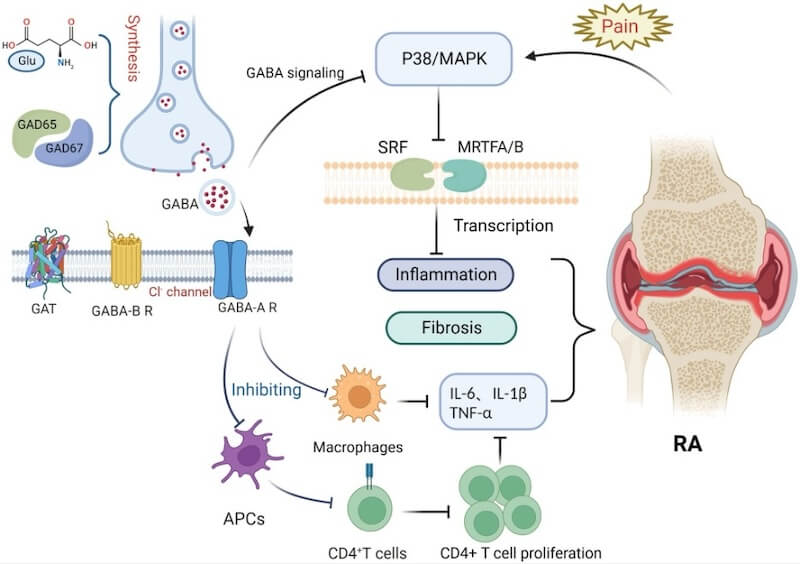
This image from the paper and the explanation provides some insights on the mechanisms at play.

  • Glutamate interacts with glutamate decarboxylase (GAD65 and GAD67) to produce gamma-aminobutyric acid (GABA).
  • Binding of GABA to GABA-A receptors inhibits macrophage activation and decreases the release of inflammatory factors such as IL-6, IL-1β, and TNF-α. Antigen presentation by antigen-presenting cells, however, is impaired, inhibiting CD4+ T cell proliferation and differentiation and reducing the expression of inflammatory factors such as IL-6, IL-1β, and TNF-α.
  • Pain signaling activates the P38/MAPK pathway, whereas GABA binding to GABA-A receptors inhibits P38/MAPK. The P38/MAPK signaling pathway contributes to inflammation and is involved in the activation of myocardin-related transcription factor A (MRTFA), myocardin-related transcription factor B (MRTFB), and serum response factor (SRF) that played key roles in fibroblast activation.
gaba and rheumatoid arthritis
Figure 1. Understanding the function of the GABAergic system and its potential role in rheumatoid arthritis

The authors don’t mention the use of the amino acid GABA as a supplement for RA but do list a number of clinical trials (mostly diabetes patients) where GABA has been used with success. It’s a start and I look forward to future research in this area.

Anxiety, depression, insomnia, cognitive issues and stress-eating in RA

This paper, Psychiatric aspects of rheumatoid arthritis: Review of literature, reports that

Among the major psychiatric disorders found in RA, the anxiety and depressive disorders are prevalent (13 to 48% of patients), as well as suicide, insomnia and tiredness. The impairment of quality of life is markedly after age 65.

This paper, A 30-Day Adjunct Wellness Intervention for the Management of Extra-Articular Symptoms of Rheumatoid Arthritis: A Formative Study, also mentions “cognitive and physical dysfunction” and “stress-related eating” in addition to anxiety, depression and insomnia in RA patients.

Doing a trial of GABA (and other amino acids such as tryptophan and d-phenylalanine/ DPA), will confirm which symptoms are related to which neurotransmitter deficiencies. It’s exciting to consider a very possible role of GABA and other amino acids given the fact that “individuals with rheumatoid arthritis (RA) continually fall short of treatment targets using standard drug therapies alone”

Looking further than GABA and other amino acids: a gluten-free diet and other root causes

With RA we obviously want to address more than just GABA (and other amino acids). Gluten removal is recommended but I do want to mention that the research is surprisingly mixed. This paper, Efficacy of gluten-free diet in patients with rheumatoid arthritis states that

Gluten seems to be a glycoprotein with a clinically relevant inflammatory effect. Several observational studies and anecdotal cases reported a correlation between gluten and various diseases, including autoimmune diseases, such as rheumatoid arthritis. This study aimed to evaluate whether gluten-free diet could be effective in controlling inflammation and ongoing rheumatoid arthritis symptoms.

We report 4 cases of patients with long-standing rheumatoid arthritis with no response to several conventional and biotechnological drugs, treated with a gluten-free diet concurrently with the drug therapy. Our patients presented different degrees of response to the diet, in terms of disease remission and improvement of symptoms. Our cases confirm that a gluten-free diet may improve symptoms of rheumatoid arthritis, even in patients resistant to conventional drug therapies.

Many other papers dismiss the role of gluten and inflammatory diets. This one is an example of a number of similar papers.

The benefits of addressing neurotransmitter imbalances with GABA and other amino acids means the addiction is stopped and quitting bread and cookies now no longer requires willpower,

Here are some autoimmune recipe resources:

  • The Autoimmune Solution Cookbook by Amy Myers MD
  • The Autoimmune Fix by Dr. Tom O’Bryan: gluteomorphins, casomorphins and withdrawal
  • Hashimoto’s Food Pharmacology, a new recipe book by Dr. Izabella Wentz

In addition to dietary changes, a full functional medicine approach is warranted as there is much research supporting the benefits of the following for RA: omega-3 fatty acids, olive oil, low vitamin B6, addressing heavy metals such as mercury and much much more.

I cover 60+ root causes of anxiety here – I’d be carefully assessing each of these root causes for RA too.

Additional resources when you are new to using GABA and other amino acids as supplements

As always, I use the symptoms questionnaire to figure out if low serotonin or low GABA or other neurotransmitter imbalances may be an issue.

If you suspect low levels of any of the neurotransmitters and do not yet have my book, The Antianxiety Food Solution – How the Foods You Eat Can Help You Calm Your Anxious Mind, Improve Your Mood, and End Cravings, I highly recommend getting it and reading it before jumping in and using amino acids on your own so you are knowledgeable. And be sure to share it with the practitioner/health team you or your loved one is working with.

There is an entire chapter on the amino acids and they are discussed throughout the book in the sections on gut health, gluten, blood sugar control (this is covered in an entire chapter too), sugar cravings, anxiety and mood issues.

The book doesn’t include product names (per the publisher’s request) so this blog, The Antianxiety Food Solution Amino Acid and Pyroluria Supplements, lists the amino acids that I use with my individual clients and those in my group programs.

If, after reading this blog and my book, you don’t feel comfortable figuring things out on your own (i.e. doing the symptoms questionnaire and respective amino acids trials), a good place to get help is the GABA QuickStart Program (if you have low GABA symptoms). This is a paid online/virtual group program where you get my guidance and community support, and is where this question was asked of me during one of the live Q&A calls.

If you are a practitioner, join us in The Balancing Neurotransmitters: the Fundamentals program. This is also a paid online/virtual program with an opportunity to interact with me and other practitioners who are also using the amino acids.

Wrapping up and your feedback

Do you have rheumatoid arthritis (RA) or another autoimmune condition and has GABA helped?

Were you aware of these possible connections?

What about dietary and nutritional approaches?

Feel free to share your feedback and ask your questions below.

Filed Under: Anxiety, GABA, Pain Tagged With: amino acids, anxiety, anxious, anxiousness, autoimmune, calming, drinking, fears, focus, GABA, GABA Quickstart, GABAergic system, Inflammation, neurotransmitter, overwhelm, pain, physical-tension, rheumatoid arthritis, sleep issues, stiff and tense muscles, stress-eating

Primary Sidebar

NEW! GABA QuickStart Homestudy (with special intro pricing)

gaba quickstart homestudy

Free Report

9 Great Questions Women Ask about Food, Mood and their Health

You'll also receive a complimentary subscription to my ezine "Food, Mood and Gal Stuff"


Connect with me

Popular Posts

  • Amino Acids Mood Questionnaire from The Antianxiety Food Solution
  • The Antianxiety Food Solution Amino Acid and Pyroluria Supplements
  • Pyroluria Questionnaire from The Antianxiety Food Solution
  • Collagen and gelatin lower serotonin: does this increase your anxiety and depression?
  • Tryptophan for the worry-in-your-head and ruminating type of anxiety
  • GABA for the physical-tension and stiff-and-tense-muscles type of anxiety
  • The Antianxiety Food Solution by Trudy Scott
  • Seriphos Original Formula is back: the best product for anxiety and insomnia caused by high cortisol
  • Am I an anxious introvert because of low zinc and vitamin B6? My response to Huffington Post blog
  • Vagus nerve rehab with GABA, breathing, humming, gargling and key nutrients

Recent Posts

  • What do I use instead of Seriphos to help lower high cortisol that is affecting my sleep and making me anxious at night?
  • BeSerene™ GABA/theanine cream eases severe muscle tension in her neck/shoulders, prevents her bad headaches and quells her anxiety
  • How the correct approach, dose and sublingual use of GABA can be calming and not cause a flushed and itchy face and neck
  • The amino acid glutamine improves low mood by addressing gut health, and it has calming effects too
  • Flight anxiety with heightened breath, physical tension and also fearing the worst (the role of low GABA and low serotonin)

Categories

  • 5-HTP
  • AB575
  • Addiction
  • ADHD
  • Adrenals
  • Alcohol
  • Allergies
  • Alzheimer's disease
  • Amino Acids
  • Anger
  • Antianxiety
  • Antianxiety Food Solution
  • Antidepressants
  • Anxiety
  • Anxiety and panic
  • Autism
  • Autoimmunity
  • benzodiazapines
  • Bipolar disorder
  • Books
  • Caffeine
  • Cancer
  • Candida
  • Children/Teens
  • Collagen
  • Cooking equipment
  • Coronavirus/COVID-19
  • Cravings
  • Depression
  • Detoxification
  • Diabetes
  • Diet
  • DPA/DLPA
  • Drugs
  • EFT/Tapping
  • EMF
  • EMFs
  • Emotional Eating
  • Endorphins
  • Environment
  • Essential oils
  • Events
  • Exercise
  • Fear
  • Fear of public speaking
  • Fertility and Pregnancy
  • Fish
  • Food
  • Food and mood
  • Functional neurology
  • GABA
  • Gene polymorphisms
  • General Health
  • Giving
  • Giving back
  • Glutamine
  • Gluten
  • GMOs
  • Gratitude
  • Gut health
  • Heart health/hypertension
  • Histamine
  • Hormone
  • Hyperparathyroidism
  • Hypoglycemia
  • Immune system
  • Inflammation
  • Insomnia
  • Inspiration
  • Introversion
  • Joy and happiness
  • Ketogenic diet
  • Lithium orotate
  • Looking awesome
  • Lyme disease and co-infections
  • MCAS/histamine
  • Medication
  • Men's health
  • Mental health
  • Mercury
  • Migraine
  • Mold
  • Movie
  • MTHFR
  • Multiple sclerosis
  • Music
  • NANP
  • Nature
  • Nutritional Psychiatry
  • OCD
  • Osteoporosis
  • Oxalates
  • Oxytocin
  • Pain
  • Paleo
  • Parasites
  • Parkinson’s disease
  • PCOS
  • People
  • PMS
  • Postpartum
  • PTSD/Trauma
  • Pyroluria
  • Questionnaires
  • Real whole food
  • Recipes
  • Research
  • Schizophrenia
  • serotonin
  • SIBO
  • Sleep
  • Special diets
  • Sports nutrition
  • Stress
  • Sugar addiction
  • Sugar and mood
  • Supplements
  • Teens
  • Testimonials
  • Testing
  • The Anxiety Summit
  • The Anxiety Summit 2
  • The Anxiety Summit 3
  • The Anxiety Summit 4
  • The Anxiety Summit 5
  • The Anxiety Summit 6
  • Thyroid
  • Thyroid health
  • Toxins
  • Tryptophan
  • Tyrosine
  • Uncategorized
  • Vegan/vegetarian
  • Women's health
  • Yoga

Archives

  • October 2025
  • September 2025
  • August 2025
  • July 2025
  • June 2025
  • May 2025
  • April 2025
  • March 2025
  • February 2025
  • January 2025
  • November 2024
  • October 2024
  • September 2024
  • August 2024
  • July 2024
  • June 2024
  • May 2024
  • April 2024
  • March 2024
  • February 2024
  • January 2024
  • December 2023
  • November 2023
  • October 2023
  • September 2023
  • August 2023
  • July 2023
  • June 2023
  • May 2023
  • April 2023
  • March 2023
  • February 2023
  • January 2023
  • December 2022
  • November 2022
  • October 2022
  • September 2022
  • August 2022
  • July 2022
  • June 2022
  • May 2022
  • April 2022
  • March 2022
  • February 2022
  • January 2022
  • December 2021
  • November 2021
  • October 2021
  • September 2021
  • August 2021
  • July 2021
  • June 2021
  • May 2021
  • April 2021
  • March 2021
  • February 2021
  • January 2021
  • December 2020
  • November 2020
  • October 2020
  • September 2020
  • August 2020
  • July 2020
  • June 2020
  • May 2020
  • April 2020
  • March 2020
  • February 2020
  • January 2020
  • December 2019
  • November 2019
  • October 2019
  • September 2019
  • August 2019
  • July 2019
  • June 2019
  • May 2019
  • April 2019
  • March 2019
  • February 2019
  • January 2019
  • December 2018
  • November 2018
  • October 2018
  • September 2018
  • August 2018
  • July 2018
  • June 2018
  • May 2018
  • April 2018
  • March 2018
  • February 2018
  • January 2018
  • December 2017
  • November 2017
  • October 2017
  • September 2017
  • August 2017
  • July 2017
  • June 2017
  • May 2017
  • April 2017
  • March 2017
  • February 2017
  • January 2017
  • December 2016
  • November 2016
  • October 2016
  • September 2016
  • August 2016
  • July 2016
  • June 2016
  • May 2016
  • April 2016
  • March 2016
  • February 2016
  • January 2016
  • December 2015
  • November 2015
  • October 2015
  • September 2015
  • August 2015
  • July 2015
  • June 2015
  • May 2015
  • April 2015
  • March 2015
  • February 2015
  • January 2015
  • December 2014
  • November 2014
  • October 2014
  • September 2014
  • August 2014
  • July 2014
  • June 2014
  • May 2014
  • April 2014
  • March 2014
  • February 2014
  • January 2014
  • December 2013
  • November 2013
  • October 2013
  • September 2013
  • August 2013
  • July 2013
  • June 2013
  • May 2013
  • April 2013
  • March 2013
  • February 2013
  • January 2013
  • December 2012
  • November 2012
  • October 2012
  • August 2012
  • July 2012
  • June 2012
  • May 2012
  • April 2012
  • March 2012
  • February 2012
  • January 2012
  • December 2011
  • November 2011
  • October 2011
  • September 2011
  • August 2011
  • July 2011
  • June 2011
  • May 2011
  • April 2011
  • March 2011
  • February 2011
  • January 2011
  • December 2010
  • October 2010
  • September 2010
  • July 2010
  • May 2010
  • April 2010
  • March 2010
  • February 2010
  • January 2010
  • November 2009

Share the knowledge!

The above statements have not been evaluated by the Food and Drug Administration. Products listed in this website are not intended to diagnose, treat, cure or prevent any disease.

The information provided on this site is for informational and educational purposes only and is not intended as a substitute for advice from your physician or other health care professional. You should consult with a healthcare professional before starting or modifying any diet, exercise, or supplementation program, before taking or stopping any medication, or if you have or suspect you may have a health problem.


Copyright © 2026 Trudy Scott. All Rights Reserved. | Privacy | Terms and Conditions | Refund Policy | Medical Disclaimer

Free Report

9 Great Questions Women Ask about Food, Mood and their Health

You’ll also receive a complimentary subscription to my ezine “Food, Mood and Gal Stuff”