• Skip to primary navigation
  • Skip to main content
  • Skip to primary sidebar

everywomanover29 blog

Food, Mood and Women's Health – Be your healthiest, look and feel great!

  • Blog
  • About
  • Services
  • Store
  • Resources
  • Testimonials
  • The Book
  • Contact
  • Search this site

Trudy Scott

The Anxiety Summit – How We Used GABA for Lyme Anxiety

June 15, 2016 By Trudy Scott 15 Comments

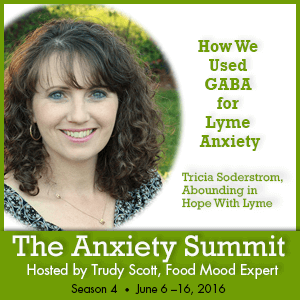
Tricia Soderstrom_Anxiety4

Tricia Soderstrom of Abounding in Hope With Lyme was interviewed on the Anxiety Summit by host of the Anxiety Summit, Trudy Scott, Food Mood Expert and Nutritionist, author of The Antianxiety Food Solution.

How We Used GABA for Lyme Anxiety

  • Lyme disease can mimic a number of psychiatric illnesses, including anxiety disorders
  • Our journey with Lyme Disease
  • Essential oil for ticks and having pets
  • My daughter’s symptoms; Lyme pain, OCD, Anxiety, Panic Attacks
  • Protocols; antibiotics, herbs, supplements, anxiety meds and anti-depressant meds
  • Used GABA Calm sublinguals with good results and the Lyme pyroluria connection

Tricia shares this about her daughter’s Lyme anxiety:

When she was about seven my husband and I started noticing that she was washing her hands a lot, to the point where her hands would be just so raw and they would bleed a little bit.  And we noticed just some repetitive things that she was doing.  She started having like facial tics and motor tics and just really certain things would just kind of scare her more than usual.  I kept taking her to the pediatrician and everything and then we started noticing more symptoms.  She just began having anxiety, and it started out just kind of like little spurts here and there, but it became so overwhelming and so controlling over her life that she did not want to leave the house and she did not want me to leave her.  Part of her anxiety was that something was going to happen to me.  So she would just try to protect me with everything in her to keep me home with her or that I would take her with me everywhere I went.  I could not leave her for a second.  And if I did you could just tell she was so afraid and it was so heartbreaking, but it was so exhausting as a mom because it was 24 hours a day, it was not wanting to go to sleep at night; waking up in the middle of the night.  If she read something for school it would set her off.  If she saw something on TV that would set her off.  And it just became a life consuming problem.  And we were desperate, just desperate for answers. 

Tricia shares how Source Naturals GABA Calm was so helpful for her daughter’s anxiety and for her too:

when your child is in this full-blown panic attack they’re not going to swallow a pill so the sublingual was great because I would put it in her mouth under her tongue and just tell her to suck on it.  And you could just tell it would start to work and start to calm her down and really help her out. 

They would take the edge off of her anxiety; they would help her to go back to sleep at night.  And they helped me because I started taking GABA when I was so stressed out trying to interact with her and trying to help her.

And it’s nice to be able to just carry it in my purse if I need to, if anybody needs one

According to Dr. Klinghart, pyroluria needs to be addressed in order for the Lyme treatment to be successful.  Here is the pyroluria questionnaire

Here are some resources from Tricia:

Pet Flea & Tick Collar

Essential Oils Repellent

Lyme Links & Resources

If you are not already registered for the Anxiety Summit you can get live access to the speakers of the day here: www.theAnxietySummit.com

Missed this interview or can’t listen live? Or want this and the other great interviews for your learning library? Purchase the MP3s or MP3s + transcripts and listen when it suits you.

You can find your purchasing options here.: Anxiety Summit Season 1, Anxiety Summit Season 2, Anxiety Summit Season 3, and Anxiety Summit Season 4.
Filed Under: Events, The Anxiety Summit 4 Tagged With: anxiety, anxiety summit, GABA, Lyme Disease, Tricia Soderstrom, Trudy Scott

The Anxiety Summit – Anxiety: Grass-fed beef, fermented foods and healthy snacks the Paleovalley way

June 14, 2016 By Trudy Scott 16 Comments

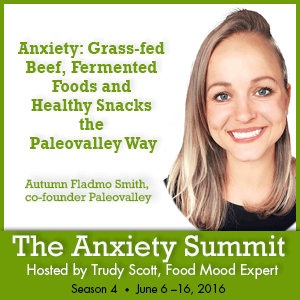
Autumn Fladmo Smith_Anxiety4

Autumn Fladmo Smith, co-founder Paleovalley, is interviewed on the Anxiety Summit by host of the Anxiety Summit, Trudy Scott, Food Mood Expert and Nutritionist, author of The Antianxiety Food Solution.

Anxiety: Grass-fed beef, fermented foods and healthy snacks the Paleovalley way

  • can dietary intervention reduce anxiety?
  • how the health of the mother affects the child’s mental health
  • nutritional and mental health benefits of grass-fed beef vs. conventionally raised beef
  • benefits of fermented foods for mental wellbeing
  • healthy snacks for blood sugar control and anxiety
  • GMOs, the shikimate pathway and serotonin
  • Paleovalley’s mission, 100% grass-fed beef sticks, why they are fermented, and how/why GMOs and hydrogenated oils were avoided

Here are some gems from our interview:

What happened in around 2009, although the link between diet and mental health was rarely investigated prior to that time, a researcher from Deacon University named Dr. Felice Jacka came on the scene and she did her dissertation exploring dietary patterns.  So not only taking those dietary triggers, which were just really specific foods, but also seeing what were people eating as overall dietary patterns that was making a difference?  And when she did that research she kind of noted two different diets emerging.  And that’s the traditional diet with high intakes of grass fed meats, fish, vegetables and fruit and then our all too familiar SAD diet, the American standard diet.  And what she found was that there were very, very different outcomes, mental health wise, for people who were eating the traditional versus the processed diet.  And in fact her dissertation elucidated that if you were eating higher amounts of processed food or a standard American diet you had a 50 percent greater incidence of depression and anxiety.  So that was really an important finding for my thesis. 

Here is a link to Dr. Felice Jacka’s interview on season 1 of the Anxiety Summit: The Research – Food to prevent and treat anxiety and depression?

It was in this interview that Dr. Jacka said this:

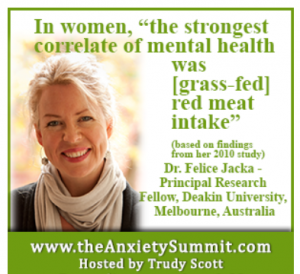
“In our study, out of every single dietary food grouping that I looked at including vegetables, fruits, salads, beans, etc the strongest correlate of mental health was red meat intake,” grass-fed red meat of course.

felice jacka red meat

This blog discusses Dr. Jacka’s current SMILES study on diet in anxiety and depression – A RCT of a dietary intervention for adults with major depression (the “SMILES” trial): study protocol.  We should see published results shortly.

Autumn shares these benefits of grass-fed red meat:

Grass fed red meat is different in two main ways.  And that’s because it has higher and a different fatty acid profile, especially omega-3 fatty acid.  There seems to be more, I think three to five times more than conventional raised beef.  And that’s important because omega-3 are known to be very therapeutic for mental health and a number of other health issues.  So as many of those omega-3’s as we can get is a good thing.  But what it also does is there’s omega-3 fatty acid and there’s omega-6 fatty acid and it improves the ratio.  It has kind of a perfect ratio.  Our ancestors had a ratio between these two fatty acid’s of about one to one and the common American today has a ratio of about 20 to one, which they hypothesize, and a lot of research suggest, leads to inflammation in the body, which is the root of basically all degenerative diseases.  So grass fed beef has a ratio of about 1.5 to one, which is almost perfect compared to one to 7.5 in conventionally raised beef.  So that’s just a huge difference. 

And then there’s also something called CLA, which is another fatty acid known to have cancer fighting properties.  One study showed that the women who ate the most CLA had a lower risk of breast cancer.  And it’s also known to optimize the deposition of fat in the body so that’s really important.  But the other major benefit of grass fed beef is its antioxidant profile.  There’s higher levels of glutathione, which is our bodies master antioxidant.  There’s I think seven times more vitamin A or beta-carotene, the precursors to vitamin A.  And I think three times more vitamin E.  There’s also higher levels of B vitamins, which are so critical for mental health, and minerals, especially zinc and iron and magnesium, which are also really, really important for mental health.  But the other side of the coin is, like Trudy said, what we’re not getting that conventionally raised beef has to offer and that is the hormones, the antibiotics and the pesticides, which just wreak havoc on our health.  And toxins are stored in fat as well, which is a really, really important thing to remember.  So when you’re eating the fat of a conventionally raised animal that fat is actually storing up all of those toxins and then you’re getting a healthy dose in every bite.  So basically grass fed beef is allowing us to only put into our body what’s going to allow us to thrive and none of what won’t, which is why I’m so passionate about it.

Here is Autumn’s digital gift: her antianxiety protocol based on her thesis 

You can use this link to get 30% off Paleovalley’s 100% grass-fed beefsticks 

If you are not already registered for the Anxiety Summit you can get live access to the speakers of the day here: www.theAnxietySummit.com

Missed this interview or can’t listen live? Or want this and the other great interviews for your learning library? Purchase the MP3s or MP3s + transcripts and listen when it suits you.

You can find your purchasing options here.: Anxiety Summit Season 1, Anxiety Summit Season 2, Anxiety Summit Season 3, and Anxiety Summit Season 4.
Filed Under: Events, The Anxiety Summit 4 Tagged With: anxiety, anxiety summit, Autumn Fladmo Smith, fermented food, grass-fed beef, paleovalley, Trudy Scott

The Anxiety Summit – Is My Anxiety and Depression from a Methylation, Pyrrole, or Copper-Zinc Imbalance?

June 14, 2016 By Trudy Scott 142 Comments

William J. Walsh_Anxiety4

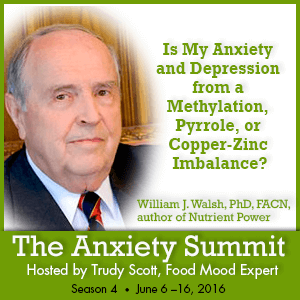
William J. Walsh, PhD, FACN, author of Nutrient Power, was interviewed on the Anxiety Summit by host of the Anxiety Summit, Trudy Scott, Food Mood Expert and Nutritionist, author of The Antianxiety Food Solution.

Is My Anxiety and Depression from a Methylation, Pyrrole, or Copper-Zinc Imbalance?

  • Neurotransmitters: how they are synthesized, transported and broken down.
  • Biochemical individuality and incidences of imbalances of copper, B6 and zinc.
  • Biotypes of depression, methylation disorders and whole blood histamine, and pyrrole disorder (pyroluria)
  • Copper-zinc imbalance and post-partum depression
  • Testing in blood and urine

Here are some gems from our interview:

Copper and estrogen are related and I’ve seen probably 400 cases of postpartum depression.  Virtually all of them have a copper overload.  These are people who might have been on SSRI antidepressants and with nothing really happening not making them better or worse.  But if we are able to simply normalize their copper most of them become completely okay and you can throw away their medications. They’re the easiest people to help. 

Well with respect to the females if a person has an anxiety disorder or a depression disorder and we find out that the onset was at puberty we kind of expect that the lab results are going to show this is a copper problem because at hormonal events copper levels tend to go awry if you’re not able to regulate your copper.  So it can happen at puberty. It can happen at childbirth.  And it can happen at menopause.  During the nine months of a pregnancy a women’s copper level more than doubles.  And this is necessary for that growing fetus.  It’s necessary for something called angiogenesis to promote the rapid development of blood vessels that that little growing baby needs.  And at the end of a pregnancy a woman’s copper level is usually more than double what it normally is.  A woman normally would be around 100 micrograms per deciliter in her blood.  Maybe it would be 220 at the end of a pregnancy. 

Well right after the baby’s born that copper level is supposed to start heading right back down to normal.  Well people with postpartum depression don’t have that ability and this can completely disrupt two of the major neurotransmitters and misery sometimes for the rest of their lives.  But the way we would bring it down, you have to do it carefully because they’re already suffering from too much copper levels in their brain and in their bloodstream so we have to remove the copper gently and gradually.  And one way to do that is to give them small doses of zinc initially and then just gradually build up the doses to the full dose it takes to normalize their zinc which will then automatically get the natural metallothionein system working.  And it takes about six to eight weeks usually.  But it can be done and it can be done without any discomfort for the patient if it’s done slowly.

I enjoyed hearing how Dr. Walsh got to work with one of the great pioneers in orthomolecular mental health, Dr. Carl Pfeiffer, author of Nutrition and Mental Illness:  An Orthomolecular Approach to Balancing Body Chemistry, and creator of the first pyroluria questionnaire.  I based my pyroluria questionnaire off this one.  Dr. Walsh has done the same thing.

Towards the end of the interview we discussed undermethylation and overmethylation and the confusion about MTHFR and terminology. I made reference to this blog post from a prior summit – Methylation and anxiety: histadelia and histapenia  and the interview with Dr. Ben Lynch – How Methylfolate can make you Feel Worse and even Cause Anxiety, and What to do about it

The takeaway from this discussion is this:

If a person had undermethylated depression they have low serotonin activity.  If you gave these people methylfolate their methylation would improve and the patient would get worse.

So basically I agree completely with Dr. Lynch on the best way to improve methylation and all I’m saying is that for some people, people who have problems of neurotransmission of serotonin you can’t give them folates because they’ll get worse.  So that’s an exception to the general rule. 

So it is these people who are the undermethylators (and using the original terminology, those with high histamine or histadelia) that do worse on folate.

Dr. Walsh agreed that the terminology undermethylation and overmethyation is confusing.

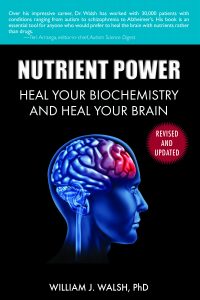
Connect with Dr. Walsh and save on his book Nutrient Power: Heal Your Biochemistry, Heal Your Brain (use discount code: ANXIETY)

Nutrient Power


You can find information about the Walsh practitioner training here 

If you are not already registered for the Anxiety Summit you can get live access to the speakers of the day here: www.theAnxietySummit.com

Missed this interview or can’t listen live? Or want this and the other great interviews for your learning library? Purchase the MP3s or MP3s + transcripts and listen when it suits you.

You can find your purchasing options here.: Anxiety Summit Season 1, Anxiety Summit Season 2, Anxiety Summit Season 3, and Anxiety Summit Season 4.
Filed Under: Events, The Anxiety Summit 4 Tagged With: anxiety, anxiety summit, copper-zinc imbalance, Methylation, pyroluria, pyrrole, Trudy Scott, William J. Walsh

The Anxiety Summit – Tryptophan for anxiety, depression and insomnia: why quality is key and the critical co-factors

June 13, 2016 By Trudy Scott 64 Comments

Ron Sturtz_Anxiety4

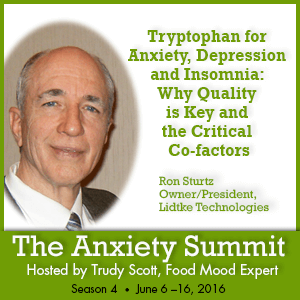
Ron Sturtz, Owner/President, Lidtke Technologies, was interviewed on the Anxiety Summit by host of the Anxiety Summit, Trudy Scott, Food Mood Expert and Nutritionist, author of The Antianxiety Food Solution.

Tryptophan for anxiety, depression and insomnia: why quality is key and the critical co-factors

  • The benefits of tryptophan for anxiety/mood/insomnia and why Trudy only recommends Lidtke
  • Tryptophan history and why safety and quality is key
  • Concerns about neurotoxic quinolinic acid
  • Tryptophan 500mg, kids chewable, Tryptophan Complete, and tryptophan for pets
  • Why use lysine, vitamin B3, B6/P5P, folate and curcumin with tryptophan
  • Other serotonin co-factors and 5-HTP
  • Client feedback and how to use these amino acids

In part 1 we start by discussing the history, the controversy in 1990 over contaminated L-tryptophan,  the impurities that lead to the EMS outbreak and why Lidtke has “been fanatical about purity and safety” since then:

the main [impurity] was EBT  [1,1′-ethylidene-bis-L-tryptophan] and that was the one that they suspected was the most heavily implicated.  They never could identify exactly which ones were toxic or in combination.  It could be like numbers one, two and five in combination were deadly or two and six in combination more deadly or maybe just six alone was deadly.  They never were able to determine that because they never found an animal model to use in research because when they would feed the rats or any other kind of animal, lab animal they had samples of this known toxic tryptophan, none of them responded the way humans do.  They have a very different gut flora and metabolism and they never responded the same so they weren’t about to use humans in any of these clinical trials so they never really could tell which of those six were the worst, but they strongly suspected that EBT was the worst

Ron covers how glyphosate/Roundup is contributing to low serotonin levels:

…the food crops  absorb the chemical, they still soak it up and then they’re sent to market and you buy them and you cook them and you eat then and then you soak it up.  Well, you don’t produce tryptophan or phenylalanine, but your gut bacteria to do.  And preferentially the beneficial gut bacteria tend to be killed by the glyphosates.  So when that happens the pathogenic bacteria tend to dominate.  And then when that happens when they grow kind of out of control then even more tryptophan is used up by the macrophages, which then attack the pathogens.

If you’d like to read more about this we covered this is much more detail in these interviews:

  • Stephanie Seneff presented in season 1: Is Roundup toxic and a cause of anxiety, autism and celiac disease?
  • Jeffrey Smith presented in season 2: on Anxiety, depression, GMOs and Roundup

In part 2 Ron reviews the serotonin biochemistry:

lidtke image serotonin biochemistry
Serotonin Biochemistry – Ron Sturtz from Lidtke Technologies

And we discuss the Tryptophan Complete product, the ingredients and rationale for including P5P, lysine, curcumin, folic acid and niacinamide. This is my feedback on the product:

the Tryptophan Complete is one that I’m not as familiar with as the 500 milligram Tryptophan.  I’ve been using the 500 milligram with my clients for over ten years.  The Tryptophan Complete is just a new one that’s sort of come on my radar and I started looking into it and I actually posted something on Facebook a few months ago and then did a blog post to get feedback from people [see below]. And I’ve had some promising feedback.  I’ve had one person say “I’ve used the Tryptophan Complete and liked it a lot better than the 500 milligrams.  It gave me a much deeper state of relaxation and a way more solid sleep.”  She used that, got benefits then tried the 500 and now has decided to go back to the Complete.  So she feels that the addition of the other ingredients really helped for her body chemistry.  I did have someone else say that she can’t do P5P at all.  It makes her agitated.  So for people who have individual reactions to any of the ingredients then you would go with the 500 milligrams.

Here is my blog: Tryptophan 500mg or Tryptophan Complete (by Lidtke)?

And my supplements blog that lists Lidtke tryptophan products (500mg tryptophan, Tryptophan Complete and Tryptophan 100mg chewable), other amino acid products and pyroluria products I recommend: The Antianxiety Food Solution Amino Acid and Pyroluria Supplements

You can also find the amino acid questionnaire (which lists the low serotonin symptoms) and amino acid precautions on the above blog.

Here is some of the research:

  • Tryptophan supplementation modulates social behavior: A review
  • Chronic treatment with a tryptophan-rich protein hydrolysate improves emotional processing, mental energy levels and reaction time in middle-aged women
  • A placebo-controlled clinical trial of L-tryptophan in premenstrual dysphoria.
  • Lysine fortification reduces anxiety and lessens stress in family members in economically weak communities in Northwest Syria.

Lidtke is kindly offering 15% off all Lidtke products through the end of June  – use coupon code anxietysummit

If you are not already registered for the Anxiety Summit you can get live access to the speakers of the day here: www.theAnxietySummit.com

Missed this interview or can’t listen live? Or want this and the other great interviews for your learning library? Purchase the MP3s or MP3s + transcripts and listen when it suits you.

You can find your purchasing options here.: Anxiety Summit Season 1, Anxiety Summit Season 2, Anxiety Summit Season 3, and Anxiety Summit Season 4.
Filed Under: Events, The Anxiety Summit 4 Tagged With: anxiety, anxiety summit, depression, insomnia, Lidtke, Ron Sturtz, Trudy Scott, tryptophan

The Anxiety Summit – A functional medicine approach to eliminate Lyme disease and the anxiety it often causes

June 13, 2016 By Trudy Scott 13 Comments

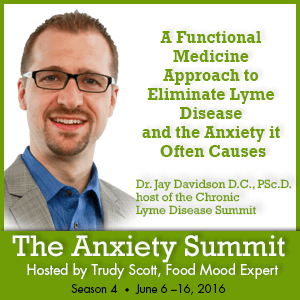
Jay Davidson_Anxiety4

Dr. Jay Davidson D.C., PSc.D., host of the Chronic Lyme Disease Summit, is interviewed on the Anxiety Summit by host of the Anxiety Summit, Trudy Scott, Food Mood Expert and Nutritionist, author of The Antianxiety Food Solution.

A functional medicine approach to eliminate Lyme disease and the anxiety it often causes

  • The incidence of anxiety in Lyme disease
  • Lyme bacteria and methyl group depletion
  • A functional medicine approach to eliminate the Lyme disease infection
  • Balancing minerals and methyl donors
  • Healing the gut and detoxing heavy metals

Here is the initial study I shared: Panic Attacks May Reveal Previously Unsuspected Chronic Disseminated Lyme Disease

The author describes the histories of three patients with panic-like episodes that turned out to be related to underlying, previously unsuspected tick-borne diseases. Each woman experienced symptoms that are not usual in panic disorder but are typical of neurological Lyme disease, including exquisite sensitivity to light, touch, and sounds, joint pain often in combination with cognitive changes including mental fogginess and loss of recent memory, and some degree of bizarre, shifting, and often excruciating neurological pain. Because these symptoms are atypical of primary panic disorder, they were very helpful in alerting the clinician to suspect an underlying physical illness.

Here are some gems from our interview:

So when you look at anxiety I look at it from an integrative standpoint – like the brain, nervous system has a huge piece in that, the neurotransmitters, and obviously the gut.  So there’s multiple pieces of the body that seem to have a link with it.  But if you have something that’s actually affecting the brain, which is the organ that’s running everything in the body, which Lyme disease or the bacteria borellia is one of those factors I really think that that in itself can cause anxiety – just due to the bacteria.  And what’s interesting about the bacteria of Lyme is it’s not uniform – it can change forms and the main form that it’s known for is called the spirochete where it basically looks like a corkscrew, a spiraling shape.  And so Lyme doesn’t like to just really float around in the bloodstream.  It loves tissues.  It loves joints and that’s where some of the symptoms are, like joint pain, and especially moves around the body. But it loves the brain too and it loves to be in those tissues. 

Dr. Jay shares that chronic Lyme disease does exist and discusses testing issues:

…the standard testing that’s still done today, the ELISA and Western blot, they call it the two tier method.  So if one shows up positive then they’ll run the other one.  That methodology was actually designed and recommended as an observational population method for Lyme.  It was never intended for a clinical diagnosis.  And somehow it became the clinical diagnosis tool that if you run the test and if you come up negative there’s no way you could have Lyme.

Rresearch has shown that 40 to 60 percent of those tests are wrong which means you could almost flip a coin and get a better result.  So you definitely want to find a practitioner that knows Lyme disease, that understands it. 

My favorite test right now is from a lab called Pharmasan Labs … a test called iSpot. So instead of B cell antibodies which traditional tests uses it’s using T cells and it’s a lot more accurate.  And studies basically show that this test is not 100 percent by any means either.  But it’s 86 percent sensitive and 94 percent specific. And basically all that means is if you get a positive result on an iSpot Lyme test there’s a six percent chance that it’s wrong.  If you get a negative on the iSpot Lyme test there’s a 16 percent chance that it is  wrong.

Here information on the Chronic Lyme Disease Summit  he hosted earlier this year. It was excellent!

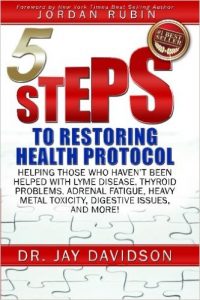
Here is Dr. Jay’s book: 5 Steps to Restoring Health Protocol: Helping those who haven’t been helped with Lyme Disease, Thyroid Problems, Adrenal Fatigue, Heavy Metal Toxicity, Digestive Issues, and More!

jay davidson book

Here are the gifts from Dr. Jay:

  • 5 Steps to Restoring Health Protocol” audio book
  • Lyme Disease: Why an Antibiotic Bug Bomb is Not the Answer eBook
  • Heavy Metal Toxicity: A Modern Day Epidemic Not Being Addressed eBook 

If you are not already registered for the Anxiety Summit you can get live access to the speakers of the day here: www.theAnxietySummit.com

Missed this interview or can’t listen live? Or want this and the other great interviews for your learning library? Purchase the MP3s or MP3s + transcripts and listen when it suits you.

You can find your purchasing options here.: Anxiety Summit Season 1, Anxiety Summit Season 2, Anxiety Summit Season 3, and Anxiety Summit Season 4.
Filed Under: Events, The Anxiety Summit 4 Tagged With: anxiety, anxiety summit, functional medicine, Jay Davidson, Lyme Disease, Trudy Scott

The Anxiety Summit – Serotonin and anxiety: tryptophan, 5-HTP, serotonin syndrome and medication tapers

June 12, 2016 By Trudy Scott 64 Comments

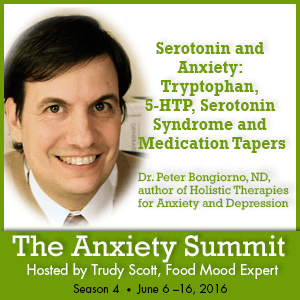
Peter Bongiorno_Anxiety4

Dr. Peter Bongiorno, ND, author of Holistic Therapies for Anxiety and Depression, is interviewed on the Anxiety Summit by host of the Anxiety Summit, Trudy Scott, Food Mood Expert and Nutritionist, author of The Antianxiety Food Solution.

Serotonin and anxiety: tryptophan, 5-HTP, serotonin syndrome and medication tapers

  • What is the serotonin hypothesis and serotonin syndrome
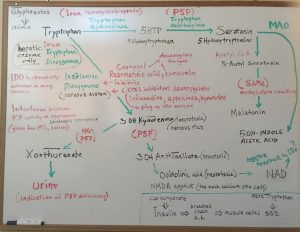
  • Concerns about tryptophan and kynurenine and neurotoxic quinolinic acid
  • When to use tryptophan and when to use 5-HTP
  • Working with a prescribing doctor to do a SSRI (and benzo) taper
  • John’s Wort, saffron and venetron for anxiety and depression
  • Hydrotherapy and hugs

Here are some snippets from our interview:

Here are some gems from our interview:

As far as St. John’s Wort I would honestly put that in a different category because St. John’s Wort is not just another type of serotonin enhancer or SSRI.  It has many, many other activities.  It supports the thyroid.  It really helps digestion.  It’s a good anti-inflammatory.  It calms the nervous system.  And it also supports other neurotransmitters too.  So to me St. John’s Wort is more like a beautiful food that has these very pleiotropic effects and really helps the whole body kind of cope and gain resilience.  Years ago St. John’s Wort was originally used to ward off evil spirits in olden times.  And so it has a tremendous history of supporting people with mood and especially people who are very fatigued in the process and they can’t cope and they have no resilience.  So I think St. John’s Wort is definitely more than just a serotonin enhancer.

We also cover carnitine:

One of the things I like to check is something called carnitine which is an amino acid which plays a role in how energy is carried in the body.  And many women get much depleted in carnitine as they move through pregnancy through the trimesters.  And that’s actually quite safe to take during pregnancy and I’ve seen that be very, very helpful in women with mood issues either during pregnancy or postpartum.  And there are plenty of studies that show the safety of carnitine.  So that’s one of the things I definitely like to look at along with taking some magnesium which is also safe during pregnancy.

We discuss medication tapers of SSRIs:

And the weaning process would have to be different for everyone.  Some patients who have been on some of these mood altering medications for many years you can’t just wean off quickly.  You have to go exceedingly slow.  And depending on how they do then we can support their brain and their body with more nutrients to help that process go as easily as possible and minimize any kind of withdrawal effect.  The body will tell us what to do as we go along.  But again the most important thing is that we really establish all the basics and that they’re in the healthiest place possible.  Because if those aren’t there, if a patient just gets off the medication and we haven’t really done anything to change the underlying reasons why they got to the place where they had the mood issue.  In most cases they’re going to go back there again.

Here are two of Dr. Bongiorno’s books:

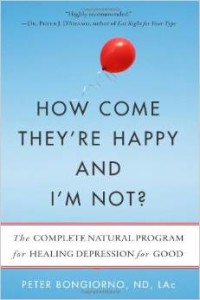
How Come They’re Happy and I’m Not – The Complete Natural Program for Healing Depression for Good

peter bongiorno how come they're happy and I'm not

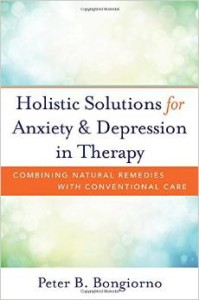
Holistic Solutions for Anxiety & Depression in Therapy: Combining Natural Remedies with Conventional Care

peter bongiorno holistic solutions for anxiety and depression

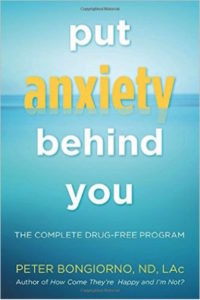
And his most recent book: Put Anxiety Behind You

put-anxiety-behind-you

Here is his digital gift: 10 Ways to Balance Serotonin Naturally http://www.drpeterbongiorno.com/serotonin/

If you are not already registered for the Anxiety Summit you can get live access to the speakers of the day here: www.theAnxietySummit.com

Missed this interview or can’t listen live? Or want this and the other great interviews for your learning library? Purchase the MP3s or MP3s + transcripts and listen when it suits you.

You can find your purchasing options here.: Anxiety Summit Season 1, Anxiety Summit Season 2, Anxiety Summit Season 3, and Anxiety Summit Season 4.
Filed Under: Events, The Anxiety Summit 4 Tagged With: 5-HTP, anxiety, anxiety summit, medication tapering, Peter Bongiorno, Trudy Scott, tryptophan

  • « Go to Previous Page
  • Page 1
  • Page 2
  • Page 3
  • Page 4
  • Page 5
  • Interim pages omitted …
  • Page 24
  • Go to Next Page »

Primary Sidebar

NEW! GABA QuickStart Homestudy (with special intro pricing)

gaba quickstart homestudy

Free Report

9 Great Questions Women Ask about Food, Mood and their Health

You'll also receive a complimentary subscription to my ezine "Food, Mood and Gal Stuff"


Connect with me

Popular Posts

  • Amino Acids Mood Questionnaire from The Antianxiety Food Solution
  • The Antianxiety Food Solution Amino Acid and Pyroluria Supplements
  • Pyroluria Questionnaire from The Antianxiety Food Solution
  • Collagen and gelatin lower serotonin: does this increase your anxiety and depression?
  • Tryptophan for the worry-in-your-head and ruminating type of anxiety
  • GABA for the physical-tension and stiff-and-tense-muscles type of anxiety
  • The Antianxiety Food Solution by Trudy Scott
  • Seriphos Original Formula is back: the best product for anxiety and insomnia caused by high cortisol
  • Am I an anxious introvert because of low zinc and vitamin B6? My response to Huffington Post blog
  • Vagus nerve rehab with GABA, breathing, humming, gargling and key nutrients

Recent Posts

  • What do I use instead of Seriphos to help lower high cortisol that is affecting my sleep and making me anxious at night?
  • BeSerene™ GABA/theanine cream eases severe muscle tension in her neck/shoulders, prevents her bad headaches and quells her anxiety
  • How the correct approach, dose and sublingual use of GABA can be calming and not cause a flushed and itchy face and neck
  • The amino acid glutamine improves low mood by addressing gut health, and it has calming effects too
  • Flight anxiety with heightened breath, physical tension and also fearing the worst (the role of low GABA and low serotonin)

Categories

  • 5-HTP
  • AB575
  • Addiction
  • ADHD
  • Adrenals
  • Alcohol
  • Allergies
  • Alzheimer's disease
  • Amino Acids
  • Anger
  • Antianxiety
  • Antianxiety Food Solution
  • Antidepressants
  • Anxiety
  • Anxiety and panic
  • Autism
  • Autoimmunity
  • benzodiazapines
  • Bipolar disorder
  • Books
  • Caffeine
  • Cancer
  • Candida
  • Children/Teens
  • Collagen
  • Cooking equipment
  • Coronavirus/COVID-19
  • Cravings
  • Depression
  • Detoxification
  • Diabetes
  • Diet
  • DPA/DLPA
  • Drugs
  • EFT/Tapping
  • EMF
  • EMFs
  • Emotional Eating
  • Endorphins
  • Environment
  • Essential oils
  • Events
  • Exercise
  • Fear
  • Fear of public speaking
  • Fertility and Pregnancy
  • Fish
  • Food
  • Food and mood
  • Functional neurology
  • GABA
  • Gene polymorphisms
  • General Health
  • Giving
  • Giving back
  • Glutamine
  • Gluten
  • GMOs
  • Gratitude
  • Gut health
  • Heart health/hypertension
  • Histamine
  • Hormone
  • Hyperparathyroidism
  • Hypoglycemia
  • Immune system
  • Inflammation
  • Insomnia
  • Inspiration
  • Introversion
  • Joy and happiness
  • Ketogenic diet
  • Lithium orotate
  • Looking awesome
  • Lyme disease and co-infections
  • MCAS/histamine
  • Medication
  • Men's health
  • Mental health
  • Mercury
  • Migraine
  • Mold
  • Movie
  • MTHFR
  • Multiple sclerosis
  • Music
  • NANP
  • Nature
  • Nutritional Psychiatry
  • OCD
  • Osteoporosis
  • Oxalates
  • Oxytocin
  • Pain
  • Paleo
  • Parasites
  • Parkinson’s disease
  • PCOS
  • People
  • PMS
  • Postpartum
  • PTSD/Trauma
  • Pyroluria
  • Questionnaires
  • Real whole food
  • Recipes
  • Research
  • Schizophrenia
  • serotonin
  • SIBO
  • Sleep
  • Special diets
  • Sports nutrition
  • Stress
  • Sugar addiction
  • Sugar and mood
  • Supplements
  • Teens
  • Testimonials
  • Testing
  • The Anxiety Summit
  • The Anxiety Summit 2
  • The Anxiety Summit 3
  • The Anxiety Summit 4
  • The Anxiety Summit 5
  • The Anxiety Summit 6
  • Thyroid
  • Thyroid health
  • Toxins
  • Tryptophan
  • Tyrosine
  • Uncategorized
  • Vegan/vegetarian
  • Women's health
  • Yoga

Archives

  • October 2025
  • September 2025
  • August 2025
  • July 2025
  • June 2025
  • May 2025
  • April 2025
  • March 2025
  • February 2025
  • January 2025
  • November 2024
  • October 2024
  • September 2024
  • August 2024
  • July 2024
  • June 2024
  • May 2024
  • April 2024
  • March 2024
  • February 2024
  • January 2024
  • December 2023
  • November 2023
  • October 2023
  • September 2023
  • August 2023
  • July 2023
  • June 2023
  • May 2023
  • April 2023
  • March 2023
  • February 2023
  • January 2023
  • December 2022
  • November 2022
  • October 2022
  • September 2022
  • August 2022
  • July 2022
  • June 2022
  • May 2022
  • April 2022
  • March 2022
  • February 2022
  • January 2022
  • December 2021
  • November 2021
  • October 2021
  • September 2021
  • August 2021
  • July 2021
  • June 2021
  • May 2021
  • April 2021
  • March 2021
  • February 2021
  • January 2021
  • December 2020
  • November 2020
  • October 2020
  • September 2020
  • August 2020
  • July 2020
  • June 2020
  • May 2020
  • April 2020
  • March 2020
  • February 2020
  • January 2020
  • December 2019
  • November 2019
  • October 2019
  • September 2019
  • August 2019
  • July 2019
  • June 2019
  • May 2019
  • April 2019
  • March 2019
  • February 2019
  • January 2019
  • December 2018
  • November 2018
  • October 2018
  • September 2018
  • August 2018
  • July 2018
  • June 2018
  • May 2018
  • April 2018
  • March 2018
  • February 2018
  • January 2018
  • December 2017
  • November 2017
  • October 2017
  • September 2017
  • August 2017
  • July 2017
  • June 2017
  • May 2017
  • April 2017
  • March 2017
  • February 2017
  • January 2017
  • December 2016
  • November 2016
  • October 2016
  • September 2016
  • August 2016
  • July 2016
  • June 2016
  • May 2016
  • April 2016
  • March 2016
  • February 2016
  • January 2016
  • December 2015
  • November 2015
  • October 2015
  • September 2015
  • August 2015
  • July 2015
  • June 2015
  • May 2015
  • April 2015
  • March 2015
  • February 2015
  • January 2015
  • December 2014
  • November 2014
  • October 2014
  • September 2014
  • August 2014
  • July 2014
  • June 2014
  • May 2014
  • April 2014
  • March 2014
  • February 2014
  • January 2014
  • December 2013
  • November 2013
  • October 2013
  • September 2013
  • August 2013
  • July 2013
  • June 2013
  • May 2013
  • April 2013
  • March 2013
  • February 2013
  • January 2013
  • December 2012
  • November 2012
  • October 2012
  • August 2012
  • July 2012
  • June 2012
  • May 2012
  • April 2012
  • March 2012
  • February 2012
  • January 2012
  • December 2011
  • November 2011
  • October 2011
  • September 2011
  • August 2011
  • July 2011
  • June 2011
  • May 2011
  • April 2011
  • March 2011
  • February 2011
  • January 2011
  • December 2010
  • October 2010
  • September 2010
  • July 2010
  • May 2010
  • April 2010
  • March 2010
  • February 2010
  • January 2010
  • November 2009

Share the knowledge!

The above statements have not been evaluated by the Food and Drug Administration. Products listed in this website are not intended to diagnose, treat, cure or prevent any disease.

The information provided on this site is for informational and educational purposes only and is not intended as a substitute for advice from your physician or other health care professional. You should consult with a healthcare professional before starting or modifying any diet, exercise, or supplementation program, before taking or stopping any medication, or if you have or suspect you may have a health problem.


Copyright © 2026 Trudy Scott. All Rights Reserved. | Privacy | Terms and Conditions | Refund Policy | Medical Disclaimer

Free Report

9 Great Questions Women Ask about Food, Mood and their Health

You’ll also receive a complimentary subscription to my ezine “Food, Mood and Gal Stuff”