• Skip to primary navigation
  • Skip to main content
  • Skip to primary sidebar

everywomanover29 blog

Food, Mood and Women's Health – Be your healthiest, look and feel great!

  • Blog
  • About
  • Services
  • Store
  • Resources
  • Testimonials
  • The Book
  • Contact
  • Search this site

MAOA

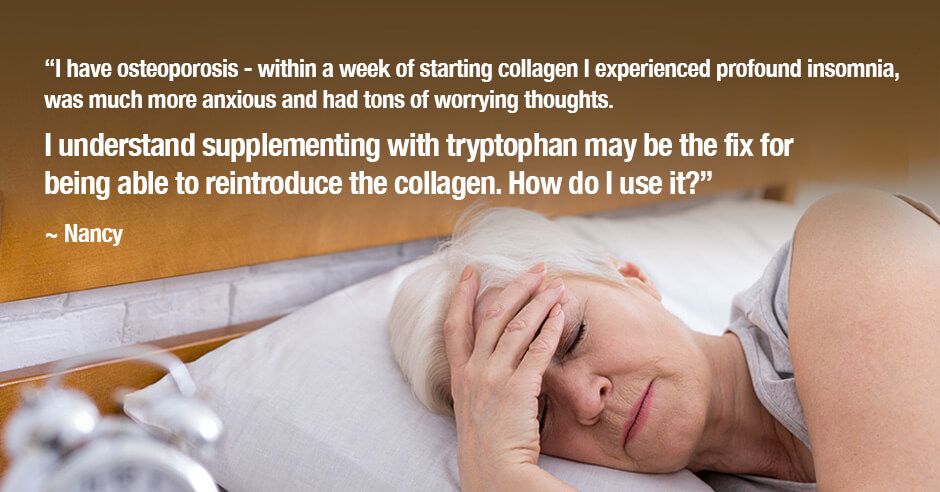
I have osteoporosis – within a week of starting collagen I experienced profound insomnia, was much more anxious and had tons of worrying thoughts

August 18, 2023 By Trudy Scott 10 Comments

osteoporosis collagen tryptophan

Nancy shares her unpleasant experience when using collagen for her osteoporosis and asks how she can use tryptophan and possibly add the collagen back:

I have osteoporosis and recently started taking a collagen peptide product (Fortibone). At the same time, I started taking a bone support formula containing calcium, magnesium, vitamin D, vitamin K2, boron, etc.

Within a week I began experiencing such PROFOUND insomnia. I felt like I was wide awake and could not drift off till 4 am each morning. Also, when I laid down at night, I was much more anxious than I normally am and had tons of worrying thoughts flitting thru my mind.

Within a couple weeks of the insomnia starting, I thankfully caught your talk about collagen and folks who are susceptible to it, at the 2023 Osteoporosis Summit. The puzzle pieces clicked together; I’m a MAO-A. I immediately stopped the collagen and the bone support supplement.

I understand supplementing with tryptophan may be the fix for being able to reintroduce the collagen.

I appreciate her for sharing her experience on one of my collagen blogs and thanked her, saying how glad I was that she heard my interview about this.

Collagen and gelatin lower serotonin in susceptible individuals

Intake of collagen (and gelatin) can lower serotonin in susceptible individuals and cause these symptoms she experienced. I first blogged about this in 2017 but it’s still not common knowledge even amongst practitioners and companies selling collagen products.

The good news is that awareness is growing. Dr. R. Keith McCormick does mention the serotonin-collagen connection in his excellent book Great Bones – Taking Control of Your Osteoporosis  (my Amazon link). He does not, however, offer tryptophan as a solution.

If this is new to you, this blog post describes why it happens (i.e. collagen does not contain any tryptophan), lists many of the tryptophan depletion studies and who may be more susceptible to this effect – Collagen and gelatin lower serotonin: does this increase your anxiety and depression?

Here is a more recent blog on the topic too: Collagen causes increased anxiety, low mood, irritability, insomnia, gut issues and an itchy skin: some questions and my answers

The causes of these symptoms can be due to the serotonin-lowering effects of collagen but also the dietary oxalate impact, a histamine reaction and/or a glutamate reaction to collagen.

Could supplementing with tryptophan be the fix for being able to reintroduce the collagen?

Nancy said “I understand supplementing with tryptophan may be the fix for being able to reintroduce the collagen.” Hearing her symptoms – profound insomnia, increased anxiety and worrying thoughts flitting through her mind – led me to the same conclusion, especially since they all started soon after starting collagen.

We know she has the MAOA (monoamine oxidase A) genetic polymorphism – this does make her more susceptible to the serotonin-lowering effects of collagen. Other factors that may make her more susceptible (explained in the 2017 blog above) are current or prior depression and/or OCD (obsessive compulsive disorder) or family history of these conditions and being a smoker. In addition to a MAOA defect is having a 5-HTTLPR genetic polymorphism.

To confirm the likely low serotonin connection, it would have been helpful to know if she also experienced other low serotonin symptoms: panic attacks and phobias, lack of confidence, depression, negativity, imposter syndrome, PMS, irritability, anger issues and afternoon/evening cravings.

It would also be helpful to know if her symptoms resolved when she stopped using the collagen.

But the best way to confirm is to do a trial of tryptophan and observe if these symptoms resolve when using collagen.

How to use tryptophan in a situation like this?

She asked these specific questions about using tryptophan:

I bought the Lidtke brand which is a 500 mg. capsule. How do I dose this? I realize you said to trial dose it but:

1) what time of day is best to take it?

2) is it taken on an empty stomach or can it be taken with food?

3) should I start taking the tryptophan BEFORE restarting the collagen and be watching for the night time anxiety/insomnia symptoms to reappear?

4) if the insomnia, anxiety do reappear, how much do I titrate up and is there a max dose of tryptophan? If I’m taking more than one capsule a day, should they be taken at one time or divided throughout the day?

Tryptophan is always taken midafternoon and evening on an empty stomach/away from protein and increased until there is symptom resolution.

For clients in a similar situation who have stopped the collagen but still have insomnia, anxiety and worry symptoms, I have them start on tryptophan before adding back collagen and adjust the tryptophan dose up if needed once collagen is reintroduced.

If symptoms resolved when the collagen was stopped, tryptophan would be trialed as soon as symptoms show up when collagen is reintroduced.

With tryptophan, 500 mg is a typical starting dose but less may work in a situation like this. I’ve had clients use up to 1500 mg tryptophan 2 x day. It’s really individualized with no one-size fits all.

I did mention my book, The Antianxiety Food Solution, as an excellent resource for Nancy. There is an entire chapter on the amino acids and how to use them. I recommend everyone read it before using any of the amino acids as supplements.

Resources if you are new to using amino acids as supplements

If you are new to using amino acids as supplements, here is the Amino Acids Mood Questionnaire from The Antianxiety Food Solution (you can see all the symptoms of neurotransmitter imbalances, including low GABA, low serotonin, low dopamine, low blood sugar and low endorphins).

If you suspect low levels of any of the neurotransmitters and do not yet have my book, The Antianxiety Food Solution – How the Foods You Eat Can Help You Calm Your Anxious Mind, Improve Your Mood, and End Cravings, (as I mentioned above) I highly recommend getting it and reading it before jumping in and using amino acids on your own so you are knowledgeable. And be sure to share it with the practitioner/health team you or your loved one is working with.

There is an entire chapter on the amino acids and they are discussed throughout the book in the sections on gut health, gluten, blood sugar control, sugar cravings, anxiety and mood issues.

The book doesn’t include product names (per the publisher’s request) so this blog, The Antianxiety Food Solution Amino Acid and Pyroluria Supplements, lists the amino acids that I use with my individual clients and those in my group programs. You can find them all in my online store.

If, after reading this blog and my book, you don’t feel comfortable figuring things out on your own (i.e. doing the symptoms questionnaire and respective amino acids trials), a good place to get help is the GABA QuickStart Program (if you have low GABA symptoms too). This is a paid online/virtual group program where you get my guidance and community support.

If you are a practitioner, join us in The Balancing Neurotransmitters: the Fundamentals program. This is also a paid online/virtual program with an opportunity to interact with me and other practitioners who are also using the amino acids.

Thanks to Nancy for sharing her experience with collagen and asking this question.

Have you used collagen for bone health/osteoporosis or for other reasons? And have you experienced insomnia, and increased anxiety and worrying?

Were your symptoms due to low serotonin and did tryptophan allow you to continue with collagen or add it back if you stopped it?

Or were your symptoms caused by oxalates in collagen, a histamine reaction and/or a glutamate reaction?

Has Fortibone led to improvements in your bone health? If yes, how long have you been using it and which collagen product (a number of products contain Fortibone)?

If you have questions and feedback please share them here too.
Filed Under: Anxiety, Collagen, Depression, Osteoporosis, Tryptophan Tagged With: amino acids; anxiety, anxious, collagen, collagen peptide, Fortibone, GABA Quickstart online program; Balancing Neurotransmitters: the Fundamentals program for practitioners, gelatin, how to use, insomnia, MAOA, osteoporosis, serotonin, serotonin-lowering, susceptible, tryptophan, wide awake, worrying thoughts

Candida: anxiety and low serotonin, testing and parasites, sugar cravings, EMFs and your genes

July 8, 2018 By Trudy Scott 9 Comments

My interview on anxiety on The Candida Summit with host Evan Brand, addresses anxiety, the tie in to low serotonin and the sugar cravings aspect. I was so excited to find a connection between serotonin and candida and share this in our interview. 

with low serotonin you’ve got the mental anxiety – the worry, the ruminating thoughts, the obsessive thinking, the reprocessing, insomnia, lying awake in bed, trying to shut down the busy mind. And the two amino acids I use for this is tryptophan; that’s my first choice. And my second choice is 5-HTP. That being said, some people do better on one versus the other.

The reason I like tryptophan is 5-HTP can raise cortisol and make people who are wired/tired feel a little bit more wired/tired. So until I’ve seen cortisol results in saliva, I like to use tryptophan first.

But let me share some of this interesting research that I’ve found. And why I’m so excited about it is because as I said earlier, I will use the amino acids first before I’m specifically addressing the candida. But it seems like using tryptophan first, as well as helping with the low serotonin, it’s starting to have an impact on the candida, which I didn’t know about, until I did the research for this. So thank you for inviting me to speak. It just reinforces what I know about the amino acids – that they are pretty powerful.

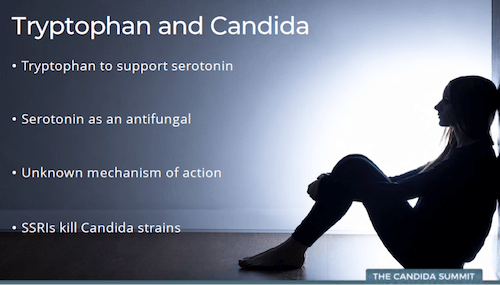
There was a study done in 2003, and the title is Antifungal Properties of Serotonin Against Candida species. And they looked at various different candida strains: albicans, glabrata, tropicalis, and a few others. And they exposed these candida strains to serotonin. The study concludes: “Serotonin showed antifungal activity towards all isolates of candida.”

What they didn’t know is what the mechanism of action was. They stated: “Identifying the mode of action would be of great help in developing and research new antifungal drugs.” I don’t agree with that. I’m just excited to see that there is this connection with serotonin, which reinforces how beneficial tryptophan is.

Of course, my solution is to provide serotonin support via diet, exercise and the use of the targeted individual amino acid tryptophan or 5-HTP.

You can read more about this serotonin-candida connection in my blog post: Symptoms, nutrient malabsorption, worsening psychiatric symptoms and the serotonin connection

In our interview I also discuss how I use the amino acids and how tryptophan/5-HTP as well as GABA, DPA, tyrosine and glutamine, can actually help with so much of the sugar craving we see in candida, PLUS how I use this approach to gauge when candida is really serious.

EMFs and the dangers of 5G – and candida

Dr. Schaffner talks about EMFs and the dangers of 5G and shares how they are protecting the Sophia Institute Clinic (which she shares with Dr. Dietrich Klinghardt):

What we have done at the clinic—and again, this is an evolving art—the two things that I think are going to make the most difference in what we can do right now is, first, of course we always say avoid exposure, try to distance yourself. Distance is your friend with any technology, when we’re looking at EMF.

But we actually shielded the clinic. We have a cell phone tower within a mile of the clinic. And so, we wanted to be mindful of that exposure. We ask everybody to turn off their cell phones when they come in to the clinic. And we don’t have Wi-Fi. So everything is ethernet corded. And then, we don’t have cell phone exposure while we’re practicing.

But we do two things that I think people should be aware of. And one is we use a type of graphite paint. It’s called YSHIELD. And that actually comes from Germany. And it has properties to, essentially, try to create a Faraday cage environment and block the incoming microwave radiation. And so, that has to be grounded, of course. And you want to always work with somebody who knows what they’re doing with this technology. Because if you don’t do it right, you can actually increase your exposures or create an unhealthy environment.

And then, Dr. Klinghardt works with the woman who creates these silver-lined curtains that actually help to block the microwave radiation coming in through the windows.

There’s a really great website—LessEMF has a lot of this technology. And then, YSHIELD, you can Google, I think it’s yshield.com. And then, the silver-lined curtains, I believe, is a fabric called, Swiss Shield. And so, you can either make them yourself or hire somebody to do that.

Learn more about candida, low serotonin, low melatonin, and your glymphatic system in the second half of Dr. Schaffner’s interview.

Candida, sugar cravings and COMT and MAOA genes

Evan Brand brings up the topic of sugar and carbs in the diet with Dr. Ben Lynch in the Candida, sugar cravings and COMT and MAOA genes interview: No one is discussing the influence of the whole epigenetic piece, and how people and their decision making with foods could be influenced by their genes?

Dr. Ben Lynch shares how he has a unique angle on this fascinating topic of our genes and sugar/carb cravings:

It’s one that always ties back to what came first—the chicken or the egg, right? So what came first, the genetic propensity towards carbohydrate binging or addictive personalities for high-caloric dense foods like ice cream and cakes, doughnuts, pastries, which then leads us to candida?

And then, they go on all these candida treatments. And they beat it. And they’re all happy again. But then their genetic propensity drives them yet again for the yeast overgrowth and the food binging.

He gives an example of how some people, when they’re down and out, may be drawn to sugar and carbs to self-medicate (this is something I see with my anxious clients all the time):

They’ll hit the chocolate. They’ll hit the doughnuts, the ice cream to make them feel good. And what these do is they spike your dopamine.

You’re not really aware of it, but you just do it. And you know you shouldn’t do it. But what happens here is, is some individuals, they have genes, which eliminate their dopamine out of their body pretty quickly. This gene is called COMT. And one of its jobs is to move dopamine out. You don’t want to always have neurotransmitters in your brain. That’s not good.

So some of these folks are born with a COMT gene that actually works faster, which is really good because they can calm down really quick in stressful environments. They can perform at a high level in stressful situations like surgeons, or EMT, or firefighters, or policemen, policewomen. They strive in these high-risk, highly-attentive situations.

But when they come home, everything’s a low normal. And they need that hit of dopamine. So they might come home and binge on sugars and carbs to drive their dopamine back up. And that’s a significant one.

Dr Lynch also shares about another gene, MAOA, which deals with our serotonin:

If you have a faster MAOA gene, which moves through your serotonin, then you are craving carbohydrates, and you’re craving pastas, and breads, and all the things that candida love, and beer. These things which increase your tryptophan levels, support your MAOA, and thus your serotonin. These are two major foods that our candida love. And these are two very, very common genes in the population which predispose us to having these issues

Candida testing, parasites and intractable yeast overgrowth 

Evan Brand asks this question about candida testing in the Candida, Mitochondrial Dysfunction, and Meditation interview with Dr. Dan Kalish: I’m guessing your statistics are similar to mine, 9 out of every 10 organic acids I find Candida overgrowth. Stool test, the GI map is missing a lot of Candida. Maybe you could help me understand why that’s happening.

Dr. Dan Kalish shares why candida testing can be challenging:

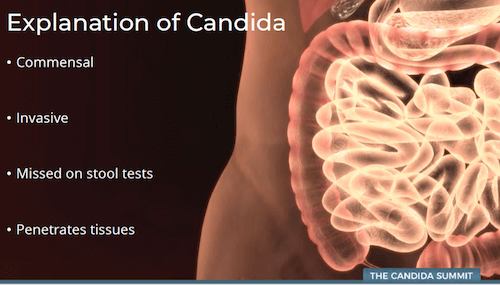
Because Candida can be commensal where it’s growing within the digestive tract itself, or it can be invasive where it penetrates into the tissue of the gut. And then it’s not going to be found in any of the stool tests. So stool tests can miss it easily. And in fact, the more severe it gets, the harder it is to find on a test.

That’s what happens with the yeast when it gets bad. It gets invasive. It goes up into the actual lining of the gut. So if it penetrates there, it causes leaky gut. But then it’s invasive, so it’s penetrating into the tissues. And you’re not going to see it in the stool. And that’s when it gets worse. In fact, it’s going to cause more symptoms. But then it’s almost impossible to find on the stool test.

He also shares this gem about intractable yeast overgrowth that just won’t go away:

You can have a Candida overgrowth, treat it and feel better, but have there be another underlying cause for the Candida. So there’s a lot of patients that will come to me and be like, “I had this Candida overgrowth. As long as I eat this radical and extreme and ridiculous diet, and take all these herbs, I’m fine. But every time I stop, it just comes back.”

Then, that leads the person to assume that it’s this horrific Candida overgrowth that’s never going to go away. And in those patients, there’s almost always Giardia, or Crypto [Cryptosporidium], or E. histo [Entamoeba histolytica], or some other bug that’s screwing up the ecology of the gut that’s allowing the Candida to keep coming back. So that’s just something to be on the lookout for.

If you feel like you have this intractable yeast overgrowth that just won’t go away, you should find a functional medicine doctor and do all the stool testing. Because you’re almost guaranteed there will be some other infection.

Click here to register for The Candida Summit which runs online from July 9-15, 2018!

Do share if you’ve successfully addressed candida overgrowth and how your symptoms improved and how bad your sugar cravings were.

Let us know if you’re EMF-aware and how addressing low serotonin has helped you.

If you have questions post them below in the blog comments.

Filed Under: Candida, Events Tagged With: 5G, anxiety, candida, COMT, EMFs, genes, MAOA, parasites, serotonin, sugar cravings, testing, tryptophan

The Anxiety Summit – Anxiety: Biochemical and genetic predispositions

November 11, 2014 By Trudy Scott 52 Comments

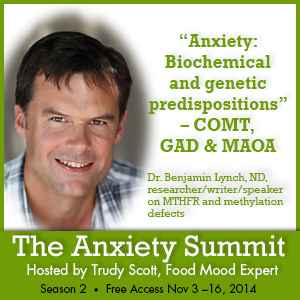
Dr. Benjamin Lynch, ND Researcher/writer/speaker on MTHFR and methylation defects, was interviewed by host of the Anxiety Summit, Trudy Scott, Food Mood Expert and Nutritionist, author of The Antianxiety Food Solution.

Anxiety: Biochemical and genetic predispositions – COMT, GAD & MAOA                                                                                         

  • MTHFR, methylation, SAMe and anxiety (and other health effects)
  • Good forms of folate
  • How too much folate can raise norepinephrine and cause anxiety
  • COMT genetic polymorphisms and anxiety: estrogens, xenoestrogens and sulfur
  • MAOA genetic polymorphisms and anxiety: tyramines and histamine
  • GAD genetic polymorphisms and anxiety: MSG, glutamates and GABA
  • How to test for and interpret these genetic polymorphisms?
  • Three top recommendations to reduce anxiety

Here are a few snippets from our interview:

MTHFR helps produce the body’s most active form of folate. So when you eat your uncooked leafy greens or your steamed leafy greens, you are getting ample amounts of methylfolate, which is great. But if you’re eating your dried cereal, your energy bars, your energy drinks or taking your prenatal vitamins and you think you’re doing a great thing and all of these things have this synthetic folic acid, then that is a big problem, because folic acid is absolutely synthetic and that folic acid has to be transformed into the most active form of folate, which is methylfolate because that’s what your body uses. It doesn’t use folic acid. You think folic acid is actually useful for things like neural tube defects, but it’s not; it actually has to be transformed. And so MTHFR contributes the last most important step for that to happen.

Methylfolate, along with vitamin B12, and the protein that you eat help make one of the most important compounds called SAMe. So when you eat your protein and your methylfolate levels are adequate, then you are able to make your neurotransmitters. And if you are unable to make neurotransmitters or eliminate them, you’re going to have symptoms of anxiety, depression, bipolar disorders, schizophrenic episodes, manic episodes, and so on.

The GAD enzyme helps get rid of glutamate and turns that into our docile calming GABA neurotransmitter. It needs magnesium and vitamin B6 to function.

One gene that’s very common in the population that’s also kind of messed up is COMT. COMT is a gene which does multiple, multiple things, but one of which is helps break down dopamine. The other one, it helps break down estrogen.

Another one for anxiety is MAOA, so that’s monoamine oxidase. Histamine is very related to anxiety, and that’s tied in because of the MAOA enzyme, so reducing your histamine-containing foods is a big one.

We mentioned that we’d share some links to MTHFR blog posts on Dr. Lynch’s site.  Here is one – MTHFR A1298C Mutation: Some Information on A1298C MTHFR Mutations and MTHFR C677T Mutation: Basic Protocol

We didn’t mention specific studies during the interview but here are a few:

  • Are there depression and anxiety genetic markers and mutations? A systematic review.
  • Association of a MAOA gene variant with generalized anxiety disorder, but not with panic disorder or major depression.

Dr. Lynch discussed the 23andme genetic testing and said this:

Genetic testing should be an empowering thing for you. You know it’s access to knowledge that can really be beneficial to you, if it’s utilized properly.

Here are links for 23andme  (my affiliate link) for doing the genetic testing, and Geneticgenie.com  and MTHFRsupport.com for getting the reports.

Here is information about Dr Lynch’s part 1 and part 2 practitioner training (which is very heavily referenced): Methylation & Clinical Nutrigenomics

Dr. Lynch has a free download: folate video presentation along with a pathway planner

If you are not already registered for the Anxiety Summit you can get live access to the speakers of the day here www.theAnxietySummit.com

Filed Under: Antianxiety, Gene polymorphisms, MTHFR, The Anxiety Summit 2 Tagged With: anxiety, Ben Lynch, COMT, Folate, GAD, genetic predispositions, MAOA, mthfr, mutations, polymorphisms, the anxiety summit, Trudy Scott

Primary Sidebar

NEW! GABA QuickStart Homestudy (with special intro pricing)

gaba quickstart homestudy

Free Report

9 Great Questions Women Ask about Food, Mood and their Health

You'll also receive a complimentary subscription to my ezine "Food, Mood and Gal Stuff"


Connect with me

Popular Posts

  • Amino Acids Mood Questionnaire from The Antianxiety Food Solution
  • The Antianxiety Food Solution Amino Acid and Pyroluria Supplements
  • Pyroluria Questionnaire from The Antianxiety Food Solution
  • Collagen and gelatin lower serotonin: does this increase your anxiety and depression?
  • Tryptophan for the worry-in-your-head and ruminating type of anxiety
  • GABA for the physical-tension and stiff-and-tense-muscles type of anxiety
  • The Antianxiety Food Solution by Trudy Scott
  • Seriphos Original Formula is back: the best product for anxiety and insomnia caused by high cortisol
  • Am I an anxious introvert because of low zinc and vitamin B6? My response to Huffington Post blog
  • Vagus nerve rehab with GABA, breathing, humming, gargling and key nutrients

Recent Posts

  • What do I use instead of Seriphos to help lower high cortisol that is affecting my sleep and making me anxious at night?
  • BeSerene™ GABA/theanine cream eases severe muscle tension in her neck/shoulders, prevents her bad headaches and quells her anxiety
  • How the correct approach, dose and sublingual use of GABA can be calming and not cause a flushed and itchy face and neck
  • The amino acid glutamine improves low mood by addressing gut health, and it has calming effects too
  • Flight anxiety with heightened breath, physical tension and also fearing the worst (the role of low GABA and low serotonin)

Categories

  • 5-HTP
  • AB575
  • Addiction
  • ADHD
  • Adrenals
  • Alcohol
  • Allergies
  • Alzheimer's disease
  • Amino Acids
  • Anger
  • Antianxiety
  • Antianxiety Food Solution
  • Antidepressants
  • Anxiety
  • Anxiety and panic
  • Autism
  • Autoimmunity
  • benzodiazapines
  • Bipolar disorder
  • Books
  • Caffeine
  • Cancer
  • Candida
  • Children/Teens
  • Collagen
  • Cooking equipment
  • Coronavirus/COVID-19
  • Cravings
  • Depression
  • Detoxification
  • Diabetes
  • Diet
  • DPA/DLPA
  • Drugs
  • EFT/Tapping
  • EMF
  • EMFs
  • Emotional Eating
  • Endorphins
  • Environment
  • Essential oils
  • Events
  • Exercise
  • Fear
  • Fear of public speaking
  • Fertility and Pregnancy
  • Fish
  • Food
  • Food and mood
  • Functional neurology
  • GABA
  • Gene polymorphisms
  • General Health
  • Giving
  • Giving back
  • Glutamine
  • Gluten
  • GMOs
  • Gratitude
  • Gut health
  • Heart health/hypertension
  • Histamine
  • Hormone
  • Hyperparathyroidism
  • Hypoglycemia
  • Immune system
  • Inflammation
  • Insomnia
  • Inspiration
  • Introversion
  • Joy and happiness
  • Ketogenic diet
  • Lithium orotate
  • Looking awesome
  • Lyme disease and co-infections
  • MCAS/histamine
  • Medication
  • Men's health
  • Mental health
  • Mercury
  • Migraine
  • Mold
  • Movie
  • MTHFR
  • Multiple sclerosis
  • Music
  • NANP
  • Nature
  • Nutritional Psychiatry
  • OCD
  • Osteoporosis
  • Oxalates
  • Oxytocin
  • Pain
  • Paleo
  • Parasites
  • Parkinson’s disease
  • PCOS
  • People
  • PMS
  • Postpartum
  • PTSD/Trauma
  • Pyroluria
  • Questionnaires
  • Real whole food
  • Recipes
  • Research
  • Schizophrenia
  • serotonin
  • SIBO
  • Sleep
  • Special diets
  • Sports nutrition
  • Stress
  • Sugar addiction
  • Sugar and mood
  • Supplements
  • Teens
  • Testimonials
  • Testing
  • The Anxiety Summit
  • The Anxiety Summit 2
  • The Anxiety Summit 3
  • The Anxiety Summit 4
  • The Anxiety Summit 5
  • The Anxiety Summit 6
  • Thyroid
  • Thyroid health
  • Toxins
  • Tryptophan
  • Tyrosine
  • Uncategorized
  • Vegan/vegetarian
  • Women's health
  • Yoga

Archives

  • October 2025
  • September 2025
  • August 2025
  • July 2025
  • June 2025
  • May 2025
  • April 2025
  • March 2025
  • February 2025
  • January 2025
  • November 2024
  • October 2024
  • September 2024
  • August 2024
  • July 2024
  • June 2024
  • May 2024
  • April 2024
  • March 2024
  • February 2024
  • January 2024
  • December 2023
  • November 2023
  • October 2023
  • September 2023
  • August 2023
  • July 2023
  • June 2023
  • May 2023
  • April 2023
  • March 2023
  • February 2023
  • January 2023
  • December 2022
  • November 2022
  • October 2022
  • September 2022
  • August 2022
  • July 2022
  • June 2022
  • May 2022
  • April 2022
  • March 2022
  • February 2022
  • January 2022
  • December 2021
  • November 2021
  • October 2021
  • September 2021
  • August 2021
  • July 2021
  • June 2021
  • May 2021
  • April 2021
  • March 2021
  • February 2021
  • January 2021
  • December 2020
  • November 2020
  • October 2020
  • September 2020
  • August 2020
  • July 2020
  • June 2020
  • May 2020
  • April 2020
  • March 2020
  • February 2020
  • January 2020
  • December 2019
  • November 2019
  • October 2019
  • September 2019
  • August 2019
  • July 2019
  • June 2019
  • May 2019
  • April 2019
  • March 2019
  • February 2019
  • January 2019
  • December 2018
  • November 2018
  • October 2018
  • September 2018
  • August 2018
  • July 2018
  • June 2018
  • May 2018
  • April 2018
  • March 2018
  • February 2018
  • January 2018
  • December 2017
  • November 2017
  • October 2017
  • September 2017
  • August 2017
  • July 2017
  • June 2017
  • May 2017
  • April 2017
  • March 2017
  • February 2017
  • January 2017
  • December 2016
  • November 2016
  • October 2016
  • September 2016
  • August 2016
  • July 2016
  • June 2016
  • May 2016
  • April 2016
  • March 2016
  • February 2016
  • January 2016
  • December 2015
  • November 2015
  • October 2015
  • September 2015
  • August 2015
  • July 2015
  • June 2015
  • May 2015
  • April 2015
  • March 2015
  • February 2015
  • January 2015
  • December 2014
  • November 2014
  • October 2014
  • September 2014
  • August 2014
  • July 2014
  • June 2014
  • May 2014
  • April 2014
  • March 2014
  • February 2014
  • January 2014
  • December 2013
  • November 2013
  • October 2013
  • September 2013
  • August 2013
  • July 2013
  • June 2013
  • May 2013
  • April 2013
  • March 2013
  • February 2013
  • January 2013
  • December 2012
  • November 2012
  • October 2012
  • August 2012
  • July 2012
  • June 2012
  • May 2012
  • April 2012
  • March 2012
  • February 2012
  • January 2012
  • December 2011
  • November 2011
  • October 2011
  • September 2011
  • August 2011
  • July 2011
  • June 2011
  • May 2011
  • April 2011
  • March 2011
  • February 2011
  • January 2011
  • December 2010
  • October 2010
  • September 2010
  • July 2010
  • May 2010
  • April 2010
  • March 2010
  • February 2010
  • January 2010
  • November 2009

Share the knowledge!

The above statements have not been evaluated by the Food and Drug Administration. Products listed in this website are not intended to diagnose, treat, cure or prevent any disease.

The information provided on this site is for informational and educational purposes only and is not intended as a substitute for advice from your physician or other health care professional. You should consult with a healthcare professional before starting or modifying any diet, exercise, or supplementation program, before taking or stopping any medication, or if you have or suspect you may have a health problem.


Copyright © 2026 Trudy Scott. All Rights Reserved. | Privacy | Terms and Conditions | Refund Policy | Medical Disclaimer

Free Report

9 Great Questions Women Ask about Food, Mood and their Health

You’ll also receive a complimentary subscription to my ezine “Food, Mood and Gal Stuff”