• Skip to primary navigation
  • Skip to main content
  • Skip to primary sidebar

everywomanover29 blog

Food, Mood and Women's Health – Be your healthiest, look and feel great!

  • Blog
  • About
  • Services
  • Store
  • Resources
  • Testimonials
  • The Book
  • Contact
  • Search this site

benzodiazepine

World Benzodiazepine Awareness Day – say NO to Benzodiazepines for anxiety!

July 11, 2016 By Trudy Scott 17 Comments

world benzo awareness day july 11 2016

Today, July 11th, is  World Benzodiazepine Awareness Day

This date was designated in recognition of Prof. Heather Ashton’s significant contributions to the benzodiazepine cause over so many decades; together with all of the help she has given to so many people around the world.

In honor of World Benzodiazepine Awareness Day, also called W-BAD I’ve decided to re-release a webinar I did last year: Say NO to Benzodiazepines for anxiety  [CLICK THIS LINK TO FIND THE WEBINAR]
say no-to-benzo

Here is an excerpt of the overview from: Say NO to benzodiazepines for anxiety! 

Benzodiazepines are a class of psychoactive drugs that work by enhancing the effect of the calming neurotransmitter GABA, and are used to treat anxiety, insomnia, pain, muscle spasms and a range of other conditions. They are widely prescribed, particularly among elderly patients and may even be used off-label with children with autism.

Use of this medication is very controversial.  We know long term use leads to tolerance, dependence, and many adverse psychological effects and even physical effects. Short term use is generally considered safe but even using them for 2 – 4 weeks can lead to problems for certain individuals.

This presentation provides an overview of benzodiazepines; when they are used; who they are prescribed to; details about tolerance, dependence, and the many adverse effects; how to taper, including nutritional support during the taper; what to do instead of saying yes to a benzodiazepine prescription in the first place; and additional resources.

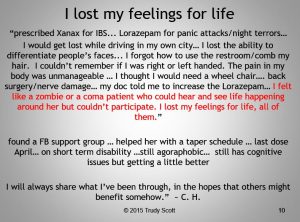
Here is one of the benzo stories I share in the webinar:
world benzo awareness day story


We know that some individuals are much more affected than others when it comes to tolerance and withdrawal.  Here are some other possible factors that may affect tolerance and withdrawal:
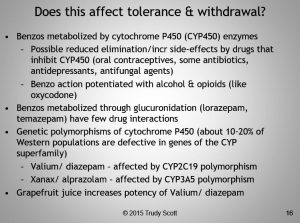
world benzo awareness day liver enzymes

During season 4 of the Anxiety Summit, Lisa Bloomquist talked about Antibiotic Induced Anxiety – How Fluoroquinolone Antibiotics Induce Psychiatric Illness Symptoms.   During this interview she shared how:

People who have gone through benzodiazepine withdrawal before should never take a fluoroquinolone because essentially it can throw people right back into the benzo withdrawal – because it has very similar effects on people’s GABA’s receptors as what happens when people go through benzodiazepine withdrawal. 

I would love to see a survey of people who have experienced adverse effects when using benzodiazepines as prescribed or when tapering. Could these be some of the contributing factors?

  • Taking Valium/ diazepam and have the CYP2C19 polymorphism (about 10-20% of Western populations are defective in genes of the CYP liver enzyme superfamily)
  • Taking Xanax/ alprazolam and have CYP3A5 polymorphism (about 10-20% of Western populations are defective in genes of the CYP liver enzyme superfamily)
  • Taking any benzodiazepine and also
    • Taking oral contraceptives
    • Taking a course of antibiotics
    • Taking a course of one of the fluoroquinolone antibiotics
    • On an SSRI prescription
    • Taking a course of antifungal medications
    • Drinking alcohol on a regular basis
    • On an opioid such as oxycodone
    • Drinking grapefruit juice on a regular basis

For withdrawal/tapering, the best resource I know of is Benzo.org.uk which contains the Ashton Manual. You will need to educate yourself and your doctor and/or find a doctor willing to help you with the adjusted prescription. It does need to be done very very very slowly.

Finding a good support group like Benzobuddies.org  is very helpful for many of my clients. Just be aware that this group and some of the other support groups say no to any supplements during the taper process. I find it to be very individualized and have many clients that see great benefit by using GABA, tryptophan, zinc, magnesium and other nutrients. (You can read more about this here: Anxiety and the amino acids overview)

That being said some people tapering can only tolerate very low amounts of the amino acids (like a dab or pinch from a capsule) and some can’t tolerate any supplements and do better with essential oils, yoga, light therapy and dietary changes.

You can find more information on World Benzodiazepine Awareness Day on Benzo Case: Raising Awareness about Benzodiazepine Drugs  (widely prescribed for anxiety, stress, sleep, pain and much more…) and additional stories on the World Benzo Awareness facebook page.

World Benzodiazepine Awareness Day was conceived by the acting Chair Barry Halsam, former Chair of Oldham TRANX, and jointly organized by Wayne Douglas, founder of benzo.case.com / benzo-case-japan.com

Please read share so your loved ones are informed and can say NO to benzos!  

If you have experienced adverse effects when taking or tapering from benzodiazepines I’d love some feedback on the above possible contributing factors.
 

Filed Under: Anxiety and panic, benzodiazapines, GABA, Gene polymorphisms Tagged With: benzodiazepine, benzodiazepines, CYP enzymes, fluoroquinolone antibiotics, GABA, Heather Ashton, Valium, World Benzodiazepine Awareness Day, Xanax

Medication tapering and withdrawal: an interview with Dr. Kelly Brogan

April 8, 2016 By Trudy Scott 80 Comments

mind-of-your-own-meme

I recently had the absolute pleasure of interviewing Dr. Kelly Brogan, holistic women’s health psychiatrist and author of the new bestseller, A Mind of Your Own. I’ve had the section on medication tapering and withdrawal effects transcribed because it’s so valuable.

=================================================================

Kelly: Now much of my practice is devoted to psychiatric medications tapers. Guess what? I didn’t learn that in my training. There wasn’t a single hour of education on this subject. I have learned how to do this from patients, and really from patients globally who are educating each other and frankly educating physicians about how to engage in a safe and responsible psychiatric medication tapers……

…when you try to taper off a medication after long-term exposure, either because you’re no longer deriving that initial benefit from it, or because something has changes about your life circumstance and you want to try a different kind of healthcare maybe, they you might learn that these are some of the most habit forming medications, I would say habit forming substances, on the planet.

I wouldn’t believe this if I haven’t seen it with my very own eyes, but this is what actually compelled me to put down my prescription pad for good. After I read that book, I began to take patients, or at least offer them the opportunity to taper them off of medication. Even when we did it responsibly, I was essentially running an outpatient rehab. I mean from neurologic symptoms to psychiatric symptoms, physical symptoms, autoimmune diseases flaring, patients developing impulsive behavior and even violence. It was beyond description.

Then I began to see that actually a lot of patients around the world are talking about this. They’re talking about withdrawal from anti-depressant specifically, but of course other medications as well. Their doctors are totally ill-equipped to help them because we don’t learn about how to do this in our training. We actually in fact dismiss patients when they talk about these being addictive medications. Of course, now finally Fava is a group of researchers who have finally begun to publish the reality of this withdrawal syndrome, and how disabling it can be.

Since I have 4 grounded lifestyle interventions, and actually begun with nutrition such that I don’t even begin a medication taper until about 2 months into lifestyle change, everything is different now in my practice. I feel that once you can optimize your physiology, you really put yourself in a much, much better position to safely and strategically taper. Wow. Isn’t that something you would want to know before taking your first prescription? I certainly never told any patients that it could be like a horror show and you might never be able come off of a psychiatric medication if you’re taking it for longer than a year or so. I never informed patients of that.

A lot of what I discuss and describe in this book is in service of presenting people with a full picture of what the science has to say before they make a decision. I think we really wish that there was a magic pill. We really wish there was a safe effective quick fix. Unfortunately, what is available is really anything but that.

Trudy: Yeah. We want that quick fix. I’ve got a few follow on questions, because this is a lot of good information here. The fact that you see all these problems when people are coming off the meds, is there a time frame, or is that really dependent on each person?

Kelly: It’s very, very dependent on each person. That ends up being the take home that we are talking about. What I like to call end of one medicine. We’re talking about the fact that our levels of biochemical individuality have ever been more relevant than when we’re exploring how we interact with chemicals in our environment, in our pharmaceuticals. We really need to understand that every single person is an individual.

When I taper patients off of meds, I normally do what’s called a test dose decrease, which often is around 20% to 25% of the dose. We come down by that. Again, this is after we’ve done the initial months at least of fairly strict dietary compliance working with relaxation response, doing 20 minutes or more of movement, working on sleep. All of this has to happen first. Then we begin, and so we start with a test dose. If we see in about 2 to 4 weeks that test dose is completely well-tolerated, meaning you don’t even notice the difference, then we probably can work in bigger increments. That’s actually a godsend. These tapers, when we’re working in 10% and less doses, could take literally years.

You want to begin to learn about what your body is capable of bouncing back from. We begin with 25%. If that’s not a pretty picture, then we’ll just scale it back to about 10% of the initial dose, and work with that 10% increment at about every 2 to 4 weeks, sometimes unfortunately slower. The increment and then the speed are 2 variables that we have to learn for each patient.

I don’t know what I would do without a compounding pharmacy. While many of these medications are available in liquid form, and some of them, like Effexor for example, have beads inside a capsule, to be able to tailor and personalize the dosage to each individual patient is wonderful and that I have that option through compounding pharmacy. I work with one in Massachusetts named Johnson Compounding, and they’ve just been a wonderful support over the years to my patients.

Trudy: Wonderful. Very slow and then obviously very individualized. Now I’m very familiar with the effects of benzodiazepines and the slow taper process that’s needed for someone on the anti-anxiety benzodiazepine medication. Would you say that SSRIs can have comparable effects in some people, or are they not as bad as the benzodiazepines?

Kelly: That’s a great question. What we’ve observed in psychiatry is that there’s really been a transition from using benzodiazepine as sort of like a spot treatment to transitioning into using anti-depressants long-term. When I was in my training, the typical gold standard protocol would be to start somebody on both benzodiazepine and anti-depressant, and then taper them off to benzodiazepine and leave on the anti-depressant with the thinking being that benzodiazepine are acknowledged for their habit forming properties and anti-depressants are totally safe.

What we are learning is in fact, that group that Fava runs, with the papers that they’re putting out, they are essentially equating the anti-depressant withdrawal phenomenon to benzodiazepines. In my clinical experience, I would actually argue that SSRIs are worse with long-term exposure. A lot of people at this point, given that it’s been decades since Prozac, have been on these medications for more than 10 years. We’re really talking about a level of habituation that could be challenging to undo. It’s not that I haven’t. I struggled a lot with Klonopin for example. It’s not that I haven’t encountered challenges with benzodiazepines.

A patient in my practice I’m taking off of Lexapro a thousandth of a milligram a month. I’ve never heard of something like that. Heroin, crack, cocaine, oxycontin: show me something that would ever require that. It’s unbelievable. I think it’s at least comparable I would say, and that’s what the literature is beginning to demonstrate, is that there are actually comparable phenomenon, but we really never ever talked about anti-depressants in this way, so it really is a game changing perspective.

Trudy: The fact that you say people are not told that this could be a possibility, and the fact that you’re talking about this and writing about it I think is so important, because people need to know. They would choose not to do this if they did know. I see there is this MA bill going through [correction: being proposed – you can read more here]. It’s about benzodiazepines and people needing to consent to the fact that it’s going to possibly cause them issues. It sounds like we need to do the same with these anti-depressants.

Kelly: Absolutely, 100%.

Trudy: Now, I’ve heard that certain SSRIs are worse than others. I’ve heard that Paxil can be really bad. Have you seen a difference between different medications?

Kelly: Basically we look at half-life of these medications, and we extrapolate from there. Assuming that Prozac would be the easiest, and there are medications like Paxil and Effexor that are more challenging. In my experience, there are 2 ways of discontinuation – the field likes to call it discontinuations issues. The first is acute. It’s within 72 hours of a dose change where you can get brain zaps and headache, and gastrointestinal distress, you feel agitated. The Paxils of the world are much more likely to cause those more immediate withdrawal symptoms.

What I have found is unfortunately there’s no free lunch. There isn’t a medication that actually is effortless to come off for everyone, so that even when you’re on Prozac, for example, for a long period of time, even though it has this long half-life, it should be easy to come off of, in my experience, it can often be challenging as well. These other medications often manifest as second waves. What I have found is almost uncanny – after about 2 months, it’s almost always 6 to 8 weeks after the final dose or after a major dose change. It’s like the other shoe can drop.

You have those immediate withdrawal symptoms, and then about 2 months later, you can begin to have what has historically been categorized as a relapse. This is when your doctor will tell you, “You see, you should have never even tried to go off your medication. You need it for life. Now you know.” That’s what we’re taught to say. In fact, it’s actually a protracted withdrawal phenomenon. Again, this has now been documented that this can occur for unfortunately, I don’t want to scare anyone, it can occur for months and months and even years after the final dose. That being said, there is a medication that spares you from that arm of this problem.

Even I went for years tapering patients off of Wellbutrin and thinking, “Well, this is the easy one. I can even come down by 50% of the dose, and it’s not a problem.” Right now, I have in my practice, a patient who has been completely destabilized coming down by 25 milligrams of Wellbutrin. Again, it’s a very individualized process, and I don’t think that there are any obvious choices in terms of medications that are easier come off of after long-term exposure.

Trudy: Thank you for sharing that. It’s scary, but the good thing is that there are solutions. People on these medications must do the slow taper and make all the changes that you’ve talked about. I’m glad that you mentioned, “Don’t rush into this, make all the food changes.” We’re going to talk about some of the things that you recommend in a second, but get yourself in a better place to start making these changes. If you’re listening to this and you’re thinking, “Oh my gosh. This is terrible.” Don’t go and rush out and just stop. You simply don’t want to stop cold turkey. You want to be working with someone. Then obviously read the book and get resources so you can be in a good place when you’re starting to make these changes.

Kelly: Absolutely. That’s all incredibly important. Yes. Please don’t ever consider just stopping your medication.

Trudy: Absolutely. I have one final question on the medication aspect. You’ve got a small section in the book where you talk about using amino acids are helping people taper, and as you know, my community is very into using the amino acids. I find them very helpful for helping people with mood and anxiety issues. Can you talk a little bit about how you use the aminos and how beneficial you find them when someone is doing this taper?

Kelly: Yes. Absolutely. I am quite certain that there are many, many, many roads to physiologic and psycho spiritual resiliency. I, in no way, intend to position myself as having the answer by any means. I am very much trying to create a space for all of those who are passionate about natural healing, including yourself and our colleagues, because I think that just about everything in the natural health arena offers you the potential for very high yield, very low-risk healthcare.

I certainly don’t consider myself an expert in amino acids and don’t have a fraction of the knowledge that you have about this arena. That being said, I do use them for tapers specifically. If I use supplements I wait after a month of dietary change before introducing any supplements, mostly because I want to, I don’t know, send patients the message of what a single intervention, in terms of lifestyle, what a dietary intervention can do in terms of moving the needle of their health. I often don’t want to cloud the picture with other interventions like even supplements or even detox.

After that period, if it is necessary, I’ll often lead with some of the supplements that I talk about, whether it’s probiotic or glandulars, I use a lot based on my work with the only mentor I’ve ever had, Dr. Nicholas Gonzales. I learned a lot about using glandulars, using specific minerals, using fatty acids, that sort of thing. Well, we’re working with SSRIs. I tend to use tryptophan more often than 5-HTP. I do use tryptophan even in the 3 to 6 gram range before dinner and before bed. I would say that it’s helpful often, not in every case, with a lot of the insomnia specifically. It’s about the worst thing that can happen in the setting of a taper. It’s the kind of insomnia that’s induced by psychiatric medication taper.

I have several tricks up my sleeve, and that’s certainly one of them. Through my own self-education, and again, you may have a more sophisticated perspective on this that when you use 5-HTP or tryptophan for the longest period of time, meaning over a couple of weeks, so you want to balance it out with tyrosine or DL-phenylalanine. If we are using it for a period of time, I might incorporate that. I have found that when I work with Wellbutrin tapers, it’s extremely helpful. Tyrosine and actually an herb called mucuna support dopamine.

Then all of my patients who are tapering – I have them on a blend of amino acids.

=================================================================

We cover much more than the medication taper and withdrawal and you can listen to the entire interview here:

https://s3-us-west-2.amazonaws.com/axmisc/kelly-brogan-mind-of-your-own-interview-spr16.mp3


A Mind of Your Own: The Truth about Depression and How Women Can Heal Their Bodies to Reclaim Their Lives is superb, brave, bold, science-based (which I love!) and offers holistic solutions for depression (and anxiety). Get the book from Amazon or better yet, get a copy from your local book store (ask them to get it if they don’t carry it)!

mind-of-your-own-meme2

It launched March 16th and there is a grass-roots effort to share this book widely because of the mainstream media blackout.  Join the grassroots effort and help share this valuable message!

Take a picture with the book and post on social media with #amindofyourown and you can have an impact. You’ll also automatically show up in “hall of fame” on the tagboard.

mind-of-your-own-meme3

You can go and get the first chapter of the book if you’re on the fence (get it here: http://kellybroganmd.com/amindofyourown/?ref=35). After reading the first chapter, I know you’ll want to get the book and join the grass roots effort.

If you already have the book lets us know in the comments what you think.

Feel free to post questions on the blog and please do share your SSRI or benzodiazepine taper and withdrawal story so we can all be better informed.

PS. Both Kelly Brogan and myself will be presenting at the Mindd Conference in Sydney in May. We’ll also be presenting at IMMH/Integrative Medicine for Mental Health Conference in September in Washington DC. Come along to those events, and you can hear Kelly Brogan speak live, and you can hear me speak live as well.

Filed Under: Antidepressants, benzodiazapines, Books, Depression, Drugs, Events Tagged With: a mind of your own, antianxiety, antidepressant, anxiety, benzodiazepine, depressed, interview, Kelly Brogan, medication, SSRI, taper, withdrawal

Benzodiazepines: informed consent? Your support is needed

March 25, 2016 By Trudy Scott 20 Comments

Benzodiazepine Bill

If you’ve been following me for a while you know how opposed I am to the long-term use of benzodiazepines. These medications are only intended to be prescribed for no longer than 2 weeks at the most. But I really do think they should not be prescribed at all.

I was very pleased when Alison Page reached out to me asking if I’d share what’s happening in Massachusetts. It’s a proposed bill that would require informed consent for benzodiazepine use: Call To Action: Massachusetts Bill H4062 for Informed Benzodiazepine Use is Official

I’ve blogged extensively about benzodiazepine dangers and mention them when I present at conferences and on summits. Here are a selection of blog posts:

  • The possible increased risk of Alzheimer’s disease (and I share some of Alison’s story in this one): Benzodiazepines linked to increased Alzheimer’s risk and other serious concerns
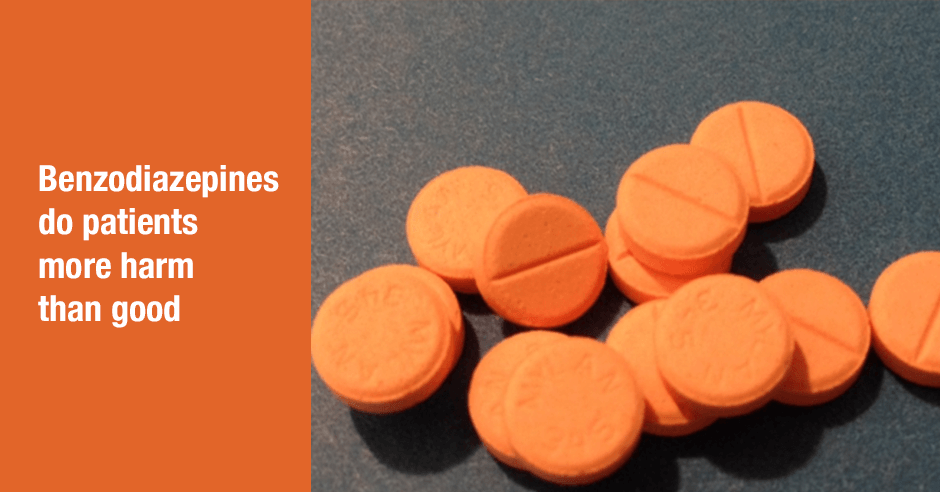
  • Nicole Beurkens shares her experiences with benzodiazepines: Benzodiazepines do patients more harm than good
  • The webinar replay of the talk I did for Hawthorn University: Say NO to benzodiazepines for anxiety! (webinar replay)

The Massachusetts Bill H4062 is calling for written informed consent from the doctor stating the risks of taking this class of drugs. Here are the Specifics of the bill:

Anyone receiving a benzodiazepine prescription will receive written informed consent from their doctor stating the risks of taking this class of drugs. The consent form will ensure that patient’s understand that benzodiazepines and sleep aids can lead to physical dependence, and in some cases, addiction. The informed consent form will also specify that this drug can, in some cases, cause an injury to the nervous system and dangerous and/or disabling withdrawal reaction. The consent form will also specify that long-term use is contraindicated.

Benzodiazepine prescriptions will be written on brightly colored paper to ensure that patients know that they are receiving a potentially harmful substance that could lead to physiological dependence or addiction.

No patient will be taken off benzodiazepines or sleep aids without their full consent. No patient will be “cold turkeyed” off their prescription. For patient’s choosing to come off, a safe taper schedule will be implemented.

Drug labels will indicate that long-term use is contraindicated.

If you would like to help this bill pass and gain momentum, Alison shares how you can reach out to Massachusetts state senators and representatives. They are also asking you to share your personal stories of benzodiazepine harm. These stories will be presented as evidence to the Joint Committee as they decide whether or not the bill moves forward. All the details on how to do this can be found here.

These are good initial steps to create awareness for both anxious individuals, and doctors who are not aware of the terrible effects so many suffer.

We certainly appreciate the efforts of people like Alison, who is a benzodiazepine survivor herself. She took prescribed benzodiazepines off and on for 16 months and was rapidly tapered off. She ended up with a severe central nervous system injury which has taken years to recover from. As a result of her experience, Alison is now an activist on behalf of psychiatric survivors and works to raise awareness about the dangers of psychiatric drugs and treatment methods.

One of her wonderful projects is the creation of an art book entitled Healing from Psychiatry: An Artist’s Perspective. She has close to 50 contributors from all over the world who have suffered or are suffering as a result of psychiatric treatments and medications.

Update 3/28/16:

Geraldine Burns worked closely with Representative Paul McMurtry to have this first of a kind bill filed in the United States.  This bill was filed in Massachussetts on February 24, 2016, and it received the official bill number H.4062 – An Act Relative to Benzodiazepines and Non-Benzodiazepine Hypnotics.

Geraldine shared this information about her pioneering work in helping to get the word out about the potential dangers of benzodiazepines: 

In 1999 I started the first Internet support group for people wishing to withdraw from tranquilizers or already off and having problems.  This was the first group of its kind and before it closed had closes to 4,000 members internationally.  The group was started to offer 24 hour/7 days a week support to people who have been made ill by prescription medications, to learn about symptoms of withdrawal, learn about tapering methods, and natural methods of healing.

She is dedicated to the responsible and informed use of addictive prescription drugs: Education, Advocacy, Research and Support.  And she was instrumental in having Professor C. Heather Ashton, Professor Emeritus from the University of Newcastle write her manual “Benzodiazepines: How They Work and How to Withdraw” also known as The Ashton Manual.  This manual has now been translated into 11 other languages and can be found online at www.benzo.org.uk

In 2006, Geraldine launched the website BenzoBookReview  after she was given the rights by eleven internationally known authors of books that had been written on the subject of tranquilizers of which some were no longer being published.  She worked to have some of them revised and updated so they could bring the most up-to-date information on tranquilizers and sleeping pills to the public. 

Currently she is being filmed for the documentary As Prescribed  which is a film project about benzodiazepine dependency and discontinuation syndrome. Here is a snippet about this documentary that is being produced by Holly Hardman:

There is a formidable health epidemic in our midst. Its sufferers tend to be “good patients” following doctor’s orders. Perhaps their doctors prescribed Ativan, Xanax, Valium, or Klonopin – common names for a class of anxiolytic drugs known as benzodiazepines. Perhaps the drug was given to calm nerves, promote sleep, balance moods, or just to make life a little easier. Too often these good patients begin to experience strange symptoms and develop mysterious illnesses that plague them for years, upending their lives. Too often they are told that the drugs could not be their problem. By following personal stories and investigating growing medical evidence, As Prescribed questions the prescribing practices and consequences of these popular, not-so-innocent drugs.

We appreciate Geraldine and Alison and everyone involved with this bill, and all the advocates like Holly and others who are working so tirelessly to create awareness.

Please do share your story with benzodiazepines too.  The more who hear this information, the more can be helped.   And please share this blog if you care and know of anyone using these medications and looking for help, and to folks who may be considering these medications or may be prescribed them in the future.  

Update 3/29/16:

The Massachusetts Benzo Bill H4062: Informed consent for benzodiazepines and non benzodiazepine hypnotics  was just scheduled to be heard by the Joint Committee on Mental Health and Substance Abuse on Monday, April 4th.  The committee will then decide whether the bill moves forward to the house and senate, goes to study, or is denied.

If the bill “goes to study” it is essentially dead in the water until the next legislative session, and in that case, the bill often dies. It is important that we rally around the bill to make sure it passes during this session.

The bill will ensure that patients get informed consent about the potential dangers of benzos, if they are already on the drug, they will have the choice of whether or not to come off, and if they do choose to come off, a safe slow taper will be implemented. The bill specifies that it is the patient who decides whether or not they would like to come off their benzodiazepine.

What Can you do to Help?

  1. Attend the public hearing and testify on Monday, April 4th, 2016 at 1:00pm in Hearing Room A-1 at the Massachusetts State House 
  2. E-mail your support of this bill. It is most important that the committee hears from Massachusetts residents, but anyone from around the world is welcome to write in support of Bill H4062. 

Please see the comment from Alison Page below (on 3/28/16).  She shares all the details on the above 2 steps: how to testify and who and what to email.

Update: 4/8/16

Alison emailed me with an update about the hearing for Bill H4062: Informed consent for benzodiazepines and non-benzodiazepine hypnotics. The hearing took place on Monday, April 4 at 1PM at the Massachusetts State House in Boston, MA.

She shared a new blog link with all the updates.  This is an overview of what will be happening next:

The committee hearing the testimonies will be reviewing all of the written testimonies of the people unable to attend the hearing, and will then decide whether or not the bill moves forward to the House and Senate. The discussion, parts of which you can watch in the video below, clarified some important points in the legislation and gave survivors an opportunity to tell their stories.

Alison also shares some additional background about the bill and benzodiazepines, and a detailed account of what happened at the hearing (same link as above).

geraldine burns MA benzodiazepine hearing april 2016
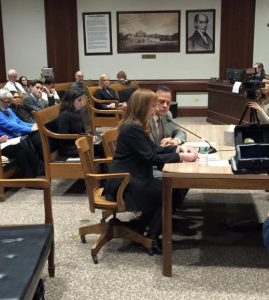
Geraldine Burns, benzodiazepines survivor who brought the “benzo bill” to representative McMurtry’s attention, speaks about her journey through long-term benzodiazepine use, the subsequent injury it caused to her nervous system, and the many years it took to recover once she was off the drug (used with permission: Alison Page)

Alison also shares her personal experiences too and how emotional and yet cathartic it was to be there to testify:

There were a lot of tears at the hearing. The personal testimonies from survivors and caretakers were poignant, honest, vulnerable, and moving. This is the first time that the “benzo community” has had the opportunity to openly tell their stories in a platform that could influence legislation so that other people will not get harmed by prescribed benzodiazepines.

I was so proud to be there and witness the courage, camaraderie, resilience, advocacy, and vulnerability of fellow survivors. This is the first time I have met these people, who I’ve talked to online for years, and who I consider dear friends. This is the first time I have visited Boston since coming off benzodiazepines several years ago, so it was a personal victory, as well.

Testifying was cathartic, both for the individuals and for the “benzo community” as a whole. This legislation is our chance to be heard. As one survivor said, through tears, to the committee, “Do not let my suffering be in vain. I beg you to pass this bill.”

Action steps to keep the momentum going:

  • Continue to send your stories
  • Reach out to Massachusetts representatives, senators, and governors and ask them to vote yes on this bill
  • Start talking about this and sharing stories in other states
  • Follow updates and “calls to action” for Bill H4062 on the new Benzodiazepines Bill Facebook page

Thanks to everyone who went to testify! 

And thank you if you  commented here, shared this post and sent in your story.

If you have questions for Alison or Geraldine or me you can post them in the comments below.


Filed Under: Antianxiety, benzodiazapines Tagged With: alison page, anxiety, As Prescribed, benzodiazepine, consent, Geraldine Burns, Holly Hardman, Massachusetts Bill H4062

Benzodiazepines do patients more harm than good

September 15, 2015 By Trudy Scott 91 Comments

benzo harm

Dr. Nicole Beurkens recently shared her experiences about benzodiazepines on the blog: Say NO to Benzodiazepines for anxiety!

In my experience as a clinical psychologist benzodiazepines do patients more harm than good. While it is appealing to think that a pill can quickly and effectively remove symptoms of anxiety, panic, and/or insomnia, the reality is that there are significant negative long-term consequences for most people who use these medications.

It is not uncommon for me to have patients on multiple psychotropic medications, including benzos, due to symptoms of anxiety, insomnia, or other mental health issues.

Patients can quickly become dependent on these medications, and they are often prescribed higher doses over time with diminishing returns.

Some patients reach a point where they are not having symptom relief with the benzos, but they cannot function at all without them.

This issue is fresh in my mind because I have a 24-year-old male patient who is entering a rehab program next week due to addiction and substance use issues. The gateway drugs that led to these addiction issues for him were Ativan and Adderall prescribed to him since he was 14 years old. He now sees that these drugs have done a significant amount of damage, but we are having to admit him to a long-term treatment program to get off of these medications (and other substances) safely.

I maintain that if prescribers fully informed patients of the risks involved with these medications most people would never start taking them. We need to do more to educate patients and practitioners about the realities of these medications, as well as safer alternatives.

I am now devoting a significant amount of time and attention to this issue not just for benzodiazepines, but psychiatric medications in general. Especially where children are concerned, parents and professionals needs to have appropriate facts about these drugs and understand the many non-medication options that are available. I’m writing about this and providing resources at my site http://www.DrBeurkens.com for anyone who is interested. Thanks, Trudy, for getting this information out to more people!

As she says, it’s so important that we need to do more to educate patients and practitioners about the realities of these medications, as well as safer alternatives. Here is a recent blog post where she does just that: Beware the Rush to Prescribe

I appreciate that Dr. Beurkens is now devoting a significant amount of time and attention to this issue not just for benzodiazepines, but psychiatric medications in general. Her motto is to provide “Solutions to End Overmedication of Children with Developmental or Mental Health Concerns.”


Filed Under: benzodiazapines, Events Tagged With: anxiety, benzodiazepine, benzodiazepines, Dr. Nicole Beurkens, harm, psychiatric medications

Say NO to benzodiazepines for anxiety!

September 3, 2015 By Trudy Scott 61 Comments

no-to-benzodiazepines

Professor Malcolm H. Lader says it well: 

It is more difficult to withdraw people from benzodiazepines than it is from heroin. 

For this reason we need to say NO to benzodiazepines for anxiety (and other conditions)!

Benzodiazepines are a class of psychoactive drugs that work by enhancing the effect of the calming neurotransmitter GABA, and are used to treat anxiety, insomnia, pain, muscle spasms and a range of other conditions. They are widely prescribed, particularly among elderly patients and may even be used off-label with children with autism.

Use of this medication is very controversial.  We know long term use leads to tolerance, dependence, and many adverse psychological effects and even physical effects. Short term use is generally considered safe but even using them for 2 – 4 weeks can lead to problems for certain individuals.  

In this presentation I’ll be providing an overview of benzodiazepines; when they are used; who they are prescribed to; details about tolerance, dependence, and the many adverse effects; how to taper, including nutritional support during the taper; what to do instead of saying yes to a benzodiazepine prescription in the first place; and additional resources.

This will be a webinar for Hawthorn University and will be on Tuesday Sept 15 at 4pm PST. Register for the webinar here:
https://attendee.gotowebinar.com/register/2859158311212769537

I’d love questions/feedback/comments/your benzodiazepine experiences and topics you’d like me to address during this presentation.

Filed Under: benzodiazapines, Events Tagged With: adverse effects, anxiety, benzodiazepine, dependence, GABAtolerance, how to taper

  • « Go to Previous Page
  • Page 1
  • Page 2
  • Page 3
  • Page 4

Primary Sidebar

NEW! GABA QuickStart Homestudy (with special intro pricing)

gaba quickstart homestudy

Free Report

9 Great Questions Women Ask about Food, Mood and their Health

You'll also receive a complimentary subscription to my ezine "Food, Mood and Gal Stuff"


Connect with me

Popular Posts

  • Amino Acids Mood Questionnaire from The Antianxiety Food Solution
  • The Antianxiety Food Solution Amino Acid and Pyroluria Supplements
  • Pyroluria Questionnaire from The Antianxiety Food Solution
  • Collagen and gelatin lower serotonin: does this increase your anxiety and depression?
  • Tryptophan for the worry-in-your-head and ruminating type of anxiety
  • GABA for the physical-tension and stiff-and-tense-muscles type of anxiety
  • The Antianxiety Food Solution by Trudy Scott
  • Seriphos Original Formula is back: the best product for anxiety and insomnia caused by high cortisol
  • Am I an anxious introvert because of low zinc and vitamin B6? My response to Huffington Post blog
  • Vagus nerve rehab with GABA, breathing, humming, gargling and key nutrients

Recent Posts

  • What do I use instead of Seriphos to help lower high cortisol that is affecting my sleep and making me anxious at night?
  • BeSerene™ GABA/theanine cream eases severe muscle tension in her neck/shoulders, prevents her bad headaches and quells her anxiety
  • How the correct approach, dose and sublingual use of GABA can be calming and not cause a flushed and itchy face and neck
  • The amino acid glutamine improves low mood by addressing gut health, and it has calming effects too
  • Flight anxiety with heightened breath, physical tension and also fearing the worst (the role of low GABA and low serotonin)

Categories

  • 5-HTP
  • AB575
  • Addiction
  • ADHD
  • Adrenals
  • Alcohol
  • Allergies
  • Alzheimer's disease
  • Amino Acids
  • Anger
  • Antianxiety
  • Antianxiety Food Solution
  • Antidepressants
  • Anxiety
  • Anxiety and panic
  • Autism
  • Autoimmunity
  • benzodiazapines
  • Bipolar disorder
  • Books
  • Caffeine
  • Cancer
  • Candida
  • Children/Teens
  • Collagen
  • Cooking equipment
  • Coronavirus/COVID-19
  • Cravings
  • Depression
  • Detoxification
  • Diabetes
  • Diet
  • DPA/DLPA
  • Drugs
  • EFT/Tapping
  • EMF
  • EMFs
  • Emotional Eating
  • Endorphins
  • Environment
  • Essential oils
  • Events
  • Exercise
  • Fear
  • Fear of public speaking
  • Fertility and Pregnancy
  • Fish
  • Food
  • Food and mood
  • Functional neurology
  • GABA
  • Gene polymorphisms
  • General Health
  • Giving
  • Giving back
  • Glutamine
  • Gluten
  • GMOs
  • Gratitude
  • Gut health
  • Heart health/hypertension
  • Histamine
  • Hormone
  • Hyperparathyroidism
  • Hypoglycemia
  • Immune system
  • Inflammation
  • Insomnia
  • Inspiration
  • Introversion
  • Joy and happiness
  • Ketogenic diet
  • Lithium orotate
  • Looking awesome
  • Lyme disease and co-infections
  • MCAS/histamine
  • Medication
  • Men's health
  • Mental health
  • Mercury
  • Migraine
  • Mold
  • Movie
  • MTHFR
  • Multiple sclerosis
  • Music
  • NANP
  • Nature
  • Nutritional Psychiatry
  • OCD
  • Osteoporosis
  • Oxalates
  • Oxytocin
  • Pain
  • Paleo
  • Parasites
  • Parkinson’s disease
  • PCOS
  • People
  • PMS
  • Postpartum
  • PTSD/Trauma
  • Pyroluria
  • Questionnaires
  • Real whole food
  • Recipes
  • Research
  • Schizophrenia
  • serotonin
  • SIBO
  • Sleep
  • Special diets
  • Sports nutrition
  • Stress
  • Sugar addiction
  • Sugar and mood
  • Supplements
  • Teens
  • Testimonials
  • Testing
  • The Anxiety Summit
  • The Anxiety Summit 2
  • The Anxiety Summit 3
  • The Anxiety Summit 4
  • The Anxiety Summit 5
  • The Anxiety Summit 6
  • Thyroid
  • Thyroid health
  • Toxins
  • Tryptophan
  • Tyrosine
  • Uncategorized
  • Vegan/vegetarian
  • Women's health
  • Yoga

Archives

  • October 2025
  • September 2025
  • August 2025
  • July 2025
  • June 2025
  • May 2025
  • April 2025
  • March 2025
  • February 2025
  • January 2025
  • November 2024
  • October 2024
  • September 2024
  • August 2024
  • July 2024
  • June 2024
  • May 2024
  • April 2024
  • March 2024
  • February 2024
  • January 2024
  • December 2023
  • November 2023
  • October 2023
  • September 2023
  • August 2023
  • July 2023
  • June 2023
  • May 2023
  • April 2023
  • March 2023
  • February 2023
  • January 2023
  • December 2022
  • November 2022
  • October 2022
  • September 2022
  • August 2022
  • July 2022
  • June 2022
  • May 2022
  • April 2022
  • March 2022
  • February 2022
  • January 2022
  • December 2021
  • November 2021
  • October 2021
  • September 2021
  • August 2021
  • July 2021
  • June 2021
  • May 2021
  • April 2021
  • March 2021
  • February 2021
  • January 2021
  • December 2020
  • November 2020
  • October 2020
  • September 2020
  • August 2020
  • July 2020
  • June 2020
  • May 2020
  • April 2020
  • March 2020
  • February 2020
  • January 2020
  • December 2019
  • November 2019
  • October 2019
  • September 2019
  • August 2019
  • July 2019
  • June 2019
  • May 2019
  • April 2019
  • March 2019
  • February 2019
  • January 2019
  • December 2018
  • November 2018
  • October 2018
  • September 2018
  • August 2018
  • July 2018
  • June 2018
  • May 2018
  • April 2018
  • March 2018
  • February 2018
  • January 2018
  • December 2017
  • November 2017
  • October 2017
  • September 2017
  • August 2017
  • July 2017
  • June 2017
  • May 2017
  • April 2017
  • March 2017
  • February 2017
  • January 2017
  • December 2016
  • November 2016
  • October 2016
  • September 2016
  • August 2016
  • July 2016
  • June 2016
  • May 2016
  • April 2016
  • March 2016
  • February 2016
  • January 2016
  • December 2015
  • November 2015
  • October 2015
  • September 2015
  • August 2015
  • July 2015
  • June 2015
  • May 2015
  • April 2015
  • March 2015
  • February 2015
  • January 2015
  • December 2014
  • November 2014
  • October 2014
  • September 2014
  • August 2014
  • July 2014
  • June 2014
  • May 2014
  • April 2014
  • March 2014
  • February 2014
  • January 2014
  • December 2013
  • November 2013
  • October 2013
  • September 2013
  • August 2013
  • July 2013
  • June 2013
  • May 2013
  • April 2013
  • March 2013
  • February 2013
  • January 2013
  • December 2012
  • November 2012
  • October 2012
  • August 2012
  • July 2012
  • June 2012
  • May 2012
  • April 2012
  • March 2012
  • February 2012
  • January 2012
  • December 2011
  • November 2011
  • October 2011
  • September 2011
  • August 2011
  • July 2011
  • June 2011
  • May 2011
  • April 2011
  • March 2011
  • February 2011
  • January 2011
  • December 2010
  • October 2010
  • September 2010
  • July 2010
  • May 2010
  • April 2010
  • March 2010
  • February 2010
  • January 2010
  • November 2009

Share the knowledge!

The above statements have not been evaluated by the Food and Drug Administration. Products listed in this website are not intended to diagnose, treat, cure or prevent any disease.

The information provided on this site is for informational and educational purposes only and is not intended as a substitute for advice from your physician or other health care professional. You should consult with a healthcare professional before starting or modifying any diet, exercise, or supplementation program, before taking or stopping any medication, or if you have or suspect you may have a health problem.


Copyright © 2026 Trudy Scott. All Rights Reserved. | Privacy | Terms and Conditions | Refund Policy | Medical Disclaimer

Free Report

9 Great Questions Women Ask about Food, Mood and their Health

You’ll also receive a complimentary subscription to my ezine “Food, Mood and Gal Stuff”