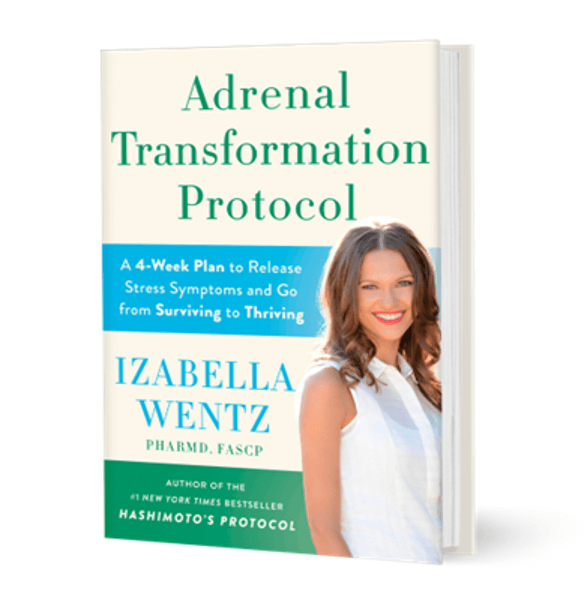
This is a guest post from my friend and colleague, Dr. Izabella Wentz, who just came out with her latest book, Adrenal Transformation Protocol (my Amazon link). The book is focused on healing your adrenals, and in it she shares specific strategies to support anxiety. Izabella shares a few of the many strategies with you here in this guest post.
You’ll notice that we share many common approaches:
- Addressing low blood sugar (much more on that below)
- Caffeine intake: Izabella recommends reducing caffeine but I have found many folks in my community need to quit altogether. I have noticed that those with panic disorders experience increases in symptoms such as nervousness, fear, nausea, heart palpitations, and tremors after consuming caffeine and said the effects were similar to how they felt during a panic attack.
- Gluten elimination: Interestingly, I have found in my clinical experience and research that there is a connection between gluten and anxiety, social phobia, depression, and even schizophrenia.
- Using herbal adaptogens, addressing nutrient deficiencies, and even pyroluria which can deplete key nutrients needed for adrenal health (especially when under high amounts of stress).
All of her approaches focus on adrenal health specifically and she has now taken over 3000 people on an adrenal healing journey. And 86% of them reported that their anxiety improved after going through her protocol.
By Dr. Izabella Wentz. PharmD
Stress is at the root cause of many chronic health issues, and very well may be at the root of your anxiety, too. Chronic stress can put a burden on our adrenal glands, resulting in an excess of stress hormones like cortisol. The body’s repeated exposure to cortisol can result in increased blood sugar levels, increased heart rate, and increased blood pressure, all of which can lead to feelings of anxiety.
The adrenals are two small glands, located on top of each kidney, that release hormones such as cortisol and adrenaline. Adrenal dysfunction generally occurs when your hypothalamic-pituitary-adrenal (HPA) axis is unable to effectively manage your stress response. The HPA axis describes the interactive feedback loop that takes place among these three endocrine, or hormone-producing, glands. If the communication among these three breaks down, your adrenals and their ability to produce important essential hormones can be jeopardized.
Overactive adrenals can leave you feeling like you’re constantly in “fight or flight” mode. First, your body releases high levels of stress chemicals like adrenaline and cortisol. To ensure you’re ready to defend yourself or run, these chemicals spike your blood sugar, as well as increase heart rate, blood pressure, and insulin levels – making you feel anxious, stressed and wide awake at night.
Chronic stress is one of the most common causes of adrenal dysfunction. Our bodies are well-equipped to respond to acute stressors (like being chased by a bear or getting out of the way of an oncoming car), where we experience activation of the fight-or-flight response, followed by a return to the rest-and-digest state.
However, many of us today face a never-ending presence of stressful, yet non-life-threatening, situations that can lead to the constant activation of the stress response.
With enough chronic stress, the HPA axis becomes overwhelmed and desensitized to the usual feedback loop, and stops sending messages to the adrenals to produce more hormones or less hormones, no matter what’s happening.[1]
Other common causes of adrenal dysfunction include sleep deprivation, blood sugar dysregulation, and chronic inflammation (which are all forms of stress on the body).
Symptoms of poor adrenal function may include the following:
- Feeling overwhelmed
- Feeling anxious
- Feeling tired despite adequate sleep
- Trouble falling asleep or trouble staying asleep
- Difficulty getting up in the morning
- Dependency on caffeine
- Cravings for salty foods (a.k.a. the “I just ate a whole bag of chips” syndrome)
- Cravings for sweet foods
- Increased effort required for everyday activities
- Intolerance to exercise
- Low blood pressure
- Feeling faint/dizzy when getting up quickly
- Easily startled
- Mental fog or trouble concentrating
- Alternating diarrhea/constipation
- Low blood sugar (often presenting as feeling angry when hungry or, as I like to call it, “hangry”)
- Decreased sex drive
- Decreased ability to handle stress
- Longer healing time
- Mild depression
- Less enjoyment in life
- Feeling worse after skipping meals
- Increased premenstrual syndrome (PMS)
- Reduced ability to make decisions
- Reduced productivity
- Poor memory
If you have three or more of these symptoms, and if these symptoms developed after experiencing a period of acute or chronic stress, sleep deprivation, an infection, or toxic exposure, chances are that you have adrenal dysfunction.
The anxiety adrenal connection
Anxiety is a hallmark symptom of adrenal dysfunction. When the adrenals are compromised, your resilience to stress starts to go down, and you might start to feel more anxious.
Of course, anxiety and adrenal dysfunction run on a two-way street. Chronic stress and anxiety can tax the adrenals, and weakened adrenals can contribute to feelings of anxiety.[2]
There’s another connection here that I’d like to highlight, and that is the thyroid. The thyroid is impacted by adrenal function, and anxiety can also be connected to thyroid conditions. In fact, I’ve noticed that up to 50 percent of my clients with anxiety have Hashimoto’s, an autoimmune thyroid condition.
A 2004 study found an association between the presence of a mood or anxiety disorder, and the presence of anti-TPO antibodies (indicating Hashimoto’s).[3] It also noted that a slight reduction in thyroid hormone secretion (such as that found in subclinical hypothyroidism) may affect mood as well. Therefore, it’s also possible that the anxiety you are feeling is related to your thyroid.
Anxiety solutions: Use the ABC’s
One of the first places to start is with the ABCs of adrenal health – adaptogens, B vitamins, and vitamin C.
Adaptogens both tone down overactive systems and boost underactive systems in the body, and are thought to help normalize the HPA axis. Examples of adaptogenic herbs that may increase the body’s ability to resist stress include: ashwagandha, astragalus, reishi mushroom, dang shen, eleuthero, ginseng, jiaogulan, licorice, maca, schisandra, spikenard, and suma.
Ashwagandha in particular is helpful for stress and anxiety, and it can also support thyroid health. Research supports that ashwagandha may offer antidepressant, antioxidant, anti-inflammatory and neuroprotective benefits.[4] It also may reduce anxiety, improve sleep, and even help address sexual dysfunction in women.[5]
Rhodiola is another favorite for stress support, mood support, and improved sleep. Sometimes referred to as golden root, rhodiola focuses on our nervous system health. Izabella has found it to be helpful for those with depressed cortisol levels (which can happen in later stages of adrenal dysfunction).
One of the main chemicals in rhodiola is salidroside, found to have neuroprotective effects that reduce the impact of stress on the immune system and the neuro-endocrine system.[6] Studies have found an anti-fatigue effect along with cognitive function improvements, such as memory improvements (during stressful conditions), and it’s also been shown to diminish depressive symptoms.[7]
B vitamins and vitamin C tend to be depleted during times of stress and high cortisol production. In particular, deficiencies in pantothenic acid and biotin (vitamins in the “B” family), have been linked to decreased adrenal function in animals and humans.[8]
Vitamin C is an important antioxidant that helps support the adrenals, mitochondria, collagen production, and immune function.[9] It’s also needed for the production of cortisol.
Supplementing with the ABCs is a really good place to start if you’re experiencing anxiety or adrenal dysfunction.
Balancing blood sugar
One of the most important strategies to reduce your anxiety involves addressing blood sugar issues. Blood sugar swings can put us on an emotional rollercoaster.
After consuming carbohydrate-rich foods, some people find their blood sugar goes up too high, too quickly.
This leads to a rapid, sometimes excessive release of insulin (a hormone that regulates blood sugar levels). These insulin surges can cause low blood sugar, which can cause unpleasant symptoms such as anxiety, nervousness, lightheadedness, fatigue, excessive hunger, and “hanger”.[10]
You can balance your blood sugar by reducing your intake of carbohydrates, and increasing your protein and fat intake. A low-carb or ketogenic diet (a low-carb diet where the body breaks down fats for fuel instead of relying on carbohydrates) could be beneficial for some.
Starting the day off by having a breakfast that is filled with good fats (for example, avocado or coconut milk), as well as a good source of protein, while limiting your intake of sugars (even from fruit). Some options include eggs with avocados, burger patties, or protein and fat-based smoothies. In addition to a good breakfast, eating frequent protein and fat-containing meals and snacks, help to balance your blood sugar throughout the day.
Eat on a schedule to avoid getting “Hangry”
It’s ideal to eat every two to three hours, and avoid high carbohydrate foods, to support balanced blood sugar. This will also help with energy levels, feelings of anxiety, and “hanger”. A typical day would look like this:
- Start the day with an energizing Adrenal Kick Start (recipe is in the book), followed by a blood-sugar-balancing breakfast smoothie.
- A mid-morning snack/caffeine-free latte/tea/green juice to help with blood sugar, hunger, hormones, and energy levels.
- A nourishing and balancing midday lunch.
- Another snack/caffeine-free latte/tea/green juice two to three hours later.
- An easy-to-digest dinner is scheduled for the early evening to set up for restful sleep.
- An optional after dinner snack or tea, to support restful sleep through stable blood sugar levels at night.
Reduce (and ideally eliminate) caffeine
If you’re currently drinking coffee, soda, green tea, or black tea, removing or reducing your intake of caffeine can be helpful for an immediate reduction in anxiety, and is supportive over time to your adrenals.
Some people who are slow metabolizers of caffeine and do not clear it effectively out of their body may not be able to have any caffeine at all – not even chocolate! Others who are fast metabolizers and are able to clear caffeine more quickly from their bodies, may be able to tolerate more daily caffeine without it impacting their anxiety levels.
Regardless of your genes and metabolism of caffeine, the weaker your adrenals and the more unbalanced your blood sugar levels are, the more likely you are to experience anxiety from caffeine. This is because caffeine forces more glucose to be produced by the liver, sending the body on a blood sugar rollercoaster that can trigger anxiety.
If you’re thinking about reducing your caffeine intake, do it gradually over time, instead of quitting cold-turkey, which can cause withdrawal symptoms such as headaches, fatigue and even vomiting.
There are ways to improve energy levels and sleep before trying to get off caffeine, such as supporting your mitochondria and tuning into the circadian rhythm.
Address low magnesium
Research suggests that a magnesium deficiency may be associated with anxiety. Several studies have found that feelings of fear and panic can be greatly reduced with an increased magnesium intake.[11] It has even been shown to have a positive effect on both post-traumatic anxiety and premenstrual anxiety, as well.[12]
Even more interesting, is the understanding that magnesium also controls the hypothalamic-pituitary-adrenocortical (HPA) axis, which is the hub of the body’s stress response system.[13] This could provide some explanation as to why a magnesium deficiency could lead to increased stress and anxiety when the HPA axis is out of balance. Other signs of a magnesium deficiency include headaches, insomnia, constipation, and menstrual cramps.
A magnesium supplement throughout the day may help, or at bedtime if you have insomnia or a racing mind when you’re trying to fall asleep. The citrate version is best if you tend to be constipated (magnesium citrate has stool softening effects), and I recommend the glycinate version if you tend to have normal bowel movements or diarrhea. Keep in mind that, for some people, magnesium glycinate can worsen anxiety symptoms. If you notice that your anxiety increases after taking magnesium glycinate, try switching to magnesium citrate.
Remove reactive foods
The most common food reactions responsible for anxiety symptoms are due to gluten, dairy, soy, grains (especially corn), sugar, caffeine (as discussed above), and surprisingly to some, nuts.[14]
Doing targeted food sensitivity testing, or simply a trial of eliminating the suspect foods for a period of time (with an elimination diet), can help you uncover your food triggers.
If anxiety is not resolved using the strategies above, there are many advanced strategies for anxiety support, and the book provides plenty of information and options for testing.
Address copper toxicity
A toxic buildup of copper may be at the root of anxiety, racing thoughts, mood swings, fatigue, and insomnia.[15] High-copper foods include shellfish, oysters, nuts, seeds, and chocolate. We can also absorb copper from our water and metal pipes and products. Certain medications (oral contraceptives, antacids, copper-rich multivitamins), excess estrogen, copper IUDs, and zinc deficiency can increase our exposure. Many people with adrenal dysfunction have a congested liver, so that is likely one reason copper toxicity is a common root cause.
Reducing copper containing foods, and increase zinc containing foods (non-organ meats, eggs, poultry).
Balance thyroid hormones
Having an excess amount of thyroid hormone can make us extremely anxious, irritable and on edge. This is commonly attributed to Graves’ disease, but can also occur in Hashimoto’s. The ideal TSH for most people is between 0.5-2 μIU/mL. Levels that are too high or too low indicate an imbalance of thyroid hormone levels and have been associated with various symptoms, including anxiety. Work with your doctor to test your thyroid and adjust medication if needed.
Address female hormone imbalances
Estrogen dominance and/or low progesterone may lead to many symptoms like irritability, mood lability, depression, and mood swings.[16] If tests reveal low progesterone, supplementing with oral or topical bioidentical progesterone might just be the chill pill you need.
Address gut infections
An imbalance of gut bacteria can contribute to mood issues. There are also certain overgrowths and gut infections that can impact anxiety levels. For example, overgrowth of Streptococcus bacteria has been associated with obsessive-compulsive disorder.[17] The book includes recommendations for further testing that can help you determine if you have an overgrowth or infection.
Address iron toxicity/overload
A buildup of too much iron can cause irritability and depression.[18] Ferritin levels above 200 ng/dL in women (300 ng/mL in men) can indicate iron toxicity or overload. The book offers several different options for treatment.
Address mold toxicity
There is a big connection between mood issues and mold exposure.[19] If your symptoms appeared or increased after moving into a new home, there’s a good chance your anxiety may be connected to mold exposure.
Address common nutrient deficiencies
Nutrient deficiencies are common in those with adrenal issues, and could be contributing to feelings of anxiety. Address these important nutrients for mood support: omega-3 fatty acids, folate (vitamin B9), iron, vitamin B12, and vitamin D.
Address the social anxiety condition called pyroluria
Symptoms of social anxiety have been associated with pyroluria, which is a condition where there are too many pyrrole molecules in your body.[20] These molecules can deplete your system of essential nutrients that play an important role in mood and adrenal health.
Adrenal Transformation Protocol – for anxiety
Adrenal Transformation Protocol (my Amazon link) provides comprehensive support for the many potential stressors the body can experience, so that you can heal anxiety using a whole body, root-cause approach.
When we address the root causes of adrenal fatigue and anxiety, like blood sugar imbalances, food sensitivities, and nutrient deficiencies, we can increase our resilience and reduce feelings of anxiety!
Adrenal dysfunction often begins after a stressful period in our lives. When the body puts cortisol front and center, rebuilding and repairing go on the backburner, and we can end up with a host of symptoms including fatigue, brain fog, and anxiety.
While most people can bounce back from small stressors, some of us can get caught up in a stress cycle that ends up affecting our physiology. When we are caught in this stress cycle, it throws our hormonal systems out of balance, and leads to us being stuck in “fight or flight” mode. Prolonged “fight or flight” mode eventually leads to burnout, and often contributes to anxiety.
Through years of research, patient study, and work with thousands of clients, my signature protocol has been shown to reverse symptoms of adrenal fatigue. It provides a foundation for optimal health, and can even be one of the keys to resolving anxiety.
In both my own work and Izabella’s, we have found that addressing the adrenals often results in the complete resolution of chronic stress symptoms!
Izabella has experienced multiple bouts of adrenal fatigue and has struggled with anxiety. She realized that her body was responding to the various stress triggers in her environment, and decided to send it safety signals instead, to put it into a healing and rebuilding state. The protocol worked so well for her that she piloted it as a program with a small group in 2020. Despite all of the things that happened in 2020, people reported that the program helped them rebalance their stress response.
Over 3000 people have now completed this protocol, with incredible results, and it’s all in her new book, Adrenal Transformation Protocol (my Amazon link). The book outlines a simple four-week plan to help you recover your adrenal function and resolve symptoms like fatigue, brain fog, depression, and anxiety. The protocol is designed to help you feel calm, strong, excited about life, and brilliant once more!
In addition to reduced brain fog, reduced fatigue, and better sleep, participants reported incredible results in mood – 86 percent reported reduced anxiety and 80 percent reported reduced feelings of nervousness.
Adrenal dysfunction can be a root cause of anxiety. If you’re still experiencing anxiety symptoms and feel like you’ve tried everything, but haven’t yet addressed your adrenal health, I’d highly recommend Adrenal Transformation Protocol (my Amazon link)!
Feel free to share your feedback once you’ve read the book.
Also, let us know if any of the above approaches have helped you address your adrenal issues?
If you have questions and other feedback please share it here too.
[1] Cook SB. Current Controversy: Does Adrenal Fatigue Exist?. Natural Medicine Journal. 2017;9(10).[2] Faravelli C, Lo Sauro C, Lelli L, et al. The role of life events and HPA axis in anxiety disorders: a review. Curr Pharm Des. 2012;18(35):5663-5674. doi:10.2174/138161212803530907
[3] Carta M, Loviselli A, Hardoy M et al. The link between thyroid autoimmunity (antithyroid peroxidase autoantibodies) with anxiety and mood disorders in the community: A field of interest for public health in the future. BMC Psychiatry. 2004;4(1). doi:10.1186/1471-244x-4-25.
[4] Lopresti AL, Smith SJ, Malvi H, Kodgule R. An investigation into the stress-relieving and pharmacological actions of an ashwagandha (Withania somnifera) extract: A randomized, double-blind, placebo-controlled study. Medicine (Baltimore). 2019;98(37):e17186. doi:10.1097/MD.0000000000017186
[5] Dongre S, Langade D, Bhattacharyya S. Efficacy and Safety of Ashwagandha (Withania somnifera) Root Extract in Improving Sexual Function in Women: A Pilot Study. Biomed Res Int. 2015;2015:284154. doi:10.1155/2015/284154
[6] Lee Y, Jung JC, Jang S, et al. Anti-Inflammatory and Neuroprotective Effects of Constituents Isolated from Rhodiola rosea. Evid Based Complement Alternat Med. 2013;2013:514049. doi:10.1155/2013/514049
[7] Cropley M, Banks AP, Boyle J. The Effects of Rhodiola rosea L. Extract on Anxiety, Stress, Cognition and Other Mood Symptoms. Phytother Res. 2015;29(12):1934-1939. doi:10.1002/ptr.5486
[8] Pan L, Jaroenporn S, Yamamoto T, et al. Effects of pantothenic acid supplement on secretion of steroids by the adrenal cortex in female rats. Reprod Med Biol. 2011;11(2):101-104. Published 2011 Dec
[9] Valdés F. Vitamina C [Vitamin C]. Actas Dermosifiliogr. 2006;97(9):557-568. doi:10.1016/s0001-7310(06)73466-4
[10] Mathew P, Thoppil D. Hypoglycemia. In: StatPearls. Treasure Island (FL): StatPearls Publishing; July 23, 2022.
[11] Boyle NB, Lawton C, Dye L. The Effects of Magnesium Supplementation on Subjective Anxiety and Stress—A Systematic Review. Nutrients. 2017 May; 9(5): 429. doi:10.3390/nu9050429.
[12] Fromm L, Heath DL, Vink R, Nimmo AJ. Magnesium attenuates post-traumatic depression/anxiety following diffuse traumatic brain injury in rats. J Am Coll Nutr. 2004;23(5):529S-533S. doi:10.1080/07315724.2004.10719396
[13] Sartori SB, Whittle N, Hetzenauer A, Singewald N. Magnesium deficiency induces anxiety and HPA axis dysregulation: modulation by therapeutic drug treatment. Neuropharmacology. 2012;62(1):304-312. doi:10.1016/j.neuropharm.2011.07.027
[14] Vatn MH. Food intolerance and psychosomatic experience. Scand J Work Environ Health. 1997;23 Suppl 3:75-78.
[15] Russo AJ. Decreased zinc and increased copper in individuals with anxiety. Nutr Metab Insights. 2011;4:1-5. Published 2011 Feb 7. doi:10.4137/NMI.S6349
[16] Glick ID, Bennett SE. Psychiatric complications of progesterone and oral contraceptives. J Clin Psychopharmacol. 1981;1(6):350-367. doi:10.1097/00004714-198111000-00003
[17] Mell LK, Davis RL, Owens D. Association between streptococcal infection and obsessive-compulsive disorder, Tourette’s syndrome, and tic disorder. Pediatrics. 2005;116(1):56-60. doi:10.1542/peds.2004-2058
[18] Cutler P. Iron overload and psychiatric illness. Can J Psychiatry. 1994;39(1):8-11. doi:10.1177/070674379403900104
[19] Harding CF, Pytte CL, Page KG, et al. Mold inhalation causes innate immune activation, neural, cognitive and emotional dysfunction. Brain Behav Immun. 2020;87:218-228. doi:10.1016/j.bbi.2019.11.006
[20] Mensah A. Mood instability: Pyrrole disorder underlying cause bipolar, DMDD. Mensah Medical. https://www.mensahmedical.com/pyroluria-pyrrole-disorder/. Published July 12, 2016. Accessed February 8, 2023.