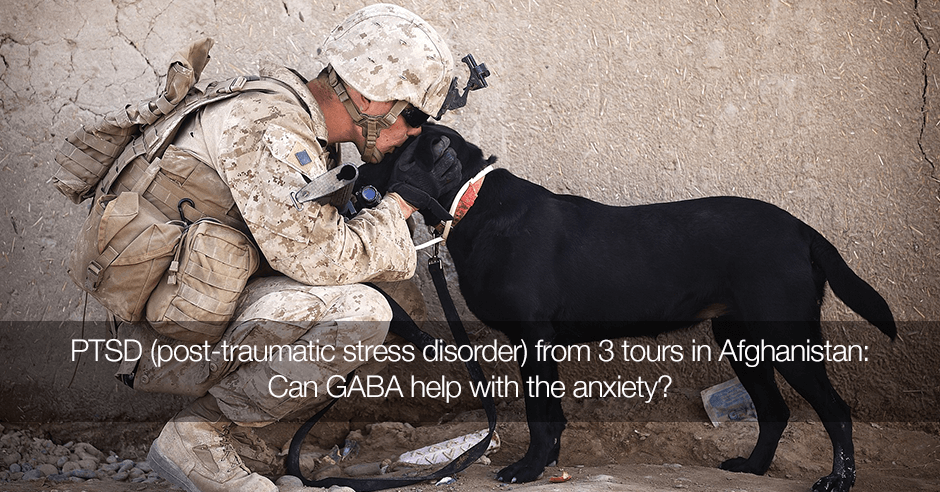
My husband is suffering from PTSD [post-traumatic stress disorder] from 3 tours in Afghanistan. Can [GABA] help with the anxiety he is experiencing. Your thoughts?
I received the above question in response to one of my blogs addressing GABA for the physical, stiff-and-tense muscle type of anxiety.
It’s very likely that GABA will help ease some of the anxiety he is experiencing. Anxiety can have many root causes and with PTSD I would look into neurotransmitter imbalances first and use three key amino acids to address these three possible root causes, before digging deeper to address other nutrient deficiencies and root causes that may take longer to address.
Amino acids to provide some anxiety relief quickly
In order to provide some anxiety relief as quickly as possible I would assess for low GABA, low serotonin and low blood sugar using the amino acid questionnaire:
- With low GABA he could be experiencing physical anxiety, muscle tension and the need to self-medicate with alcohol or sugary foods in order to calm down and relax. We would do an amino acid trial with calming GABA. Research also now shows that GABA helps with unwanted obtrusive thoughts which are common with PTSD.
- With low serotonin he could be experiencing mental anxiety, ruminations, fears, phobias, anger and irritability and probably insomnia. We would do an amino acid trial with tryptophan first and then 5-HTP if the tryptophan isn’t helping and we know cortisol is not high.
- With low blood sugar he could experience anxiety and feel extra stressed when he goes too long without eating. It’s likely he could also have an intense desire to eat candies and sweet treats. We would do a trial with glutamine and make sure he’s eating a breakfast that contains quality animal protein such eggs and bacon, or a protein smoothie.
High cortisol?
We would also want to determine if high cortisol is a driving factor of the anxiety. I’d want to see the results from a 4-collection cortisol saliva test (on waking, noon, around 5pm and around 10pm).
We would address adrenal issues (either high or low) with adrenal support of a good 50mg B-complex, extra pantothenic acid, vitamin C, and adaptogen such as rhodiola. If cortisol is high this can trigger anxiety and adrenaline-type surges and the phosphorylated serine product Seriphos used a few hours before the high cortisol is the best for lowering the high cortisol.
Recent research finds evidence that orange essential oil reduces fear and anxiety, diminishes immune system markers of stress in mice and may help alleviate PTSD and a blend of lavender, ylang-ylang, marjoram, and neroli (also a citrus oil) reduces stress and lowers cortisol too.
Other factors: gut health, diet, low vitamin D
When it comes to anxiety and PTSD, there are other factors to be considered:
- gut health and the microbiome – has he picked up parasites or other gut bugs or been impacted by foodborne pathogens
- diet and the importance of getting back to eating a real whole foods quality diet in order to provide the body with the best nutrients. An example from a recent study report that blueberries boost serotonin and may help ease PTSD
- addressing low vitamin D: “Through its association with testosterone production, vitamin D deficiency may increase the risk for posttraumatic stress disorder”
- removal of gluten, sugar and caffeine – all of which can contribute to anxiety and cause nutrient depletions
Possible effects from malaria drugs and other toxic exposures
If symptoms persist other factors like the effects of medications (or other toxic exposures) must be considered. In one case study, Malaria drug causes brain damage that mimics PTSD, a service member was diagnosed with anxiety, PTSD and a thiamine deficiency. Various treatments, including medication, behavioral therapy and vitamins didn’t help. It was determined that his symptoms were due to the anti-malaria medication mefloquine, which is now known to contribute to neuropsychiatric symptoms in susceptible individuals.
As with any anxiety condition, the root causes and solutions are unique to each individual and the above approach would be adapted based on each person’s unique needs and biochemistry. Additional approaches over and above these listed here may well need to be considered.

Wow! That is so helpful for the general public to know about too.
Other than what you mentioned is the very interesting fact that excessive high iron levels or ferritin can cause a host of problems. Someone I know has very high ferritin that has been undiagnosed for a long time yet they are anemic and male (anemia can occur even though iron intake is high, and high iron on blood tests, sometimes copper deficiency causes anemia, they have a delicate balance). I’ll cut to the chase, this person has high anxiety, sleep disorders, reacts like someone that has lived through military conflicts, leg swelling but not terrible, just odd things. Well their recent blood test showed this ferritin twice as high as the high normal. In other words HIGH. One of Gods wonderful mechanisms to control pathogens in your body is to hide the iron from bacterial and viral infections, or even cancer so the pathogens can’t find it and feed on that excess iron. Hemochromatosis can also bring sore joints, there can be spots on the skin or a tan look, and the liver can be poisoned and ruined if the person is not in the right treatment. There are blood tests and gene tests for this much under diagnosed problem. Donating blood every few months is the treatment among a few other things. This person did just that, and is calmer now and awaiting the results of his tests from a hematologist. Who knew?! Could it be that soldiers are getting vast more quantities of iron than a body can get rid of? Seeing iron and copper in a delicate Goldylocks balance and too much of either can be bad, especially if you carry a gene that causes you to get iron overload, it is something to look into.
Jo
Yes iron overload is a very real problem and not well-recognized. This and overload of other metals can be an issue for service men and women too (and others who may have been shot at) and would need to be considered. This article discusses metal fragments in wounds and how released metals can travel to other parts in the body. Lead, iron, depleted uranium, tungston, nickel and cobalt are all mentioned http://journals.sagepub.com/doi/abs/10.1177/0033354916669324?journalCode=phrg
Glad to hear your friend found his root cause
Hi Trudy, your post about anti-malaria drugs has prompted me to write to you about my current situation. Although it is not about malaria or the anti malaria drug I thought you might have some insight on the drug Metronidazole (generic for Flagyl). I was prescribed this antibiotic for Bacterial Vaginosis and I am certain it has triggered my anxiety. I took the antibiotic and had horrible side effects. Night sweats, uncontrollable muscle spasms, a feeling of electricity running though my body and worst of all ANXIETY. The Dr. refused to believe that I had an intolerance to this drug. I wonder if you’ve ever come across any information about this drug in relation to anxiety?
Thanks all you do for people with anxiety.
Diana
Sorry to hear about your symptoms and also sorry to hear your doctor doesn’t believe you. Anytime new symptoms emerge after taking a new medication it’s fair to expect it plays a role.
I encourage my clients to be aware of side-effects. Fever, muscle issues and “burning, numbness, tingling, or painful sensations in the hands or feet” but not anxiety shows up as side-effects on this site: https://www.drugs.com/sfx/flagyl-side-effects.html. However anxiety and other psychiatric symptoms are reported in research but “rapid resolution typically occurs with discontinuation of the antibiotics” https://www.ncbi.nlm.nih.gov/pubmed/28072642
For long-term impacts of flagyl that don’t resolve when the medication is discontinued this is an excellent resource – Metronidazole: The New Mitochondrial Nightmare https://www.hormonesmatter.com/metronidazole-mitochondrial-nightmare/
And finally, if you google “flagyl side-effects anxiety” you’ll see many reports in various online forums.
At my practice, we now use the term Post Traumatic Stress INJURY.
Clients find this very helpful, as they understand injuries, e.g. a sprained ankle. And we all get injured, but we usually recover fairly well, and the better we look after ourselves and the more we understand why we were injured, the less likely the injury- PTSI- is to reoccur
Sophie
Thanks for sharing – I really like this because it makes so much sense because we can recover! I’m aware the word disorder carries a stigma and had read some articles about leaving off the word disorder but wasn’t aware there is a whole movement to change PTSD to PTSI.
I’m sure you know this but am posting here for other blog readers: “The “D” in PTSD, the word, “disorder,” discourages some from seeking care, from revealing their condition and from feeling a sense of honor, when their PTSD is just as honorable as any physical injury. When an injury is earned in battle, awards are given. There is no Purple Heart for PTSD. While the APA uses the term, “disorder,” for most diagnoses, there are many diagnoses without that word, Anorexia, Bulimia, Parasomnia, Social Phobia to name a few.
The former Vice Chief of Staff of the Army, an advocate for reducing the stigma of PTSD, argues strongly in favor of dropping that word, “disorder,” because, “disorder” perpetuates a bias and “has the connotation of being something that is a pre-existing problem that an individual has” before they came into the Army and “makes the person seem weak.” http://www.posttraumaticstressinjury.org/
I see see his letter was written in 2012 – do we expect this to officially change anytime soon?
Hi Trudy,
You are quite correct and there are calls for the condition to be renamed. Sadly, I believe the issue has not be resolved yet, but I would suggest to everyone reading this to consider-
– If you are a practitioner, perhaps consider using the term PTSI, including in conversation with clients and in any material you produce- e.g. website material. This helps to emphasize that you can recover from PTSI.
– If you are having an experience of PTSI – and please note the language used – not ‘I have PTSI’- instead ‘I am having an experience/ another episode etc of PTSI’- what you need it a ‘toolkit’. Just as with an injury that reoccurs, you need to know what to do and who to see etc. when your injury flares up. And that it is normal for injuries to flare up sometimes!
I myself have COMPLETELY RECOVERED from experiencing PTSI. And just to reassure anyone reading this, PSTI is not a mental illness, it can happen to anyone who experiences severe trauma.
And remember…you are not merely a collection of your past experiences and memories. You have a ‘unique you’ which is totally outside of your experiences. And your past is not real, it’s an illusion- I know this sounds challenging, people!, but the past literally does not exist anymore. You can be free.
Keep up the good work, Trudy.
Kindest
Sophie
Hi Trudy,
Thank you for all your wonderful and informative articles! I have a questions about natural GABA supplementation. I recently took a written neurotransmitter quiz from my functional medical doctor that indicated I have low GABA levels. However, I am also wondering about any side effects/damage as well, from doing a slow taper off Clonazepam about a year and a half ago. I understand that my problem may be down regulated GABA receptors and not a lack of GABA in my system. My doctor wants me to try a natural liposomal GABA spray with L-Theanine but, I’m afraid to try it because, I’m not sure if the problem is a true GABA deficiency or down regulated/ damaged GABA receptors from the Benzo drug. Thank you!
Kate
Kate
I have found the best way to use amino acids like GABA is to check for low GABA symptoms via a questionnaire and then do a trial to see the response, and then adjust the dose accordingly. For sensitive folks (and this often includes those with current or prior use of benzodiazepines) I start really really low and increase slowly. Benzodiazepines can down regulate GABA receptors and yet GABA can still be helpful for many. I have my clients think back how they felt before they started the benzo – if physical anxiety was an issue GABA may have been low then.
The other thing may be to address the fear and serotonin support can help when fear is holding someone back.
Thank you very much Trudy! I was stressed out and heading for bad adrenal burnout before I crashed due to severe GI issues and was then prescribed benzodiazepines. I never thought about a low GABA issue prior to things falling apart. I will try a low dose of natural GABA and see if it’s helpful. Thanks again, Kate
Sounds like a bunch of bunk. PTSD is caused by inability to cope with stressful situations, not vitamin definciency
Rob
The ability to cope with stressful situations is mitigated to a great extent when a person has great nutritional status and no deficiencies. The title of this paper – nutritional armor – says it all: The response of an expert panel to Nutritional armor for the warfighter: can omega-3 fatty acids enhance stress resilience, wellness, and military performance? https://www.ncbi.nlm.nih.gov/pubmed/25373106
This paper has a great chart showing the role of trauma, genetics, childhood events and lifestyle factors (sleep, diet, exercise) and smoking/alcohol/drugs all play in contributing to PTSD, depression and suicide ideation: The Role of Nutrients in Protecting Mitochondrial Function and Neurotransmitter Signaling: Implications for the Treatment of Depression, PTSD, and Suicidal Behaviors https://www.ncbi.nlm.nih.gov/pmc/articles/PMC4417658/
I would say that the clearest evidence is that there is a link between PTSI- such as PTSI occurring after combat- and adverse childhood experiences (e.g one parent going to prison).
Sophie
Thanks and yes ACEs/adverse child events/experiences do play a role as mentioned above. Is this something you see a lot? Care to share some research links on this?
Hi Trudy,
On the road right now, so no time to share research on the link between ACEs and PTSI- but there is lots of it! And I see it a lot.
You are absolutely right that diet plays a very important part in the recovery from ANY injury- stands to reason! No 1 for me it taking people off sugar and highly processed carbs- as sugar crashes make you anxious…
More than this, I also want to see a very full blood panel- incl CBC, sex hormones, full thyroid, full iron panel, D, B12 etc etc. PTSI can sometimes really be a thyroid issue!
Kindest
Sophie
Sophie
Thanks for the feedback and I agree on sugar and processed carbs, as well as comprehensive testing. A fatty acid test is also very helpful as low omega-3s can also be a contributing factor. As with any condition, a full functional workup will also pick up leaky gut, food sensitivities, candida, parasites etc which can impact nutrient absorption and the microbiome (and neurotransmitter production, B12 and other nutrients).
Absolutely!
Dearest Trudy,
I have been receiving your emails and words of wisdom, and have learned so incredibly much from you.
It’s sad that there is so much dissention amongst so many people in the world right now, and it’s especially disheartening when it’s being directed in the wrong way and at the wrong people. Ironically these angry people are the ones that probably have the most to learn from you.
Thank you for all you do and the compassionate way in which you spread your knowledge.
Michele
Thanks for your kinds words and you’re most welcome
Apologies for the delay in your comment approval and my response. We had a computer glitch where a large number of comments were hidden from view in a spam folder. It mostly affected new folks who were commenting for the first time but it’s hopefully resolved now.
In addition to amino acid support for Post-traumatic Stress, which I fully support, it’s important to deal with the psychological trauma, although traditional talk therapy is not the most effective way to do this. I would recommend EFT (emotional freedom technique) that uses tapping on acupuncture points, as a highly effective way to do this. See https://www.youtube.com/watch?v=yHE684m6nIE&t=58s
Steven
Thank you for mentioning EFT/tapping and sharing Carol Look’s video. I fully support this too, as well as EMDR in many instances.
I have just come across your website through wellness mama talk about Anxiety and Amino acids. This is very valuable information, thank you for your work.
I suffered a miscarriage 4 months ago that required a surgery. It was traumatic and I believe I am suffering from PTSD. Prior to the surgery my blood pressure was 120/80, I eat excellent and workout several times a week. Post surgery I am now suffering from high blood pressure 140/90 plus. This has me so anxious and nervous, because this is not due to my lifestyle. I tried lowering it with some hawthorne berry or olive leaf and I had a reaction at night, I think it causes it to go to low. I believe I may have high cortisol levels. Could this be the cause of my high blood pressure? I have started to take Gaba to see if I can bring it down as I know I am depleted in Gaba now due to a test with my naturalpath.
Should I seek a cortisol test? If so, how long would it take to correct the high blood pressure if I took the Seriphos typically? We are dying to try for another baby but the high blood pressure has us holding off. Thank you in advance for your time.
Shawna
I’m sorry to hear you went through this. I would work with your naturopath and test for cortisol, sex hormones and other nutritional deficiencies that may have contributed to your miscarriage. Post surgery, gut testing and microbiome support may help too. I have all my clients who have had miscarriages also look into pyroluria – questionnaire here https://www.everywomanover29.com/blog/pyroluria-questionnaire-from-the-antianxiety-food-solution/ ( Pyroluria is seen more frequently in all-girl families and you may see a history of miscarried boys.)
I’d also recommend some EMDR sessions and possibly EFT in addition to the nutritional support.
Apologies for the delay in your comment approval and my response. We had a computer glitch where a large number of comments were hidden from view in a spam folder. It mostly affected new folks who were commenting for the first time but it’s hopefully resolved now.