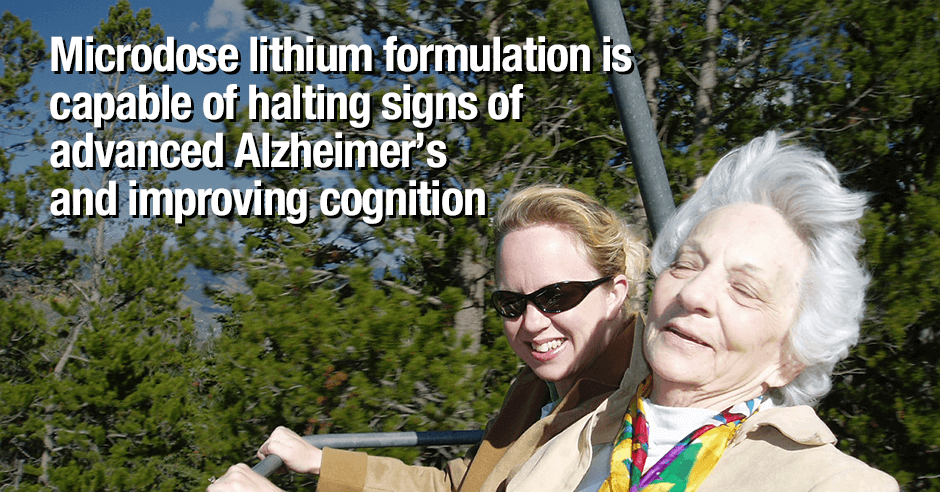
In a new study, a team of researchers has shown that, when given in a formulation that facilitates passage to the brain, lithium in doses up to 400 times lower than what is currently being prescribed for mood disorders is capable of both halting signs of advanced Alzheimer’s pathology and of recovering lost cognitive abilities.
The above snippet is from a press release published in January 2020 on Science Daily: Can lithium halt progression of Alzheimer’s disease? Keep in mind that this is an animal study but the results are so promising. I’m also very intrigued by the delivery method (more on that below).
In order to give this microdosing context, a typical adult prescription is 900-1800mg lithium carbonate/day. I reached out to the lead author for clarification about the dosing of this new formulation and lead researcher Dr. Cuello shared this with me:
I calculate that our lithium dosage is 285 times lower concentration than the 900 mg dose (based on 70 kg of body weight) and 570 times lower than the 1800 mg dose.
This translates to around 3.2 mg to 6.4 mg NP03 based on 70kg of body weight (which is around 154.3 lbs).
NP03 is a disease-modifying nano dose formulation of lithium citrate which is used sublingually. I assume it’s not yet commercially available.
Also from the press release: “our findings show that microdoses of lithium in formulations such as the one we used, which facilitates passage to the brain through the brain-blood barrier while minimizing levels of lithium in the blood, sparing individuals from adverse effects, should find immediate therapeutic applications.”
Here is a link to the actual paper: NP03, a Microdose Lithium Formulation, Blunts Early Amyloid Post-Plaque Neuropathology in McGill-R-Thy1-APP Alzheimer-Like Transgenic Rats
Can we compare NP03 to low dose lithium orotate?
What is really interesting is that low dose lithium in the form of lithium orotate is commonly recommended by integrative practitioners for anxiety, mild mood swings, brain fog, ADHD and insomnia. I have found it to be extremely beneficial for many of my clients and have used it personally with success (for brain fog and insomnia).
Just how much lithium orotate is low dose? Typical doses are 5-10 mg per day, increasing to 20mg per day.
Can we compare NP03 to low dose lithium orotate? It’s too early to know for sure but we I believe we can start to make extrapolations, especially given that both are very low doses.
Integrative psychiatrist, Dr. James Greenblatt, MD has written extensively about low dose lithium orotate for the above purposes and for Alzheimer’s too. In this article, Lithium: The Cinderella Story About a Mineral That May Prevent Alzheimer’s Disease, he shares that
Scientists first became interested in the use of lithium for treating neurodegenerative disorders when they observed that bipolar patients using lithium therapy seemed to have lower rates of cognitive decline than peers on other medications.
He writes how an enzyme called Glycogen Synthase Kinase-3 (GSK-3) – a serine/threonine protein kinase – normally plays a major role in neural growth and development and how lithium
works as a direct GSK-3 inhibitor… halting inappropriate amyloid production and the hyper-phosphoryation of tau proteins before they become problematic.
If all this fascinates you as much as it does me, Dr. Greenblatt writes more about lithium orotate in his excellent book: “Nutritional Lithium: A Cinderella Story: The Untold Tale of a Mineral That Transforms Lives and Heals the Brain” (my Amazon link).
Lithium deficiency and the onset of Alzheimer’s disease: a 2025 study
Update August 8, 2025:
A new animal study, Lithium deficiency and the onset of Alzheimer’s disease (and published Aug 2025), supports the above, concluding that lithium orotate is “a potential approach to the prevention and treatment of Alzheimer’s disease.” The authors share this about lithium in the brain:
endogenous lithium is dynamically regulated in the brain and contributes to cognitive preservation during ageing. Of the metals we analysed, lithium was the only one that was significantly reduced in the brain in individuals with mild cognitive impairment (MCI), a precursor to Alzheimer’s disease. Lithium bioavailability was further reduced in Alzheimer’s disease by amyloid sequestration.
The authors explored the role of endogenous lithium in the brain (i.e. lithium within the brain) by depleting it from the diet of wild-type and Alzheimer’s disease mouse models and found that:
Reducing endogenous cortical lithium by approximately 50% markedly increased the deposition of amyloid-β and the accumulation of phospho-tau, and led to pro-inflammatory microglial activation, the loss of synapses, axons and myelin, and accelerated cognitive decline.
It’s exciting that they found that lithium orotate, “a lithium salt with reduced amyloid binding, prevents pathological changes and memory loss in Alzheimer’s disease mouse models and ageing wild-type mice.” And this paper also mentions the fact that these “effects were mediated, at least in part, through activation of the kinase GSK3β.”
They conclude that:
These findings reveal physiological effects of endogenous lithium in the brain and indicate that disruption of lithium homeostasis may be an early event in the pathogenesis (cause) of Alzheimer’s disease. Lithium replacement with amyloid-evading salts [such as lithium orotate] is a potential approach to the prevention and treatment of Alzheimer’s disease.
Given the concerns with the toxicity of high dose prescription lithium carbonate, I appreciate that this was addressed:
An important limitation in the treatment of aged individuals with pharmacological doses of lithium [i.e. lithium carbonate] is kidney and thyroid toxicity. It is encouraging that toxicity could not be detected following long-term treatment of ageing mice with a low dose of lithium orotate.
Alzheimer’s and cognitive decline have many root causes
Keep in mind that Alzheimer’s and cognitive decline have many root causes that must be considered. This may include inflammation, stress and candida, and even insecticide exposure.
The best Alzheimer’s book is “The End of Alzheimer’s: The First Program to Prevent and Reverse Cognitive Decline” by Dr. Dale Bredeson (my Amazon link). He doesn’t mention lithium orotate so I look forward to hearing his thoughts on this new research. [I’ll come and update the blog when I do]
You can read about some of Dr. Bredesen’s work here: Alzheimer’s disease, mercury and mycotoxins.
Benzodiazepines have also been linked to increased Alzheimer’s risk which is why a nutritional approach for anxiety is the best approach. Let’s use the amino acids like GABA (for physical anxiety), and tryptophan (for worry and fears), as well as dietary changes and improving gut health instead of anti-anxiety medications (more on these below).
Additional resources when you are new to using tryptophan and other amino acids as supplements
As always, I use the symptoms questionnaire to figure out if low serotonin or other neurotransmitter imbalances may be an issue.
If you suspect low levels of any of the neurotransmitters and do not yet have my book, The Antianxiety Food Solution – How the Foods You Eat Can Help You Calm Your Anxious Mind, Improve Your Mood, and End Cravings, I highly recommend getting it and reading it before jumping in and using amino acids on your own so you are knowledgeable. And be sure to share it with the practitioner/health team you or your loved one is working with.
There is an entire chapter on the amino acids and they are discussed throughout the book in the sections on gut health, gluten, blood sugar control (this is covered in an entire chapter too), sugar cravings, anxiety and mood issues.
The book doesn’t include product names (per the publisher’s request) so this blog, The Antianxiety Food Solution Amino Acid and Pyroluria Supplements, lists the amino acids that I use with my individual clients and those in my group programs.
If, after reading this blog and my book, you don’t feel comfortable figuring things out on your own (i.e. doing the symptoms questionnaire and respective amino acids trials), a good place to get help is the GABA QuickStart Program (if you have low GABA symptoms). This is a paid online/virtual group program where you get my guidance and community support. You can sign up to be notified when the next live launch is happening.
If you need serotonin support, the Serotonin QuickStart Program is a good place to get help. This is also a paid online/virtual group program where you get my guidance on using tryptophan and 5-HTP safely, and community support during 5 LIVE Q&A calls. You can sign up to be notified when the next live launch of this program is happening.
If you are a practitioner, join us in The Balancing Neurotransmitters: the Fundamentals program. This is also a paid online/virtual program with an opportunity to interact with me and other practitioners who are also using the amino acids.
Wrapping up and your feedback
I look forward to human clinical trials of NP03. Dr. Cuello “ believes that there is an excellent opportunity to launch initial clinical trials of this formulation with populations with detectable preclinical Alzheimer’s pathology or with populations genetically predisposed to Alzheimer’s, such as adult individuals with Down Syndrome.”
I also look forward to human clinical trials of lithium orotate for Alzheimer’s disease. And I would love to see lithium orotate compared to NP03 in future research.
In the meantime I feel this research is exciting because it supports so much of what is being seen clinically with lithium orotate.
Have you used lithium orotate with success? How much has helped you and have you seen cognitive benefits? What about a more even mood, better sleep and less anxiety?
And have you or a family member seen improvements with the Bredesen protocol?

Dr. Joseph Mercola has shared thoughts on low dose lithium therapy
Karen
Thanks for letting me know – I can’t find anything online – do you have a link to share? And have you used low dose lithium orotate with success?
Hi there, how about lithium orotate which is the natural form which crosses the blood brain barrier so much easier than lithium carbonate. I would have thought it would be better.
Eleanor
My article is about lithium orotate 🙂
Oh, I only read the first bit and didn’t see your reference to lithium orotate. Duh!
Eleanor
No problem! Have you used low dose lithium orotate with success?
I started about 1 month ago taking 5mg, increasing after 2 weeks to 10mg. My Lyme doctor recommended it for insomnia and mood stabilization. I definitely sleep better now and my mood is much better. I’m thrilled, my husband takes it too & he sleeps much better & also has improved mood.
Dee, do you take the Lithium Orotate before you go to sleep or in the morning? or several doses during the day? with food or between meals or doesn’t matter?
Hi Suzanne,
I take it in the evening. Sometimes just before bed, sometimes earlier in the eve. I don’t pay any attention to food or no food as I wasn’t instructed to do so. I started at 5mg for 2 weeks then increased to 10mg.
Dee
Glad to hear your Lyme doctor recommended this and that it’s helping you and your husband. May I ask which product you’re using?
Thank you for this thread on Lithium Orotate & for your newsletter which I faithfully read! Pure Encapsulations is the brand we take. My Lyme doctor is world renowned & will introduce in May his new book called Chronic – about the underlying infections behind autoimmunity. I’m happy to share anything that might help others who are suffering.
Be careful with it. I tried lithium orotate and found it slowed my processing. I was almost in two car accidents because I couldn’t judge the timing of ongoing traffic while I was trying to make a left hand turn. I turned right out in front of cars and nothing like this has ever happened to me before. I immediately went off it. Now I’m afraid to recommend it.
Annie
Thanks for sharing – it sounds like it relaxed you too much! May I ask what product and how much you used? And why your practitioner recommended it?
Trudy, lithium orotate in “pixie dust” doses precipitates high blood sugar and extreme polyuria. My hair analysis shows no lithium. I know I need it, but am not sure what to do. How does one access microgram doses?
I mean, I have a high blood sugar and excessive urination reaction to very small doses of lithium orotate. I would like to try microgram doses.
Elaine
I have not had anyone report these effects. I would work with your practitioner to find a product that comes in mcg doses
When I tried lithium orotate at 10mg it was great for calming anxiety but gave me terrible night sweats and I had to discontinue.
Trudy, I asked this above but I’d like to ask it of you as well, since you use it and recommend it sometimes.
Re: Lithium Orotate..
1. .do you take the Lithium Orotate before you go to sleep or in the morning? or several doses during the day? with food or between meals or doesn’t matter? You said it helped with Brain Fog and insomnia, so not sure if it matters when you take it during the day, or just maintaining levels.
2. How and why do you increase the dose, and what feedback tells you when to increase from 5-10 mg to 20 mg?
Thanks so much for your excellent help!
Suzanne
I have my clients use it morning and noon 5mg each (typically with a meal) and after a week go up to 10 mg each time (based on how they’re responding i.e, doing better but could do even better)
My son tried it for 3 days a very low dose few drops I can’t remember now how many maybe 3 in a glass of water for brain fog he was 16 had was sleep walking from the first night which never happened before and was imagining something was in his bed was a scary experience so we stopped it and never tried again
Maisa
Thanks for sharing – I have not heard of this adverse effect but anything is possible. if you can remember the dose and product name that would be helpful
Biotics research produces Li-zyme Forte. It’s 150mcg of phytochemically bound vegetable culture source. I have used this product in clinical practice for 20 yrs with no adverse reactions.
Loren
Thanks for sharing! To give this context for the non-metric folks 150mcg is 0.15mg. May I ask how much you use and for what purposes? Do you find this form allows lower doses to be used with similar benefits to say 5 or 10mg of the lithium orotate?
Hi Trudy,
I use between 4 and 6 tabs a day in divided doses-Am/Pm.
I find it helpful for mood stabilization, anxiety, and cognitive support.
As people are reporting here, the 5mg works for some and others experience adverse reactions. This form not just the dose appears to make the difference.
Best,
Dr. Marks
Hi Loren, I’m interested to know what percentage of your patients have benefited from taking Li-zyme?
Have been taking 5 mg 3-4 x day & really feel it’s helped with calmness and clarity
Karla – thanks for sharing
Could anyone share experience in use of lithium orotate 5 mg and thyroid issues? My husband says it interferes with his thyroid meds and he has to increase his dose of thyroid hormone.
Janna
Prescription lithium carbonate is known for adverse thyroid effects. I’m not familiar with adverse thyroid effects with lose dose lithium orotate in the 5-20mg range. It is 5mg lithium orotate he has an issue with? May I ask what brand he used?
I tried taking 5mg lithium Orotate for a few days in response to undetectable lithium on my hair analysis test, but I stopped taking it as I found my brain fog became even worse. So it’s not for everyone.
Ps. Undetectable lithium is a hallmark sign of mercury toxicity.
Mila
Thanks for sharing. May I ask May I ask what brand you used?
The brand name is KAL.
1. An article on magnesium supplements at fixyourgut.com does not recommend magnesium citrate. They state that this formulation interferes with iron metabolism.
2. When I can afford it, lithium orotate keeps me from drooling. (I am certain I have Lyme Disease.) I learned about lithium orotate from Stephen Harrod Buhner who says it is neuroprotective.
Merry
How interesting that lithium orotate keeps you from drooling. Is your drooling at night only? This can be a sign of parasites especially when it happens at night when parasites are active. Lyme bacteria can live inside parasites
I’m curious where you’ve heard Stephen Buhner say this about lithium? And do you have a link to share?
that’s so interesting, I drool at night and sometimes wake up because of it. I always assumed because of my sinuses that my mouth was open which allowed the saliva to pour out. knowing it might be parasites is intriguing. if you have a recommendation for parasites please let me know
Amy
Feel free to search the blog for other posts about parasites
Hi Trudy, Thank you for your passion to helping people get their lives back. I recently checked my lithium blood levels and it was under that the low range. I also did a Hair Mineral Tissue Analysis and my lithium level was low there as well. I am going to start with the 5mg of Lithium Orotate and work up to the 15 to 20 mg range. How long should one wait before retesting my blood lithium levels? Also I have low serotonin blood levels and my GABA was undetectable. Will bringing my lithium levels into “normal” range benefit my serotonin or GABA levels? Best regards.
Eddie
I don’t have answers about testing blood lithium levels but 1-3 months may be reasonable. I would guess hair retesting 3 months and longer. I would love to hear your results – blood work, hair and symptoms. Lithium does help with GABA production but I like to use GABA for supporting low GABA levels.
May I ask what are you using lithium orotate for? And which labs tested blood lithium, hair minerals, serotonin and GABA?
My client had pretty severe depression and was on an SSRI for about 15 years. She tried all sorts of alternative options including a serious amino acids cocktail- all to no avail.
Two pills of Lithium Orotate (5mg)/day (one in the morning, one in the afternoon) and she has literally had a miraculous recovery since.
I am astounded!
Michael
This is great to hear – thanks for sharing! I love to hear from counselors who are incorporating nutritional approaches into their work. Is this an approach you often use with clients and see often or is this a new approach?
You mention an amino acids cocktail – for future reference I find that using individual amino acids one at a time and dosed based on unique needs works better than a cocktail
No, I am too apprehensive to make these type of suggestions often. I WISH I had a better training in it to give me a better sense of competence so I could bring this to my clients and community.
Hi Trudy
I am a 65 year old male suffering Chronic fatigue an fibromyalgia. For the last two months I take 5 mg Lithium orotate from the KAL brand . It sure helps with my depression and anxiety but it hasn’t done anything for my terrible sleep. I feel now that I’m getting more tired then I already was. Should I take it before bed rather than in the morning as I do now or is there another brand that you could suggest that would work better for me? Thank you kindly, Peter
Peter
Some folks find it works better later in the day. Glad to hear it helps with depression and anxiety
Apologies for the delay in your comment approval and my response. We had a computer glitch where a large number of comments were hidden from view in a spam folder. It mostly affected new folks who were commenting for the first time but it’s hopefully resolved now.
I take Pure encapsulation 5 mg around noon everyday.
It has helped with anxiety and panic attacks. Although I still have shortness of breath when I get stressed. I used to have issues sleeping and I have slept great since taking it. So I will keep taking. I am thinking of trying 10 mg to see if that will help my anxiety symptoms
Lani
Thanks for sharing. 5-10mg is a typical dose for many.
Apologies for the delay in your comment approval and my response. We had a computer glitch where a large number of comments were hidden from view in a spam folder. It mostly affected new folks who were commenting for the first time but it’s hopefully resolved now.
What about the ionic liquid form of lithium would this be ok as I always prefer a liquid to tablets for absorption and no fillers ?
Anne
I can’t be sure but I suspect this would have similar benefits. The form and dosage is what is important. Please keep us posted if you do use it
It suggests a size on the bottle of 10 drops = 500 mcg. Do you think that sound suitable?
I have been using a product called Luma TC that has 5mg of Lithium Orotate. I had severe depression for years that went away within 6 weeks. I tried many anti depressants during that time and nothing. Not sure of how all this works in the brain but I,m really hoping it helps with my insomnia as well. I,m still getting used to what normal feels like.- John
John
This is wonderful to hear – thanks for sharing. Love this: “I’m still getting used to what normal feels like” !
This does have a few ingredients other than lithium orotate that contributing to these results – curcumin, folate, B12, NAC and vitamin B6. It’s a super combination but I’m not excited about some of the inactive ingredients.
You may find this helpful too https://www.everywomanover29.com/blog/low-lithium-questionnaire-and-how-we-use-lithium-orotate-with-the-amino-acids/
Also, my book is an excellent resource for learning about the amino acids, and dosing and timing options, and all the other nutritional solutions, many of which also help insomnia too – The Antianxiety Food Solution https://www.everywomanover29.com/blog/the-antianxiety-food-solution-by-trudy-scott/
If you feel like you need guidance and support using GABA (low GABA is a common factor with insomnia), consider joining the online GABA Quickstart program so you can get help figuring it out. More here about the program and purchase info https://www.anxietynutritioninstitute.com/gabaquickstart/
My husband was diagnosed with early onset AD well over 7 years ago. We have managed to maintain some sort of a plateau by loosely following many of the protocols set out by experts like Dale Bredesen and administering coconut oil regularly. He is now 73 years old and the progression seems to have sped up. I would like to try him on the Lithium Orotate – can it be bought without a prescription in South Africa?
Also the medics are insisting that he go onto statins – which I have been avoiding doing although his cholesterol is high – Red rice yeast has not helped. He recently had three stents put in. Do you have any views on this?
ps I find your opinions on pyroluria so helpful, as I am someone who has always been tense and uncomfortable in socialising and am trying to take all of that in as well. Thank you.
Regards Ann
Ann
An integrative doctor in South Africa can order lithium orotate. I’m not a fan of statins but this is really something to discuss with the integrative doctor who would have his entire medical history and can offer dietary advice (presumably low carb/low sugar)
Wonderful to hear about pyroluria for you!
Hi Trudy- I took your advice and tried Gaba Calm. Its fine during the day for anxiety but activating at night for me. Is there a similar product without the nac l tyrosine? thanks so much and the Luma Tc is still working for me. Just need something to help with sleep. Very Frustrating.
John
A GABA powder (like NOW) or GABA/theanine combo (like GABA-T SAP from NFH) works well at night for many of my clients.
See more here https://www.everywomanover29.com/blog/amino-acids-pyroluria-supplements/
i just tried 5 mg of lithium before bedtime and noticed a strange pulsing feeling, kind of a fluttering heartbeat a bit after. this lasted maybe 20 to 30 minutes (guess). i felt concerned. is this from the lithium? i am nervous to try it again. maybe i shouldn’t have used it at bedtime. i am taking it for anxiety/depression. brand: Purely Holistic
thanks ahead of time, Karen
Karen
I’m not familiar with this brand and haven’t had this feedback from anyone. I don’t have clients push through and typically have them use less if they have benefits and adverse effects. I’d discuss these results with your practitioner
Karen
I’m not familiar with this brand and haven’t had this feedback from anyone. I don’t have clients push through and typically have them use less if they have benefits and adverse effects. I’d discuss these results with your practitioner
Hi Trudy. I heard about Lithium Orotate for severe CFS brain fog about 12 years ago. I took the Kal brand 5mgs (iHerb), and continue to this day. I take it around 12md. The brain fog shifted and my thinking has been clear ever since, though the rest of the CFS symptoms took 9 years to ease up gradually.
I have been an insomniac as a shift working Nurse since my 30s (now 69). I did not notice any improvements there, but don’t want to try higher dosage, as my mood remains on an even keel. I take Melatonin 3 mgs and a half dose Mogadon sedative to fall asleep. I have tried adding 5-HTP or L-Tryptophan to these. Sometimes they work, but mostly still take up to an hour to fall asleep if I’m lucky.
BTW, I heard a guest doctor talking about the neuro benefits of Lithium Orotate on Del Bigtree’s ‘The Highwire’ online program about 2 years ago.
Janne
Wonderful to hear lithium orotate has helped your brain fog and thinking. It can often help with sleep too and I have many clients trial a dose at bedtime too.
With shift work we also look at high cortisol and with a benzodiazepine we have to always consider rebound insomnia so it can get tricky. In addition to tryptophan/5-HTP we also look at using GABA if there are also low GABA symptoms. And lithium orotate can help make it more effective. It often makes all the amino acids work better.