A press release from Loma Linda University reports that two new studies show dark chocolate consumption reduces stress and inflammation, while improving memory, immunity and mood. These are wonderful results from human trials and if you’re like most of us I’m sure this subject brings great delight! However (and sorry to be the party-pooper here), there are a number reasons why you may want to hold back on the excitement: if you’re addicted to chocolate and/or sugar this is a big red flag, and if dietary oxalates and caffeine are issues for you then this news won’t be good. But there may be ways you can get some of the benefits without the harmful effects (more on that below).
These papers were presented as posters at the Experimental Biology 2018 annual meeting in San Diego, and the press release reports that
dark chocolate with a high concentration of cacao (minimally 70% cacao, 30% organic cane sugar) has positive effects on stress levels, inflammation, mood, memory and immunity. While it is well known that cacao is a major source of flavonoids, this is the first time the effect has been studied in human subjects to determine how it can support cognitive, endocrine and cardiovascular health.
Lee S. Berk, a researcher in psychoneuroimmunology and food science from Loma Linda University, School of Allied Health Professions, served as principal investigator on both studies and stated the following:
For years, we have looked at the influence of dark chocolate on neurological functions from the standpoint of sugar content – the more sugar, the happier we are. This is the first time that we have looked at the impact of large amounts of cacao in doses as small as a regular-sized chocolate bar in humans over short or long periods of time, and are encouraged by the findings. These studies show us that the higher the concentration of cacao, the more positive the impact on cognition, memory, mood, immunity and other beneficial effects [such as enhanced neuroplasticity].
The flavonoids found in cacao are extremely potent antioxidants and anti-inflammatory agents, with known mechanisms beneficial for brain and cardiovascular health.
In these 2 small studies (which have yet to be published in a peer-review journal) the consumption of 48g of 70% dark organic chocolate offered many of these health benefits in as quickly as 30 mins (in one the study) and when consumed every day for a week (in the other study).
In case you’re wondering how much this means in practical terms: 48 g is just over an ounce and a half, or 2 tablespoons. So think about 2 squares of 70% dark chocolate.
But are you addicted to chocolate? And do you binge?
I know I sounded like a real party pooper in the introduction but if your eyes lit up or you even got a little teary-eyed or felt a really warm “I so deserve this treat” glow or you felt realy joy at the thought of indulging (or maybe all of the above emotions) when you read the subject line then these may be red flag for you. But despair not as there are ways to help you not overdo it and binge on a week’s supply of dark chocolate in one sitting. If you relate to the binge comment you know exactly what I mean and have felt that deep regret and shame afterwards.
Lorraine shares this about her chocolate addiction:
the minute I start eating it – I am like a heroin addict. I can’t stop. I end up bingeing for a few weeks as it’s all I can think about. It’s the weirdest thing – so I mainly abstain from it and have a slip, binge, anxiety relapse about once a year until I am able to buckle down and fight the cravings knowing the anxiety is not worth the euphoria.
For some people the anxiety that is caused by chocolate is too severe (more on that below) but if Lorraine’s anxiety and bingeing are related there may be a solution for her and if yes, it would be the GABA solution below.
The brain chemistry balancing solution for bingeing
Cravings for chocolate can often be due to brain chemical imbalances and when these are addressed no willpower is required and there are no feelings of being deprived. Here is a simple way to help you figure it out:
- if you have to eat chocolate when you haven’t eaten in awhile it’s likely low blood sugar and glutamine on the tongue stops the desire on the spot
- if you stress-eat your chocolate cravings are likely due to low GABA, and GABA will stop the stress-eating and calm you down
- if you eat chocolate to feel happy (and especially from late afternoon onwards) then your cravings are likely due to low serotonin, and tryptophan stops the cravings and boosts mood and reduces anxiety
- if you eat chocolate for an energy boost then it’s likely due to low catecholamines and tyrosine will stop those cravings and give you a mood and energy boost
- if you are a comfort-eater then it’s likely due to low endorphins and DPA will stop that “I deserve-it-reward-eating” and also give you a hug-like mood boost
I write more about this in the glutamine cravings blog and you can find all the individual amino acids listed on my supplements blog here with details on how to purchase them from my distributor.
Once you have this figured out this brain balancing there is no bingeing, you can eat a small portion and feel very satisfied and will actually address some mood and anxiety issues at the same time!
Dark chocolate is a no-no if dietary oxalates are an issue for you
If dietary oxalates cause you issues like anxiety, insomnia, vulvar pain, urinary issues, or other pain (for me they cause dreadful foot pain – like shards of glass combined with hot coals)
When considering high oxalate foods, 41mg and above is considered an exceptionally high oxalate food. In one study, the total oxalate contents of 34 samples of dark chocolate collected from 13 different countries ranged from 155 to 485 mg/100 g which equates to around 77 to 240mg for 48g. So dark chocolate does need to be avoided and I would not even consider eating some even with calcium citrate or magnesium citrate.
In a related study published last year by lead author Professor Lee Birk, Is Chocolate Beneficial for Brain Health? the 20 subjects were subjected to a sequence of cacao sensory awareness tasks ranging from:
- recall of past experiences
- imagine eating chocolate right now
- visualization/looking at real chocolate
- olfaction [or sense of smell]
- taste but not swallow
- and finally chocolate consumption (70% cocoa bar) to satiation
And for many the above provided benefits for them. For me a good long deep sniff of dark chocolate feels quite satisfying, as strange as it may sound.
I do sometimes miss the texture of melted chocolate but solid coconut butter satisfies that need. Believe it or not, but so does pemmican, a savory snack that is made with beef fat and beef jerky, honey/cherries and sea salt. Check out pemmican from US Wellness Meats here (my affiliate link).
Avoid it if the caffeine causes anxiety, insomnia, heart palpitations and/or migraines
For many of my clients the caffeine in dark chocolate can cause anxiety, insomnia, heart palpitations and/or migraines. Some of these “twitchy” effects may also be due to the theobromine, a chemical compound, which roughly translates to “food of the gods” and is also what makes chocolate deadly for dogs.
I have to admit that chocolate would be my “drug” of choice before cakes, cookies or sweets. Putting aside the oxalate issues, it also affects my sleep and creates mild anxiety/sort of edginess with mild heart palpitations with restless sleep. This is how I remember a coffee buzz feeling. But worse than this is the migraine I get a day or 2 days later. It is wicked pain above my left eye that leaves me horizontal for a day. So, no chocolate for me unfortunately, other than enjoying the aroma of it.
Carob as a delicious alternative
Carob is a delicious alternative to dark chocolate as it doesn’t contain caffeine and is lower in oxalates. It has a definite chocolate-like flavor.
A 2002 study found that carob may actually have calming effects. It is also antioxidant rich, contains the polyphenol gallic acid which has been shown to help metabolic syndrome, has chemoprotective properties and helps with digestion.
Check out my Carob Cinnamon Delight al la Trudy hot beverage recipe and this recipe for Carob Coconut Avocado bites (leave out the sesame seeds and add extra coconut flakes if oxalates are an issue).
Organic and Fair Trade of course
If you can get to enjoy dark chocolate be sure to consume only organic as cocoa plants are heavily sprayed, Other than the concerns with the actual pesticides and insecticides, there is cause for concern about raised copper levels because of copper-based pesticides.
Fair Trade is a global movement made up of a diverse network of producers, companies, shoppers, advocates, and organizations putting people and planet first
I know I’m going to get questions on what brands I recommend that are organic, Fair Trade and gluten-free so here goes – Vital Choice is my pick right now.
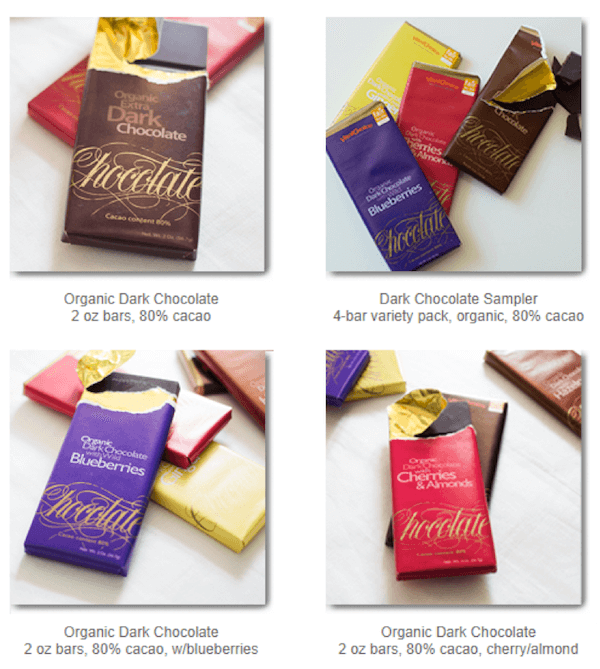
Vital Choice has quality dark chocolate that is both organic and Fair Trade. It is labeled gluten-free but they state it is “Manufactured on shared equipment with products containing wheat, milk, peanuts, and tree nuts.” I have not had any reports of anyone having a gluten issue with it but please use your own discretion. Here is the link to check them out and make a purchase (it is my affiliate link). Simply search for dark chocolate.
Feel free to share how you do with dark chocolate and how it makes you feel when you consume it and be sure to post any questions you may have.
And if you know of brands that are organic, Fair Trade and gluten-free please do share them.

An alternative to choclate bars is cacao beans. These are the beans before they are ground up to be made into cocoa.
You also can get cacao ‘nibs’ which are chopped up cacao beans.
These are really easy to use in baking or sprinkle into muesli or just eat raw.
I grind my cacao beans in a coffee grinder and use it to make a ‘tea’ in a coffee plunger. I mix my ground cacao beans with some ground cinnamon sticks and rooibos tea to make my ‘tea’ mixture.
This makes a lovely chocolatey tea with cinnamon overtones.
I was a total sugar addict and had to give up sugar completely, but I really missed the flavour of chocolate, so this way I can have the chocolate flavour without the sugar.
Cacao beans are quite bitter so if you are used to eating very sweet things you probably won’t like them, but if (like me) you’ve given up or significantly cut back on sugar then you should find them quite palatable.
One downside of cocoa (and chocolate) , is that due to where and how the plant grows, it tends to have a high level of cadmium which is toxic. I subscribe to consumerlab.com which tests supplements and some food and they have done a test on chocolate bars and cacao beans to test for cadmium. They all contain it but at least the report helps you choose ones that are lower in cadmium.
Here is a link to the European commision which has a proposal to limit cadmium levels in cocoa and chocolate by 2019
https://ec.europa.eu/jrc/en/science-update/reduction-cadmium-levels-food-chain-robust-tools-analysis
So glad you are talking about this. Cadmium is indeed very high in chocolate, also lead is high in chocolate. Also I have heard it is high in phytates which can bother digestion. The elevated lead seems to come from third world processing somehow, but they are unsure last time I checked.
Thank you so much for providing the website to check on foods or products we may have an interest in.
Jo
Jo
My understanding is that the raw cacao beans are high in phytates but that chocolate itself is lower.
I had totally missed the lead issue so thank you for bringing this up. It seems the dark chocolate is higher in lead which goes back to eating small amounts and purchasing quality products that have been tested for levels. I’m going to check with Vital Choice if they test for lead and cadmium.
Some possible sources include: lead contamination during drying and grinding, possibly during storage and transport, lead contamination from leaded fuels, pesticides and even from volcanic soils. This article has a good summary http://goodfoodfighter.com/why-is-there-lead-in-my-chocolate/
Natalie
Thanks for sharing about cacao beans and nibs – which of course have similar benefits without the sugar. And similar issues with caffeine and oxalates for some people.
I do also see many folks addicted to their morning energy hit of cacao beans/nibs in a similar way some folks can’t live without their coffee – so we have to watch this and ask why do they need this energy boost – low ferritin, low catecholamines, poor sleep etc
Thanks for mentioning cadmium – it’s is an issue which is why consuming small amounts is important. Lead may be an issue too.
With regards to the Consumer reports testing – I’m sure you’re in agreement – most of the products listed are poor quality anyway – because they are not organic https://www.consumerlab.com/reviews/Cocoa_Powders_and_Chocolates_Sources_of_Flavanols/cocoa-flavanols/
Thanks Trudy.
Thankfully I have found that I’m not addicted to cacoa and don’t even notice if I don’t have it on a given day.
Hi Trudy,
My husband is almost a new man now because we found out about a weird but common genetic disorder that causes high ferritin. Ferritin is never tested for unless you are seeing a hematologist, or in this case, our local cardiologist with a weight loss and wellness clinic. I was going to them for weight loss. But decided to make my very “healthy eating and exercising” husband go also. For a very fit, healthy habit guy, he had anxiety, OCD, insomnia, joint pain, etc. Well they discovered his ferritin was high leading to a genetic test for hemochromatosis. He has it. But he is lucky he at least has one good gene to keep the iron from going up so high that it could kill him. The test must be specifically for ferritin, not just a regular iron level test. A regular test for iron shows him deficient in iron and he is also slightly anemic. His iron is really very high and supplementing with iron can actually kill someone with his genetic problem. So this ferritin thing is what you need to test.
Well since diagnosis he was told to 1)change diet to less iron containing foods, 2) don’t take extra vitamin C because that makes the body suck up iron like mad 3) and he must give blood on a schedule.
Now my “iron man” has lots more energy and needs less sleep. He is relaxed and happy. His joints and back don’t hurt now. He is really a different guy without the iron rusting and inflaming the inside of his mind and body anymore. He feels better and better all the time.
How common is hemochromatosis? About 1 in every 150 people or 1 in every 200 people are going around with this problem. They are sore, sad and rusty inside. Get tested folks.
Jo
Thanks for sharing this hemochromatosis story about your husband. I’m very aware of this condition, that we need to test ferritin levels, the HFA gene involved, and some of the symptoms you mention he had. Good for you for taking him to be tested and good for the doctor for recognizing this to be an issue as many dismiss it.
May I ask how high you’re “iron man’s” ferritin was? and how quickly he started to feel better?
I have this topic on my list of article to write about and would love to share his story if I may.
A number of NDs have not found the eating of less iron to be such a big factor. I do have some protocols and nutrients that help other than the blood draw as I don’t like to have my clients cut back on grass-fed red meat consumption. I’ll gather those for the article.
I’m not sure that your comment had anything to do with dark chocolate but that’s ok
My husband’s first ferritin test revealed it to be 531, but ferritin should be no higher than 300 and that is really pushing it. So his was probably at times a full two times higher than the highest level. Optimal range is less that 147!
So the poor guy was going around like that his whole life. When we met he was on his way to a doctorate in science, and successful. But he was very shy, with severe social anxiety, OCD, insomnia, depression, tired easily, moody, impatient, and later developed more physical problems, joint issues and severe back pain. He persevered weightlifting, running and eating healthy. Trying different supplements and prescriptions for pain. He saw a councilor for his mood issues. He doesn’t give up easily, that makes him a great scientist.
But I don’t give up easily either. His healthy and well thought out plans and self discipline, keep him looking great but he felt terrible mentally and physically. How could someone look so good but feel so bad?
On my own part I have a fat fight going on. Yes, a fat fight, with my own chubby self. So, my weight loss doctor is with a cardiologist and they practice integrative medicine. They do some fancy blood tests that are seldom run by other doctors, which is exactly what I wanted for me. But, looking at the fellow I married, I said maybe there is a chance they can run some tests on him. And, bam! The guy gets red flagged for ferritin. Good thing he was sweating at the gym like mad because that gets out some of the iron at least.
The happy ending is he sticks with low toxin fish like sardines, eats chicken also now, yes he still eats red meat but not like he did before (twice a day!). He also sticks to veggies with low iron content. And gives blood every three months. His ferritin is 307 now, which is still above the allowable level. Optimal range is less than 147. So he has a way to go but it is doable. He felt better after the first blood draw and thought it maybe a placebo effect. This all started on February 1 this year. He is like a completely different guy now. Sleeps wonderfully, no back pain, only one wrist still bothers him a little at night. Iron crystals in the joints take a while to go away. Some joints may have permanent damage for some people because the iron crystals really do cut into the delicate surfaces badly. But my husband was not as bad as some people with his problem, probably because he is so good with everything else and doesn’t drink alcohol too often. They ordered scans of his heart, EKG, and a liver scan with labs. All, checked out perfectly, thank the Lord.
Can I tell you about his sunny moods now? He comes home with energy and happiness from a long day at work. And after going to the gym he is not completely depleted and grouchy like before, he still has energy and is ready to start some home project or help with some gardening! His shyness and social avoidance is gone, he has a relaxed nature now, just polar opposite of his old self. Crowds don’t bother him like before. Who is this guy? He is my sweetie.
And on my part, I am losing weight slowly but surely. I am not addicted to sugar now. Everyday I am marveling at how easy it is. Me and hubby eat pretty much alike but I eat less than he does. We are eating foods that are from the low insulin producing index because my blood test shows that I need to improve insulin sensitivity. I am not diabetic, but my sugar and high carbs had to go to better fight my fat war.
Thank you Trudy for your work and the help you give to so many people. Yes, please use my husbands story. Really, lives can be saved by finding out about hemochromatosis. How many cases of Type 2 diabetes are actually started from hemochromatosis? Yes, that does happen too.
May the Lord bless you Trudy and all your fans,
Jo
Thanks Jo – so wonderful to hear all this about your husband! I’d love to share his story!
Trudy, one issue with chocolate for me is that chocolate is one of my gluten cross reactive foods. Here is a link to gluten and cross reactivity. https://www.mindbodygreen.com/0-7875/are-you-not-healing-because-your-body-thinks-coffee-chocolate-cheese-are-gluten.html Our bodies think that certain foods are gluten, even though they are not. I imagine that this happened for me because of the number of years I did not know that I had gluten sensitivity. The same is true for carob as well.
Helen
Thank you for sharing your story and this great article by Dr Amy Myers! I’m curious if you were able to figure this out by doing the Cyrex test that measures cross-reactive foods?
Hi! Thank you for the article! How does one know if it is oxalates that one is reacting to? I do have foot pain, but I thought it was small fiber neuropathy. However, that has not been confirmed. Thank you!
Linda
Linda
You lower the intake of oxalates very slowly so as not get oxalate dumping and observe pain symptoms. With oxalate pain it’s often described as sharp “shards-of-glass” type pain. My feet pain was a combo of shards-of-glass and hot-coals.
Julie Matthews and I discuss oxalates in great deal in her interview “BioIndividual Nutrition for Autism” on her upcoming Nourishing Hope for Autism Summit. The same concepts for oxalates and autism apply for other conditions. More about the summit and the camel’s milk interview plus link to register for the summit here https://www.everywomanover29.com/blog/the-healing-properties-of-camels-milk-for-autism-and-anxiety/
Linda,
I know one thing. I gave up peanuts, cashews, chocolate and coffee, and now my own knee and foot pain has gone away.
I also use some of Dr. Steven Gundry’s product, “Lectin Shield” if I think I am going to run into the lectins he says actually make a person have joint pain. Funny thing, I also have experienced an extreme drop in appetite and cravings. Also dropped 2 pounds in two days. Win win!
Also, I am far more limber in the knees, much happier and calmer too. Peanuts and cashews have plant toxins that I have heard about before Dr. Gundry’s book came out. But he gives great detail about the role of plants in our lives and how to handle them for optimum health. I buy tomato sauce from Italy like he does, because they remove the skin and seeds to reduce the natural plant toxins. I know a lot about plants and his book was spot on, except for the flaxseeds he doesn’t think is a problem. But I know from a bad experience, that they can screw up thyroid function. But he is great on all other plant matters.
Thank you, Jo. I will look into his work and perhaps the supplement! I have been eating macadamia nuts, but talk about cravings! I can’t stop eating them. I think it is because I cannot eat any sweeteners right now because of candida, and the macadamia nuts are so sweet! I have finally decided that I cannot have them in the house anymore. Or the nut butter (which is delicious). I already peel and de-seed my vegetables like cucumbers and zucchini to help my digestion, (which is weak due to SIBO). That has helped, and my body is able to digest more. I will also look into Lectin Shield. But, having never had any hint of kidney stones, I am not sure if going on a Low Oxalate diet would be good for me, since my diet is already so limited by SIBO and Candida and AIP. My variety is already far less than ideal for a healthy microbiome! Feel free to add more thoughts! Thank you!
Hi Linda Alessio,
Actually Gundry offers lots of variety. He even had a new book out that is a cookbook. He recommends using a pressure cooker called an Instant Pot for cooking many foods to denature their natural toxins. That pot is electric and so easy to use, nothing like the one you mom used. This thing is digital. Throw the food in, hit the appropriate buttons, and walk away. Tons of recipes on the internet for lovers of that pot. My daughter does almost all of her cooking with one.
Yes, I noticed today that my knee that is always swollen is now not bulging like before. They really both look so much more attractive. Loosing fat and swelling is great.
Good luck girl,
Jo
My favorite chocolate brand is Alter Eco. It is USDA organic, fair trade and gluten free. The 85% cocoa bar called “Blackout” is delicious.
Hi chocolate lovers,
I just got back from an international heavy metals meeting. So sad that chocolate is high in cardmium. The tree just naturally sucks it out of the soil. Moderation in the consumption of things. Our great grandmas would agree, that somethings should be for a treats only. The food industry is always looking to sell us on the next food fad.
Jo
Thanks for sharing from the meeting – did they share more on how/why the tree sucks cadmium from the soil? Would love to hear which meeting and where and a link if you have it please?
Smart grandmas!
Hi Trudy,
Reading your book (great so far), and went to check on one of my favorite chocolate brands, Good Stuff, since I was pretty sure they said that theirs doesn’t contain caffeine. On their goodstuffcacao[dot]com website, in the “Learn More” tab, they say so and include a link to a site that explains that caffeine is added by most producers of chocolate to replace the theobromine (which seems like an easy cost-saving market opportunity: skip it)–but they don’t. They also sweeten theirs with honey. Fair trade and organically grown beans.
Just an fyi for you and your readers.