• Skip to primary navigation
  • Skip to main content
  • Skip to primary sidebar

everywomanover29 blog

Food, Mood and Women's Health – Be your healthiest, look and feel great!

  • Blog
  • About
  • Services
  • Store
  • Resources
  • Testimonials
  • The Book
  • Newsletter
  • Contact
  • Search this site

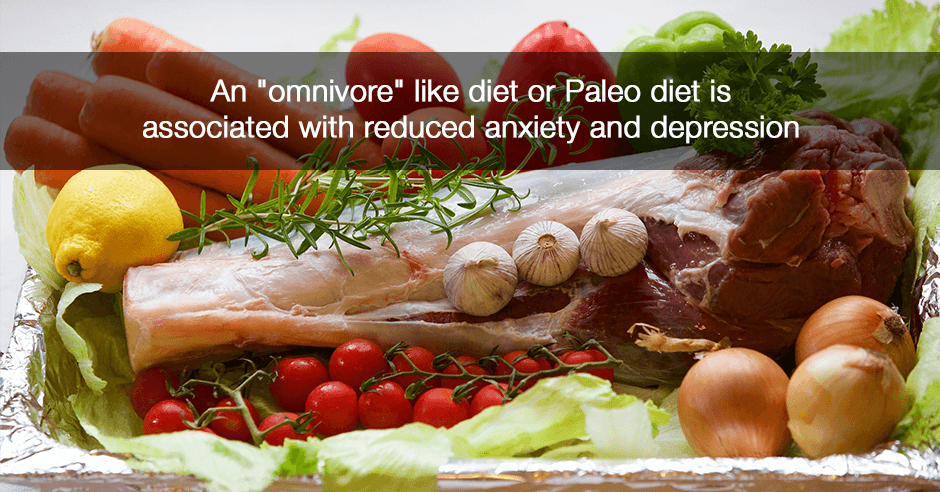
An “omnivore” like diet or Paleo diet is associated with reduced anxiety and depression

March 23, 2018 By Trudy Scott 12 Comments

A new study published last month, Do patterns of nutrient intake predict self-reported anxiety, depression and psychological distress in adults? SEPAHAN study, reports that

An “omnivore” like diet high in amino acids, cobalamin, zinc, phosphorus, saturated fat, cholesterol and pantothenic acid is associated with reduced psychological disorders.

This was a cross-sectional study, meaning it was a type of observational study design where the outcome and the exposures in the study participants are measured at the same time. The aim was to find an association (rather than causal relationship) between patterns of nutrients intake and psychological disorders such as anxiety and depression.

The study authors had 3846 Iranian adults between 18 and 55 of age complete questionnaires in order to assess their diets and nutrient patterns, as well as psychological factors including anxiety, depression, and overall health in general. This group comprised 1712 males and 2134 females.

The study results

After calculating the daily intakes of 57 nutrients (including individual amino acids,

starch, dietary fiber, simple sugars, different fatty acids, vitamins, minerals, and bioactive substances), 3 nutrient patterns were identified:

1) the “omnivore” pattern

high in individual amino acids, cobalamin, zinc, phosphorus, saturated fatty acids, cholesterol and pantothenic acid

in both women and men, with pyridoxine (vitamin B6) high in men only

2) the “grains and dairy” pattern

high in thiamin, folate, selenium, iron, starch, maltose, betaine, calcium, riboflavin, and niacin

and low in the following

mono-unsaturated fats, vitamin E and polyunsaturated fats

3) “fruits and vegetables” pattern

high in copper, vitamin C, glucose, fructose, potassium, dietary fiber, sucrose, vitamin A, magnesium and vitamin K.

These are the associations that were observed after adjusting for confounding factors:

  • Men in the top tertile of the omnivore nutrient pattern had lower anxietyand depression scores than those in the bottom tertile
  • Women in the top tertile of the omnivore nutrient pattern had better overall poor health scores than those in the bottom tertile and had lower odds of psychological distress, such as anxiety and depression.

This type of diet is also referred to as a Paleo or cave-man type of diet. Even though this study was only showing associations and not a cause-and-effect, it’s still very encouraging to see new research in the field of nutritional psychiatry, further supporting the results we see in clinical practice.

What are the mechanisms?

The high amino acids provide the building blocks for the production of our feel-good neurotransmitters such as serotonin, GABA, dopamine and endorphins, with zinc being a key co-factor for making these brain chemicals. The authors share some of the mechanisms for the association in the discussion section of the paper:

Dietary protein intake and also individual amino acid status have been linked to psychological status in previously published studies. For instance, methionine in the form of S-adenosyl-L-methionine, tryptophan and serine were inversely associated to depression. Lysine, arginine, beta-alanine, tryptophan and tyrosine have been shown to have anxiolytic effects. As amino acids are important precursors for neurotransmitters; they might affect psychological condition. Important neurotransmitters like dopamine and serotonin are made from amino acids tyrosine and tryptophan, respectively.

Pantothenic acid is a B vitamin that is key for stress and adrenal health. Low levels of B12 or cobalamin can be associated with both anxiety and depression, as well as fatigue. Both zinc and B12 are common deficiencies, and more so in vegetarian and vegan diets. The authors discuss some possible zinc mechanisms:

  • zinc has antidepressant-like activities such as up-regulation of the expression of brain derived neurotrophic factor (BDNF) gene
  • zinc is an antagonist of the glutamate/N-methyl-D-aspartate (NMDA) receptor

Seeing saturated fat and high cholesterol mentioned in favorable terms in a study – both of which are needed for a healthy brain and for good blood sugar control – is always exciting. The authors discuss these possible mechanisms:

low serum total cholesterol may increase the risk of depression and suicide attempts. It is hypothesized that low cholesterol intake might cause a depressed central serotonergic activity which in turn leads to depression.

Here is my addition to the discussion: in our interview on a prior Anxiety Summit, Dr. Kurt Woeller and I discuss the link between low cholesterol and low oxytocin and the role this plays in anxiety, social bonding and depression.

One area I’m a little confused about is the findings on pyridoxine (vitamin B6). They report it was high only in men in the omnivore group, and not in women. As they report, vitamin B6 is also a key co-factor in the serotonin-tryptophan pathway and we know it’s important for alleviating anxiety- related PMS symptoms in women. It’s mentioned in the concluding paragraph for playing a role in the association for both men and women and yet it is not mentioned in the abstract. I’ll report back as I find out more.

Here are some actual real-life results from someone eating this way

I blogged about anxiety and depression success stories on Paleo and grain free diets around this time last year. I shared Andrea’s feedback about her diet-mood results with a grain-free and high fat diet:

I happened upon a fat loss diet that had me cut out grains, most dairy, and sugar while focusing on mostly meat, fish, fats from nature such as butter, olive, and coconut oils. Nuts, seeds, and legumes were allowed too. These rules made it so I had to avoid processed foods. There was one day a week of eating anything.

Within 6 weeks I was shocked that I got much much more than fat loss. My depression, anxiety, mood swings, sleep issues and all but one pesky health symptom disappeared. I was stronger, faster, and felt energy I never remember having.

Have you found benefits with an omnivore or Paleo diet? Less anxiety and depression? Better overall health? More energy? Better sleep?

If you’re a practitioner have you found this approach works with your clients/patients?


The above statements have not been evaluated by the Food and Drug Administration. Products listed in this blog post are not intended to diagnose, treat, cure or prevent any disease.

The information provided on this site is for informational and educational purposes only and is not intended as a substitute for advice from your physician or other health care professional. You should consult with a healthcare professional before starting or modifying any diet, exercise, or supplementation program, before taking or stopping any medication, or if you have or suspect you may have a health problem.


The amino acids and pyroluria supplements I use with my clients

Additional Anxiety Resources
Click on each image to learn more

gaba quickstart live gaba quickstart hs
Signup for my newsletter


Filed Under: Diet Tagged With: amino acids, anxiety, cave-man diet, depression, health, omnivore, paleo, psychological distress, saturated fats, zinc

About Trudy Scott

Food Mood Expert Trudy Scott is a certified nutritionist on a mission to educate and empower anxious individuals worldwide about natural solutions for anxiety, stress and emotional eating.

Trudy is the author of The Antianxiety Food Solution: How the Foods You Eat Can Help You Calm Your Anxious Mind, Improve Your Mood and End Cravings and host of The Anxiety Summit now in its 6th season and called a “bouquet of hope.”

Trudy is passionate about sharing the powerful food mood connection because she experienced the results first-hand, finding complete resolution of her anxiety and panic attacks.

Reader Interactions

Comments

  1. heidi says

    March 29, 2018 at 12:02 pm

    Hi,
    Just wondering if you might have some resources you could point me to for treating ALS naturally? I didn’t see a category for ALS and tried to post in the Alzheimers section, but there was no way to post a comment.

    Thanks in advance for any advice you might have.

    Reply
    • Trudy Scott says

      March 30, 2018 at 8:32 pm

      Heidi
      If you check out the comments in this blog you’ll find some discussing the Deanna protocol for ALS https://www.everywomanover29.com/blog/gaba-amino-acid-supplement-neurotransmitter-support-anxiety-relief/

      Reply
      • Heidi says

        March 30, 2018 at 9:25 pm

        Thank you so much for the advice. I knew there was probably some information but I didn’t know where to look

  2. Stellalucia Aagaard says

    March 31, 2018 at 3:31 am

    Hi Trudy,

    Thank you for your ever thorough research and inspiration.

    What is your opinion on oxalates? I have had an OAT test done and it shows an elevated level of oxalates in my urine. Do you recommend supplementation for instance with Calcium citrate before each meal?

    I know that you are a big fan of L-Tryptophan. In my recent OAT test it says the following:
    “Supplementation with tryptophan itself may form the neurotoxic metabolite quinolinic acid”. I take the one you recommend from Lidtke. I do not tolerate 5 Http, which they recommends together with L-tryptophan in the case above. Should I worry about this?

    Thank you so much for your help and your continuing inspiration.

    With kind regards

    Stella

    Reply
    • Trudy Scott says

      May 2, 2018 at 10:56 pm

      Stella
      I always look at symptoms in conjunction with labs so if someone has symptoms from dietary oxalates (pain, anxiety, insomnia) then I have them reduce dietary oxalates and keep calcium or magnesium citrate on hand for accidental exposures.

      I am aware that Great Plains has this warning on the OAT test but there is no evidence that supplementation with tryptophan can do this. It’s not something I worry about unless someone is using tryptophan and experiencing adverse effects. It they are seeing benefits they continue with it

      Reply
  3. Stellalucia Aagaard says

    March 31, 2018 at 3:48 am

    Dear Trudy,

    What is your opinion on the Gaps Diet in order to heal leaky gut? I have tried the AIP and Paleo but it does not seem to be enough in order to heal.
    I was wondering, you mention somewhere that you recommend a good multivitamin without cobber in it. Could you provide an example? I use MultiTherra at the moment but it has cobber in it. It has methylated B vitamins.

    Thank you.

    With kind regards

    Stella

    Reply
    • Trudy Scott says

      May 2, 2018 at 10:51 pm

      Stella
      The GAPS diet is wonderful but also add glutamine and other healing nutrients, plus removal of the source of damage. DFH have a few copper free multis – here is my supps blog https://www.everywomanover29.com/blog/amino-acids-pyroluria-supplements/

      Reply
  4. Beatriz says

    April 7, 2018 at 8:45 am

    Dear Trudy,
    I’m so confused if I should follow de Paleo Diet or the Ketogenic one. Do you have any opinion about it? I trust you so much that would be very important to me.
    Thanks for everything.
    Love
    Beatriz

    Reply
    • Raz says

      April 22, 2018 at 7:42 pm

      My thought is do paleo and add extra fats like olive oil, avocado, MCT. Etc. that has helped me lose weight.

      Reply
    • Trudy Scott says

      May 2, 2018 at 10:09 pm

      Beatriz
      Each person is unique so we start with real whole foods with no gluten, then remove all grains for a Paleo diet and then if we still need to see benefits I’d look into a ketogenic diet/intermittent fasting (probably cyclical).

      Reply
  5. Sonia says

    May 18, 2018 at 7:29 am

    Trudy, I was following a keto diet. Having lots of energy and loosing weight. But there is a problem many who follow this diet face:* insomnia* that is to go away once you get used running on fats instead of carbs.
    Everything was great but my sleep. What is your input? Thanks!

    Reply
    • Trudy Scott says

      May 18, 2018 at 10:42 pm

      Sonia
      Glad to hear of the benefits you saw on the keto diet. Sleep issues can be due to many factors – adrenal issues (adaptogens and minerals help here) and high cortisol in particular (Seriphos helps to lower high levels https://www.everywomanover29.com/blog/seriphos-original-formula-anxiety-insomnia-cortisol/), sex hormone imbalances like low progesterone, low GABA, low serotonin, SIBO, too much WiFi and light late and even medication side-effects

      Reply

Leave a Reply Cancel reply

Your email address will not be published. Required fields are marked *

Primary Sidebar

GABA QuickStart Homestudy

gaba quickstart homestudy

Free Report

9 Great Questions Women Ask about Food, Mood and their Health

You'll also receive a complimentary subscription to my ezine "Food, Mood and Gal Stuff"


Connect with me

Popular Posts

  • Amino Acids Mood Questionnaire from The Antianxiety Food Solution
  • The Antianxiety Food Solution Amino Acid and Pyroluria Supplements
  • Pyroluria Questionnaire from The Antianxiety Food Solution
  • Collagen and gelatin lower serotonin: does this increase your anxiety and depression?
  • Tryptophan for the worry-in-your-head and ruminating type of anxiety
  • GABA for the physical-tension and stiff-and-tense-muscles type of anxiety
  • The Antianxiety Food Solution by Trudy Scott
  • Seriphos Original Formula is back: the best product for anxiety and insomnia caused by high cortisol
  • Am I an anxious introvert because of low zinc and vitamin B6? My response to Huffington Post blog
  • Vagus nerve rehab with GABA, breathing, humming, gargling and key nutrients

Recent Posts

  • Her cravings for chips and peanut butter were triggered by stress: GABA ends cravings and reduces physical tension and fear of heights
  • It is truly miraculous to be able to move through life without crippling anxiety and panic
  • GABA and tryptophan combo provide immediate and noticeable relief for tremors and cervical dystonia in just 7 days
  • Red light therapy for back and neck pain, plantar fasciitis and low mood – a complement to the amino acids GABA, DPA and tryptophan
  • What do I use instead of Seriphos to help lower high cortisol that is affecting my sleep and making me anxious at night?

Categories

  • 5-HTP
  • AB575
  • Addiction
  • ADHD
  • Adrenals
  • Alcohol
  • Allergies
  • Alzheimer's disease
  • Amino Acids
  • Anger
  • Antianxiety
  • Antianxiety Food Solution
  • Antidepressants
  • Anxiety
  • Anxiety and panic
  • Autism
  • Autoimmunity
  • benzodiazapines
  • Bipolar disorder
  • Books
  • Caffeine
  • Cancer
  • Candida
  • Children/Teens
  • Collagen
  • Cooking equipment
  • Coronavirus/COVID-19
  • Cravings
  • Depression
  • Detoxification
  • Diabetes
  • Diet
  • DPA/DLPA
  • Drugs
  • EFT/Tapping
  • EMF
  • EMFs
  • Emotional Eating
  • Endorphins
  • Environment
  • Essential oils
  • Events
  • Exercise
  • Fear
  • Fear of public speaking
  • Fertility and Pregnancy
  • Fish
  • Food
  • Food and mood
  • Functional neurology
  • GABA
  • Gene polymorphisms
  • General Health
  • Giving
  • Giving back
  • Glutamine
  • Gluten
  • GMOs
  • Gratitude
  • Gut health
  • Heart health/hypertension
  • Histamine
  • Hormone
  • Hyperparathyroidism
  • Hypoglycemia
  • Immune system
  • Inflammation
  • Insomnia
  • Inspiration
  • Introversion
  • Joy and happiness
  • Ketogenic diet
  • Lithium orotate
  • Looking awesome
  • Lyme disease and co-infections
  • MCAS/histamine
  • Medication
  • Men's health
  • Mental health
  • Mercury
  • Migraine
  • Mold
  • Movie
  • MTHFR
  • Multiple sclerosis
  • Music
  • NANP
  • Nature
  • Nutritional Psychiatry
  • OCD
  • Osteoporosis
  • Oxalates
  • Oxytocin
  • Pain
  • Paleo
  • Parasites
  • Parkinson’s disease
  • PCOS
  • People
  • PMS
  • Postpartum
  • PTSD/Trauma
  • Pyroluria
  • Questionnaires
  • Real whole food
  • Recipes
  • Research
  • Schizophrenia
  • serotonin
  • SIBO
  • Sleep
  • Special diets
  • Sports nutrition
  • Stress
  • Sugar addiction
  • Sugar and mood
  • Supplements
  • Teens
  • Testimonials
  • Testing
  • The Anxiety Summit
  • The Anxiety Summit 2
  • The Anxiety Summit 3
  • The Anxiety Summit 4
  • The Anxiety Summit 5
  • The Anxiety Summit 6
  • Thyroid
  • Thyroid health
  • Toxins
  • Tryptophan
  • Tyrosine
  • Uncategorized
  • Vegan/vegetarian
  • Women's health
  • Yoga

Archives

  • May 2026
  • April 2026
  • October 2025
  • September 2025
  • August 2025
  • July 2025
  • June 2025
  • May 2025
  • April 2025
  • March 2025
  • February 2025
  • January 2025
  • November 2024
  • October 2024
  • September 2024
  • August 2024
  • July 2024
  • June 2024
  • May 2024
  • April 2024
  • March 2024
  • February 2024
  • January 2024
  • December 2023
  • November 2023
  • October 2023
  • September 2023
  • August 2023
  • July 2023
  • June 2023
  • May 2023
  • April 2023
  • March 2023
  • February 2023
  • January 2023
  • December 2022
  • November 2022
  • October 2022
  • September 2022
  • August 2022
  • July 2022
  • June 2022
  • May 2022
  • April 2022
  • March 2022
  • February 2022
  • January 2022
  • December 2021
  • November 2021
  • October 2021
  • September 2021
  • August 2021
  • July 2021
  • June 2021
  • May 2021
  • April 2021
  • March 2021
  • February 2021
  • January 2021
  • December 2020
  • November 2020
  • October 2020
  • September 2020
  • August 2020
  • July 2020
  • June 2020
  • May 2020
  • April 2020
  • March 2020
  • February 2020
  • January 2020
  • December 2019
  • November 2019
  • October 2019
  • September 2019
  • August 2019
  • July 2019
  • June 2019
  • May 2019
  • April 2019
  • March 2019
  • February 2019
  • January 2019
  • December 2018
  • November 2018
  • October 2018
  • September 2018
  • August 2018
  • July 2018
  • June 2018
  • May 2018
  • April 2018
  • March 2018
  • February 2018
  • January 2018
  • December 2017
  • November 2017
  • October 2017
  • September 2017
  • August 2017
  • July 2017
  • June 2017
  • May 2017
  • April 2017
  • March 2017
  • February 2017
  • January 2017
  • December 2016
  • November 2016
  • October 2016
  • September 2016
  • August 2016
  • July 2016
  • June 2016
  • May 2016
  • April 2016
  • March 2016
  • February 2016
  • January 2016
  • December 2015
  • November 2015
  • October 2015
  • September 2015
  • August 2015
  • July 2015
  • June 2015
  • May 2015
  • April 2015
  • March 2015
  • February 2015
  • January 2015
  • December 2014
  • November 2014
  • October 2014
  • September 2014
  • August 2014
  • July 2014
  • June 2014
  • May 2014
  • April 2014
  • March 2014
  • February 2014
  • January 2014
  • December 2013
  • November 2013
  • October 2013
  • September 2013
  • August 2013
  • July 2013
  • June 2013
  • May 2013
  • April 2013
  • March 2013
  • February 2013
  • January 2013
  • December 2012
  • November 2012
  • October 2012
  • August 2012
  • July 2012
  • June 2012
  • May 2012
  • April 2012
  • March 2012
  • February 2012
  • January 2012
  • December 2011
  • November 2011
  • October 2011
  • September 2011
  • August 2011
  • July 2011
  • June 2011
  • May 2011
  • April 2011
  • March 2011
  • February 2011
  • January 2011
  • December 2010
  • October 2010
  • September 2010
  • July 2010
  • May 2010
  • April 2010
  • March 2010
  • February 2010
  • January 2010
  • November 2009

Share the knowledge!

The above statements have not been evaluated by the Food and Drug Administration. Products listed in this website are not intended to diagnose, treat, cure or prevent any disease.

The information provided on this site is for informational and educational purposes only and is not intended as a substitute for advice from your physician or other health care professional. You should consult with a healthcare professional before starting or modifying any diet, exercise, or supplementation program, before taking or stopping any medication, or if you have or suspect you may have a health problem.


Copyright © 2026 Trudy Scott. All Rights Reserved. | Privacy | Terms and Conditions | Refund Policy | Medical Disclaimer

Free Report

9 Great Questions Women Ask about Food, Mood and their Health

You’ll also receive a complimentary subscription to my ezine “Food, Mood and Gal Stuff”