One common question I hear from folks who are new to my work is this: “is GABA the same as gabapentin?” Quite frankly it has always surprised me to get this question since they are different words – why would you think they are the same? But I’d carefully explain the difference, educate the person and move on. A few months ago I shared a blog post on how the amino acid GABA was effective for an 11 year old with ADHD, irritability, anxiety and tantrums and someone asked this question again: “GABA sold at health store or prescription Gabapentin?”
I decided it was finally time to ask why she thought they may be the same thing. I first explained what GABA is (an amino acid supplement), shared some links to products and said “no, not prescription Gabapentin – I’m curious why you’d think that?”
She replied that “some people refer to GABA the same as Gabapentin” and thanked me for the clarification.
I appreciate her response but it did still concern me that the amino acid GABA is lumped together with prescription gabapentin. My next step was a facebook post sharing the above dialogue and asking my community there for feedback: “Have you heard GABA and gabapentin used interchangeably? Did you think they were the same thing at one stage?”
The response was enlightening, hence this blog post to provide clarification if you’re not sure either or if you know exactly what GABA is but have had confused conversations with your practitioner, family members, friends and/or colleagues. And to also get your feedback on this topic.
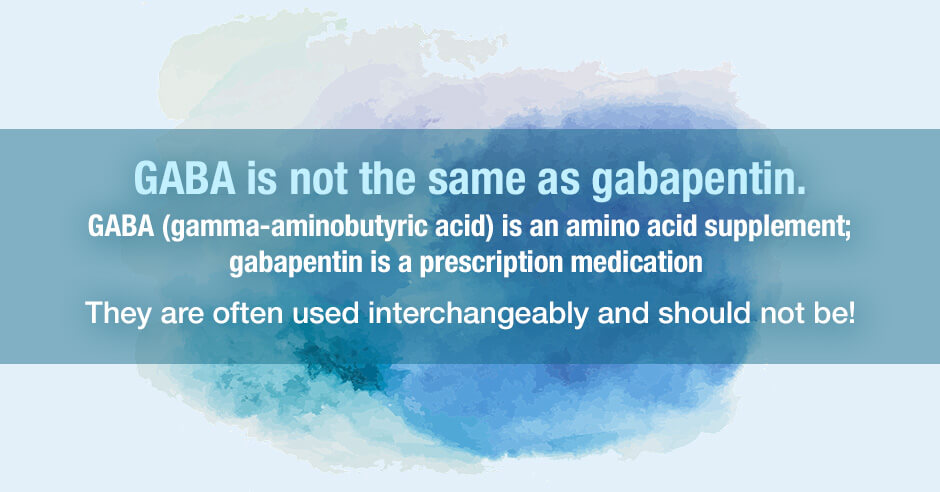
GABA is not the same as gabapentin. GABA (gamma-aminobutyric acid) is an amino acid supplement and neurotransmitter; gabapentin is a prescription medication. They are often used interchangeably (as you’ll read below) and should not be!
GABA and gabapentin is used interchangeably by a variety of practitioners
Here are some of the many responses showing how GABA and gabapentin is used interchangeably by a variety of practitioners:
Jennifer shared this: Yes in the vet world, gabapentin is often called gaba. Not surprising since western medicine likes to pretend that supplements don’t exist. I didn’t know GABA existed as a supplement for many years. I always explain what it is when I talk about it, to make sure there’s no confusion.
Val shared this: I was just at the dentist and I shared that I take Gaba to help me sleep. She said “Gabapentin?” I said “no I don’t take a synthetic medication, instead I take Gaba which is an amino acid.” It’s good to share with all who are willing to listen.
Katie shared this: I have never heard them used interchangeably but, whenever I talk about GABA, I say “GABA otc amino acid, not gabapentin the prescription” to be extra clear and educational.
Heather said: I was wondering this earlier in the week. My husband’s [nurse practitioner] suggested gabapentin temporarily for a back injury but she used the term “gaba”. I quickly got clarification. Hopefully she won’t do that again. But I understand it. Her field is all pain management.
Theresa shared this: Nurses who don’t know medicine often do that. I’ve found that [gaba] is listed in my med list when they don’t seem to know the difference.
Laura shared this: I always knew that they were different but I have had psychiatrists use them interchangeably.
Bonnie shared this: I mentioned GABA to my dad’s nurse and she got all upset, thinking I meant Gabapentin. At the time I didn’t know it was two different things. Dad was in the hospital and I suggested gaba to calm him. She said, no, no, no! I didn’t realize we were speaking of two different things.
Lisa shared this: When I told my primary doctor [an MD] that I was taking Gaba instead of prescription drugs she asked “gabapentin?” I said “no, Gaba which is a supplement”. She looked confused.
Lindy shared this: It’s a common assumption. I think some GPs (general practitioners) shorten gapapentin to gaba.
Jane shared this: “Yes – I am very careful to say the “supplement GABA.” I mentioned it to an Anesthesiologist when I had surgery. I normally don’t tell the medical profession my supplements – they have no idea what they are. I do specify the “supplement GABA” to holistic providers – I don’t want any misunderstanding. I was on Gabapentin and Lyrica for a long time. Horrific medications with severe consequences
If you relate to any of this feedback, keep sharing in order to educate, explain the difference and clarify to make sure there is no confusion.
What is GABA?
If you are new to the amino acid GABA, it’s a supplement that is used to raise low GABA (the neurotransmitter) levels and ease the physical-tension and stiff-and-tense-muscles type of anxiety.
The other symptoms we see with low GABA are panic attacks, physical tension in certain settings like public speaking or driving, and the need to self-medicate to calm down, often with alcohol but sometimes with carbs and sugary foods. Insomnia can also be due to low GABA and you’ll experience physical tension (rather than the ruminating thoughts which is the low serotonin type of insomnia – although it’s not uncommon to experience both). GABA also helps with muscle spasms and pain relief when muscles are tight.
You can read this blog, GABA for the physical-tension and stiff-and-tense-muscles type of anxiety for my biggest takeaways for using GABA effectively. I also share a number of GABA products and some feedback from folks who have experienced the benefits. One example is this:
I have used GABA (several brands, just open a capsule and sprinkle a small amount under the tongue) for years now, with calming results within minutes.
With regards to the question about GABA being available in health stores: there are amino acid supplements that are available over the counter at a health store and also via my online health store here (these are products I have vetted and use with clients).
Here is the blog I referred to above: GABA for children: ADHD, focus issues, irritability, anxiety and tantrums. My blog is a wealth of information when it comes to GABA so be sure to use the search feature.
What is gabapentin?
Per the Cleveland Clinic site:
Gabapentin is a prescription medication known as a gamma aminobutyric acid (GABA) analogue. GABA reduces the excitability of nerve cells (neurons) in the brain, which play a role in seizures and the transmission of pain signals. Gabapentin mirrors the effects of GABA calming excited neurons. Gabapentin is in a class of medications called anticonvulsants.
It’s been approved for seizures and nerve pain caused by shingles, however, off-label use is common when it comes to other types of pain, anxiety and depression. This paper, Outpatient Off-Label Gabapentin Use for Psychiatric Indications Among U.S. Adults, 2011-2016 warns of
risks associated with gabapentin combined with central nervous system depressant (CNS-D) drugs, which are commonly prescribed in psychiatric treatment….Over 6 years, 58.4% of off-label gabapentin visits listed one or more concomitant CNS-D medications, most frequently antidepressants (24.3%), opioids (22.9%), and benzodiazepines (17.3%).
The above Cleveland Clinic site lists some brand names – Horizant®, Gralise® and Neurontin® – but it is known by many different names in other countries. You can look it up in your country here.
You’ll also see all the side effects and the fact that dependence and withdrawal is downplayed despite the growing evidence that these are very real issues. More on that below.
There are many issues with gabapentin dependence and withdrawal
This blog post is really about terminology and the interchangeable use of GABA and gabapentin, but if you’re new to gabapentin, it’s important to be aware that there are many issues with dependence and withdrawal (often similar to benzodiazepines):
On day 3 of hospitalization, she developed restlessness, disorientation, confusion, agitation, and anxiety. She was presumed to be suffering from ethanol withdrawal and was treated with benzodiazepines but had no improvement in symptoms. During days 4 and 5, the patient became increasingly confused, agitated, and anxious, with complaints of headache, light sensitivity, and increasing nervousness. On day 5, gabapentin was reinitiated, and the patient’s confusion and agitation improved that evening. The next morning, the patient was calm, alert, and cooperative.
To our knowledge, this is the first reported cases of akathisia induced by gabapentin withdrawal. Available case reports suggest that gabapentin withdrawal can occur at doses ranging from 400-8000 mg/day. Patients experienced symptoms similar to those that develop with benzodiazepine withdrawal and were taking gabapentin for as little as 3 weeks to as long as 5 years.
This case highlights the need for patient-centered slow tapers in patients with severe gabapentin dependence and withdrawal.
The withdrawal took 18 months.
There is one case report of macular edema after gabapentin use and gabapentinoid (pregabalin/Lyrica) more so than gabapentin/Neurontin) prescriptions increased risk of suicidal behavior and unintentional overdose.
This 2017 paper, Gabapentin and pregabalin: do the benefits outweigh the harms? summarizes as follows: “Prescribers should be aware of the very limited clinical evidence for use of gabapentin and pregabalin outside their licensed indications, as well as their capacity to do harm.”
The amino acid GABA has none of these issues.
Why it may be confusing for practitioners
Other than the fact that gabapentin is described as a GABA analogue, I can see why it may be confusing for practitioners who don’t yet know about my work and the amino acid GABA.
The fact that GABA is an amino acid supplement and also a neurotransmitter may also be contributing to some of the confusion.
The other fact that I believe is adding to the confusion is because of how gabapentin is often referred to in the research. Let’s take this 2020 paper as an example: γ-Aminobutyric Acid and Derivatives Reduce the Incidence of Acute Pain after Herpes Zoster – A Systematic Review and Meta-analysis
It has γ-aminobutyric acid and derivatives in the paper title and as part of the aim, is mentioned in the results and elsewhere too:
- The aim of the present study was to investigate the effectiveness of GABA and its derivatives in reducing acute pain incidence in patients having HZ.
- The results showed that the treatment with GABA and its derivatives significantly reduced the number of patients with acute zoster pain.
- There is no guideline for using and dosing GABA and its derivatives to prevent acute HZ pain.
And elsewhere they refer to GABA-like compounds:
- The optimal dosage of GABA-like compounds is still to be determined.
- Nevertheless, the presently available data indicate that the application of GABA-like compounds in this respect is very promising.
The entire review is about gabapentin/neurontin and is not about the amino acid GABA at all, even though the search terms used for this paper included: gamma-aminobutyric acid and gaba.
This is just one example of many such papers. I know what the amino acid GABA is and I was initially confused when reading the title and abstract, and even when reading the full paper (initially hopeful the paper would also be discussing the amino acid GABA).
Resources if you are new to using GABA and other amino acids as supplements
If you are new to using GABA or any of the other amino acids as supplements, here is the Amino Acids Mood Questionnaire from The Antianxiety Food Solution (you can see all the symptoms of neurotransmitter imbalances, including low GABA and low serotonin).
If you suspect low levels of any of the neurotransmitters and do not yet have my book, The Antianxiety Food Solution – How the Foods You Eat Can Help You Calm Your Anxious Mind, Improve Your Mood, and End Cravings, I highly recommend getting it and reading it before jumping in and using amino acids on your own so you are knowledgeable. And be sure to share it with the practitioner/health team you or your loved one is working with.
There is an entire chapter on the amino acids and they are discussed throughout the book in the sections on gut health, gluten, blood sugar control, sugar cravings, self-medicating with alcohol and more.
The book doesn’t include product names (per the publisher’s request) so this blog, The Antianxiety Food Solution Amino Acid and Pyroluria Supplements, lists the amino acids that I use with my individual clients and those in my group programs. You can find them all in my online store.
If, after reading this blog and my book, you don’t feel comfortable figuring things out on your own (i.e. doing the symptoms questionnaire and respective amino acids trials), a good place to get help is the GABA QuickStart Program (if you have low GABA symptoms). This is a paid online/virtual group program where you get my guidance and community support.
If you are a practitioner, join us in The Balancing Neurotransmitters: the Fundamentals program. This is also a paid online/virtual program with an opportunity to interact with me and other practitioners who are also using the amino acids.
I appreciate these women for sharing their interactions with practitioners so we can all be enlightened.
Have you heard GABA and gabapentin used interchangeably? Did you think they were the same thing at one stage?
How do you refer to GABA and gabapentin in order to avoid confusion?
If you’ve been prescribed gabapentin what was/is it prescribed for? And did you/do you also have a prescription for an antidepressant, opioid or benzodiazepine?
Have you had/do you have any issues using gabapentin?
Have you had success using the amino acid GABA? If yes, what for?
Feel free to post your questions and feedback in the comments below.