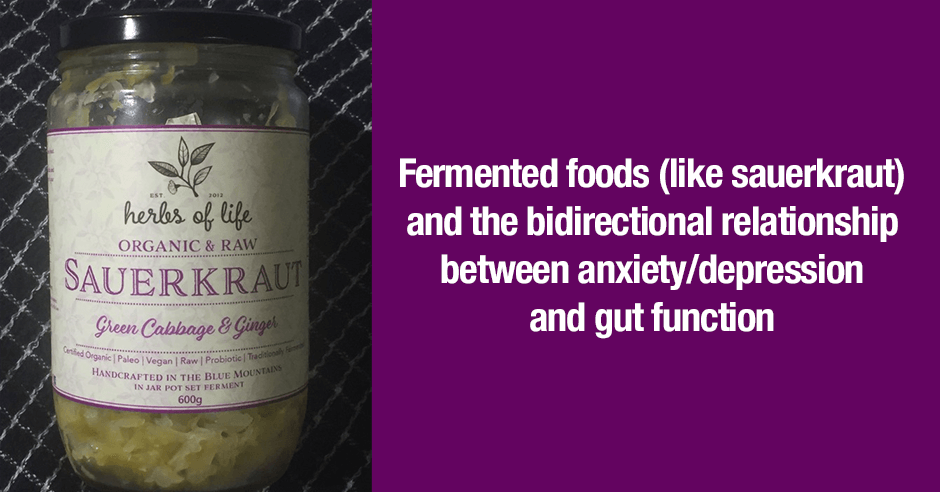
Today’s blog is to whet your appetite (pun intended) with some snippets from my interview – Anxiety: Gut-Brain Communication & Diet – with Dr. David Perlmutter, author of Grain Brain and Brain Wash. In this interview we talk about fermented foods (like sauerkraut) and a study that highlights mechanisms underlying the bidirectional relationship between anxiety/depression and gut function.
With anxiety at an all-time high and the ever-evolving research on the gut-brain connections we are relaunching the Anxiety Summit 5: Gut-Brain Axis summit on November 8-14, 2021. This interview is featured during the summit and is meaty (you’d expect nothing less from Dr. Perlmutter.)
The two-way connection between the gut and brain is powerful and needs to be explored and addressed if you have anxiety. Diet, fermented foods, reducing inflammation, addressing leaky gut (or intestinal permeability) and neurotransmitter support with amino acids are some of the ways that make a difference.
For the summit relaunch we have 4 incredible new guest expert interviews on sugar addiction, thiamine deficiency, trauma and the freeze response and safe tapering of SSRIs. And I have a new deep dive interview on glutamine, DPA and tyrosine for anxiety and sugar cravings/addiction. I’m excited to share it all with you!
For now, save the date and look out for the registration link in a few weeks. We’re in edit mode for the videos and transcripts, and getting all the backend setup done.
This is the first question I ask Dr. Perlmutter: I’d like to start with the microbiome and the fact that there is a bidirectional relationship between mental health and gut function. There’s a paper titled, Fermented foods, the gut and mental health: a mechanistic overview with implications for depression and anxiety published online late 2018 in The Journal of Nutritional Neuroscience. It highlights this important bidirectional relationship and the role of fermented foods. Can you share a little bit more about this and why this is important?
Before I share Dr. Perlmutter’s response, let me share a few quotes from the abstract of the paper:
- Mental disorders including depression and anxiety are often comorbid with gut problems, suggesting a bidirectional relationship between mental health and gut function.
- Several mechanisms might explain this comorbidity, such as inflammation and immune activation; intestinal permeability; perturbations in the hypothalamic-pituitary-adrenal axis; neurotransmitter/neuropeptide dysregulation; dietary deficiencies; and disturbed gut microbiome composition.
- The potential of modulating the microbiome-gut-brain axis, and subsequently mental health, through the use of functional foods, is an emerging and novel topic of interest.
- Fermented foods are considered functional foods due to their reputed health benefits.
The paper goes on to discuss food fermentation and summarizes how these foods “act biologically in the gastrointestinal tract and have the ability to modify the gut microbiota, influence translocation of endotoxins and subsequent immune activation, and promote host nutrition.” They are exploring their theoretical potential to improve symptoms of depression and anxiety in humans, saying more research is needed.
Dr. Perlmutter highlights various section of the paper and starts by sharing more about fermented foods and that we’ve been actively fermenting for thousands of years:
I think it’s first instructive to recognize that we’ve been actively fermenting foods for thousands of years as humans as a technique to preserve them, and allow us to travel with a food source. But beyond that, our ancestors prior to that would eat fermented foods. Fermentation is actually what happens to food when it’s left outside and is exposed to bacteria and begins the process of, dare I say, rotting. I don’t want that to be off putting to people who are going to hear the later part of our discussion dealing with eating fermented foods, because we have wonderful fermented foods that we eat these days.
He goes on to elaborate on what the paper terms functional foods. What this means is that these fermented foods have far-reaching health benefits for optimal health and for making us resistant to disease (i.e. improving our immunity):
The point is that the process of fermentation is basically a process of enrichment of food sources with bacteria. And what a notion that is, where we’re looking at the idea of eating a food that’s teeming with bugs, with germs, if you will. I say it that way, because it has such a negative connotation, but it really is what we want to do. These bacteria are involved in so many processes that deal with our health, and nurture our health, and our resistance to disease.
Some common examples of fermented foods are kimchi, sauerkraut, kefir (dairy kefir and water kefir), kombucha, and yogurt. Keep in mind, you can ferment many different vegetables. One of my favorites is cauliflower.
The paper also mentions inflammation as one possible mechanism for the bidirectional relationship between anxiety/depression and gut function, and Dr. Perlmutter discusses this in great detail, in the context of chronic health conditions. And he ties it all back to the microbiome:
From my perspective, of course, that has to do with the functionality of the brain, the way the brain remains healthy, and disease-free moving forward. And there are multiple mechanisms that relate to what’s going on in the gut to the brain. When we think of disease processes, most of what we are concerned about is the notion of inflammation, at least, in terms of a mechanism that relates to so many of the chronic degenerative conditions of the brain; be it Alzheimer’s, Parkinson’s, or even a non-chronic degenerative condition, which is autism is not necessarily considered to be progressive, but nonetheless at its heart, is in fact an inflammatory disorder.
So beyond that, of course, all of the chronic degenerative conditions that plague our planet, including heart disease, cancer, diabetes, the autoimmune conditions are at their very core, primarily inflammatory.
And let me be very clear that chronic degenerative conditions are ranked by the World Health Organization as the number one cause of death on planet Earth.
So we have to pay attention to anything that’s involved in the regulation of inflammation in the human body. And front and center right now in terms of gaining the spotlight, is the health of the gut bacteria, as well as its metabolites and it’s gene expression, collectively, we call that the microbiome.
The paper mentions intestinal permeability as another mechanism. Dr. Perlmutter covers the importance of the gut lining integrity and why it’s so important when it comes to anxiety, depression and the chronic diseases he mentions:
So we realize that the gut bacteria have a very important function, and that is to maintain the integrity of the gut lining.
And why would I, as a neurologist, give a hoot about the integrity of the gut lining? Quite categorically it’s because that is where inflammation in the body, in the long term, has its genesis. So, meaning we’ve got to have a strong gatekeeper at the lining of the gut to keep various gut-related proteins and other chemicals from making their way into the rest of the body, and challenging the immune system, upregulating the production of inflammatory chemicals that then do damage.
Dr. Perlmutter ends by discussing neurotransmitter dysregulation (also mentioned in the paper):
We know that our gut bacteria are involved in the manufacture of various neurochemicals, various neurotransmitters, serotonin, for example, dopamine, norepinephrine, epinephrine, [GABA], etcetera, that are primarily manufactured in the gut.
As a matter of fact, when it comes to serotonin, which certainly gains the spotlight; 90% is manufactured in the gut, another 9% is manufactured in the blood platelets, meaning that only 1% is actually manufactured in the brain, though, we call it a brain transmitter, a neurotransmitter. That said, the availability of the precursor for serotonin; the amino acid tryptophan, the availability of that even to the brain, is in fact controlled to a significant degree by actions of the gut microbes.
He wraps up by bringing in the microbiome, inflammation, chronic health conditions, anxiety and depression, and our lifestyle choices and diet (which includes foods such as fermented vegetables):
If we simply recognize that our gut bacteria are playing a massive role in regulating inflammation in the body, that’s enough, because our mission for the prevention of chronic degenerative conditions in the brain and out of the brain is controlling inflammation.
And it’s through the lens of the microbiome that we realize the detrimental or effectiveness of our food choices, and other lifestyle choices that can act to increase or balance inflammation. So it becomes extremely important.
The paper does discuss perturbations in the hypothalamic-pituitary-adrenal axis but we didn’t get into this during this interview. However, we do cover this in Dr. Peter Bongiorno’s interview on the summit.
Some of the recent research on specific fermented foods and mental health
Here is some of the recent research on specific fermented foods and mental health, where some or all of the above mechanisms may be a factor:
- Kefir peptides exhibit antidepressant-like activity in mice through the BDNF/TrkB pathway
- Effects of Fermented Milk Containing Lacticaseibacillus paracasei Strain Shirota on Constipation in Patients with Depression: A Randomized, Double-Blind, Placebo-Controlled Trial
- Consumption of OLL1073R-1 yogurt improves psychological quality of life in women healthcare workers: secondary analysis of a randomized controlled trial (this improved mood, sleep and gastrointestinal health)
- Possible use of fermented foods in rehabilitation of anorexia nervosa: the gut microbiota as a modulator
Some simple changes you can make
Here are some simple changes that be incorporated when you have anxiety or depression:
- Include fermented foods and beverages in the diet (ideally on a daily basis). If you decide to include sauerkraut, you can make it yourself or buy it from the store. If you buy it ready-made, always make sure it’s raw and found in the refrigerated section. Vinegar should not feature on the label but do look for salt as this is used in the fermentation process. In the example I share above, the added ginger helps with digestion even further and is very delicious!
- Eat a real whole foods diet with quality animal protein, healthy fats and organic vegetables and fruit (there is much research supporting dietary changes for improving mood and easing anxiety i.e. nutritional psychiatry)
- Avoid inflammatory foods like gluten, sugar, processed foods/fast foods and foods that you have a sensitivity to
- Address intestinal permeability if necessary (glutamine is my go-to nutrient for this and I take a deep dive into this amino acid in one of the new interviews on the summit)
- Use targeted individual amino acids such as GABA to boost GABA (for physical anxiety symptoms) and tryptophan or 5-HTP to boost serotonin (for worry-type anxiety). You can do this while you are addressing underlying gut issues and making dietary changes. Keep in mind that these amino acids help you quit sugar, gluten and junk food at the same time as easing anxiety!
Resources if you are new to using the amino acids as supplements
If you are new to using the amino acids as supplements and want to know more, here is the Amino Acids Mood Questionnaire from The Antianxiety Food Solution and a brief overview here, Anxiety and targeted individual amino acid supplements: a summary.
If you suspect low neurotransmitters and do not yet have my book, The Antianxiety Food Solution – How the Foods You Eat Can Help You Calm Your Anxious Mind, Improve Your Mood, and End Cravings, I highly recommend getting it and reading it before jumping in and using amino acids so you are knowledgeable.
Do join us on the summit relaunch of Anxiety Summit 5: Gut-Brain Axis summit on November 8-14, 2021. Registration details coming soon.
And if you’d like to learn more about Dr. Perlmutter’s book, Brain Wash: Detox Your Mind for Clearer Thinking, Deeper Relationships, and Lasting Happiness (written with his son Dr. Austin Perlmutter), here is my review. In our interview on the summit, he shares about disconnection syndrome (and loneliness) and how our decision-making abilities have been compromised.
Are fermented foods and beverages included in your diet (and your family’s diet) on a daily basis? And what are your favorites?
Do you make your own fermented vegetables?
Have you observed mood and/or digestive improvements since including fermented foods in your diet?
If you are a practitioner, do you recommend fermented foods and discuss this bidirectional communication between the gut and the brain with your clients/patients?
Feel free to post your questions too.