• Skip to primary navigation
  • Skip to main content
  • Skip to primary sidebar

everywomanover29 blog

Food, Mood and Women's Health – Be your healthiest, look and feel great!

  • Blog
  • About
  • Services
  • Store
  • Resources
  • Testimonials
  • The Book
  • Contact
  • Search this site

adolescents

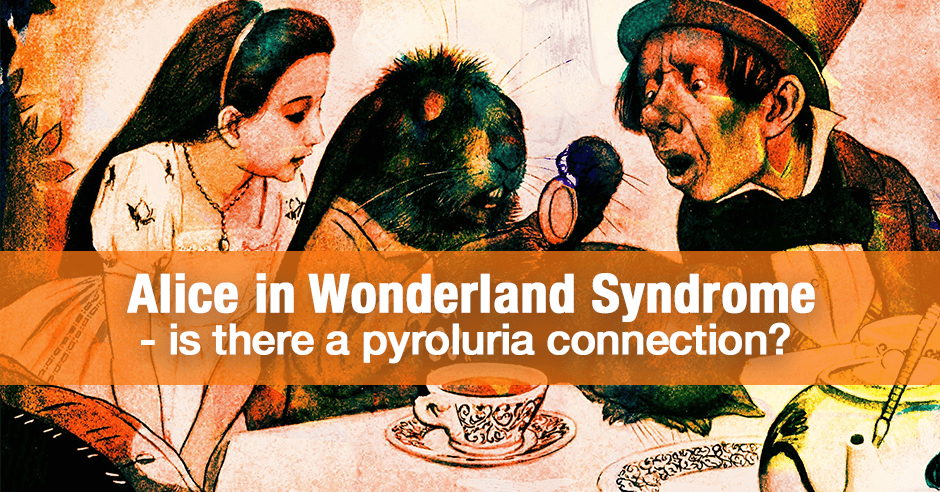
Alice in Wonderland Syndrome – is there a pyroluria connection?

June 25, 2021 By Trudy Scott 48 Comments

alice in wonderland syndrome

I first learned about Alice in Wonderland Syndrome (AIWS) during one of the Anxiety Summits. I’m surprised at how many queries I get about this syndrome and the fact that everyone who has reached out also has the social anxiety condition called pyroluria or suspects they have it.

This 2017 paper, Alice in Wonderland Syndrome: A real life version of Lewis Carroll’s novel, describes it as follows:

Alice in Wonderland Syndrome was originally coined by Dr. John Todd in 1955. The syndrome is named after the sensations experienced by the character Alice in Lewis Carroll’s novel Alice’s Adventures in Wonderland. Alice in Wonderland Syndrome consists of metamorphopsia (seeing something in a distorted fashion), bizarre distortions of their body image, and bizarre perceptual distortions of form, size, movement or color. Additionally, patients with Alice in Wonderland Syndrome can experience auditory hallucinations and changes in their perception of time. Currently, there is no known specific cause of Alice in Wonderland Syndrome. However, theories point to infections such as the Epstein-Barr virus, medications such as topiramate and associated migraines.

You can read about all the types of visual and non-visual distortions in this paper: Alice in Wonderland syndrome – A systematic review. This paper also includes a list of conditions in which Alice in Wonderland syndrome has been described in the literature, with infections and migraines being very common. The authors also feel that what we see in the published literature may only be the tip of the iceberg:

Since 1955, no more than 169 case descriptions of AIWS have been published. The literature indicates that this may be only the tip of the iceberg, with many individual symptoms of AIWS being experienced (albeit occasionally and only fleetingly) by up to 30% of adolescents in the general population.

The published case numbers have increased slightly (this paper was published in 2016) and it’s reported that many of the 30% of adolescents with AIWS experience non-clinical symptoms i.e. they are not severe enough to need treatment.

I still find “up to 30% of adolescents in the general population” to be very surprising for a syndrome which was once considered very rare and is frequently misdiagnosed.

Read on to hear from some folks in my community who have reached out and described their AIWS episodes. They all have pyroluria and I’d love to know if there is a possible connection.

Everything either looks really far away but massive or really close up but tiny

Sallie, a mom in my community, shared about her son and what he experienced in the comments section of the pyroluria prevalence and associated conditions blog. During his episodes, everything either looks really far away but massive or really close up but tiny:

I believe he has Alice in Wonderland syndrome. I have taken him to GP’s, pediatricians, optometrists, opthamologists and no one knew what was wrong. I spent about 6 months researching the possibilities myself and came across AIWS. When I showed him some of the journal articles, he was so relieved to finally have an answer. Since then, I have had a gut feeling that pyroluria and AIWS may be linked somehow.

She believes his AIWS may have been triggered by an infection when he was around 6 years of age. He developed sudden onset of vomiting, fever and delirium:

Still to this day, he distinctly remembers this night and recalls (like it was yesterday) not being able to stop looking at his hands because they were changing size and how far away/close up they were.

Once he was old enough to articulate what he was experiencing, he was able to tell me he feels weird, like he needs to go to a pitch-black room and lie down. Sometimes it coincides with a headache.

Everything suddenly appears as if far away then everything either looks really far away but massive or really close up but tiny. He feels dizzy while this happens also. Stress definitely increases the number of AIWS episodes.

Infections are reported as one (of possibly many) root causes of AIWS: “Reported causes include infection (especially with Epstein Barr virus), migraine, epilepsy, depression, and toxic and febrile delirium.”

Infections are common mental health triggers. Strep as a trigger for PANDAS/PANS is a classic example. I blog about Bartonella and sudden-onset adolescent schizophrenia here.

He has pyroluria and stress increases the number of episodes he experiences. My question is this: is there a link between the dumping of zinc and vitamin B6 during these times of stress and episodes of AIWS?

The feeling of being extremely small somatically (or physically), like how you feel when in a football stadium

Mike is a 21 year old male and thinks he may very well have pyroluria based on the questions. He also shares this in the blog comments about his AIWS experiences:

I have experienced sensations similar to Alice in Wonderland Syndrome throughout my life, more so during periods of stress. The feeling of being extremely small somatically (or physically), like how you feel when in a football stadium.

Again, he has pyroluria and his symptoms are worse during periods of stress. Keep in mind that stress makes pyroluria symptoms more intense too.

She usually experiences objects/people smaller than what they are but her more pronounced symptoms are sound distortions

Brenda, another mom in the community, shared this about her daughter’s dreams and PMS on the pyroluria questionnaire blog:

I’m quite certain that my 17 year old daughter has pyroluria. I counted 23 symptoms that she definitely exhibits. Her dream recall is so poor that she insists she doesn’t dream at all. I’m going to start her on zinc, B6 and evening primrose oil right away. Her PMS/premenstrual syndrome is so severe that I had decided to see a gyno to discuss birth control pills. Of course I won’t after listening to your interview with Karla Maree (on the Anxiety Summit).

She also asked if I was familiar with Alice in Wonderland Syndrome and if so do I think it may be connected to pyroluria?  She shares this about her daughter’s AIWS experiences:

My daughter has experienced occasional Lilliputian (trivial or small) hallucinations since childhood.  She usually experiences objects/people smaller than what they are but her more pronounced symptoms are sound distortions. She hears voices/noises (real, not imagined) much louder than they are in reality.

She does not have migraines, has never had mononucleosis or any of the other conditions listed as possible causes of Alice in Wonderland Syndrome. That’s why I’m thinking it may be caused by nutritional deficiencies.

This was my introduction to this syndrome and I appreciate her for asking the question. I did some reading of the research and the word “hallucination” got me thinking that a pyroluria connection was possible. The original work by Dr. Carl Pfeiffer with pyroluria was with individuals with schizophrenia.

However, the second paper mentioned above does state that “AIWS is characterized by perceptual distortions rather than hallucinations or illusions and therefore needs to be distinguished from schizophrenia spectrum and other psychotic disorders.”

We clearly have much to learn and I’m still curious to find out how often these two conditions do overlap – pyroluria/social anxiety and Alice in Wonderland Syndrome.

Resources if you are new to pyroluria

Pyroluria is a social anxiety condition and the physical and emotional symptoms are caused by deficiencies of vitamin B6 and zinc. When you experience high levels of stress, vitamin B6 and zinc will be further depleted, so you may notice worsening symptoms and more anxiety. Here is the symptoms questionnaire and additional resources if you are new to pyroluria:

  • Pyroluria questionnaire (from my book, The Antianxiety Food Solution):
  • Pyroluria prevalence and associated conditions
  • Social anxiety caused by pyroluria: oxytocin, the vagus nerve, pectus excavatum and Ehlers-Danlos Syndrome
  • My book, The Antianxiety Food Solution, has an entire chapter on pyroluria

Have you (or a family member) had episodes of Alice in Wonderland Syndrome? And do episodes coincide with times of added stress?

Do you also suspect pyroluria and has the pyroluria protocol or other nutritional interventions helped to reduce or stop the episodes?

I’d love to also hear anything else you’re willing to share: age at onset, age AIWS stopped, do you suspect an infection as the trigger (or a medication or toxins or something else?), do others in the family have AIWS episodes and how would you describe your AIWS episodes?

Feel free to post any questions here too.
Filed Under: Anxiety, Children/Teens, Pyroluria Tagged With: adolescents, AIWS, Alice in Wonderland Syndrome, auditory hallucinations, close up, distortions, Epstein-Barr virus, extremely small, far away, in a football stadium, infection, massive, medications, metamorphopsia, objects/people smaller, perceptual, pyroluria, sound distortions, tiny

More kids are showing up in ERs with anxiety, depression and other common mental health problems: why isn’t nutritional psychiatry part of the discussion?

November 16, 2018 By Trudy Scott 23 Comments

This article on NBC news, More kids are showing up in ERs (Emergency Rooms) with mental health crises, reports large increases across the country.

Dr. Anna Abrams, a pediatrician and researcher at Children’s National Medical Center in Washington, finds the numbers both shocking and disheartening.

In the 5-year period from 2012 to 2016, when looking at ER mental health admissions in 45 children’s hospitals, they found the following increases:

  • 48 % in white children
  • 64% in non-Hispanic black children
  • 77% increase in Hispanic children

with about a 55 % increase overall.

Dr. Abrams and her colleagues presented these findings at the American Academy of Pediatrics conference in earlier this month.

Other than the very large increases, there is something else to be concerned about: the researchers say they aren’t sure why we are seeing these increases, speculating it “could be due to the scarcity of mental health professionals who can help children” and “People are also talking more openly about depression, anxiety and other common mental health problems and that may make parents feel more comfortable about seeking help for their children.”

While these are very valid reasons, we really do need to be incorporating nutritional psychiatry (a term coined in 2015) and functional medicine (Dr. Mark Hyman is one of the leaders in functional medicine) into these discussions, studies and conferences. Other than poor diets and nutritional deficiencies we need to be considering stress, exposure to toxins, poor gut health and increasing Wifi exposure, to name a few.

If we look at diet alone, there is so much recent research supporting the connection between diet and mental health. Here are two of many new studies:

  • Is there an association between diet and depression in children and adolescents? A systematic review

Despite some contradictory results, overall there was support for an association between healthy dietary patterns or consumption of a high-quality diet and lower levels of depression or better mental health. Similarly, there was a relationship between unhealthy diet and consumption of low-quality diet and depression or poor mental health.

  • A Pro-Inflammatory Diet Is Associated With an Increased Odds of Depression Symptoms Among Iranian Female Adolescents: A Cross-Sectional Study

These data suggest that Iranian adolescent females eating a pro-inflammatory diet…had greater odds of having at least moderate depressive symptoms.

And here are just a few other factors to consider:

  • Integrative Medicine Approach to Pediatric Obsessive-Compulsive Disorder and Anxiety – in this case study gluten removal was a big factor
  • GABA for children: ADHD, focus issues, irritability, anxiety and tantrums With this pre-teen young girl, her mom reports that “She’s almost like different child. GABA has truly changed our life.“

How do we get this nutritional psychiatry research and case studies into the hands of those who can change actually policy and the way mental health is addressed? I believe it has to be a grass-roots effort from the bottom up and I have these suggestions:

  • share this blog and the research with your doctor and/or allied health practitioner
  • reach out to study authors, journalists and legislators and share research and success stories like the above, and your own personal results
  • if you’re a practitioner, write blogs like this sharing the good results you see with your clients and patients – with researchers, journalists and legislators
  • share in forums and on social media, and with your neighbors, friends and family
  • comment on blogs like this – with success stories in your family or with clients – so more people get to see what really is working

Every little bit helps! I’d love to hear your ideas too.

Filed Under: Children/Teens, Mental health Tagged With: adolescents, anxiety, children, depression, diet, ERs, GABA, gluten, kids, mental health, nutrition, nutritional psychiatry

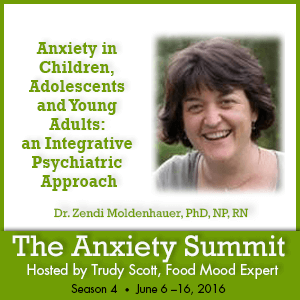
The Anxiety Summit – Anxiety in children, adolescents and young adults: an integrative psychiatric approach

June 11, 2016 By Trudy Scott 23 Comments

Zendi Moldenhauer_Anxiety4

Dr. Zendi Moldenhauer, PhD, NP, RN, is interviewed on the Anxiety Summit by host of the Anxiety Summit, Trudy Scott, Food Mood Expert and Nutritionist, author of The Antianxiety Food Solution.

Anxiety in children, adolescents and young adults: an integrative psychiatric approach

  • The incidence of anxiety in children: official stats and real life numbers
  • How to identify anxiety in children and the IBS-anxiety connection
  • Medication over-prescribing, hidden side-effects and electroshock
  • Food, toxins, gut health, the adrenals and an integrative approach
  • How to use calming theanine and GABA

Here are some gems from our interview:

…anxiety disorders in children are probably the most common psychiatric disorders that start in childhood.  And depending on studies and depending on how anxiety is defined the rates are anything between 10 to 30 percent.  Less common in younger ones and more common in teenagers.  But really the lifetime prevalence of that is a child or teenager developing anxiety sometime up to age 18 is somewhere between 25 and 30 percent. That means one in three to one in four children or adolescents at some point during that time period which is very high.

…when somebody has an anxiety disorder they’re more like to have more than one anxiety disorder because they could have generalized anxiety disorder or social anxiety disorder or separation anxiety or panic disorder.  So it’s really very common like up to 60 percent of patients with anxiety disorder can have another anxiety disorder or depression or ADHD. 

And that’s just sort of more the mental health disorders.  There’s also an incredibly high association between anxiety and IBS.  In fact nearly half to three-quarters of children with IBS can have anxiety.  So there’s a huge relationship between anxiety and other mental health disorders but anxiety and other physical disorders like gut issues or headaches for example.

Here are some of the studies we discuss related to IBS and anxiety:

  • Relationship between irritable bowel syndrome, worry and stress in adolescent girls
  • Symptom Profiles in Patients With Irritable Bowel Syndrome or Functional Abdominal Pain Compared With Healthy Controls

Dr. Zendi shares that children can’t necessarily identify that they’re anxious: 

Children with anxiety can often not express that they’re anxious.  And if you can imagine a five or six or seven year old they don’t necessarily come to us and say mommy, I feel anxious about whatever is going on in their lives.  So often with children we see it through their behavior.  So children who are either nonverbal at all or haven’t yet developed the emotional language to describe anxiety act out anxiety.  So you might see a child that’s more withdrawn and doesn’t want to participate, doesn’t want to leave the house, doesn’t want to get on the school bus, doesn’t want to go to school, doesn’t want to participate in activities.  There’s a lot of avoidance kind of behavior. 

We discussed this article in Scientific American – The Hidden Harms of Antidepressants: Data about the true risks of suicide and aggression for children and teens taking these drugs have been suppressed

And this one about ECT: American Psychiatric Association Lobbies FDA to Electroshock Children  https://www.cchrint.org/2016/05/05/apa-lobbies-fda-to-electroshockchildren/

We covered organic food and the EWG dirty dozen list for fruits and vegetables

Dr Zendi’s go to nutrient for anxiety and adrenal dysfunction is theanine:

which is an amino acid derivative from green tea and it’s thought to really cross the blood brain barrier and exerts a variety of neurophysiological and even like pharmacological effects on the brain in terms of its anxiolytic and calming effects because it actually upregulates inhibitory neurotransmitters like GABA and possibly modulates serotonin and dopamine in specific areas of the brain.  It actually also increases alpha wave activity.  So children can either sleep better because they’re sleeping at a deeper level or they feel more calm and focused during the day without feeling drowsy so there’s no side effect to L-Theanine which is great. 

Here are two of the theanine papers we discussed:

  • The effects of L-theanine (Suntheanine®) on objective sleep quality in boys with attention deficit hyperactivity disorder (ADHD): a randomized, double-blind, placebo-controlled clinical trial.
  • A randomized targeted amino acid therapy with behaviourally at-risk adopted children

Here is Dr. Zendi’s digital gift: Practical Tips for Parents of Children and Teens with Anxiety and Irritable Bowel Syndrome (IBS) 


If you are not already registered for the Anxiety Summit you can get live access to the speakers of the day here: www.theAnxietySummit.com

Missed this interview or can’t listen live? Or want this and the other great interviews for your learning library? Purchase the MP3s or MP3s + transcripts and listen when it suits you.

You can find your purchasing options here.: Anxiety Summit Season 1, Anxiety Summit Season 2, Anxiety Summit Season 3, and Anxiety Summit Season 4.

Filed Under: Events, The Anxiety Summit 4 Tagged With: adolescents, anxiety, anxiety summit, children, integrative psychiatric approach, Trudy Scott, Zendi Moldenhauer

Primary Sidebar

NEW! GABA QuickStart Homestudy (with special intro pricing)

gaba quickstart homestudy

Free Report

9 Great Questions Women Ask about Food, Mood and their Health

You'll also receive a complimentary subscription to my ezine "Food, Mood and Gal Stuff"


Connect with me

Popular Posts

  • Amino Acids Mood Questionnaire from The Antianxiety Food Solution
  • The Antianxiety Food Solution Amino Acid and Pyroluria Supplements
  • Pyroluria Questionnaire from The Antianxiety Food Solution
  • Collagen and gelatin lower serotonin: does this increase your anxiety and depression?
  • Tryptophan for the worry-in-your-head and ruminating type of anxiety
  • GABA for the physical-tension and stiff-and-tense-muscles type of anxiety
  • The Antianxiety Food Solution by Trudy Scott
  • Seriphos Original Formula is back: the best product for anxiety and insomnia caused by high cortisol
  • Am I an anxious introvert because of low zinc and vitamin B6? My response to Huffington Post blog
  • Vagus nerve rehab with GABA, breathing, humming, gargling and key nutrients

Recent Posts

  • What do I use instead of Seriphos to help lower high cortisol that is affecting my sleep and making me anxious at night?
  • BeSerene™ GABA/theanine cream eases severe muscle tension in her neck/shoulders, prevents her bad headaches and quells her anxiety
  • How the correct approach, dose and sublingual use of GABA can be calming and not cause a flushed and itchy face and neck
  • The amino acid glutamine improves low mood by addressing gut health, and it has calming effects too
  • Flight anxiety with heightened breath, physical tension and also fearing the worst (the role of low GABA and low serotonin)

Categories

  • 5-HTP
  • AB575
  • Addiction
  • ADHD
  • Adrenals
  • Alcohol
  • Allergies
  • Alzheimer's disease
  • Amino Acids
  • Anger
  • Antianxiety
  • Antianxiety Food Solution
  • Antidepressants
  • Anxiety
  • Anxiety and panic
  • Autism
  • Autoimmunity
  • benzodiazapines
  • Bipolar disorder
  • Books
  • Caffeine
  • Cancer
  • Candida
  • Children/Teens
  • Collagen
  • Cooking equipment
  • Coronavirus/COVID-19
  • Cravings
  • Depression
  • Detoxification
  • Diabetes
  • Diet
  • DPA/DLPA
  • Drugs
  • EFT/Tapping
  • EMF
  • EMFs
  • Emotional Eating
  • Endorphins
  • Environment
  • Essential oils
  • Events
  • Exercise
  • Fear
  • Fear of public speaking
  • Fertility and Pregnancy
  • Fish
  • Food
  • Food and mood
  • Functional neurology
  • GABA
  • Gene polymorphisms
  • General Health
  • Giving
  • Giving back
  • Glutamine
  • Gluten
  • GMOs
  • Gratitude
  • Gut health
  • Heart health/hypertension
  • Histamine
  • Hormone
  • Hyperparathyroidism
  • Hypoglycemia
  • Immune system
  • Inflammation
  • Insomnia
  • Inspiration
  • Introversion
  • Joy and happiness
  • Ketogenic diet
  • Lithium orotate
  • Looking awesome
  • Lyme disease and co-infections
  • MCAS/histamine
  • Medication
  • Men's health
  • Mental health
  • Mercury
  • Migraine
  • Mold
  • Movie
  • MTHFR
  • Multiple sclerosis
  • Music
  • NANP
  • Nature
  • Nutritional Psychiatry
  • OCD
  • Osteoporosis
  • Oxalates
  • Oxytocin
  • Pain
  • Paleo
  • Parasites
  • Parkinson’s disease
  • PCOS
  • People
  • PMS
  • Postpartum
  • PTSD/Trauma
  • Pyroluria
  • Questionnaires
  • Real whole food
  • Recipes
  • Research
  • Schizophrenia
  • serotonin
  • SIBO
  • Sleep
  • Special diets
  • Sports nutrition
  • Stress
  • Sugar addiction
  • Sugar and mood
  • Supplements
  • Teens
  • Testimonials
  • Testing
  • The Anxiety Summit
  • The Anxiety Summit 2
  • The Anxiety Summit 3
  • The Anxiety Summit 4
  • The Anxiety Summit 5
  • The Anxiety Summit 6
  • Thyroid
  • Thyroid health
  • Toxins
  • Tryptophan
  • Tyrosine
  • Uncategorized
  • Vegan/vegetarian
  • Women's health
  • Yoga

Archives

  • October 2025
  • September 2025
  • August 2025
  • July 2025
  • June 2025
  • May 2025
  • April 2025
  • March 2025
  • February 2025
  • January 2025
  • November 2024
  • October 2024
  • September 2024
  • August 2024
  • July 2024
  • June 2024
  • May 2024
  • April 2024
  • March 2024
  • February 2024
  • January 2024
  • December 2023
  • November 2023
  • October 2023
  • September 2023
  • August 2023
  • July 2023
  • June 2023
  • May 2023
  • April 2023
  • March 2023
  • February 2023
  • January 2023
  • December 2022
  • November 2022
  • October 2022
  • September 2022
  • August 2022
  • July 2022
  • June 2022
  • May 2022
  • April 2022
  • March 2022
  • February 2022
  • January 2022
  • December 2021
  • November 2021
  • October 2021
  • September 2021
  • August 2021
  • July 2021
  • June 2021
  • May 2021
  • April 2021
  • March 2021
  • February 2021
  • January 2021
  • December 2020
  • November 2020
  • October 2020
  • September 2020
  • August 2020
  • July 2020
  • June 2020
  • May 2020
  • April 2020
  • March 2020
  • February 2020
  • January 2020
  • December 2019
  • November 2019
  • October 2019
  • September 2019
  • August 2019
  • July 2019
  • June 2019
  • May 2019
  • April 2019
  • March 2019
  • February 2019
  • January 2019
  • December 2018
  • November 2018
  • October 2018
  • September 2018
  • August 2018
  • July 2018
  • June 2018
  • May 2018
  • April 2018
  • March 2018
  • February 2018
  • January 2018
  • December 2017
  • November 2017
  • October 2017
  • September 2017
  • August 2017
  • July 2017
  • June 2017
  • May 2017
  • April 2017
  • March 2017
  • February 2017
  • January 2017
  • December 2016
  • November 2016
  • October 2016
  • September 2016
  • August 2016
  • July 2016
  • June 2016
  • May 2016
  • April 2016
  • March 2016
  • February 2016
  • January 2016
  • December 2015
  • November 2015
  • October 2015
  • September 2015
  • August 2015
  • July 2015
  • June 2015
  • May 2015
  • April 2015
  • March 2015
  • February 2015
  • January 2015
  • December 2014
  • November 2014
  • October 2014
  • September 2014
  • August 2014
  • July 2014
  • June 2014
  • May 2014
  • April 2014
  • March 2014
  • February 2014
  • January 2014
  • December 2013
  • November 2013
  • October 2013
  • September 2013
  • August 2013
  • July 2013
  • June 2013
  • May 2013
  • April 2013
  • March 2013
  • February 2013
  • January 2013
  • December 2012
  • November 2012
  • October 2012
  • August 2012
  • July 2012
  • June 2012
  • May 2012
  • April 2012
  • March 2012
  • February 2012
  • January 2012
  • December 2011
  • November 2011
  • October 2011
  • September 2011
  • August 2011
  • July 2011
  • June 2011
  • May 2011
  • April 2011
  • March 2011
  • February 2011
  • January 2011
  • December 2010
  • October 2010
  • September 2010
  • July 2010
  • May 2010
  • April 2010
  • March 2010
  • February 2010
  • January 2010
  • November 2009

Share the knowledge!

The above statements have not been evaluated by the Food and Drug Administration. Products listed in this website are not intended to diagnose, treat, cure or prevent any disease.

The information provided on this site is for informational and educational purposes only and is not intended as a substitute for advice from your physician or other health care professional. You should consult with a healthcare professional before starting or modifying any diet, exercise, or supplementation program, before taking or stopping any medication, or if you have or suspect you may have a health problem.


Copyright © 2026 Trudy Scott. All Rights Reserved. | Privacy | Terms and Conditions | Refund Policy | Medical Disclaimer

Free Report

9 Great Questions Women Ask about Food, Mood and their Health

You’ll also receive a complimentary subscription to my ezine “Food, Mood and Gal Stuff”