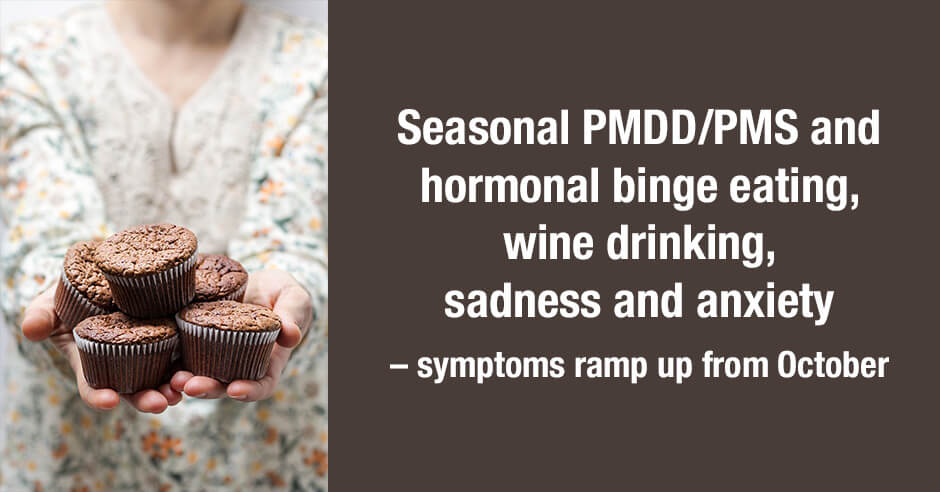
Someone in the community asked for help for the seasonal aspect of her PMDD symptoms i.e. more severe symptoms in winter …
My PMDD symptoms massively increase around the beginning of October right through to March. Would love some advice.
The binge eating and wine drinking is becoming habitual
She specifically mentions binge eating and wine drinking but I assume her other PMDD symptoms – such as anxiety, tension, anger, irritability, depression, sadness, hopelessness, insomnia, overwhelm, low energy, breast tenderness, headaches, pain, bloating, and/ or weight gain – are more severe at this time too.
As you can see, her symptoms are much more severe from October through March (winter in the Northern Hemisphere). If you live in the Southern Hemisphere you could expect more severe symptoms from May through September (or thereabouts).
There is a seasonal aspect to PMDD (premenstrual dysphoric disorder) and PMS (premenstrual syndrome and other hormonal imbalances. It’s not well recognized despite the fact that it’s documented in the research and seen clinically.
My feedback for her is to look into and address low serotonin, low GABA and/or low endorphins with the respective amino acids (adjusting up and down based on the season and symptoms), using recognized SAD (seasonal affective disorder) approaches and addressing pyroluria if needed (the nutrients are cofactors for neurotransmitter production.) I share more about each of these approaches and the research below.
The research: patients with PMDD have substantial seasonal patterns in mood and premenstrual symptoms
Premenstrual dysphoric disorder (PMDD) “accounts for the most severe form of PMS with the greatest impairment of women’s functioning and perceived quality of life, often prompting them to seek treatment.”
This older paper from 1997, Seasonality of symptoms in women with late luteal phase dysphoric disorder
- Out of 100 patients treated in a subspecialty clinic in a university teaching hospital, “a significantly higher rate of seasonal affective disorder (38% versus 8%) as determined by Seasonal Pattern Assessment Questionnaire criteria.”
- Also, 25% of the patients with seasonal variations in their premenstrual symptoms, consider them marked or a severe problem
The authors conclude that:
These results suggest that patients with LLPDD [or PMDD] have substantial seasonal patterns in mood and premenstrual symptoms. These seasonal patterns have implications for the clinical assessment and treatment of LLPDD [or PMDD]. For example, light therapy may be beneficial for women with seasonal worsening of LLPDD [or PMDD].
As you look at the research keep in mind the fact that late luteal dysphoric disorder (LLDD),“is now known as premenstrual dysphoric disorder (PMDD)”, as mentioned in the above paper and other older studies.
Seasonal variations in serotonin and GABA
Seasonal variations in serotonin have long been documented with much research on the winter blues. This paper, The chronobiology and neurobiology of winter seasonal affective disorder describes winter seasonal affective disorder (SAD) as “a mood disorder characterized by the predictable onset of depression in the fall/winter months, with spontaneous remissions in the spring/summer period.” They also state that “The typical patient with SAD is a premenopausal woman who experiences carbohydrate craving, hypersomnia, and prominent fatigue during winter depressive episodes.”
There is less awareness about GABA seasonality but GABA levels may also be lower in the winter months. In this animal study, Effect of the pineal gland on 5-hydroxytryptamine and γ-aminobutyric acid secretion in the hippocampus of male rats during the summer and winter, it is reported that: “GABA secretion in the hippocampus of rats had a seasonal rhythm consisting of increased secretion in summer and decreased secretion in the winter.” I share more about this and the seasonality of GABA here.
It makes sense that supporting these lower levels in winter is going to help with the more severe PMDD symptoms that correlate with each neurotransmitter imbalance.
One solution: address low levels of neurotransmitters with amino acids
As you can see the PMDD symptoms mentioned above could fall into the categories of low GABA, low serotonin and/or low endorphins (and possibly low dopamine/catecholamines and low blood sugar too: binge eating, wine drinking, anxiety, tension, anger, irritability, depression, sadness, hopelessness, insomnia, overwhelm, low energy, breast tenderness, headaches, pain, bloating, and/ or weight gain.
(You can read this StatPearls ebook for the full description of the above symptoms: Premenstrual Dysphoric Disorder)
It’s for this reason I always have clients with PMDD (and other hormonal issues) do the Amino Acids Mood Questionnaire and trials of the respective amino acids.
Using a food mood log and tracking what time of day you binge eat and drink wine (and all the other symptoms) is a clue as to which amino acids may help most. I would expect tryptophan, GABA and DPA would be at the top of the list, and possibly tyrosine and glutamine too.
Because of the seasonality aspect, a higher dose is likely to be needed in the winter time so if you’re just starting your amino acid trails keep this in mind. If you are already using amino acids with success in summer, then bumping up the amounts during winter is going to help further. And then be sure to reduce amounts once winter is over.
Hopefully you’ve also been working on diet, gut health, liver health, adrenal function, toxin removal and other factors to reduce or eliminate PMDD/PMS so the amino acids are not needed long term.
How targeted individual amino acids may help – some examples
As you can see from one study, tryptophan can help with premenstrual dysphoria/sadness, mood swings, tension, and irritability.
Low endorphins and low dopamine may also be a factor. I share more on this blog: DLPA (DL-Phenylalanine) eases PMDD/PMS symptoms in women who experience declining endorphin levels in the second half of their cycles
Here are some specific amino acid cases around binge eating/cravings and excessive wine drinking:
- Would using 5-HTP or tryptophan help when you crave sugar (as a sort of antidepressant) late afternoon/evening?
- Tryptophan had the added benefit of turning me completely off alcohol when I took it to improve mood and sleep during perimenopause
- GABA for ending sugar cravings (and anxiety and insomnia)
None of the above are specific to seasonal changes in symptoms but illustrate the use of amino acids.
Supportive solutions: a SAD lamp when serotonin is low and addressing pyroluria
The late luteal phase dysphoric disorder paper above doesn’t mention amino acids (which is unfortunate but not surprising) but it does mention light therapy. I do recommend the use of a SAD lamp (full spectrum light) when there are low serotonin symptoms that get more severe in the winter.
With PMDD/PMS and other hormonal imbalances, we also always consider pyroluria and the use of higher amounts of zinc, vitamin B6 and evening primrose oil. The “stress” of winter and increased sugar consumption can deplete zinc and vitamin B6 for everyone but more so if you have pyroluria. These nutrients are also key for hormonal imbalances.
Additional resources when you are new to using amino acids as supplements
We use the symptoms questionnaire to figure out if low GABA or low serotonin or low endorphins or low dopamine or low blood sugar may be an issue with your seasonal PMDD/PMS.
If you suspect low levels of any of the neurotransmitters and do not yet have my book, The Antianxiety Food Solution – How the Foods You Eat Can Help You Calm Your Anxious Mind, Improve Your Mood, and End Cravings, I highly recommend getting it and reading it before jumping in and using amino acids on your own so you are knowledgeable. And be sure to share it with the practitioner/health team you or your loved one is working with.
There is an entire chapter on the amino acids and they are discussed throughout the book in the sections on gut health, gluten, blood sugar control, sugar cravings, anxiety and mood issues.
The book doesn’t include product names (per the publisher’s request) so this blog, The Antianxiety Food Solution Amino Acid and Pyroluria Supplements, lists the amino acids that I use with my individual clients and those in my group programs. You can find them all in my online store.
If, after reading this blog and my book, you don’t feel comfortable figuring things out on your own (i.e. doing the symptoms questionnaire and respective amino acids trials), a good place to get help is the GABA QuickStart Program (if you have low GABA symptoms too). This is a paid online/virtual group program where you get my guidance and community support.
Another option is the budget-friendly GABA QuickStart Homestudy program.
If you also need serotonin support, the Serotonin QuickStart Program is a good place to get help. This is also a paid online/virtual group program where you get my guidance on using tryptophan and 5-HTP safely, and community support during 5 LIVE Q&A calls. You can sign up to be notified when the next live launch of this program is happening.
If you are a practitioner, join us in The Balancing Neurotransmitters: the Fundamentals program. This is also a paid online/virtual program with an opportunity to interact with me and other practitioners who are also using the amino acids.
Now I’d like to hear from you
Does any of this resonate with you? If yes, has any of the above helped with the seasonal aspect of your PMDD, PMS or other hormonal issues?
Feel free to share and ask your questions below.

I am 20 years post menopausal at 71. I still have SAD, difficulty maintaining and losing weight holiday/winter weight. Year ‘round I have sleep issues with waking up after 4 hours and unable to go back to sleep deeply, if at all. Phosphatydilserine doesn’t help. I also take GABA, Glycine, Taurine, Tryptophan, and Theanine.
I can’t seem to find anything that will make the vagus nerve/parasympathetic complex pick up the ball and prevent Cortisol from releasing during the 2 – 4 AM time frame. I wish I could just permanently block Cortisol.
It has been a problem since I began menopause in Feb 1997. I was only 44. Don’t know why it happened so early. Stress maybe.
Sue
Per the blog I have clients focus on making sure they get optimal doses of the amino acids that are helping and adjusting up in the winter as needed. Using the amino acids sublingually or opened can often help too.
Also light therapy and the pyroluria protocol is very helpful. How do you score on the pyroluria questionnaire? https://www.everywomanover29.com/blog/pyroluria-questionnaire-from-the-antianxiety-food-solution/
If waking in the night is due to high cortisol I find Seriphos to be more effective than PS/Phosphatidylserine https://www.everywomanover29.com/blog/seriphos-lowers-high-cortisol-prevent-waking-in-the-night-and-nighttime-anxiety/
We also look into dietary oxalates, toxins and gallbladder issues https://www.everywomanover29.com/blog/waking-in-the-night-due-to-environmental-toxins-impacts-on-the-liver-gallbladder-and-fat-digestion-making-oxalate-issues-worse/
And of course all the foundational work from my book is key: real whole foods, quality animal protein, eating for blood sugar control, no gluten, no sugar, no caffeine, addressing gut health/SIBO/parasites etc. More here on my book “The Antianxiety Food Solution” https://www.everywomanover29.com/blog/the-antianxiety-food-solution-by-trudy-scott/
Dear Trudy,
I have been using Amino Acids to cope with PMDD for about three years. I found that tryptophan really helped imporved my mood in general but it took me a while to get the dose right (1,500mg a day usually).
Some of the other amino acids made me worse. Although I got energy and motivation from tyrosine and DLPA it created a stronger depression afterwards and although 5htp was strong and gave euphoria it soon stopped working and gave me also terrible anxiety as a side effect.
Also glutamine seemed to help me gain a blood sugar balance but it also increases my depression after a few days. So I just wanted to mention my experience with this so far, although I have not found a solution yet for the worst days.
What do you think about Amitriptyline? Sometimes I take 5mg (half or a third of a tablet) to help break down my bad state but I find long term it makes me too drowsy. Any other suggestions for PMDD when I have this pattern of only a positive response to tryptophan?
Many thanks, I am grateful for amino acids as an alternative to stronger medication.