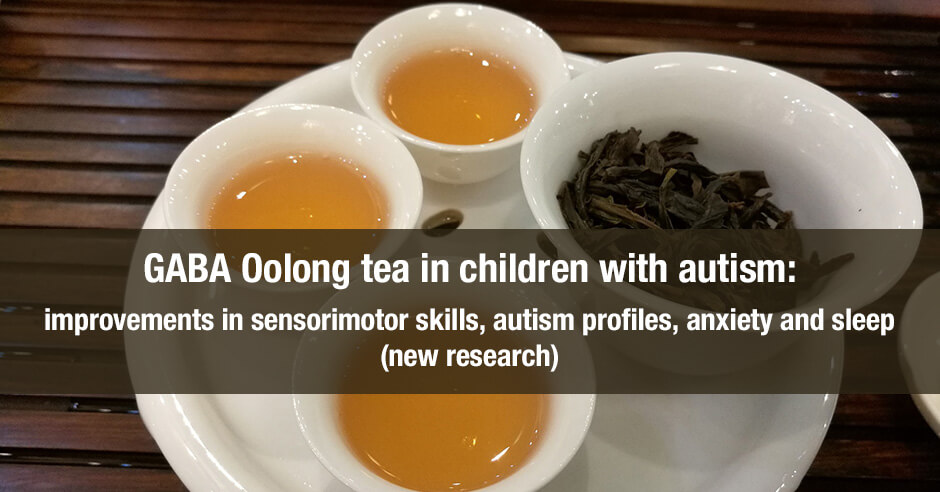
A small feasibility study, A double-blind, placebo-controlled, randomised-designed GABA tea study in children diagnosed with autism spectrum conditions, explored the effect of drinking GABA Oolong tea on sensorimotor skills, autism profiles, anxieties and sleep of children with autism.
It was a very small study with nine children (5 male and 4 female) but the results were very promising… “significant improvement in manual dexterity and some large individual improvements in balance, sensory responsivity, DSM-5 criteria and cortisol levels with GABA tea.”
In addition to reducing anxiety (in all but one participant – more on that below), the paper lists the following additional information related to sensory issues, cortisol levels and sleep:
- Results also demonstrated that sensory responsivity improved in two-thirds of the participants and autism symptomology decreased in over half, with four of these individuals being positively re-classified on the DSM-5 scale
- Differences between evening and morning cortisol levels, deemed the ‘carryover’ effect and cortisol awakening levels were also decreased in over two thirds of the participants, which we attribute to a reduction in stress response which may have helped to reduce sensorimotor responsivity in individuals with autism.
- Contrary to our hypotheses, GABA Oolong tea did not appear to impact sleep, with no discernible differences noted in a range of sleep parameters compared with the placebo, despite parents’ subjective reports that their children appeared to sleep more deeply.
They conclude as follows … “These results suggest that sensorimotor abilities, anxiety levels and DSM-5 symptomology of children with autism can benefit from the administration of GABA in the form of Oolong tea.”
What is GABA Oolong tea?
When I shared this study and results on Facebook, I had a few people ask if they could simply add the amino acid GABA to their Oolong tea: “Is it just brewed tea with GABA powder added? Or does someone make a specific tea? I can totally add some GABA to my daily tea.”
It’s not regular oolong tea with GABA added, instead it’s specially fermented to increase GABA levels naturally. Amber GABA Oolong tea by Meileaf is the actual tea used in the study and they share this on the product page.
The farmers achieve this by alternating the leaves between air and a nitrogen rich environment (with no air) during the oxidation phase. This is done over a matter of hours and naturally increases the GABA levels in the tea leaves.
They also share this: “In order to be called GABA tea, the leaves must contain at least 150 mg of GABA per 100g (normal oolong has about 6 mg so that is 25 times higher).”
GABA Oolong tea does also contain theanine, caffeine and epigallocatechin gallate. There is a large part of the study dedicated to theanine so feel free to read that at your leisure.
How much GABA was ingested by study participants?
It was a surprisingly low dose of GABA! They were given 4 cups a day of the GABA Oolong tea and this provided a total of 39.2mg GABA for the day. The authors share this about the amount of daily GABA the study participants received:
With the GABA Oolong tea the dose would be approximately 280 mg per 100 g tea. Based on using 3.5 g per tea portion this equates to 9.8 mg of GABA; multiplied by 4 throughout the day, being 39.2 mg of GABA.
I’ve reached out to confirm which tea was used in the study since Meileaf mentions that this tea contains 205 mg of GABA per 100 g whereas the study states there was 280 mg GABA per 100 g tea. I see consistency with assessing GABA levels accurately being a possible issue (more on that below).
One of the first questions I had was how could such a small amount – 39.2 mg GABA for the day – be so effective? I typically have clients start with 125 mg GABA and they may end up using this dose 3 or 4 x day (so 375 to 500 mg GABA total for the day.)
That said, we are all unique and as I’ve shared, there can be an extremely large variation in dosing. In this blog I share how Syd gets sleep and body anxiety benefits with just 1.5 mg to 3 mg GABA and yet Christina’s agoraphobic client was able to leave the house with 3000 mg GABA.
My other questions: the placebo, caffeine, a histamine reaction, low cortisol and B1 depletion
With new research there are always many factors to consider and I have a number of other questions I’d love to see addressed:
- Why did the placebo tea also contain GABA? It had 22.2 mg per day of GABA – about half that found in the GABA Oolong tea.
- GABA Oolong tea does contain small amounts of caffeine and how would this affect susceptible individuals? One child was more anxious – was it due to caffeine or was it too much GABA for his needs or a histamine reaction due to the fermentation process (or something else)?
- Do we need to be concerned about long term use and depletion of vitamin B1/thiamine which happens with regular tea.
- And what about the effects if someone already has low cortisol levels?
- Will there be standard levels and accurate measures of GABA in the various GABA Oolong teas that we can rely on? This applies to consumers and practitioners wanting to try this approach and for ongoing research.
- How much of the effect was also due to addressing dehydration and helping with dietary oxalate issues which are known to be common in autism?
Hopefully new ongoing research with more participants will shed light on some of these questions.
I’d also love to see head to head research comparing GABA Oolong tea with supplementation of the amino acid GABA, and a study where both are used for possible synergistic effects.
I do appreciate that the authors attempt to address the GABA blood brain barrier (BBB) debate and how GABA could work, focusing on a permeable blood brain barrier in epilepsy and increased epilepsy in autism. This angle is new to me. I’ve addressed the leaky BBB at length here in my interview with Dr. Kharrazian (it’s a theory) and one of my interviews on a prior Anxiety Summit (there are many possible mechanisms and the peripheral effects).
If you’re new to symptoms of low GABA (and cases highlighting the calming effects of the amino acid GABA used as as a supplement)
GABA (gamma aminobutyric acid) is a calming neurotransmitter and the calming amino acid GABA used as a supplement can raise GABA levels. With low GABA levels you’ll feel a physical-tension and stiff-and-tense-muscles type of anxiety.
The other symptoms we see with low GABA are panic attacks, physical tension in certain settings like public speaking or driving, and the need to self-medicate to calm down, often with alcohol but sometimes with carbs and sugary foods. Insomnia can also be due to low GABA and you’ll experience physical tension (rather than the ruminating thoughts which is the low serotonin type of insomnia – although it’s not uncommon to experience both). GABA also helps with muscle spasms and pain relief when muscles are tight.
Here are are some case studies where you can read about the calming effects (and other benefits) of the amino acid GABA used as as a supplement:
- GABA is a life saver for anxiety, theanine helps at night (insomnia) and 5-HTP makes a significant difference in lessening daily pain
- Drastic reduction in intrusive thoughts, anxiety and fears (and better sleep) with GABA, tryptophan, 5-HTP and the pyroluria protocol
- GABA, Heartmath and EFT ease Micki’s mold-induced anxiety and panic attacks
- GABA, Rescue Remedy & essential oils for eliminating dental anxiety
- GABA for children: ADHD, focus issues, irritability, anxiety and tantrums
Resources if you are new to using GABA and other amino acids as supplements
If you are new to using GABA or any of the other amino acids as supplements, here is the Amino Acids Mood Questionnaire from The Antianxiety Food Solution (you can see all the symptoms of neurotransmitter imbalances, including low GABA and low serotonin).
If you suspect low levels of any of the neurotransmitters and do not yet have my book, The Antianxiety Food Solution – How the Foods You Eat Can Help You Calm Your Anxious Mind, Improve Your Mood, and End Cravings, I highly recommend getting it and reading it before jumping in and using amino acids on your own so you are knowledgeable. And be sure to share it with the practitioner/health team you or your loved one is working with.
There is an entire chapter on the amino acids and they are discussed throughout the book in the sections on gut health, gluten, blood sugar control, sugar cravings, self-medicating with alcohol and more.
The book doesn’t include product names (per the publisher’s request) so this blog, The Antianxiety Food Solution Amino Acid and Pyroluria Supplements, lists the amino acids that I use with my individual clients and those in my group programs. You can find them all in my online store.
If, after reading this blog and my book, you don’t feel comfortable figuring things out on your own (i.e. doing the symptoms questionnaire and respective amino acids trials), a good place to get help is the GABA QuickStart Program (if you have low GABA symptoms). This is a paid online/virtual group program where you get my guidance and community support.
If you are a practitioner, join us in The Balancing Neurotransmitters: the Fundamentals program. This is also a paid online/virtual program with an opportunity to interact with me and other practitioners who are also using the amino acids.
Have you used GABA Oolong tea with clients/patients or personally? How much and what benefits have you seen? Which product have you used?
If you’ve also used the amino acid GABA sublingually and with success, I’d love to hear how much (and which product) and how it compares with GABA Oolong tea for anxiety, insomnia, sensorimotor skills and/or autism symptoms (as applicable to you, your child or other family member and/or your client/patient)?
If you have questions please share them here too.