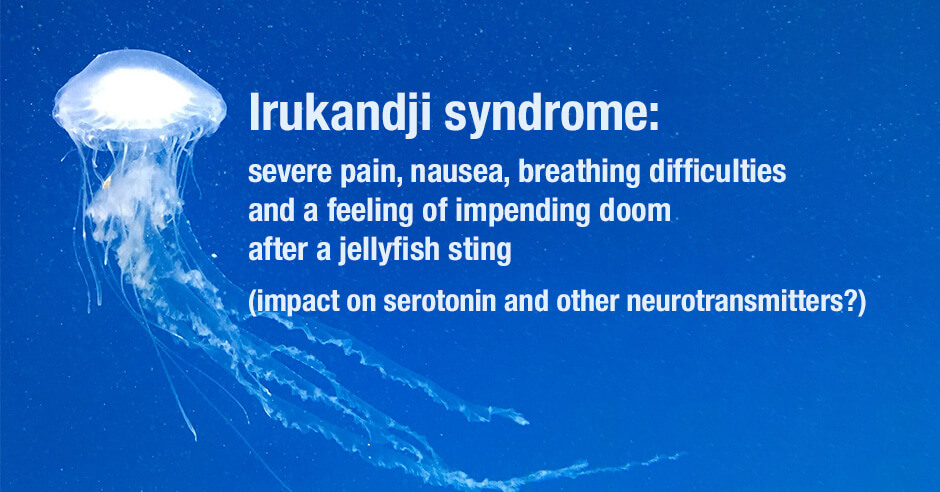
Irukandji syndrome is in the news again. In addition to the jellyfish sting causing severe pain, nausea and breathing difficulties, the research states there is a feeling of impending doom after you’re stung. I’m sharing this current news from Australia and a recent study because I’m curious about the mechanisms and short- and long-term impacts on serotonin and other neurotransmitters, likely affecting anxiety, depression, pain and insomnia. And I’d like to help create awareness since there is not 100% consensus on what to do right away after a sting and less awareness in the medical community than I feel comfortable with.
From the ABC article published this week in Australia: “Another child has been flown to Hervey Bay Hospital with a suspected Irukandji sting after swimming in a creek off Wathumba Road on K’gari (Fraser Island) in Queensland, Australia on Wednesday afternoon.
The key points of the article:
- “Three young girls and a boy have been flown to hospital with suspected Irukandji stings in the past two days
- The jellyfish stings can cause severe pain, nausea and breathing difficulties
- A Toxicologist is calling for more research into their movements and physiology”
The yahoo news article expanded on the symptoms: “They have this severe body pain, often low back pain, nausea, vomiting, and this feeling of impending doom that sort of lays over the top of this whole thing.”
I found the latter interesting as impending doom is a classic sign of low serotonin. So I went digging into the research. I was enlightened and surprised by what I found.
Raising awareness on this worldwide increasing threat
This 2022 paper, Raising Awareness on the Clinical and Forensic Aspects of Jellyfish Stings: A Worldwide Increasing Threat is eye-opening and concerning and also mentions the impending doom symptom.
Irukandji syndrome is a severe illness produced by the envenomation i.e. injection of venom, of some species of small jellyfish from the Cubozoa class, known as box jellyfish.
It consists of a clinical picture dominated by systemic symptoms similar to a catecholamine surge, including hypertension, tachycardia, intense pain, and muscle cramping, eventually leading to pulmonary edema, shock and cerebral hemorrhage.
Also listed are symptoms of anxiety, restlessness, headache, localized sweating and impending doom. A feeling of impending doom is a classic symptom of low serotonin.
With regards to Irukandji syndrome it’s becoming a worldwide problem: “The first cases described happened in the northern Australian territories. However, similar disorders have been observed all over the tropical waters, including Thailand, the Caribbean, Florida, and Hawaii.”
The good news is that the authors state “Irukandji syndrome is typically not deadly, especially if supportive care is given early” and “not all encounters with species capable of producing Irukandji syndrome result in this clinical state.” They also share that typically the severe pain only lasts a few hours but do mention one case where “pain recurred up to a year later.” I discuss possible longer term effects below.
As you read the paper, be aware there are many types of jellyfish with many different mechanisms. Cubozoa includes the deadliest jellyfish species and includes Carukia barnesi and Chironex fleckeri. (commonly known as the Australian box jelly). It’s the Carukia barnesi that causes Irukandji syndrome.
The images in the above paper are graphic so be warned.
There is not 100% consensus on what to do right away
What is also really concerning is that there is not 100% consensus on what to do right away. This 2017 paper, Cubozoan Sting-Site Seawater Rinse, Scraping, and Ice Can Increase Venom Load: Upending Current First Aid Recommendations, published by Hawaiian researchers, found the “best outcomes occurred with the use of venom-inhibiting technologies (Sting No More® products)” and they state not to use a sea water rinse. They also found vinegar and heat treatment were less effective with certain types of jellyfish.
And yet the tentative recommendation from the above 2022 paper is to use vinegar, heat, sea water, and careful removal of remaining tentacles with tweezers quickly because only “about 1% of nematocysts (stinging cells) discharge upon initial contact.” They do suggest using Sting No More® before removing tentacles in order to deactivate the nematocysts.
I’m not sharing any of the above as conclusive in all situations but more to illustrate what both papers state: further research is needed in different places of the world, as different jellyfish species seem to react differently to the treatments.
There is also less awareness in the medical community than I feel comfortable with hence my desire to share this so you are more aware if you or a family member is stung by a jellyfish.
Are there possible long-term impacts on anxiety, depression, pain and insomnia? (and the potential role of amino acids)
Just like we have long-term impacts on anxiety, depression, pain and insomnia with Lyme disease and other infections like Bartonella – due to effects on serotonin, GABA and other neurotransmitters – do we need to consider these long term impacts after a jellyfish sting too?
I have to wonder if there are also longer term impacts given the trauma of the situation and the many medications that are needed to save your life: nitroglycerin, opioids, benzodiazepines and others.
If mood, anxiety, pain and sleep issues persist after the acute recovery phase (which can take up to 3 months and more) and there are other signs of low serotonin, GABA, dopamine and endorphins, it’s important to consider the use of targeted amino acids. I recommend tryptophan or 5-HTP for low serotonin symptoms (worry type of anxiety, insomnia and low mood), GABA for low GABA symptoms (physical anxiety and tension), tyrosine for low dopamine symptoms (depressed with low energy and poor focus) and DPA for low endorphin symptoms (pain and weepiness).
It would be wonderful to see research in this area.
Is there a possible role for GABA right after the sting too?
Given there is “hypertension, tachycardia, intense pain, and muscle cramping”, would the amino acid GABA help?
With Irukandji syndrome, “there have been reports of blood pressures as high as 300/180 mmHg” (normal is 120/80 mmHg). In one study, 80mg GABA was found to reduce mild hypertension and it’s possible that a higher dose of GABA may help right after the sting. It may also help to alleviate pain and muscle tension/muscle cramping too.
It would be wonderful to see research on GABA use right after the sting too.
Resources if you are new to using amino acids as supplements
If you are new to using GABA or any of the other amino acids as supplements, here is the Amino Acids Mood Questionnaire from The Antianxiety Food Solution (you can see all the symptoms of neurotransmitter imbalances, including low GABA and low serotonin).
If you suspect low levels of any of the neurotransmitters and do not yet have my book, The Antianxiety Food Solution – How the Foods You Eat Can Help You Calm Your Anxious Mind, Improve Your Mood, and End Cravings, I highly recommend getting it and reading it before jumping in and using amino acids on your own so you are knowledgeable. And be sure to share it with the practitioner/health team you or your loved one is working with.
There is an entire chapter on the amino acids and they are discussed throughout the book in the sections on gut health, gluten, blood sugar control, sugar cravings, self-medicating with alcohol and more.
The book doesn’t include product names (per the publisher’s request) so this blog, The Antianxiety Food Solution Amino Acid and Pyroluria Supplements, lists the amino acids that I use with my individual clients and those in my group programs. You can find them all in my online store.
If, after reading this blog and my book, you don’t feel comfortable figuring things out on your own (i.e. doing the symptoms questionnaire and respective amino acids trials), a good place to get help is the GABA QuickStart Program (if you have low GABA symptoms). This is a paid online/virtual group program where you get my guidance and community support.
If you are a practitioner, join us in The Balancing Neurotransmitters: the Fundamentals program. This is also a paid online/virtual program with an opportunity to interact with me and other practitioners who are also using the amino acids.
I do hope these 4 young Australian children are doing well after having been stung.
Have you or a family member been stung by a jellyfish? Where did it happen and what type of jellyfish? What symptoms did you experience? What was the treatment and what was recovery like?
Have you or your family member had any long-term lingering symptoms of anxiety, depression, pain and insomnia? Have the amino acids or other solutions helped?
If you’re a practitioner have you seen long-term lingering symptoms of anxiety, depression, pain and insomnia in your clients/patients who have had a jellyfish sting?
Feel free to post your questions and feedback in the comments below.