Julie Matthews, CNC, author of Nourishing Hope for Autism, was interviewed on the Anxiety Summit by host of the Anxiety Summit, Trudy Scott, Food Mood Expert and Nutritionist, author of The Antianxiety Food Solution.
Addressing Anxiety in Individuals with Autism
- How common is anxiety in autism and medications commonly prescribed
- Autism prevalence and the exponential growth and why this is important beyond those with autism
- Underlying biochemical factors that contribute to anxiety in autism
- The microbiome and gut involvement
- Sensory sensitivity, light and sound sensitivity, weighted blankets and more
- Foods, food compounds and nutrients like GABA and zinc
- The far-reaching benefits of a BioInidividual Nutrition approach for autism, anxiety, ADHD and many chronic diseases
This is the first paper we discussed: Treatment of comorbid anxiety and autism spectrum disorders
Clinically significant anxiety occurs frequently among individuals with autism spectrum disorders (ASDs) and is linked to increased psychosocial, familial, behavioral and academic impairment beyond the core autism symptoms when present.
Up to 80% of children with ASDs experience clinically significant anxiety, with high comorbidity rates for social phobia (30%), generalized anxiety disorder (GAD) (35%), obsessive–compulsive disorder (OCD) 37% and separation anxiety disorder (SAD) 38% having been observed (30, 35, 37 and 38%, respectively).
Patients with ASDs and anxiety are at increased risk for social avoidance, difficulties establishing and maintaining peer relationships, sleep problems, disruptions in family functioning and at school.
SSRIs have NOT been consistently linked to improvements in core ASD symptoms (e.g., communication and social skills deficits, repetitive behaviors and stereotypies) or anxiety and repetitive behaviors in youths
High rates of behavioral activation (e.g., agitation, irritability, aggression and disinhibition) and diminished tolerability have been reported across trials, which may suggest that youths with ASDs are more vulnerable to side effects compared with their typically developing peers.
Here is the initial multisystem study Julie covered at the start – Pathway Network Analyses for Autism Reveal Multisystem Involvement: Major Overlaps with Other Diseases and Convergence Upon MAPK and Calcium Signaling
Julie covered folate receptor autoantibodies and cerebral folate deficiency (common in autism and now found in anxiety too):
It was a concept that in the autism community was brought forward by Dr. Fry and Dr. Rosignol and Dr. Quadros looking at this particular condition. And so there’s a condition called cerebral folate deficiency. And it’s a neurodevelopmental disorder where the baby doesn’t get enough folate to their cerebral spinal fluid in their brain. And so they don’t get the proper development that they need. And the reason for that is they looked into what could be causing that and they found that children with autism have a high rate of folate receptor autoantibodies. And so what happens is the folate receptor is basically taking folate from the bloodstream and puts it into the cerebral spinal fluid. It gets it to the brain basically.
And these folate receptors are basically what take it across the membrane. But in children with autism they have these autoantibodies and that blocks their ability to get the folate into the brain. So they have neurodevelopmental issues and then during their lifetime as well they still don’t have enough folate they need on a daily basis to do the things that they need to do. So it’s an ongoing challenge for them as well.
Here are the folate receptor autoantibody studies:
- Cerebral Folate Receptor Autoantibodies in Autism Spectrum Disorder (serum folate receptor autoantibody concentrations as a prevalence of 75 percent of the children with autism)
- High milk consumers have an increased risk of folate receptor blocking autoantibody production but this does not affect folate status in Spanish men and women.
Most of the research regarding these folate receptor autoantibodies are around autism. But now it seems like we’ve seen this new animal study that actually mentions anxiety as well – Exposure to Folate Receptor Alpha Antibodies during Gestation and Weaning Leads to Severe Behavioral Deficits in Rats: A Pilot Study
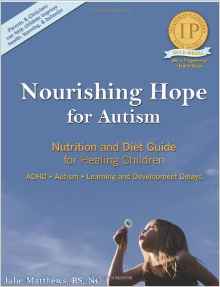
Here is Julie’s wonderful book – Nourishing Hope for Autism: Nutrition and Diet Guide for Healing Our Children
Here are the digital gifts from Julie
- Using Food and Nutrition to Improve ADHD and Autism
- Integrative Medicine and BioIndividual Nutrition webinar (for practitioners)
If you are not already registered for the Anxiety Summit you can get live access to the speakers of the day here: www.theAnxietySummit.com
Missed this interview or can’t listen live? Or want this and the other great interviews for your learning library? Purchase the MP3s or MP3s + transcripts and listen when it suits you.
You can find your purchasing options here.: Anxiety Summit Season 1, Anxiety Summit Season 2, Anxiety Summit Season 3, and Anxiety Summit Season 4.

Thank you for this interview and additional information. Would you be able to also share the website of the researcher Judy mentioned towards the end who studied 5 treatments (including diet and supplementation). I believe his name was Dr Adams.
I have a second question for Judy–Judy have you worked with people who have brain injuries (mild TBIs or post concussion syndrome), but may not have a diagnosis of ASD? Many of the symptoms are similar, and I suspect some of the underlying issues may be also.
Many thanks for all your work!
Aislinn
I believe Dr Adam’s research has not yet been published. I’ll have Julie come and share any additional info she may have.
There is no Judy – only Julie and Trudy – confusing I know! but I’ll chime in here about TBIs. Yes many conditions can have similar underlying issues (obviosuly with a TBI there is the physical trauma) and similar approaches may help.
Of course, sorry–I was listening and heard “Julie”! Oops.
Here is Dr. Adam’s website: http://www.autismnrc.org/advice-and-research-updates
could you give the reference for the study that did show positive results from a gluten free diet.
David, the most recent study isn’t published yet but you may be able to find Dr. Adams online presentation at Autism One last year (2015). There are studies on gluten from my blog: http://nourishinghope.com/study-on-gluten-sensitivity-in-autism-sheds-further-light-on-the-gluten-free-diet/
Trudy, I first learned about you a few years ago while listening to the seminar hosted by Dr. Susan Albers about mindful eating. I was having terrible food cravings and feeling guilty about my weight. It’s nearly impossible to exercise and eat well when insomnia controls your life.
Trudy, I’ve been listening to your summits and reading your blog since.
Last year, I finally decided that I needed help from a functional medicine clinic. I was deficient in several vitamins and minerals, including magnesium, zinc and B6. I was following the protocols recommended by Trudy on her blog. I felt somewhat better but knew I still had a long way to go.
So I searched and I found a functional medicine clinic that does methylation testing. At the time, I didn’t know I had a methylation defect. I only thought that a clinic that does that sort of testing would be of the caliber that could offer me some real help.
So here’s the way it ties back into you, Trudy, and into Julie’s topic:
It turns out that I was having an autistic-like “overwhelm” from light, noise and vibration. It’s been getting progressively worse over the five decades of my life. Chronic pain from hypermobility, RSD following a car accident, intractable insomnia, and a mild concussion made me miserable and unable to function.
As soon as the functional medicine doc had done enough testing to make his determination (“Don’t guess; test.”) I was put on a gluten, dairy and soy free diet aimed at restricting free glutamate, based on the GARD protocol. It is similar to the diet Julie is recommending for certain autistic people to improve their symptoms.
I also underwent “brainwave optimization” (Google that) in order to reduce the disharmony in my brain function. Before the ten sessions were over, I suddenly felt less overwhelmed by light, noise and vibration. Screaming children did not grate on my nerves. Sunlight didn’t make me squint as much. Potholes in the road made me feel like I was slowly being beaten up, especially on long road trips. On the way home from one of the brainwave sessions, I actually drove through a few potholes on purpose, and noticed that they did not bother me. Hardly at all!
Bing bing bing bing! I think we have a winner here!
Reading about free glutamate online, I came across the website msgtruth.org, which lists foods highest in free glutamate. Those were all the foods I had craved. My cravings made the mindful eating advice of Dr. Albers nearly impossible to follow. I stopped feeling so guilty about my food choices when I finally realized that my brain was addicted to free glutamate and I had been craving all the foods highest in free glutamate!
I’m taking GABA three times a day plus low amounts of all the other neurotransmitters, prior to transitioning into a time where I will take single neurotransmitters. It’s my next step with the functional medicine doc. I know that some people cannot find or afford supervision like this. I wish this were the standard of care for everyone!
Sorry for the long story but I think you’ll agree that it is highly relevant to this particular interview. Both of you ladies keep up the good work because it benefits so many people. THANKS!
Way to go Mary! And thanks for sharing your experience with us.
Thanks for sharing Mary – it’s wonderful to hear how you’re putting all the puzzle pieces together. And lovely that you have great support and are doing so much better
I am also very sensitive to glutamate. I had quit junk food many years ago and last year after much facial pain and flunking my glaucoma screening, gratefully discovered farm fresh, homemade chicken broth wasn’t good for me. http://www.biodynamicwellness.com/stock-vs-broth-confused/, http://www.dramyyasko.com/wp-content/uploads/2011/08/The-Role-of-Excitotoxins-in-Autistic-Type-Behavior.pdf, and http://www.holistichelp.net/blog/how-to-increase-gaba-and-balance-glutamate/
I have a daughter who is 13 and has struggled since preschool. We have done everything the conventional methods have offered. She is on Zoloft for OCD and Strattera for focus. She has had sensory issues since 3 or 4 which contributes to her focus. Her mind never stops. I have learned a great deal about the functional approach and diet over the last year… her doctors have always told me there aren’t any diets that make a significant difference. I discussed with my husband eliminating gluten and dairy ( she reacted to cows milk the first time she had it and it continues show up as mild intolerance on her IGg food test). My husband feels it would be too overwhelming to eliminate both at the same time for all of us, and wants to start with gluten first and then dairy if necessary. This option will take longer but is there a reason this would be counterproductive? Also, Trudy I wanted to ask about Inositol. I just received mine and have given her about 2000 mg 2 days without results. I’m not sure whether to continue to give her more over the course of several hours or wait until the next day and give her a larger dose. Can you advise? I would really like to get her off the Zoloft for her OCD. Thank you for your work.
Kristi, The way you choose to implement a gluten-free and dairy-free diet is individual. You are correct it will take longer. Without knowing your daughter I can’t say for sure, but I haven’t seen a downside to this suggested approach. The only pitfall I see (as your scenario is laid out) is when people don’t continue on to the dairy-free portion. They either see results and stop or they don’t see results from the first and the abandon the whole diet concept before giving it a good try.
Kristi
With inositol the results are felt quickly like with the amino acids GABA and tryptophan so I’ll often try a little more on the first day and then slowly increase each day
The dosage of inositol is 18g/day and I have used this much with many clients. I also look at low serotonin and tryptophan and would also consider strep/PANDAs.
Of course the GFCF diet may very well be a huge aspect or the only factor. See this OCD case study – gluten-free diet https://www.everywomanover29.com/blog/integrative-medicine-approach-pediatric-ocd-anxiety/
Reading comments is so helpful I thought I better share my story that my local newspaper published last week in case it can help anyone here. Thank-you Trudy & Julie for all of your help. I do my best to pass it on and keep learning. http://www.valleycenter.com/news/2016-06-09/Valley_Life/Detoxing_and_eliminating_lead_helps_fight_fibromya.html
Hi Trudy and Julie,
Would you mind providing links for the research on specific bacterial gut infections that Julie mentioned in this interview. I’d like to share them with our doctor.
Thanks!