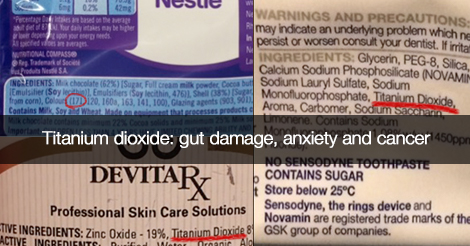
Titanium dioxide, a common food additive found in candy, gum, bread, sunscreens, cosmetics and medications, has been shown in new research to alter digestive cell structure and function due to the damage it causes to the gut lining:
The ability of small intestine cells to absorb nutrients and act as a barrier to pathogens is ‘significantly decreased’ after chronic exposure to nanoparticles of titanium dioxide, a common food additive found in everything from chewing gum to bread.
Acute exposures did not have much effect, but chronic exposure diminished the absorptive projections on the surface of intestinal cells called microvilli. With fewer microvilli, the intestinal barrier was weakened, metabolism slowed and some nutrients — iron, zinc, and fatty acids, specifically — were more difficult to absorb. Enzyme functions were negatively affected, while inflammation signals increased.
The study was done using an in vitro (i.e. “in glass” or test-tube) cell culture model of the small intestinal epithelium. You can read the actual January 2017 study here.
Since this was not a human study this could be some of the extrapolations we could possibly make because of how chronic exposure led to fewer microvilli:
- The intestinal barrier was weakened and metabolism slowed. If you suspect you may have damage to the gut lining (as in leaky gut and malabsorption), glutamine is an amino acid that when taken as a supplement is very healing of the gut.
- Malabsorption of iron, zinc, and fatty acids was a factor so it would be important to assess for low levels and address deficiencies if necessary, especially since low levels of all three can have a direct impact on increasing anxiety.
- Enzyme functions were negatively affected so this would need to be addressed with a broad spectrum enzyme and possibly HCl.
- Inflammation signals also increased so using something like curcumin and omega-3 fatty acids may be a good choice to reduce likely inflammation.
- And it goes without saying, eating a nutrient-dense anti-inflammatory diet is key
As soon as I read this paper I thought of my good friend and colleague Mira Dessy, NE, known as The Ingredient Guru, and author of The Pantry Principle: how to read the label and understand what’s really in your food. She is an expert in all things ingredient and food labels related so I reached out to her and she shared that the titanium dioxide powder itself appears to be somewhat harmless (although there are reports of the dust causing causing respiratory irritation). Even this concerns me but it gets even more concerning. Mira goes on to say:
The challenge, however, is that there is an increasing amount of titanium dioxide nanoparticles being used. The microscopic size and their ability to penetrate into the blood stream and from there circulate throughout the body is very worrisome. These titanium dioxide nanoparticles represent a significant challenge to nerve tissue and also impact brain health through oxidative stress.
Given the ability of the nanoparticles to go through the skin and into the blood stream I’m not surprised that there is growing evidence for gut disruption in addition to the nerve and brain health issues. The damage to epithelial cells and impairment of micronutrient absorption is highly concerning.
I love Mira’s book The Pantry Principle (and learned so much from it) and I asked her this week when I reached out for a quote from her why it didn’t make it into her book published just a few years ago in 2013. She shared that it did not really come up on her radar at the time:
Sadly it turns out that this is because food producers can use up to 1% titanium dioxide (food grade) without declaring it on the label. Unfortunately when I wrote the book I did not know that. At the time it appeared to be primarily used in personal care products. Approved for use in cosmetics back in 1973 it is often found in bath powders, cosmetics, antiperspirants, nail polish, sunscreen, and lotions. It seems to be growing in food usage, appearing in candies, gums, dairy products, condiments, processed meats, and snack foods.
I’m sharing this because I want you to be aware how quickly things can change and how we really need to keep up with labeling! (be sure to check out Mira’s other work on additives and labeling and my review of her book The Pantry Principle for additional information.)
I was also shocked to find out that food producers can use up to 1% titanium dioxide (food grade) without declaring it on the label – what!? I suspect (and hope) this will be changing in the near future.
I would expect some radical changes from governments and companies using it especially with this IARC (International Agency for Research on Cancer) monograph (another resource Mira provided):
Titanium dioxide is possible carcinogenic to humans (Group 2B) based on sufficient evidence in experimental animals and inadequate evidence from epidemiological studies.
and this conclusion they reach:
Given the increasing applications of nano titanium dioxide in consumer products (e.g., food or food packaging and skin care products), there is a need to develop better techniques to detect titanium dioxide in tissues and to examine possible carcinogenicity of nano titanium dioxide by other routes of exposure (oral, dermal).
Another recent study found that injected titanium dioxide nanoparticles increased anxiety in rats, increased inflammation and there was increased accumulation in the liver, lungs and brain:
The results suggest that TiO2 NPs [titanium dioxide nanoparticles] could alter the neurobehavioral performance of adult Wistar rats and promote alterations in hepatic [liver] tissues.
I plan to avoid this additive. The best way you can avoid it too is to do the following:
- eat real food and avoid food that has been processed
- if you do eat something processed make sure it’s organic because titanium dioxide is not approved for use in organic foods (also make sure it’s not organic “junk food” – there is plenty of that around these days!)
- read cosmetic labels and avoid toothpastes, makeup, lotions and sunscreens that contain the titanium, especially when in nanoparticle form
Just to be clear, not all titanium dioxide used in food products are nanoparticles (which are defined as smaller than 100 nanometers in diameter). However up to 36 percent of the titanium dioxide found in nearly 90 food products were nanoparticles, according to this 2012 article: Titanium Dioxide Nanoparticles in Food and Personal Care Products.
I also reached out to my friend and colleague Lara Adler, Environmental Toxins Expert & Educator for her expert opinion:
The issue of nanoparticles in consumer products, whether it’s food, or personal care products like makeup or sunscreen can be confusing. The first issue is that there are no current labelling or disclosure requirements regarding nanoparticles, at least here in the US. Companies that are more keen to appeal to health-minded consumers will often disclose that they are not using nanoparticle sized ingredients, but there’s no legal requirement for anyone to do so, which means it’s totally possible for a product to contain nanoparticles of titanium dioxide and we won’t know. In the European Union, companies are required to disclose and fully label nano-ingredients.
When it comes to topical use in say, sunscreen, research is showing that non-nano titanium dioxide is unlikely to penetrate the skin and enter the body, and is therefore a low risk. The bigger health risk, for nano, or non-nano are products that are aerosolized, like the spray sunscreens as these products are easily inhaled. Most of the research into the negative health effects of titanium dioxide are inhalation studies.
Her feedback supports what Mira and I have discovered from the research: there’s a growing body of research that’s indicating potential negative health effects of nanoparticles, including their ability to migrate throughout the body. She shared these papers with me (both about nanoparticles in general):
A rodent study found that inhaled nanoparticles ended up in the central nervous system, and another study found them ending up in the liver.
But most shocking is this study Lara shared with me about maternal exposure to nanoparticles of titanium dioxide:
It caused the changes in the expression of genes associated with brain development, cell death, response to oxidative stress, and mitochondria in the brain during the perinatal period.
Changes of the expression of genes associated with neurotransmitters and psychiatric diseases were found.
Here are some examples of what you may see on labels:
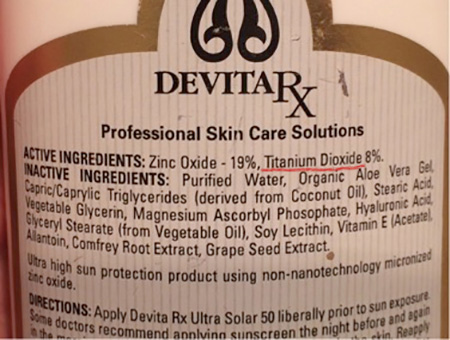
Titanium dioxide in Devitar sunscreen – this is the sunscreen I have been using and recommended by an integrative cancer doctor. This is a common ingredient in sunscreen since it reflects the sun. I’m on the look-out for a new sunscreen that is free from titanium dioxide because we just don’t know what research is going to find. Right now a product like this is better than some of the other sunscreens that contain endocrine-disrupting oxybenzone and should definitely be avoided at all costs.
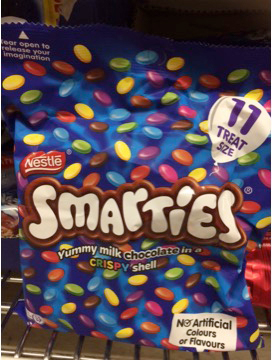
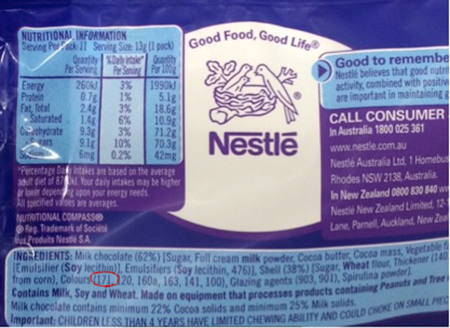
A bag of Smarties (yes, I was prowling the candy aisle here in Australia looking for ingredients!). You’ll see it on this label as 171. Titanium dioxide or E171 is used by the food industry to whiten and brighten food. Children have been identified as having the highest exposures because titanium dioxide content of sweets is higher than other food products.
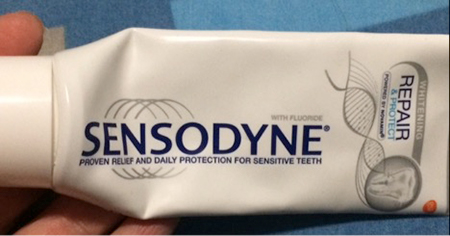
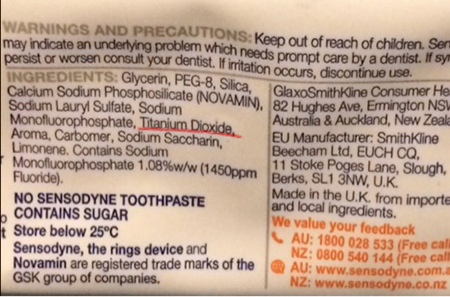
It’s very commonly found in toothpaste for it’s whitening and brightening properties. This is from a tube of Sensodyne toothpaste here in Australia.
Have you got products in your home with titanium dioxide on the label? I’d love to hear where you see it labelled and if you’ll be avoiding it in the future?

Hi Trudy,
I can’t help but wonder if the same would apply to the titanium used as metal implant devices in so many patients….thoughts?
Thank you always!
Lisa
Lisa
Excellent question – this could be an entire series of blog posts but here are a few links re concerns
Risks of Corrosion With Titanium Dental Implants https://www.milesofsmilesdental.net/1248/risks-of-corrosion-with-titanium-dental-implants/
Another article by a dentist recommending ceramic rather than titanium dental implants http://www.marilynkjonesdds.com/1432/titanium-dental-implants-pose-serious-health-risks-allergy-sensitive/
From Dr Weil: “I discussed your question with my (holistic) dentist, Steven Swidler, who agrees with me that the bigger problem with dental implants is not infection or immunity but the issue of having something foreign implanted in the body. He said that bacteria and viruses tend to target implants, setting up colonies around them, and that the immune system can’t fight as efficiently in that setting as it can elsewhere in the body.” https://www.drweil.com/health-wellness/body-mind-spirit/dental-oral-health/are-dental-implants-safe/
There appears to be a way to test for leaks (this is new to me and I don’t know much about it): “Researchers have identified a new, highly sensitive method to assess the extent of titanium leaks from implants. Titanium implants are routinely used for bone fractures as well as dental work.” https://www.sciencedaily.com/releases/2011/07/110725101257.htm
This from a 2011 paper titled: Titanium dioxide in our everyday life; is it safe? https://www.ncbi.nlm.nih.gov/pmc/articles/PMC3423755/
“although there is no direct experimental evidence that released TiO2 can be deposited in the body or can cause systemic effects, it can be postulated from other exposure studies and mechanistic data that at least for individuals with hypersensitivity to titanium such exposure may represent a permanent health threat. Thus, it should be obligatory to test the patients for titanium hypersensitivity prior to implantation of titanium based implants.”
And this conclusion from the above paper – we simply don’t know enough (as of 2011 – right now we do have more evidence of harm) and lets err on the side of caution plus lets label foods and cosmetics so we have a choice regarding using it or avoiding it
“Taken together, the overall exposure of an average individual TiO2 NPs is not known; there are still opened questions regarding toxicokinetics and specific organ toxicity of TiO2 NPs, in particular at oral and dermal exposure, and thus it is impossible to make a reliable quantitative risk assessment. One of the main observations of this review is that, due to the versatility of the TiO2 NPs in terms of particle size, shape, crystal structure, dispersion in biological surroundings (bioavailability) and UV-induced photocatalytic activity, no single conclusion can be drawn, since different forms of TiO2 may act very differently. Until we know more, in our opinion TiO2 NPs should be used with great care, in particular in food and cosmetics. The least that should be done for the consumer is that a declaration of nano-sized TiO2 in these products is obligatory, so that we will have the choice whether to use it or not.”
I’m curious why you ask? Do you have personal experience with titanium implants and health issues?
Thanks for this heads up Trudy.
Interesting question Lisa. I have a titanium clip from a gall bladder surgery five years ago. I am low in zinc, ferritin and now copper and assumed the deficiencies were simply related to a genetic condition I have.
I want to add some medications people take regularly contain titanium dioxide either in the coating or gelatin capsule. Commonly prescribed Medicines with titanium dioxide include: certirizine (zyrtec), cyclobenzaprine, gabapentin, OxyContin, diclofenac, amoxicillin, tramadol and morphine sulfate.
Robin
I just posted a bunch of links for Lisa. I’m not sure how much toxicity one could expect from a titanium clip from gallbladder surgery but it amazes me they leave these in the body! I have heard of reports of these migrating (as do things like MESH implants).
Thanks for the list of medications – it’s used extensively so you’ll see it in benzodiazepines, Lyrica, Zoloft, Celexa etc. I’m looking for a comprehensive list online or in a book and have yet to find one so please share your source.
I would assume these all contain titanium dioxide in the non-nano form which is “FDA approved to be safe” right now. And titanium dioxide is just one of the questionable inactive ingredients in medications. I could do an entire blog post on others such as polyethylene glycol, colors, talc etc
Hi Trudy,
I look forward to that post on excipients. As someone with mast cell issues, I try to avoid as many excipients as I can. For the titanium listed medications I consulted drugs.com.
Also, because sometimes dental implants are a necessity, my biologically oriented dentist recommends ceramic posts over any metal based post.
Robin
Robin
Yes ceramic posts rather than metal
Hi Trudy,
Very interesting!!! I have know for years I am allergic to Titanium Dioxide. I break out in tiny blisters wherever it is applied or contacts my skin. As a result I have avoided all topical sources such as make-up, soap, sunscreens, lip balms, lotions, etc. I travel with my own soap, sunscreen etc. Fortunately, I have had success in finding those products without titanium dioxide, although it has sometimes been very difficult. Only last year did I find make-up without Titanium dioxide, and at 65 I am grateful to finally be able to wear lipstick!!!
I did not know that T.D. was in food… I typically read labels, but when eating at friend’s homes, or restaurants, they don’t check to see if the foods they prepare contain it…
Like another reader, I also have wondered if it is in hip or knee replacements. I know they use Titanium in those implants, but is that the same and if not, how is it different from Titanium Dioxide also know as CI77891?
From another Gayle!
Interesting! What make-up brand did you find?
G.
Gayle
Thanks for sharing and yes it’s in many cosmetics, soaps and creams. I’d love to hear about brands that work for you.
Thanks for the question about CI77891. I don’t like to use wikipedia as reference (because of reported manipulation of data and big industry ties) but I feel ok sharing here for this purpose “Titanium dioxide, also known as titanium (IV) oxide or titania, is the naturally occurring oxide of titanium, chemical formula TiO2. When used as a pigment, it is called titanium white, Pigment White 6 (PW6), or CI 77891… It has a wide range of applications, from paint to sunscreen to food coloring. When used as a food coloring, it has E number E171.” https://en.wikipedia.org/wiki/Titanium_dioxide
Re implants I posted a series of links for Lisa – please check them out there
Hi Trudy,
Had a quick look at medicines Im stuck on for depression/anxiety and yes both contain titanium dioxide. Just one more reason to believe pysch drugs are poisons.
Hi Trudy
One of my pet hates (as others have mentioned) is the titanium dioxide they use in medications to make them ‘white’
I have to take Anastrozole, because I’ve had breast cancer. I looked at all the different companies that make Anastrozole and they ALL include titanium dioxide, which is so ironic in an anti-cancer drug. In fact with medications in general they include so many dodgy excipients. I was on a medication once that included pthalates! Also in Australia, they don’t list the excipients on the packet – you have to go and search online to find out what is in the tablets so there is very little consumer awareness of what is in medications.
Agreed! It’s crazy!
Good to know about Australia
I wonder if the metal clips they put in us after a biopsy are made of titanium? I have had extreme itching after these clips were put in me and taking the same drug you are in addition they put me on vitamin D3 which also had titanium in it.
Helen
Clips can be titanium. Your vitamin D contains titanium? I do not recommend supplements that contain titanium dioxide – this is why I recommend professional grade supplements
Thanks Trudy for sharing this. The biological impact has the potential to be devastating.
Unfortunately it’s not just affecting us. The environmental impact is, in my opinion, even worse. According to information found in Nanotechnology: Health and Environmental Risks of Nanoparticles – “Nanoparticles may have the potential to accumulate in organisms and in the food chain.
While the following statement from Implications of Nanotechnology for Environmental Health Research shares that, “some engineered nanoparticles may be more toxic (inflammatory) than other fine-sized particles of identical chemical composition…this concept is based primarily on a system evaluation of three particle types: titanium dioxide, carbon black, and diesel particles. ”
And when looking at other nanoparticle types we have this article http://news.nationalgeographic.com/2015/05/150514-sunscreen-nanoparticle-nanotechnology-oceans-marine-beach-boat-toxic/
Sadly we’re leaching these particles into the environment and disrupting life all along the food chain from food, personal care products, and other environmental agents. Yet in spite of the growing body of science showing the devastating impact producers continue to use nanoparticles.
Keep reading labels and shopping clean whenever you can as your best bet to avoid them.
Mira
Thanks for this additional information (very sad) and your valuable work and contribution to this topic on my blog!
Do you have any additional thoughts about what we may discover about the non-nano titanium dioxide that we know is in so many foods and cosmetics? Any thoughts about it acting like heavy metals (lead and mercury) and displacing minerals like zinc or iron? Or is it of much less concern compared to the nano particles of titanium dioxide?
Titanium dioxide is an insoluble particle. Although the nano-particles are being shown to be potentially harmful there is not as much research available on titanium dioxide in general. However as far back as 2006 there is evidence that any size titanium dioxide molecule can be harmful. http://www.sciencedirect.com/science/article/pii/S0378427406013798 ” hepatic injury was induced after exposure to mass different-sized TiO2 particles”
Other research indicates that titanium dioxide may act as a carrier for heavy metal accumulation (this was mostly looking at nano particles).
I suggest avoiding titanium dioxide in any form in both food and personal care products.
Thanks Mira – I agree – until we know more I also suggest avoiding titanium dioxide in any form in both food and personal care products.
This raised a question for me! I have a titanium implant (molar) and I guess I am flooded with titanium nano particles. It was tested by a biogeedback machine that showed tinanium-reaction. How can I sweep them? Is there something like molybdenum sweeps copper? I cant find the answer on the internet. Am I the only one with this question?
I hope you know of something that could work!
Have a nice day,
Belinda den Ouden
The Netherlands.
My focus tends to be more on food than on this kind of exposure. There is one quick article that I found https://www.sciencedaily.com/releases/2011/07/110725101257.htm. I think part of the challenge is that medical devices tend to rely on titanium. Titanium also tends to be partly comprised of nickel. It could present a problem if there is an sensitivity to either metal and/or there is significant leaching.
You may want to consult with someone who has experience in heavy metals and do some testing to see if this is an issue for you.
Thanks Mira!
I just wanted to clarify– since we are now trying to avoid hormone disrupting chemicals (like oxybenzone) by using sunscreens with physical barriers (like titanium dioxide)… Could you make recommendations about what ingredients we should be looking for in sunscreens instead?
Kunya
Yes oxybenzone is really harmful but the current thinking is to avoid the titanium dioxide and especially if it’s nanoparticles. There are a number of companies now removing the titanium dioxide
Hello Trudy,
I asked a question about the safety of titanium dioxide in a sunscreen product by AnnMarie Skin. The company responded saying that it was safe and referenced this article.
What do you think about this article by the Organic Make Up company??
http://www.organicmakeup.ca/ca/titaniumdioxide.asp
Margaret
Margaret
It’s a good article but doesn’t have the latest research. I have also been seeing many companies moving away from using titanium dioxide so that’s a good clue too.
New discussion on Titanium Dioxide is showing likelihood that it causes Type 2 Diabetes – https://www.sammyboy.com/threads/latest-research-found-link-between-type-2-diabetes-and-titanium-dioxide.255845/
Timing is about right – around the 1970’s they started adding this whitener to everything under the sun, including foods, and Type 2 Diabetes has been steadily increasing ever since !
Just passing on the info !
Veronica
Thanks for sharing this connection!
My daughter has severe ADHD with a mood disorder as well. She has not yet been diagnosed on whether it may be a psych disorder or on the spectrum. For this reason, treating the ADHD has been difficult as so drugs increase the mood issues. Recently we tried ridilin extended release tabs and had a bad reaction. Terrible tantrums and fits all day. I couldn’t even make a full three day trial. Then we moved on to adderall but Incase of an issue we did the 4 hour salts that release at one time so if she reacted badly we wouldn’t have to deal for so many hours. Well she had a great response so we continued the med. now we needed to cover the full school day so we switched to the adderall extended release tabs and the first day she had the same terrible behavioral reaction as she did with the ridilin! How could this happen from the same drug? In comparing ingredients. The only common ingredient in the ridilin and the adderall ER CAPSELS (that is not in the adderall tabs) is titanium dioxide… which led me here. Could this be what’s causing these tantrums? And thoughts on this?
Chris
Sorry to hear this. This is very possible but I’d check with the doctor if this is the only difference as extended release tablets often contain fillers like cellulose so they are absorbed more slowly.
Just so you know – there are many non-drug approaches to ADHD that address the root cause and have no side-effects. These can include dietary changes like switching to real food, getting rid of gluten, sugar, caffeine and eating protein at breakfast to keep blood sugar stable. Some people react to salicylates (found in apples, berries etc). Finally nutrients like iron and zinc can help if they are low + amino acids like GABA can help too. Here is a great success story https://www.everywomanover29.com/blog/gaba-children-adhd-focus-issues-irritability-anxiety-tantrums/
I noticed about 3 years ago I started having panick attacks. So I started watching labels. I noticed when I get to much titanium dioxide I have panick attacks. I’ve told people this and they don’t believe me. Doctors to! When I have a panick attack I go back and see what I’ve used different. And I find it has titamium dioxide in it. So thank you for putting this out there!
Pam
Thanks for sharing – glad you made the connection. I’d love to hear what you have identified that has titanium dioxide and is affecting you?
Trudy, I noticed they put it in some probiotics as well!!!Thank you so much for sharing!!
Oh my.. and just the last few times brushing my teeth with that sensodyne toothpaste thinking to myself as it’s all in my mouth on my tongue absorbing in my mouth etc… I really need to stop using this toothpaste there has to be something else.
And I’m reading about the smarties had a good chuckle cuz I do the same thing and have been curious about the numbers etc and then… There it is! The toothpaste. Oh my gosh anyway exactly what you say about not having to declare etc or even those ones saying they are natural, I just don’t feel they are and so I have returned back to the sensodyne. Never again unless it’s for cleaning my bathroom sink!! I’ve had a look on the ingredients straight away seen titanium dioxide. As well as the rest of the unnecessary poisonous ones…
Not sure how to post a photo on here but I’m in New Zealand so it’s probably similar. I had started noticing it mainly in makeup and sunscreen, also today seen some vitamin skin health pills and investigated the ingredients to find none other than titanium dioxide…
That is deep. Thank you so much for your information and I can’t wait to explore more Soon. Also found the mitochondria effects study very interesting… Once again that’s the mother’s DNA and makeup contains so much of it also… Women wear makeup every day! And it doesn’t say not to wear it when pregnant.
Alas I send vibes of confidence that this will change very soon and these poisonous additives will be not just labeled but completely removed.
Kindest regards from your neighbor in NZ , alison 🙂
Ps. finding this has been a real gem for me today thanks again so so much very very grateful to you Trudy
Alison
Glad you found this to be so helpful
I really don’t know where to begin…
My name is Richard and I suffer from chronic abdominal pain with bleeding every day… 8-9 years ago I had no choice anymore after all the cold sweats literally running down my face and passing out from pain I gave in and went to the hospital. After tests the doctor said I had a blockage in my large bowel and would need immediate surgery because my bowel was ready to burst and would kill me from septicemia if not dealt with.
“Skipping ahead”
I ended up going into respiratory failure because of incompetence and got septicemia anyway… It should have killed me but I’m to damn stubborn OR stupid to let that happen… Anyway after so many more procedures and surgery I was approached by higher ups in the hospital that informed me that my original diagnosis “may” have been wrong… (Diverticulitis)
Now I was told by original surgeon that the blockage was unidentifiable and all said and done 22 inches of my large bowel had been removed because it ceased to function as in it died…
Now the reason for writing this is could titanium dioxide cause bowel death?
Titanium dioxide is also added to dairy products including organic dairy products to make them more white, mozzarella in particular. It may also be added to cows’ feed as a “mineral” to help make the milk white.