Seasonal affective disorder (SAD) or “winter blues” is a form of depression most often associated with the lack of light during the fall and winter months. It is very common and may be associated with low serotonin levels. We often associate low serotonin with depression, however low serotonin can also be associated with: anxiety, excessive worry and feeling overly stressed. There’s evidence of seasonality in anxiety and panic attacks, just as there is with seasonal affective disorder (SAD). Another common sign of low serotonin is increased carbohydrate cravings, especially during the afternoon or evening.
One very effective approach for SAD is light therapy. I also find the use of targeted individual amino acids and a dietary approach to be very useful and share more about that below.
Winter Blues by Dr. Norman Rosenthal MD
I’ve just finished reading a really great book called Winter Blues: Everything You Need to Know to Beat Seasonal Affective Disorder by Dr. Norman Rosenthal MD, and the research is fascinating. He is a fellow South African who moved to the USA and found he was depressed each winter. After 3 seasons of this, he started doing research on light therapy and was one of the original SAD researchers. He is internationally recognized for his pioneering contributions to understanding SAD and using light therapy to treat it.
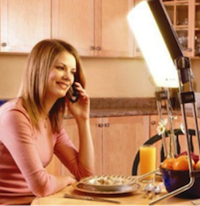
Feedback from colleagues: desk lamp, desk panels, floor lamps and light boxes
I asked some colleagues what they have used and/or liked, and recommend and share some of these below (providing my Amazon links in most cases so you can find them easily). Due to models being discontinued/revamped, I’ve made some updates as of Jan 2024.
Donna Kelley, Certified Holistic Nutritionist
I have a Blue Max, full spectrum, 70 watt dimmable desk lamp. I have had it for 3 years and actually use it to work by. It was recommended by Julia Ross in her certification program. (The company that makes this one is Full Spectrum Solutions)
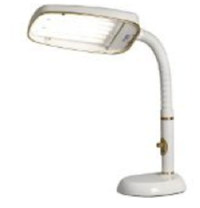
UPDATE: Jan 2024 – the above model is no longer available but a very comparable one is the Verilux HappyLight Duo – 2-in-1 Light Therapy & Task Desk Lamp. Be sure to read some of the reviews. This is a really good one: “
Christine Wokowsky, Board Certified in Holistic Nutrition
My office is the darkest room in the house and I have one sitting on my desk, especially helpful in the winter. This is the second Verilux Happy Light I have used and I really like it. Living in Nevada where there is sunshine over 330 days of the year I am so accustomed to light and brightness if I am in a dark room or space for too long it really affects me. This has been a great product for me and I can recommend it.
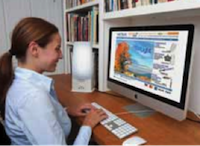
Tracey Schuyler, Owner, Nutrition Counselor at Redefining Food 4 Health, LLC, also likes the Verilux
Like Christine, I personally use the Verilux Happy Light, which I purchased recently. It made a difference right away. I live in Boise, Idaho, and we are accustomed to winter inversions … sometimes days / weeks on end without any sunlight! I place it on my bathroom counter, turn it on in the morning before I shower, and turn it off as I’m leaving the bathroom, after drying my hair, etc. (about 25 minutes).
UPDATE: Jan 2024 – the above model, Verilux Happy Light, is no longer available but a very comparable one by the same company is the Verilux® HappyLight® Alba – New Round UV-Free LED Therapy Lamp. This one has a count-down timer and is portable so can be moved from room to room easily.
Shirley Pastore McCormack, Writer, Life/Wellness Coach, Registered Yoga Teacher
I use the Blue Max Lighting (BlueMax 70W dimmable) floor lamp. I use it 20 minutes each morning from the fall to spring equinoxes. I noticed a great level of improvement, but even more improvement when a doctor prescribed Vitamin D therapy. I was moderately to severely deficient, and needed 10,000 IU for 4-6 weeks under her care to bring my levels up. I do well with the light therapy as long as it is used in conjunction with regular daily doses of D3 (I’m now on 2000IU daily). The light therapy just seems to be “part of the whole solution.” (The company that makes this one is also Full Spectrum Solutions.)”
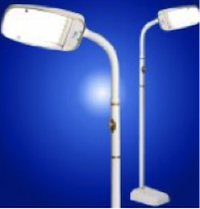
UPDATE: Jan 2024 – the above model, Blue Max Lighting floor lamp, is no longer available but a very comparable one is the Verilux® HappyLight® Duo – 2-in-1 Light Therapy & Task Floor Lamp.
Dr Josh Friedman, PHD, Integrative Psychotherapy of Omaha
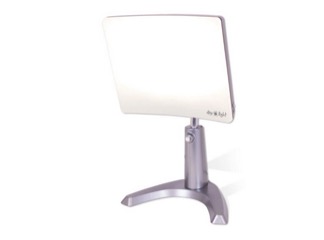
I follow the guidelines of Columbia University’s Center for Environmental Therapeutics. They have done research on a variety of light boxes and the one on this page is inexpensive and effective [and is 10,000 lux] You can find it on Amazon here: Carex Day-Light Classic Plus Bright Light Therapy Lamp
This is what the Center for Environmental Therapeutics has to say about this newer light therapy device:
This handsome new bright light therapy unit ― the Carex Day-light “Classic” Plus Model supersedes our former Daylight “Classic” Model, presenting the same benefits at lower cost and with enhanced design. The required parameters for 10,000 lux light therapy have been thoroughly clinically tested at major university centers, and have been established as the international standard for treatment of winter depression, milder “winter doldrums,” and other chronobiological, circadian rhythm sleep and mood disturbances.
Using light therapy with amino acids or adjusting up the amino acids or doing both
Additional Jan 2024 updates:
I often recommend the use of light therapy in conjunction with amino acids. We may just add light therapy and keep amino acid dosing the same or we may use higher doses of amino acids like tryptophan, 5-HTP and GABA during the winter months. We may also do both depending on the person’s unique needs.
Here are some blog posts where I address adjusting up/increasing the amino acids during winter:
- Increasing tryptophan or 5-HTP temporarily when a winter dip in serotonin causes more severe anxiety, OCD and/or the winter blues
- The seasonality of GABA: worsening anxiety, insomnia and intrusive thoughts in winter (and the need for increased GABA supplementation)
There may even be a seasonal aspect to PMDD/PMS with an increase in hormonal binge eating, wine drinking and anxiety – with symptoms ramping up from October (click here to read that blog post).
More binge eating, emotional eating and carb cravings in Winter
This paper, The Role of Diet, Eating Behavior, and Nutrition Intervention in Seasonal Affective Disorder: A Systematic Review discusses the eating and drinking habits of individuals with SAD (seasonal affective disorder):
Compared with non-clinical subjects, SAD patients tended to consume significantly larger dinners and more evening snacks during weekdays and weekends and exhibit a higher frequency of binge eating, external eating, and emotional eating. Additionally, compared to healthy controls, SAD patients presented more cravings for starch-rich food and food with high fiber.
This paper also mentions vegetarianism being associated with higher SAD prevalence. As outlined in my book (link below) and various blogs, I am an advocate of quality animal protein as it provides amino acids, zinc, iron, omega-3s and vitamin B12 – all needed for neurotransmitter production.
It also mentions that alcoholism is “associated with higher SAD prevalence.”
Amino acids and light therapy help emotional eating and excessive drinking
The authors don’t offer a solution but I can share that the amino acids mentioned above help with sugar/carb cravings and emotional eating and alcohol addiction.
Using light therapy is going to help too, with research suggesting that bright light therapy is potentially effective at improving both disordered-eating behavior and mood.
Seasonality to anxiety and panic disorder and how to use bright light therapy
There is a seasonality to anxiety and panic disorder just as there are seasonal variations in mood for certain susceptible individuals. You can read more about this and some of the basics like how to use bright light, and for how long, possible adverse effects and who should not use bright light therapy.
The blog is: How to use bright light therapy for increased anxiety, increased panic and SAD during the cold dark winter months
This information about bright light and mood disorders can be applied to anxiety and panic attacks, in addition to SAD.
Additional resources when you are new to using tryptophan and the other amino acids as supplements
We use the symptoms questionnaire to figure out if low serotonin or other neurotransmitter imbalances may be an issue for you.
If you suspect low levels of any of the neurotransmitters and do not yet have my book, The Antianxiety Food Solution – How the Foods You Eat Can Help You Calm Your Anxious Mind, Improve Your Mood, and End Cravings, I highly recommend getting it and reading it before jumping in and using amino acids on your own so you are knowledgeable. And be sure to share it with the practitioner/health team you or your loved one is working with.
There is an entire chapter on the amino acids and they are discussed throughout the book in the sections on gut health, gluten, blood sugar control, sugar cravings, anxiety and mood issues. The importance of quality animal protein is also covered.
The book doesn’t include product names (per the publisher’s request) so this blog, The Antianxiety Food Solution Amino Acid and Pyroluria Supplements, lists the amino acids that I use with my individual clients and those in my group programs.
If, after reading this blog and my book, you don’t feel comfortable figuring things out on your own (i.e. doing the symptoms questionnaire and respective amino acids trials), a good place to get help is the GABA QuickStart Program (if you have low GABA symptoms too). This is a paid online/virtual group program where you get my guidance and community support.
If you are a practitioner, join us in The Balancing Neurotransmitters: the Fundamentals program. This is also a paid online/virtual program with an opportunity to interact with me and other practitioners who are also using the amino acids.
Do you get the winter blues and increased anxiety in the winter months? Have you had success with light therapy?
If yes, which full spectrum lamp have you found to be the most useful? What time of the day do you use it, how often do you use it and for what duration?
Have you used a combination of amino acids and light therapy, and adjusted up your amino acids during the colder and darker winter months?
If you’re a practitioner do you recommend light therapy to your clients/patients?
Feel free to share and ask your questions below.

Hi Trudy
Do you have any lamp recommendations for those in Australia? These are all US brands and it seems they don’t ship to Australia.
Thank you
Hi Madeleine
I don’t right now but can do some digging. Hopefully we’ll have someone from Australia also comment and share what they use and where they got it.
Trudy
Thanks, Trudy.
I admire the terrific events you are offering,Trudy, and if you’ve found me in Connecticut, USA, then your computer and networking skills are way beyond mine. But when I saw the light boxes below, it took me back 20 years…. There are so many better solutions to depression now, that actually END IT without sitting in front of a light box, even in winter. I describe the healing process and solutions in both my books, Healing Depression & Bipolar Disorder Without Drugs (2006), and Who’s Crazy Here? Steps to Recovery Without Drugs for 9 different mental diagnoses (2010).
Crazy Recovery Without Drugs | Holistic Steps to Recovery
Not having to struggle with bipolar mania or depression since 2002 makes my life a breeze!
Please allow me to help you help your followers discover what’s involved.
Hi Gracelyn
Thanks for your feedback and sharing these wonderful resources – I look forward to learning more and sharing this with my followers.
I would like to clarify that I’m not saying only use light boxes/light therapy (although this may work for some people). This is in addition to all the wonderful food changes, addressing low serotonin with tryptophan, looking at gut health, addressing low zinc (or whatever is contributing to the anxiety/depression). Also, I do feel we should continue to use tried and tested methods even if they are 20 years old.
I think we’re on the same page here….:)
Trudy
I have learned so much from your blog and summits- Thank you! I have a question about GABA supplements. If they are taken on a daily basis and suddenly discontinued is it possible to experience withdrawl symptoms such as headache similar to benzo discontinuation?
You’re welcome Jennifer! What form was being used, how much and how long? The only GABA that I know of that may do that is phenibut.
Thanks for sharing this great information about the winter blues and the use of light therapy. I definitely find myself feeling a little down in the winter months when we don’t see as much sunlight.
Hi Lauren
How many months do you find you need to use light therapy? Do you find many Alaskans get the winter blues? And are they aware of the mood benefits of light therapy? Please do also share more about Alaska Northern lights and what you offer. Thanks
Trudy
Couldn’t survive the winters without my Lumie Vitamin L, Lumie Brazil, Lumie Bodyclock Iris 500, SaunaSpace Photon, RED LED flood lamps, salt lamp and Joovv Max combo (red & infrared) whilst moisturising myself! Such a godsend – how did people survive winter before these amazing devices? So grateful to live in these times. x
Drew
You are all set up! I like the look of the Lumie Vitamin L and the Lumie Brazil. I’d love to hear how you are using both of these lamps and for what duration?
I use the Vitamin L in my kitchen first thing every morning when I arrive there to do my salt water and other early morning protocols, say 15 mins duration – I also use it during the day on gloomy/cloudy days when in the kitchen preparing lunch (my kitchen is quite dark!). I use it for the whole time I am in the kitchen and it gives me a boost. At night I slip an A4 sized red plastic filter over the front of the lamp and in addition to the overhead halogen kitchen lamps, it gives me a lovely warm and calming red ambiance blend of light in my kitchen whilst I am preparing meals. I find red light at night very, very calming. In fact I have a few red LED flood lights inconspicuously placed around my home at floor level shining upwards and this in conjunction with the halogen overheads creates a fantastic ambiance which turns visitors’ heads! Along with birdsong (during the day), crickets (at night) and nature drone filmed videos, I simulate a lovely calming environment. No noise polluting Sky News allowed in my home!
As to the Brazil, I have this unit in my study and run it for about an hour when I get to my desk after lunch. I don’t have it too close to me so the hour duration is acceptable. These protocols along with the SaunaSpace Photon, a Himalayan salt lamp and Joovv Max combo (red & infrared), enable me to survive winter!
Drew
Thanks for sharing all this – you have painted quite the picture! 🙂 I love that you’ve found red light and nature sounds so calming too!
Now I’d love to hear how and when you use the SaunaSpace Photon and Joovv Max combo (red & infrared)? I assume you have the Himalayan salt lamp on all the time?
I use the SaunaSpace Photon for 10 minutes every hour at my desk for a boost angled towards my face and upper body – I set a reminder timer. I use the Joovv Max Combo full body morning (after shower) and evening (just before bed) for 20 minutes total (10 min each front & back). I listen to podcasts whilst doing so as well as apply my face creams etc so killing 2+ birds with one stone! 🙂
Drew
I love hearing all this and so glad you have a plan like this – top marks for self-care!
Do you also have a SaunaSpace sauna?
Thanks Trudy – it takes a lot of time, commitment and effort and I sometimes feel ‘guilty’ for spending so much time on self, but it’s the only way I can function and survive! I don’t have a SaunaSpace sauna yet, but will be purchasing once I’ve moved to my new place (on the river and close to parks) and modified a bathroom to accommodate it! A long term plan…
Hi Trudy,
Checkout the Center For Environmental Therapeutics at Columbia University. They have done a lot of research on SAD and have tested a variety of bright light devices for efficacy and sell the one they approve on their site. Likewise, they have looked into Dawn Simulators which are lights that come on gradually during the winter months to mimic a summer sunrise. This can be quite effective for SAD as well. Glad you are writing about this.
Josh
I know you’re a big fan of the one from the Center For Environmental Therapeutics at Columbia University – and actually mention this and you as the last one in the blog! Linking to the Dawn Simulator they recommend too https://cet.org/product/smart-lamp-dawn-simulator/ Thanks for sharing this additional resource!
I have an old Go-Lite. I just started using it again as I can really feel being isolated in a dark apartment during this pandemic really impacting me. (I have major fatigue so getting out is often hard for me.)
I can only do five minutes at an angle from pretty far away or I start to feel really nauseated. Any hypotheses as to why this might be??
Thanks much!
Syd, I can’t be sure without seeing your therapy light unit operating, but as a light professional and a health professional I can tell you that the spectrum of all light we predominantly experience during our waking hours significantly affects our health, our moods and our behavior. We especially notice a difference under artificial lighting. And when it is a high-intensity light device the effects can be even greater and experienced much more quickly.
Think of a rainbow, or better yet the beautiful rainbow produced by a quartz glass prism. What you are seeing in the colors of the sunlight represented in the rainbow are the spectra that make up the light we call sunlight. Splitting the light into individual spectra [colors] with the use of a prism allows us to see this. But you will only see colors that are in that light. Different light sources produce different combinantions and amounts of light in specific colors or spectra.
If you were to split the light from a light bulb, or any light source distinct from sunlight you would see that some colors might be more intense in one rainbow or completely missing from it in another if that spectra is missing from the light produced by the light source.
Obviously, the light you are receiving from your light therapy device is not a healthy combination of spectra and with that and the intensity of the light you can only tolerate 5 minutes. This light is not helping you and obviously is creating disharmony in your body. I would suggest that you discontinue its use immediately.
Now you’re wondering how could this wonderful light become so bad for me?
Lighting technology, even the latest generation of LEDs experience something we call ‘color shift’ as they age. When you said “old Go-Lite” that was my first clue to a likely source of the problem.
Basically what that means is that the colors of the spectrum produced by the light source are no longer close to the original spectrum.
In you unit the light source is producing light of a combination of spectra that is creating your nausea, and what I’m hearing are three indicators that your body is telling you that the light is no longer healthy for you; you can only tolerate five minutes of the light, you cannot sit directly in front of it, and the result is nausea. Although we don’t know what other effects it may be having on your health, positive or negative, these three speak loudly to the fact that you aren’t benefiting from it.
I hope you find it helpful. I do continue to follow comments, so if you have further questions about my response, post them here and I’ll provide a response.
Syd
Mild nausea for some is a documented side-effect of light therapy. It’s reported to go away after a few days. Too much serotonin can cause nausea so I wonder if it has to do with the body getting used to the additional boost of serotonin. If benefits are seen with less time that may also be something to consider. It’s not unusual that some folks do well with very short periods of light therapy so we have to find what works for each person.
I would not push through and continue if the nausea persists. And would consider serotonin support via other means – such a tryptophan or 5-HTP. More on that here https://www.everywomanover29.com/blog/tryptophan-worry-head-ruminating-type-anxiety/
I’m not familiar with the Phillips GoLite Blu (if that is the one you have) but see it does uses Bluewave technology which does differ from the devices in this blog.
Thanks very much, Trudy. I feel quite sure that my serotonin is low. I feel quite depressed – for the first time in my life, actually. And my body “knows” it needs more sunlight. Hard to explain, but I can feel it.
My device is a GoLite from Apollo Health. I can’t be sure, but I don’t think it’s the device that’s the issue. (Though I’m open to Michael’s feedback.)
Interestingly, I tried very low does tryptophan – breaking open a capsule and just taking 1/64th tsp! (I have tiny teaspoons!), and I also react to that. I’m a freak! 😉 BUT, I don’t think this means I don’t need it. I think it might mean I really, really need it, but, as you said about the light, my body isn’t used to the serotonin. (I’m also SUPER sensitive to GABA. I’m talking 2mg.)
It’s all a bit confusing and hard to know how to proceed.
I don’t see Trudy’s comment on here yet even though I can read part of it in an automatic email sent by the site.
Syd, I missed where you said you had just started using it again. And if, as Trudy says, your serotonin is high already… from taking tryptophan or 5-HTP in large or frequent doses then adding the light therapy on top of it might be too much. Especially if all of this was done within a short period of time causing everything to contribute to one big spike in serotonin levels.
However, first of all, I didn’t get the impression that your serotonin levels were high enough for you because you wouldn’t be looking to use the light therapy to increase them, but as I said, above I don’t know what the timing might have been.
How old is the light, and does it have a lot of hours of use? If so, there could be a color shift and a reduction in effectiveness or even side-effects as mentioned in my previous post. If in doubt, I’d replace it.
Thank you, Michael, for such an awesome, thoughtful reply. As I’ll also say to Trudy, I actually feel quite sure my serotonin is LOW, and maybe my body isn’t used to having serotonin.
I neglected to say (because I had forgotten when I first posted) that when I first got my light, maybe five years ago or so, I remember also having a reaction to it. Nausea and getting a hot flash “surge,” for lack of a better word. I can tell that I need this, but maybe I’ll just start with a minute and work my way up! I can’t afford a new one, but if there was a decent one under $200 to try, I might be able to swing it.
Thanks again!
Hubby got me one for Christmas (CAREX DAY-LIGHT SKY LIGHT THERAPY LAMP).
But I am afraid to use it for my deep depression because of my sensitive eyes (weighed 1 lb 14 oz at premature birth; bad astigmatism and near-sightedness; cataracts at 39; detatched retina at 57; blinking light has always triggered migraine).
How CAREFUL does one have to be to avoid eye damage?
Thank You.
And…..HAPPY NEW YEAR to ALL!
Frances
I would check with your eye doctors
Apologies for the delay on your comment approval and my response. We had a computer glitch where a large number of comments were hidden from view in a spam folder. It mostly affected new folks who were commenting for the first time but it’s hopefully resolved now.
I have a new Verilux Happy Light from Costco and was wondering if I can have it on my desk while I work for a couple hours. I don’t get symptoms from having it on for long periods. I have anxiety and have been on Celexa for 30 years and just switched to a very low dose of Zoloft 50mg. I can’t really tell if it helps. I see a naturopath and also take a lot of supplements. I tried 5 HTP when decreasing Celexa to change meds but I got very anxious and even had a panic attack the first week but I did take it on an empty stomach which I didn’t I shouldn’t have.
Lucy
It’s a matter of trying it out to see how much helps and how long is tolerated. Lamps work well for many so I see no reason to try the Verilux Happy Light.
Meds tapering can be tricky for some. Being nutritionally stable is key to success
Apologies for the delay on your comment approval and my response. We had a computer glitch where a large number of comments were hidden from view in a spam folder. It mostly affected new folks who were commenting for the first time but it’s hopefully resolved now.
Syd, Your idea of beginning with one minute and slowly increasing it sounds like a smart approach. Just remember what Trudy said, “…if the nausea persists” to discontinue using the light.
I used to sell light therapy devices but don’t anymore, mostly after learning and applying the concept of therapeutic individuality – we don’t all respond in the same way to the same therapeutic modalities.
The Go-Lite BLU was one that I not only sold but used myself, with good results. Yours must be old, they haven’t made them in years, I believe.
Here’s a less expensive option to replacing your Go-Lite, and I’ve already sent out some queries to my lighting suppliers – a decent hi-lumen output LED lamp with a high CRI [color rendering index] in either a 4000º or 5000º Kelvin color temperature with a standard Edison screw base [E26] . As soon as I have the information on them, I will post it on here.
Note: if you’re trying to limit your blue light levels after sunset to prevent disruption of melatonin production, you might want to go with the lower color temperatures 4000º K or 3500º K. But the CRI still needs to be over 90%; a CRI of 92-93 is very good. A balanced spectrum blend is important.
Now, you will need to experiment with distance and time if you’re doing targeted light therapy which involves sitting in front the light within a specified distance with direct light entry into the eyes versus a longer period of exposure with mostly indirect or reflected light entering the eyes while you go about normal daily of evening activities.
The indirect method of receiving the full spectrum light is to put the LED lamps in a ceiling fixture in the room where you spend most of your time each day and leave it on during waking hours. [LEDs don’t use much electricity so one or two of these won’t increase your electric bill dramatically.]
As with everything else, you will need to try these methods for yourself and see which works best for you. When working to establish the right time and distance for you with the direct light method, be sure to keep notes or make a chart that you can fill in as you try different combinations. Be sure to develop an objective rating scale for evaluating [typically a scale of one to 10 with 10 being the best or highest degree of benefit] Tie this scale to your symptoms and their reduction or disappearance. Include a place for notes and be to note any NEW symptoms – things you didn’t experience before and therefore didn’t expect – these might be either good or unwanted symptoms.
Once I have the info on the high CRI LEDs I’ll post it here.
Thanks, Michael! All great info!
Syd, A numerologist friend reminded me recently that 2021 is a ‘five’ year and five is all about freedom! So how about striving for freedom from the winter blues as a great resolution for this new year!
A teacher friend likes to remind me that words merely inform us, true learning comes from experience. Information and knowledge have no intrinsic value per se – their value can only be realized when they are applied in action [both mental and physical action] – put to use.
I have many wise and wonderful friends – I just need to do a better job of applying what they tell me too! Like the journey of a thousand miles – best taken one step at a time, don’t hurry. I have seen over and over how we all have an amazing power to transform our lives when we set our intentions, give ourselves what we really need to heal, regenerate and grow, and make our daily choices in life while keeping those intentions in mind.
Peace & Blessings in the New Year to all who read this.
Do any of the “full spectrum” lightbulbs work to replace the bulbs in the lights around my house and office instead of using a device for a short time each day? I did not see any of them mentioned on this article. I have lots of plants filling all my windows, so it would be helpful for all of us, if so ; }
Linda
The best best are the lamps.
Apologies for the delay on your comment approval and my response. We had a computer glitch where a large number of comments were hidden from view in a spam folder. It mostly affected new folks who were commenting for the first time but it’s hopefully resolved now.
Linda, in my experience in working with SAD clients, I have found that some do better with full spectrum lighting in the areas where they spend most of their time.
Be sure that the CRI [color rendering index] is 92 or above for best results. Experiment with the color temperatures but I have found 4000º K and up seemed to have the best effect [with a CRI of 92 or higher]. This approach seems to work better with less severe SAD, but experiment to find which works better for you as we are as individual in our response to therapeutics as we are in other areas of our lives.
However, some find that the short-term, sit in front of a light box with a higher lumen lamp bathing your retinas. You don’t need to look directly at it but the light needs to directly enter your eyes not be bounced off walls etc.
I work outside but still get SAD. Do I still need light therapy?
thx
Robert
If someone has low serotonin symptoms with worse symptoms in winter/SAD/seasonal affective disorder), whether they work indoors or out, we always consider serotonin support with tryptophan, 5-HTP and/or light therapy.
And other anxiety nutrition solutions like gluten/sugar/caffeine removal, blood sugar control, gut health, pyroluria, optimal vitamin D etc that I cover in my book “The Antianxiety Food Solution.” More here https://www.everywomanover29.com/blog/the-antianxiety-food-solution-by-trudy-scott/
what’s the difference between red light therapy and blue light therapy.
Ann
You may find this article helpful https://healthlighting.com/blogs/lighting-guide/guide-to-the-spectrum-of-light
really wish there was links to products (lamps) that are actually affordable! I’m sorry, but $100 for a light that’s a bit ridiculous, & the other one was $70!
Misty
I wish they were more affordable too but I see the value because these are lights/lamps/panels that provide so many therapeutic benefits for mental health/anxiety/insomnia/emotional eating/addiction and will provide those benefits every single day for years and years. I have many clients also say the entire family benefits when you have a panel/light set up in the bathroom or at the kitchen table.
They do also come with a timer and different light settings.
Another way to look at it is to compare a few bottles of Lidtke Tryptophan (which provide serotonin support too but will run out) to a panel/lamp (which will keep providing relief).
I believe that the “winter blues” is mainly due to people not getting enough sleep in the winter. We have evolved with long winter nights for millennia. To get the same amount of sleep in the winter as in the summer is bucking nature. It does not help that mid-winter (i.e. the winter solstice) comes with holidays and people are pushing themselves to see family and buy gifts etc.
I also think that, weather permitting, getting outside and getting sunshine in the eyes (not literally) and on the skin would help.
Merry
Yes one of the mechanisms is related to circadian rhythm and sleep. And the mid-winter holiday rush/stress very likely contributes for those in in the Northern hemisphere.
Yes getting outdoors in the sun is key but it’s impossible mid-winter on dark, cloudy, snowy, cold, rainy winter days – hence the benefits of SAD lamps. The whole premise of full spectrum light devices is getting 10,000 LUX (for 30 mins a day) which mimics sunlight and provides all these wonderful benefits.
Hello Trudy,
I have read some of the thoroughly researched information on your site and am so impressed. I feel that you have the keys to figuring out the source of many health problems. However, I am a bit on overwhelm with all the information and the different possible tweaks to finding the right combination. I am wanting to help my daughter (50 years old) deal with a 15-year problem of lack of sleep. She has not had a good night’s sleep in all that time (often getting only 3 hours, sometimes only 2), which started with a first pregnancy. She is worn down from all that lack of sleep. She needs help fast as she is also dealing with breast cancer. A personal consultation with you is what we are looking for but I cannot find a way to do that on your website or emails. Would you please get in touch with me at email address below to advise me on if and how it is possible to get an appointment with you?
Simone
I’m sorry to hear your daughter is struggling with no sleep – I know how brutal this can be.
You can sign up for the waiting list here https://www.everywomanover29.com/blog/services/. The wait is long so have her start to review some of the resources shared on that page. My book “The Antianxiety Food Solution” is a great place to start – making dietary changes can have a big impact esp no sugar, no gluten and no caffeine. https://www.everywomanover29.com/blog/the-antianxiety-food-solution-by-trudy-scott/