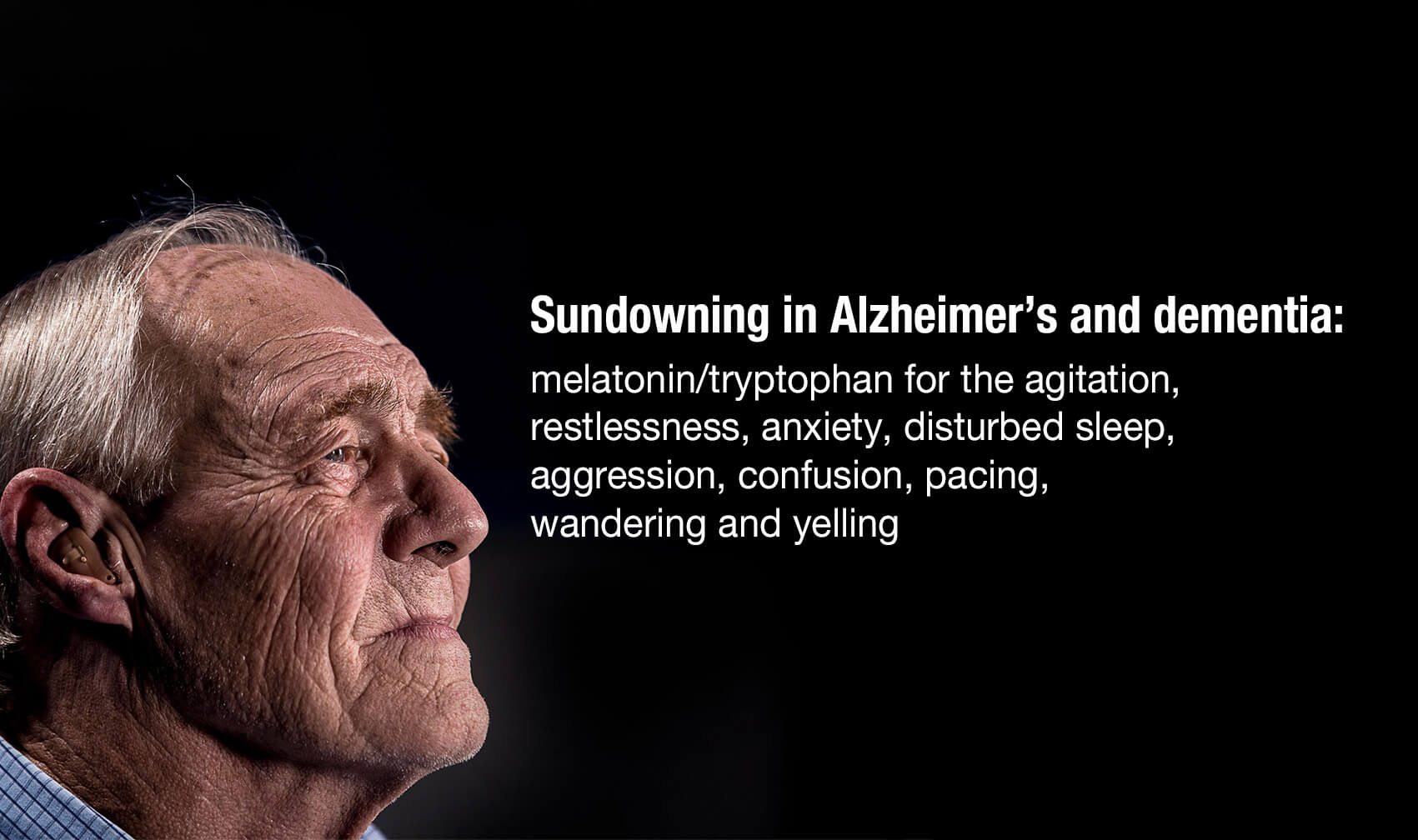
The terms “sundown syndrome” or “sundowning” are used to describe a wide range of neuropsychiatric symptoms occurring in individuals with dementia in the late afternoon, evening, or night. These symptoms include confusion, restlessness, anxiety, agitation, aggression, pacing, wandering, screaming, yelling, and hallucinations. The treatment of sundown syndrome is challenging, and pharmacological therapies are not particularly effective.
This definition is from a very encouraging case study published as a letter to the editor of the Journal of the American Geriatrics Society – Melatonin for Sundown Syndrome and Delirium in Dementia: Is It Effective?
This case study is very typical in terms of symptoms and a pharmacological approach:
An 81-year-old man with Alzheimer’s disease diagnosed 4 years previously was admitted to the elderly department because of behavioral disturbances, sleep disorders, and wandering. His wife said that his cognitive and functional impairments had gradually worsened over the past 4 years and that, in the last 6 months, her husband had become verbally aggressive, agitated, and restless; wandered; and paced. He did not sleep for long and had difficulty falling asleep. The symptoms increased in the late afternoon and at night. He had no hallucinations or delusions. One month before admission, delirium was suspected, and his general practitioner prescribed haloperidol, but it was not effective.
During admission, sundown syndrome was diagnosed, and he received pharmacological and nonpharmacological interventions for behavioral and sleep disturbances, but none was effective, and some aggravated symptoms. The pharmacological interventions consisted of benzodiazepines, antipsychotics, cholinesterase inhibitors, mood stabilizers, and antidepressants, all given in an optimal dosing schedule.
Melatonin led to much improved symptoms within a few hours
None of the medications were effective and some made his symptoms worse. This case study is atypical in that his doctors were open to the use of melatonin. This led to much improved symptoms within a few hours and complete resolution in 2 weeks with a second dose:
After extensive review of his history, the effect of past treatments, and the published literature, melatonin was started at a dose of 2 mg at 8:00 p.m. for sleep disorders. Not only did his sleep quality improve within a week, but there was also significant improvement in his behavior within 2 hours of initiation of melatonin. A therapeutic trial with an additional dose of 2 mg given at 3:00 p.m. was started, and his symptoms gradually improved over the subsequent 2 weeks (NPI score 20). No behavioral changes were observed in the 2-month follow-up.
These results are powerful and mirror what a number of other studies are showing, for sundowning and to also slow “down the progression of cognitive impairment”). We also see melatonin working clinically for this population.
I share this case study so if you are a carer or have a parent or loved one with Alzheimer’s or dementia, you have a resource to share with the medical team. There is growing awareness of this research and some neurologists are prescribing melatonin with success. Typically 0.5 mg to 5 mg melatonin is used once or twice a day.
My hope is that this becomes the standard of care instead of prescribing psychiatric medications which the authors acknowledge are not particularly effective. And they don’t get to the root cause that is triggering these symptoms: low melatonin and low serotonin (more on low serotonin below).
Melatonin and anxiety
Melatonin also improves sleep quality and reduces anxiety after a TBI (traumatic brain injury). I blogged about a study that used timed-release melatonin here. The study participants used 2 mg of timed-release/prolonged-release melatonin for 4 weeks. This improved sleep quality and melatonin was also associated with a small decrease in self-reported anxiety.
As outlined in this paper, Melatonin as a Potential Approach to Anxiety Treatment, “melatonin’s benefit in anxiety may reside in its sympatholytic action, interaction with the renin-angiotensin and glucocorticoid systems, modulation of interneuronal signaling and its extraordinary antioxidant and radical scavenging nature.”
The serotonin connection and using tryptophan or 5-HTP
Keep in mind the strong serotonin connection: these sundowning symptoms start late afternoon and evening (hence the name sundowning) and serotonin is a precursor to melatonin production.
I look forward to seeing research on the use of tryptophan or 5-HTP for sundowning symptoms too. Until then, based on the above, and the fact that many of these symptoms are classic signs of low serotonin, I feel comfortable recommending either of these amino acids.
As always, we start low, use afternoon and evening doses and increase based on symptom resolution. The typical adult dose of tryptophan is 500 mg and 50 mg of 5-HTP. I recommend starting with 100 mg tryptophan and 10mg of 5-HTP. The amino acid precautions are always reviewed. I would not recommend either tryptophan or 5-HTP if the individual is currently prescribed an antidepressant, unless you are working with a knowledgeable practitioner and always with the approval and monitoring of the prescribing doctor. This is because of the possibility of serotonin syndrome.
Dr. Dale Bredesen recommends tryptophan and melatonin
Dr. Dale Bredesen is the author of The End of Alzheimer’s (my Amazon link) and a number of other books on Alzheimer’s. He is an authority on Alzheimer’s and recommends both tryptophan and melatonin. In this paper, Reversal of cognitive decline: A novel therapeutic program, he reports the use of 0.5 mg melatonin and 500 mg tryptophan used (3 x week) for sleep issues.
Interestingly and surprisingly, he doesn’t mention sundowning in his books or papers. However, if you are new to his work, I encourage you to look into his functional medicine approach, which is extensive and offers results and hope for many.
Low GABA in Alzheimer’s disease and dementia
This paper, Implications of GABAergic Neurotransmission in Alzheimer’s Disease, shares that “of the two major types of synapses in the central nervous system (CNS): glutamatergic and GABAergic, which provide excitatory and inhibitory outputs respectively, abundant data implicate an impaired glutamatergic system during disease progression.”
The amino acid GABA may also help anxiety, disturbed sleep and restlessness. And it’s common to have both low serotonin and low GABA.
This case study illustrates how using the amino acid GABA can help ease the anxiety often experienced in those with Alzheimer’s disease.
It’s too entrenched in our thinking that there is nothing to be done
It saddens me that it’s too entrenched in our thinking that there is nothing to be done. Unfortunately, many family members and medical professionals consider sundowning a normal part of the disease progression and question whether it’s worth doing anything.
My feedback is this: please don’t discount the power of the amino acids, melatonin and other nutritional approaches to offer some relief and improved quality of life for the patient. And when they are calmer, less aggressive and sleeping better it’s so much easier for the caregivers too.
Resources if you are new to using tryptophan or GABA as supplements
If you are new to using tryptophan or GABA as supplements, here is the Amino Acids Mood Questionnaire from The Antianxiety Food Solution (you can see all the symptoms of neurotransmitter imbalances, including low GABA and low serotonin).
If you suspect low levels of any of the neurotransmitters and do not yet have my book, The Antianxiety Food Solution – How the Foods You Eat Can Help You Calm Your Anxious Mind, Improve Your Mood, and End Cravings, I highly recommend getting it and reading it before jumping in and using amino acids on your own so you are knowledgeable. And be sure to share it with the practitioner/health team you or your loved one is working with.
There is an entire chapter on the amino acids and they are discussed throughout the book in the sections on gut health, gluten, blood sugar control, sugar cravings, self-medicating with alcohol and more.
The book doesn’t include product names (per the publisher’s request) so this blog, The Antianxiety Food Solution Amino Acid and Pyroluria Supplements, lists the amino acids that I use with my individual clients and those in my group programs. You can find them all in my online store. The above oral lavender products are available in my online store too.
If, after reading this blog and my book, you don’t feel comfortable figuring things out on your own (i.e. doing the symptoms questionnaire and respective amino acids trials), a good place to get help is the GABA QuickStart Program (if you have low GABA symptoms). This is a paid online/virtual group program where you get my guidance and community support.
If you are a practitioner, join us in The Balancing Neurotransmitters: the Fundamentals program. This is also a paid online/virtual program with an opportunity to interact with me and other practitioners who are also using the amino acids.
Have you used melatonin to help with sundowning symptoms with your loved one and if yes how much helps?
Was melatonin prescribed or did you research it and bring the information to the doctor?
Have you used melatonin to help with sundowning symptoms in your clients/patients? What ranges have you seen to help?
Have you also found tryptophan, 5-HTP and/or GABA to help?
If you have questions and other feedback please share it here too.