• Skip to primary navigation
  • Skip to main content
  • Skip to primary sidebar

everywomanover29 blog

Food, Mood and Women's Health – Be your healthiest, look and feel great!

  • Blog
  • About
  • Services
  • Store
  • Resources
  • Testimonials
  • The Book
  • Contact
  • Search this site

International Society for Nutritional Psychiatry Research

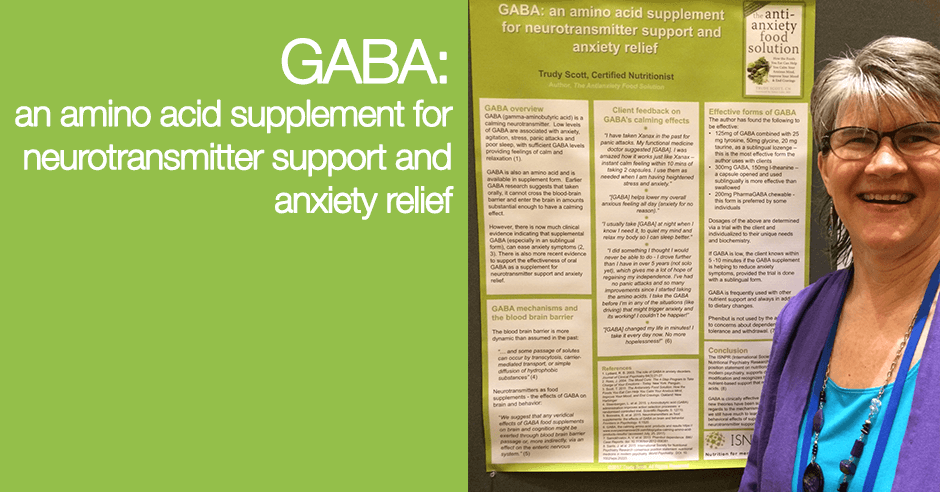
GABA: an amino acid supplement for neurotransmitter support and anxiety relief

August 4, 2017 By Trudy Scott 44 Comments

I recently attended the first international meeting of International Society for Nutritional Psychiatry Research and was honored and thrilled to present my poster – GABA: an amino acid supplement for neurotransmitter support and anxiety relief

Because you were not able to be there, here are the contents of my poster word for word.

GABA overview

GABA (gamma-aminobutyric acid) is a calming neurotransmitter. Low levels of GABA are associated with anxiety, agitation, stress, panic attacks and poor sleep, with sufficient GABA levels providing feelings of calm and relaxation (1).

GABA is also an amino acid and is available in supplement form. Earlier GABA research suggests that taken orally, it cannot cross the blood-brain barrier and enter the brain in amounts substantial enough to have a calming effect.

However, there is now much clinical evidence indicating that supplemental GABA (especially in a sublingual form), can ease anxiety symptoms (2, 3). There is also more recent evidence to support the effectiveness of oral GABA as a supplement for neurotransmitter support and anxiety relief.

GABA mechanisms and the blood brain barrier

The blood brain barrier is more dynamic than assumed in the past:

… and some passage of solutes can occur by transcytosis, carrier-mediated transport, or simple diffusion of hydrophobic substances (4)

Neurotransmitters as food supplements – the effects of GABA on brain and behavior:

We suggest that any veridical effects of GABA food supplements on brain and cognition might be exerted through blood brain barrier passage or, more indirectly, via an effect on the enteric nervous system. (5)

Client feedback on GABA’s calming effects

I have taken Xanax in the past for panic attacks. My functional medicine doctor suggested [GABA]. I was amazed how it works just like Xanax – instant calm feeling within 10 mins of taking 2 capsules. I use them as needed when I am having heightened stress and anxiety.

[GABA] helps lower my overall anxious feeling all day (anxiety for no reason).

I usually take [GABA] at night when I know I need it, to quiet my mind and relax my body so I can sleep better.”

I did something I thought I would never be able to do – I drove further than I have in over 5 years (not solo yet), which gives me a lot of hope of regaining my independence. I’ve had no panic attacks and so many improvements since I started taking the amino acids. I take the GABA before I’m in any of the situations (like driving) that might trigger anxiety and its working! I couldn’t be happier!

[GABA] changed my life in minutes! I take it every day now. No more hopelessness! (6)

Effective forms of GABA

The author has found the following to be effective:

  • 125mg of GABA combined with 25 mg tyrosine, 50mg glycine, 20 mg taurine, as a sublingual lozenge – this is the most effective form the author uses with clients
  • 300mg GABA, 150mg l-theanine – a capsule opened and used sublingually is more effective than swallowed
  • 200mg PharmaGABA chewable – this form is preferred by some individuals

Dosages of the above are determined via a trial with the client and individualized to their unique needs and biochemistry.

If GABA is low, the client knows within 5 -10 minutes if the GABA supplement is helping to reduce anxiety symptoms, provided the trial is done with a sublingual form.

GABA is frequently used with other nutrient support and always in addition to dietary changes.

Phenibut is not used by the author due to concerns about dependence, tolerance and withdrawal. (7)

Conclusion

The ISNPR (International Society for Nutritional Psychiatry Research) consensus position statement on nutritional medicine in modern psychiatry, supports dietary modification and recognizes the need for nutrient-based support that may include amino acids. (8)

GABA is clinically effective for anxiety, and new theories have been suggested with regards to the mechanism of action. However, we still have much to learn about the behavioral effects of supplemental GABA for neurotransmitter support and anxiety relief. (5)

References

  1. Lydiard, R. B. 2003. The role of GABA in anxiety disorders. Journal of Clinical Psychiatry 64(3):21-27.
  2. Ross, J. 2004. The Mood Cure: The 4-Step Program to Take Charge of Your Emotions – Today. New York: Penguin.
  3. Scott, T. 2011. The Antianxiety Food Solution: How the Foods You Eat Can Help You Calm Your Anxious Mind, Improve Your Mood, and End Cravings. Oakland: New Harbinger 
  4. Steenbergen, L. et al. 2015. γ-Aminobutyric acid (GABA) administration improves action selection processes: a randomised controlled trial. Scientific Reports. 5: 12770.
  5. Boonstra, E. et al. 2015. Neurotransmitters as food supplements: the effects of GABA on brain and behavior. Frontiers in Psychology. 6:1520.
  6. GABA, the calming amino acid: products and results (accessed July, 25, 2017)
  7. Samokhvalov, A. V. et al. 2013. Phenibut dependence. BMJ Case Reports. doi: 10.1136/bcr-2012-008381.
  8. Sarris, J. et al. 2015. International Society for Nutritional Psychiatry Research consensus position statement: nutritional medicine in modern psychiatry. World Psychiatry. DOI: 10. 1002/wps.20223
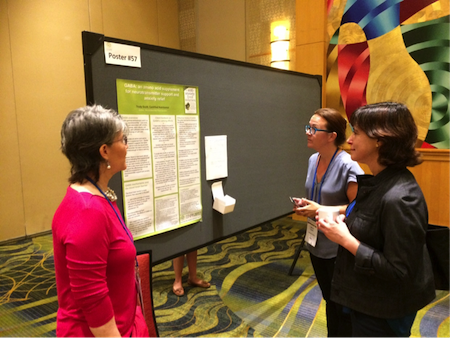
It was very encouraging to see the interest in my poster and this topic of GABA for anxiety! I shared how I use GABA with a number of psychiatrists, some dietitians, a psychiatric nurse practitioner, a number of researchers, and a number of nutritionists and health coaches.

I’m really pleased to have had the opportunity to meet so many amazing researchers and hope to be able to collaborate on research.  

Please let me know if you have questions and do share if you use GABA personally or use it with clients/patients.


Filed Under: Events, GABA Tagged With: anxiety relief, GABA, International Society for Nutritional Psychiatry Research, neurotransmitter support

International Society for Nutritional Psychiatry Research: 2017 conference

July 21, 2017 By Trudy Scott Leave a Comment

This is the first major international meeting of the International Society for Nutritional Psychiatry Research and will be held July 30 – August 2, in Bethesda, MD, USA. The conference will comprise:

  • Plenary presentations from leading international researchers
  • State of the art symposia and free oral presentations from researchers and clinicians
  • Multidisciplinary workshops for psychiatrists, psychologists, dietitians, nutritionists and other health professionals
  • An exciting social program

This meeting will reflect the broad spectrum of research, from the sub-cellular to translation and implementation science. There will also be a strong focus on basic science and the biological processes and factors that underpin the links between diet, nutrition and mental health, including the brain-gut-microbe axis, immunology and metabolic processes and molecular science. The program will cater to the interests of researchers and clinicians from the fields of public health, diabetes, cardiovascular disease, obesity and dietetics, as well as psychiatry and psychology.

I’m excited to have the opportunity to hear and meet so many amazing food/nutrient and mental health researchers, many of whom I’ve referenced in my book and shared on my blog and in presentations:

  • Food mood /microbiome researcher, Professor Felice Jacka, President, International Society for Nutritional Psychiatry Research
  • Microbiome researcher, Professor John F. Cryan
  • Micronutrient researcher, Julia Rucklidge
  • Sugar and trans fats researcher, Professor Almudena Sánchez-Villegas, University of Las Palmas de Gran Canaria, Spain
  • Nutraceuticals researcher, Professor Jerome Sarris;
  • Hypoglycemia/anxiety researcher, Monique Aucoin ND and so many more!

I’ve been accepted to do a rapid fire presentation on gluten-free/Paleo diet for anxiety and will also be presenting a poster on GABA/amino acids for anxiety. What an honor!

You can find the program information here.

This is a conference for health professionals but I’m pleased to announce that the Sunday sessions are OPEN TO THE PUBLIC.

More information and registration for INSPR 2017 here.

Filed Under: Events Tagged With: anxiety, felice jacka, food, GABA, gut-brain, International Society for Nutritional Psychiatry Research, ISNPR

Nutritional medicine in modern psychiatry: position statement by ISNPR

October 2, 2015 By Trudy Scott 6 Comments

world-psychiatry

A letter published this month in World Psychiatry, the official journal of the World Psychiatric Association, is titled: “International Society for Nutritional Psychiatry Research consensus position statement: nutritional medicine in modern psychiatry.”

You may recall my interview with Dr. Felice Jacka on season 1 of The Anxiety Summit: The Research – Food to prevent and treat anxiety and depression?  Dr. Jacka is one of the authors of this position statement and a co-founder of the International Society for Nutritional Psychiatry Research/ISNPR which was formed in 2013 with the aim to advance research and communication on nutritional medicine in the field of psychiatry.

Here is an excerpt from the position statement from ISNPR:

Although the growth in scientific research related to nutrition in psychiatry may be recent, it is now at a stage where it can no longer be ignored. In light of this, we aim to provide a platform to move towards a new integrated paradigm in psychiatry whereby nutritional considerations (both educational and prescriptive) can be considered “mainstream”. To this end, we present a consensus position statement from the International Society for Nutritional Psychiatry Research (ISNPR).

They state that what we are doing now is not working, that little is being done about prevention, and that nutrition needs to be part of treatment and prevention:

Present treatment of mental disorders is achieving sub-optimal outcomes; in addition little attention is given to preventative efforts. Due to the immense burden of mental disorders, there is now an urgent need to identify modifiable targets to reduce the incidence of these disorders. Diet and nutrition offer key modifiable targets for the prevention of mental disorders and have a fundamental role in the promotion of mental health.

They state that diet and nutrient-based approached approaches need to be included for mental health treatment and for prevention:

In addition to dietary modification, we recognize that nutrient-based (nutraceutical) prescription has the potential to assist in the management of mental disorders at the individual and population level. Many of these nutrients have a clear link to brain health, including: omega-3s, B vitamins (particularly folate and B12), choline, iron, zinc, magnesium, S-adenosyl methionine (SAMe), vitamin D, and amino acids. While we advocate for these to be consumed in the diet where possible, additional select prescription of these as nutraceuticals may also be justified.

veggies

They call for ongoing research, changes in food policy, and better public and clinician education (based on all the new research in this field of nutritional psychiatry).

I look forward to the outcome of the RCT dietary intervention for depression / “SMILES” trial later this year, additional dietary studies, and more studies on individual nutrients such as amino acids like GABA and tryptophan, minerals like zinc and others (which we know work so well for so many people). I’d also love to see trials that look at biochemical individuality and diets and nutrients customized to that uniqueness. I know we’re heading in this direction.    

The position statement ends with this:

It is the intention that this position statement and the ongoing work of ISNPR will assist in facilitating a transformation in psychiatry to better address the substantial global burden of mental illness, recognizing and embracing diet and nutrition as central determinants of both physical and mental health.

You can read the whole statement here in World Psychiatry

I say bravo to Dr. Jacka, ISNPR and the researchers who are at the forefront of this exciting research. I also say bravo to all the health practitioners who are already using this work with patients and clients. And finally, I say bravo to the anxious and depressed individuals who are implementing these powerful changes and seeing dramatic results.

It certainly is exciting to be part of this change!


Filed Under: People Tagged With: felice jacka, International Society for Nutritional Psychiatry Research, ISNPR, World Psychiatry

Primary Sidebar

NEW! GABA QuickStart Homestudy (with special intro pricing)

gaba quickstart homestudy

Free Report

9 Great Questions Women Ask about Food, Mood and their Health

You'll also receive a complimentary subscription to my ezine "Food, Mood and Gal Stuff"


Connect with me

Popular Posts

  • Amino Acids Mood Questionnaire from The Antianxiety Food Solution
  • The Antianxiety Food Solution Amino Acid and Pyroluria Supplements
  • Pyroluria Questionnaire from The Antianxiety Food Solution
  • Collagen and gelatin lower serotonin: does this increase your anxiety and depression?
  • Tryptophan for the worry-in-your-head and ruminating type of anxiety
  • GABA for the physical-tension and stiff-and-tense-muscles type of anxiety
  • The Antianxiety Food Solution by Trudy Scott
  • Seriphos Original Formula is back: the best product for anxiety and insomnia caused by high cortisol
  • Am I an anxious introvert because of low zinc and vitamin B6? My response to Huffington Post blog
  • Vagus nerve rehab with GABA, breathing, humming, gargling and key nutrients

Recent Posts

  • What do I use instead of Seriphos to help lower high cortisol that is affecting my sleep and making me anxious at night?
  • BeSerene™ GABA/theanine cream eases severe muscle tension in her neck/shoulders, prevents her bad headaches and quells her anxiety
  • How the correct approach, dose and sublingual use of GABA can be calming and not cause a flushed and itchy face and neck
  • The amino acid glutamine improves low mood by addressing gut health, and it has calming effects too
  • Flight anxiety with heightened breath, physical tension and also fearing the worst (the role of low GABA and low serotonin)

Categories

  • 5-HTP
  • AB575
  • Addiction
  • ADHD
  • Adrenals
  • Alcohol
  • Allergies
  • Alzheimer's disease
  • Amino Acids
  • Anger
  • Antianxiety
  • Antianxiety Food Solution
  • Antidepressants
  • Anxiety
  • Anxiety and panic
  • Autism
  • Autoimmunity
  • benzodiazapines
  • Bipolar disorder
  • Books
  • Caffeine
  • Cancer
  • Candida
  • Children/Teens
  • Collagen
  • Cooking equipment
  • Coronavirus/COVID-19
  • Cravings
  • Depression
  • Detoxification
  • Diabetes
  • Diet
  • DPA/DLPA
  • Drugs
  • EFT/Tapping
  • EMF
  • EMFs
  • Emotional Eating
  • Endorphins
  • Environment
  • Essential oils
  • Events
  • Exercise
  • Fear
  • Fear of public speaking
  • Fertility and Pregnancy
  • Fish
  • Food
  • Food and mood
  • Functional neurology
  • GABA
  • Gene polymorphisms
  • General Health
  • Giving
  • Giving back
  • Glutamine
  • Gluten
  • GMOs
  • Gratitude
  • Gut health
  • Heart health/hypertension
  • Histamine
  • Hormone
  • Hyperparathyroidism
  • Hypoglycemia
  • Immune system
  • Inflammation
  • Insomnia
  • Inspiration
  • Introversion
  • Joy and happiness
  • Ketogenic diet
  • Lithium orotate
  • Looking awesome
  • Lyme disease and co-infections
  • MCAS/histamine
  • Medication
  • Men's health
  • Mental health
  • Mercury
  • Migraine
  • Mold
  • Movie
  • MTHFR
  • Multiple sclerosis
  • Music
  • NANP
  • Nature
  • Nutritional Psychiatry
  • OCD
  • Osteoporosis
  • Oxalates
  • Oxytocin
  • Pain
  • Paleo
  • Parasites
  • Parkinson’s disease
  • PCOS
  • People
  • PMS
  • Postpartum
  • PTSD/Trauma
  • Pyroluria
  • Questionnaires
  • Real whole food
  • Recipes
  • Research
  • Schizophrenia
  • serotonin
  • SIBO
  • Sleep
  • Special diets
  • Sports nutrition
  • Stress
  • Sugar addiction
  • Sugar and mood
  • Supplements
  • Teens
  • Testimonials
  • Testing
  • The Anxiety Summit
  • The Anxiety Summit 2
  • The Anxiety Summit 3
  • The Anxiety Summit 4
  • The Anxiety Summit 5
  • The Anxiety Summit 6
  • Thyroid
  • Thyroid health
  • Toxins
  • Tryptophan
  • Tyrosine
  • Uncategorized
  • Vegan/vegetarian
  • Women's health
  • Yoga

Archives

  • October 2025
  • September 2025
  • August 2025
  • July 2025
  • June 2025
  • May 2025
  • April 2025
  • March 2025
  • February 2025
  • January 2025
  • November 2024
  • October 2024
  • September 2024
  • August 2024
  • July 2024
  • June 2024
  • May 2024
  • April 2024
  • March 2024
  • February 2024
  • January 2024
  • December 2023
  • November 2023
  • October 2023
  • September 2023
  • August 2023
  • July 2023
  • June 2023
  • May 2023
  • April 2023
  • March 2023
  • February 2023
  • January 2023
  • December 2022
  • November 2022
  • October 2022
  • September 2022
  • August 2022
  • July 2022
  • June 2022
  • May 2022
  • April 2022
  • March 2022
  • February 2022
  • January 2022
  • December 2021
  • November 2021
  • October 2021
  • September 2021
  • August 2021
  • July 2021
  • June 2021
  • May 2021
  • April 2021
  • March 2021
  • February 2021
  • January 2021
  • December 2020
  • November 2020
  • October 2020
  • September 2020
  • August 2020
  • July 2020
  • June 2020
  • May 2020
  • April 2020
  • March 2020
  • February 2020
  • January 2020
  • December 2019
  • November 2019
  • October 2019
  • September 2019
  • August 2019
  • July 2019
  • June 2019
  • May 2019
  • April 2019
  • March 2019
  • February 2019
  • January 2019
  • December 2018
  • November 2018
  • October 2018
  • September 2018
  • August 2018
  • July 2018
  • June 2018
  • May 2018
  • April 2018
  • March 2018
  • February 2018
  • January 2018
  • December 2017
  • November 2017
  • October 2017
  • September 2017
  • August 2017
  • July 2017
  • June 2017
  • May 2017
  • April 2017
  • March 2017
  • February 2017
  • January 2017
  • December 2016
  • November 2016
  • October 2016
  • September 2016
  • August 2016
  • July 2016
  • June 2016
  • May 2016
  • April 2016
  • March 2016
  • February 2016
  • January 2016
  • December 2015
  • November 2015
  • October 2015
  • September 2015
  • August 2015
  • July 2015
  • June 2015
  • May 2015
  • April 2015
  • March 2015
  • February 2015
  • January 2015
  • December 2014
  • November 2014
  • October 2014
  • September 2014
  • August 2014
  • July 2014
  • June 2014
  • May 2014
  • April 2014
  • March 2014
  • February 2014
  • January 2014
  • December 2013
  • November 2013
  • October 2013
  • September 2013
  • August 2013
  • July 2013
  • June 2013
  • May 2013
  • April 2013
  • March 2013
  • February 2013
  • January 2013
  • December 2012
  • November 2012
  • October 2012
  • August 2012
  • July 2012
  • June 2012
  • May 2012
  • April 2012
  • March 2012
  • February 2012
  • January 2012
  • December 2011
  • November 2011
  • October 2011
  • September 2011
  • August 2011
  • July 2011
  • June 2011
  • May 2011
  • April 2011
  • March 2011
  • February 2011
  • January 2011
  • December 2010
  • October 2010
  • September 2010
  • July 2010
  • May 2010
  • April 2010
  • March 2010
  • February 2010
  • January 2010
  • November 2009

Share the knowledge!

The above statements have not been evaluated by the Food and Drug Administration. Products listed in this website are not intended to diagnose, treat, cure or prevent any disease.

The information provided on this site is for informational and educational purposes only and is not intended as a substitute for advice from your physician or other health care professional. You should consult with a healthcare professional before starting or modifying any diet, exercise, or supplementation program, before taking or stopping any medication, or if you have or suspect you may have a health problem.


Copyright © 2026 Trudy Scott. All Rights Reserved. | Privacy | Terms and Conditions | Refund Policy | Medical Disclaimer

Free Report

9 Great Questions Women Ask about Food, Mood and their Health

You’ll also receive a complimentary subscription to my ezine “Food, Mood and Gal Stuff”