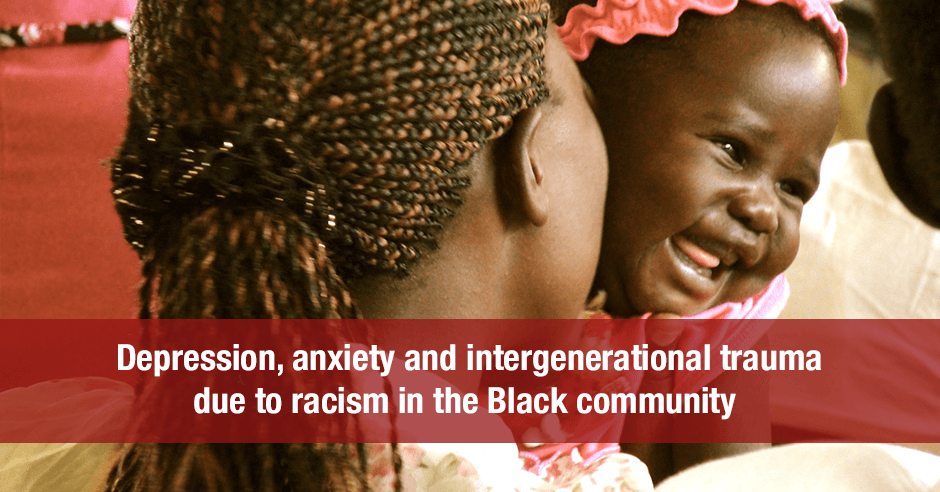
I feel sickened by George Floyd’s death and the police brutality we all witnessed. I stand by Black Lives Matter and an end to racism, social injustice and inequalities. In the light of current events in the USA and around the world, today’s article highlights the prevalence of mental health in the Black community, the biological impacts of trauma, racism and intergenerational trauma, some reasons why mental health services are not being used, the impacts of racism on physical health and some resources geared to Black mental health.
In this recent article by Columbia University Department of Psychiatry, Addressing Mental Health in the Black Community, we learn the following:
Research suggests that the adult Black community is 20% more likely to experience serious mental health problems, such as Major Depressive Disorder or Generalized Anxiety Disorder.
Additionally, Black emerging adults (ages 18-25) also experience higher rates of mental health problems and lower rates of mental health service utilization compared to White emerging adults, and older Black adults.
What shocked me was reading this statistic: “the Black community comprises approximately 40% of the homeless population, 50% of the prison population, and 45% of children in the foster care system.” All of this puts the Black community is at more risk for mental health issues.
The article also highlights the biological impacts of trauma“through enslavement, oppression, colonialism, racism, and segregation” and shares that “intergenerational trauma may be passed down biologically from one generation to the next.”
Some of the factors that may lead to mental health services not being used amongst the Black community are lack of trust, lack of finances and fear:
Lack of trust in the medical system due to historical abuses of Black people in the guise of health care, less access to adequate insurance, culturally responsive mental health providers, financial burden, and past history with discrimination in the mental health system.
I encourage you to read the entire article at this link.
This paper, Transgenerational Consequences of Racial Discrimination for African American Health goes further into the intergenerational effects of racism on both psychological and physical health: immune health, heart health, obesity, diabetes and so on. The paper concludes as follows:
without addressing the harmful consequences of racial discrimination, improving the health of African Americans as well as other marginalized groups, will remain inadequately addressed.
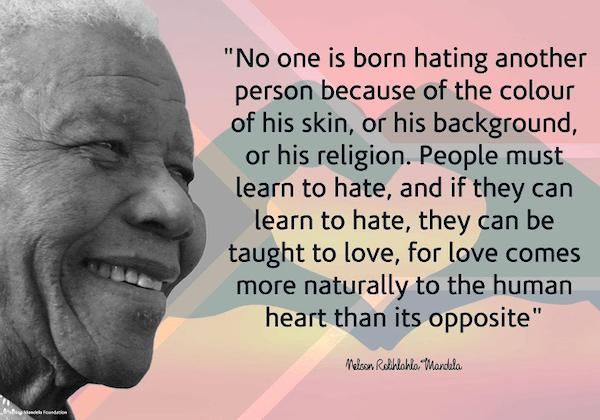
This inspiring quote is from Nelson Mandela from his autobiography, Long Walk to Freedom (1994) and no-one says it better than him. It is a message of hope!
Here are some resources geared specifically to Black mental health
- Black Mental Health Resources to Fight the Harmful Effects of Racism
- Black lives matter. Black mental health matters too.
With regards to nutritional support for anxiety, depression and PTSD, everything that I write about in terms of nutritional psychiatry applies. My book, The Antianxiety Food Solution, covers the foundations of diet and how to use amino acids. This recent blog, The psychological trauma of coronavirus – nutritional support for doctors, nurses and their loved ones could easily be adapted to be: The psychological trauma of racism – nutritional support for the Black Community.
I am very aware that when it comes to working with a functional medicine practitioner or a nutritionist, and purchasing supplements/doing special diets may be a major stumbling block for many Blacks with financial hardships. This needs to become the standard of care so everyone has access to resources like these.
Until then finding access to real whole foods is a powerful first step. In the SMILES diet depression trial, the first randomized controlled diet depression study, ONE THIRD of the dietary intervention group saw improvements in their depression and anxiety symptoms. This was simply by switching from processed/junk food to real food with no specific dietary restrictions.
This is the power of nutritional psychiatry:
Although the growth in scientific research related to nutrition in psychiatry may be recent, it is now at a stage where it can no longer be ignored. In light of this, we aim to provide a platform to move towards a new integrated paradigm in psychiatry whereby nutritional considerations (both educational and prescriptive) can be considered “mainstream”.
The International Society for Nutritional Psychiatry Research/ISNPR made the above statement via a letter published in 2015 in World Psychiatry, the official journal of the World Psychiatric Association – “International Society for Nutritional Psychiatry Research consensus position statement: nutritional medicine in modern psychiatry.” You can read more about this here.
This recent paper, Nutritional Psychiatry: Towards Improving Mental Health by What You Eat, further adds to the discussion, providing an “overview of the emerging field of nutritional psychiatry, exploring the scientific evidence exemplifying the importance of a well-balanced diet for mental health.”
I recently heard integrative psychiatrist Dr. Kelly Brogan, share this on The Trauma and MindBody Super Conference:“it’s best to address trauma when your nervous system has physiologically improved.” She always starts with addressing physiology: diet, gluten issues, the gut and microbiome, blood sugar stability, micronutrient deficiencies such as low B12, low thyroid and other contributing physiological root causes.
By incorporating nutritional psychiatry and functional medicine approaches we can provide additional healing support for the depression, anxiety, current trauma and intergenerational trauma caused by racism and inequalities.
Updates 7/7/20:
The above SMILES Diet Depression study doesn’t mention race. There are, however, many studies that didn’t make it into the blog because I felt compelled to publish something quickly.
Here are some of them:
China, Ghana, India, Mexico, the Russian Federation, and South Africa…examine the relationship between demographic and lifestyle characteristics and depression….. Increased fruit and vegetable intake appeared to co-occur with significantly lower rates of depression, suggesting diet as a modifiable factor for addressing depression burden.
Among overweight/obese women, improvement in health-related quality of life related to physical health, a significant decrease in depressive score, and a reduction in waist circumference were noted.
I am not an authority on Black mental health, racism or intergenerational trauma. As I look into the research, read articles and listen to podcasts, I acknowledge that I’ve been learning a great deal. And I know I still have much to learn.
I am, however, an authority on food and using a nutritional approach for anxiety. Real whole nutrient-dense food is the foundation and always will be – for every single human regardless of race. We do, however, need more programs and studies that are specific for people of color.
This needs to be a public health initiative where we also address the food security issues. According to this paper, Food Insecurity and Maternal Mental Health Among African American Single Mothers Living With HIV/AIDS in the Alabama Black Belt, “Food insecurity places low-income African American women at risk of depression.” This is one of many similar such studies.
Together with this we need to address racism. This paper, Experiences of Racial and Ethnic Discrimination Are Associated with Food Insecurity and Poor Health, sums up with this:
Public health interventions intended to improve food security and health may be only partially effective without simultaneously addressing racism and discrimination
If you have information on non-profit organizations, community gardens, community kitchens and other resources for supporting Black communities when it comes to nutritional supplements, food insecurity and food deserts, and eating real foods please share in the comments.
For now check out and be inspired by Ron Finley, the Gangsta Gardener – and his amazing community garden and gardening masterclasses:
Ron envisions a world where gardening is gangsta, where cool kids know their nutrition and where communities embrace the act of growing, knowing and sharing the best of the earth’s fresh-grown food.
Determined to change South Central Los Angeles from food desert to food forest, he wants his actions to be educational, inspiring, and nutritious. He wants kids to grow up with the option of healthy food, instead of fried, fattening staples. He wants to sweep up and transform his street, his hood, the city of LA and communities everywhere.
Please also share your experiences supporting mental health in Black communities. And if you’ve been subject to racism and felt the mental and physical effects please share too. We’re here to support you and learn how we can do better.

Hello Trudy,
I felt the same that most of us are sicken by violence and brutality inflicted on marginalized people.
However, are we being fed by correct news or is there a hidden agenda, especially in the US.
Have a look at this:
https://youtu.be/0xkokrL0uBw
Candice Owen, a black woman says she does not support George Floyd, because he is a unreformed criminal.
Regards,
Robert
Robert
I don’t support what Candice Owen is saying and encourage her and anyone who has watched this video to learn about systemic racism in the USA. The movie 13th is a good start.
You can be outraged at what happened to George Floyd and support good police officers at the same time. Those police officers should be prosecuted to the fullest extent of the law. But when you make no distinction between those officers and the overwhelming majority of good, decent hardworking officers who put THEIR lives on the line for people they don’t even know, you are guilty of being prejudice towards police officers. How is that any different?
Nowhere in your article do you list support for police officers. Have you written a blog post on emotional and anxiety support for police officers? It is very easy to sit in the comfort of your own home and second guess decision made by police officers who are put in situations that you or I have never been in.
My daughter and son in law are both police officers. I think I will share her words below. Since she actually has experience.
I will continue to say, the good people in the black communities are the ones suffering, while the criminal portion hoot and holler and blame everything and everyone else for their behavior. These good people desperately need law enforcement in their communities. If you don’t know that, then you are ignorant.
“I spent 6 years serving the black community, responding to their never-ending 911 calls for help, going above and beyond to help them, even if to just help them understand or to listen to them vent, I’ve spent hours listening, I’ve volunteered my time, I’ve played with their kids, I’ve bought food with my own money. Sure some shouting at me “cracker bitch” or whatever but way more than that I made positive connections with people and they trusted me. I did everything humanly possible to help people in some of these crime-ridden communities by enforcing the law and putting the bad people in jail so the good people can rest peacefully in their beds at night, so their kids can walk down the streets safely. That was the goal anyway. 6 years.
What have you done? ”
I think I will just leave that^^^^ right here.
The solution is necessary. Have all candidates that register to become police officers ,to be Tested.
Given a very strong test about their personality, like are they sadists,.?or sociopaths ? Or any kind
Of men or woman that want to shoot a gun…without a powerful reason…. most country’s have those tests……
So it will cost money!but it is very effective.
England has it ,so does Germany and Norway and France,Spain and……Israel….why can’t we have it, it will weed out the abusers and all the good cops will shine…..simple but very effective….Ava
Marie
Of course I support and appreciate good police officers. I happen to have a family member who is in the police force too and very much appreciate the work they do.
This article happens to focus on the black community but I’m very aware that anxiety/depression/PTSD is common in the police. I do actually address this in my recent blog acknowledging doctors, nurses and other front-line workers during the pandemic https://www.everywomanover29.com/blog/the-psychological-trauma-of-coronavirus-nutritional-support-for-doctors-nurses-and-their-loved-ones/ I don’t specifically mention police officers but like to said to Lisa below many communities/professions deserve and need support.
Here are two recent studies – Mental Disorders, Suicidal Ideation, Plans and Attempts Among Canadian Police https://pubmed.ncbi.nlm.nih.gov/32154872/ and Global Prevalence and Risk Factors for Mental Health Problems in Police Personnel: A Systematic Review and Meta-Analysis https://pubmed.ncbi.nlm.nih.gov/32439827/
This study addresses the benefits of intermittent fasting due to “shift work, poor diet, lack of physical activity, and irregular sleep patterns put men and women employed in high-stress occupations (e.g., firefighters, police officers) at risk for cardiometabolic diseases” – Time-restricted Feeding for the Prevention of Cardiometabolic Diseases in High-Stress Occupations: A Mechanistic Review https://pubmed.ncbi.nlm.nih.gov/31774508/
I also believe in a bigger solution that is not only about policing but also allocating funds to schools, community programs, urban gardening, food in schools, fixing food deserts and more.
Also, addressing systemic racism in the USA is imperative. I found the movie 13th to be very educational. I only watched it very recently so I admit to being unaware like many others probably are.
First of all, I am a white woman and this comes with considerable privilege. I do not speak on behalf of the black community. What I hope to do is bring up some questions about what it means to be a white ally, as this seems to be the intention of the newsletter.
Second, to the comment that preceded this one by Marie Watson. Yes, there’s a lot of good police officers here and there. I have some in my community. The fact still remains, that a lot of tax dollars are allocated towards policing and people of colour are the most likely to be the victim of fatal police shootings in the United States and Canada. The existence of the police force is a significant part of structural racism in North America. We know for a fact that folks are more likely to act violently if they feel unsafe. For much too long we’ve focused on the physical safety of the privileged and ignored the feelings of safety of black people. In order to make people’s nervous systems feel safer, I urge people to consider the idea of spending less money on policing and reinvest that into services that we know work at reducing crime: public health care, social services, housing, basic universal income, food programs. We need to take better care of each other.
And Trudy Scott, I get the feeling you genuinely care and want to say the right thing. That you really tried to engage in the racism conversation with this post. This isn’t meant to be a criticism of your intent, but to plant some seeds and offer some considerations and questions for your interpretation of the situation. We all have so much learning left to do, and I urge you to sit in the discomfort of examining how racism has manifested in your life and who you are.
I understand that you know a lot about mental health and you really want to help. However, suggesting that black people eat “real food” to “start to slowly heal some of the depression, anxiety, current trauma and intergenerational trauma caused by racism and inequalities” sounds really patronizing, as if you’re an authority on black people’s mental health. I know that’s not what was intended, but that’s how it comes across to me.
I could not find anything about the race of the people in the small study about “real food” that was sited, and there’s been a long history of medical studies done on white people that are then generalized to people of colour. It may not be obvious, but this is an example of structural racism within healthcare.
There’s a lot of wonderful guides out there by black people on how to be an ally. Here’s one on instagram I like by @wastefreemarie https://www.instagram.com/p/CA8FJhIhhRt/
If you got this far in my comment, thank you for reading! I am far from an expert on this subject, however I hope it brought up some questions to consider. If you would like to continue this conversation Trudy, I would love to talk to you about it. I can be reached at secordes@gmail.com.
Dr. Cordes
Thank you for contributing to the discussion.
I too am a white woman and acknowledge that this comes with considerable privilege. The current situation is having many of us asking questions and wanting to do better.
I’m with you the idea of spending less on policing and reinvesting that into services that we know work at reducing crime. As you’ve been seeing there is a call to defund the police. I personally don’t favor the “defund” term because it has to be explained and does invoke fear in many. I found this article helpful for explaining it: “You’ve heard calls to ‘defund the police’ and ‘abolish the police.’ What do those actually mean? https://www.sfgate.com/news/slideshow/What-is-defund-the-police-abolish-police-203572.php
I’m not clear about this comment “I urge you to sit in the discomfort of examining how racism has manifested in your life and who you are”. I grew up in apartheid South Africa and I have never been racist. However, I have also not been actively anti-racist and perhaps this is what you’re referring to? The current situation is opening up dialogues with friends, family and colleagues. I will be more vocal going forward.
I’m sorry my comment about eating “real food” to “start to slowly heal some of the depression, anxiety, current trauma and intergenerational trauma caused by racism and inequalities” sounds patronizing. That was not my intention and the message is the same as what I share in all my blogs. I am not an authority on black mental health and don’t pretend to be. I am, however, an authority of food and mental health. Real whole nutrient-dense food is the foundation and always will be – for every single human regardless of race.
I agree – the SMILES Diet Depression study doesn’t mention race. And yes we need more studies that are not generalized to people of color. There are however many such studies that didn’t make it into the blog because I felt compelled to publish something quickly. Here is one of them:
Variation in the Prevalence of Depression and Patterns of Association, Sociodemographic and Lifestyle Factors in Community-Dwelling Older Adults in Six Low- And Middle-Income Countries https://pubmed.ncbi.nlm.nih.gov/30927583/
“China, Ghana, India, Mexico, the Russian Federation, and South Africa…examine the relationship between demographic and lifestyle characteristics and depression….. Increased fruit and vegetable intake appeared to co-occur with significantly lower rates of depression, suggesting diet as a modifiable factor for addressing depression burden.”
I’ll be updating the blog with others. Until then feel free to share studies you are aware of.
Hi Trudy,
What a great reply, thank you so much for taking the time. You make a lot of a good points, including the urgency of getting the post out limiting being a factor. I love this. It’s important for us to talk about racism and writing perfect blog posts is not what it’s about.
I was pretty angry already when I read your newsletter, as social media and comments online have been pretty rough lately. You’re 100% right, you are an expert on food and how that effects health, and I would agree that food security and access to produce is a major problem. I admit I may have been looking for points to argue, and I apologize if it came across as defensive. Your reply was very well thought out and composed, I really appreciate it.
Yes, defunding the police is important, especially if we’re talking about the physical safety of black people. You can call it “spending less on police and reinvesting the money into social services we know reduces crime”, but that’s a mouthful. Who knows, maybe a new term would help open people up to the idea.
I think a key point that we differ on, is that I know I can be racist. I live in a racist world, my existence was shaped by it. We can be anti-racist, even though we do or say things that are racist (because we are unaware). This, in my opinion, is so important to anti-racism, because this approach opens ourselves up to radical change.
Again, thank you so much for taking the time to reply. I would image it’s not easy.
S
Not the intention Overarching vision is unethical unregulation to ethics.
Charmain
I’m afraid I’m not clear what this means?
Thank you for the helpful information, Trudy Scott! I will be sure to share with my networks, and I very much look forward to your future blog about accessibility (financial and otherwise) to holistic/functional nutrition support to members of underserved communities.
As the title says, this article is focused on “Depression, anxiety and intergenerational trauma due to racism in the Black community”. I am sure you value the wellbeing of members of all communities, and I appreciate the focus on what is relevant to the Black community in this article.
Lisa
You’re most welcome – I’ve gathered some additional resources and will be updating the blog shortly.
And yes, of course, I value the wellbeing of all communities. Many communities suffer anxiety/depression/trauma and racism-like attacks/thinking/behaviors and all deserve and need support. Some of this may be carried across generations too. Some examples
1) nurse/doctors and other front-line workers (like paramedics, police officers, cleaners, factory workers etc) during the pandemic (I blogged about this here https://www.everywomanover29.com/blog/the-psychological-trauma-of-coronavirus-nutritional-support-for-doctors-nurses-and-their-loved-ones/
2) those in the military (my blog here https://www.everywomanover29.com/blog/ptsd-3-tours-afghanistan-can-gaba-help-anxiety/)
3) domestic abuse victims and women and others let down by the medical community (this one addresses some of this https://www.everywomanover29.com/blog/kate-spade-suicide-hormonal-imbalance-antidepressants-as-a-trigger-and-the-stigma-of-mental-health/
4) those in the LGBTQ community
5) folks who are overweight and folks with physical/metal disabilities (think bullying)
6)Jewish/Native American/Indigenous Australians and other religious/ethnic groups
7) individuals in war zones/refugees
8) victims of natural disasters and first responders/volunteers (blog here https://www.everywomanover29.com/blog/nutrition-solutions-psychological-stress-natural-disaster/)
and many many more.
I plan to tackle each of these in future blogs.