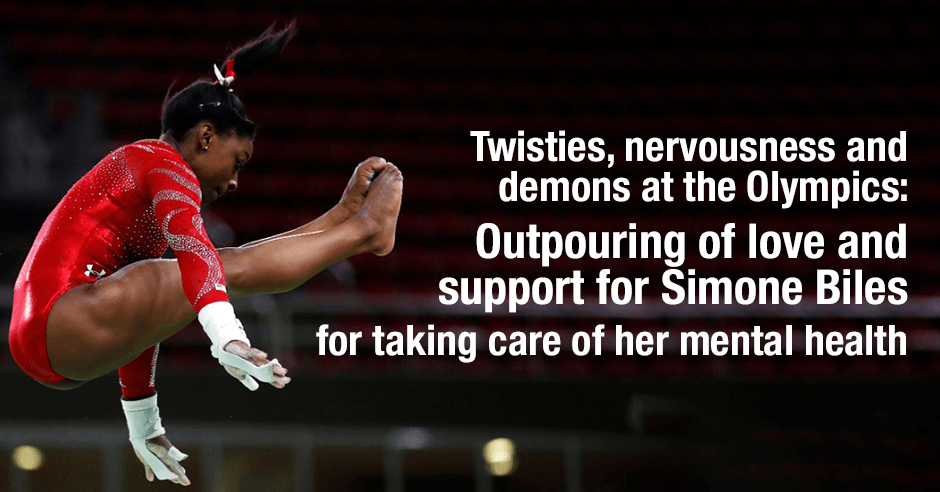
Simone Biles at a training session at the Rio 2016 Summer Olympic Games (Salty View / Shutterstock.com)
There has been an incredible outpouring of love and support for gymnast Simone Biles, as she withdrew from the 2020 Olympics Women’s Team final on Tuesday and All-Around Individual Final on Wednesday. This was due to the twisties, nervousness and mental demons. I’ve decided to gather some of this admiration into a blog post as a testament to Simone who I adore and respect even more than I did before today. I want this to be all about the love and support, but in order to tie it all together, I share more on the twisties (and anxiety), being vulnerable and taking care of yourself, nutritional psychiatry, using amino acids and mental health advocacy below.
Before we get into all that, here is an ET video that explains some of the backstory leading up to this:
Simone shares that she feels good physically but emotionally, her feelings vary by the day. She also talks about the stress of the Olympics and being the star gymnast and that she feels she has the weight of the world on her shoulders.
You’ll also see and hear the love and support she gets from her team members and fellow gymnasts. Two-time Olympian, Aly Raisman, says this about Simone: “She is human too and sometimes people forget that. She is doing the best she can.”
The love and support continued to show up all over social media (and is still showing up)! What follows are some of my favorite posts and mentions.
The love and support – Simone Biles already won
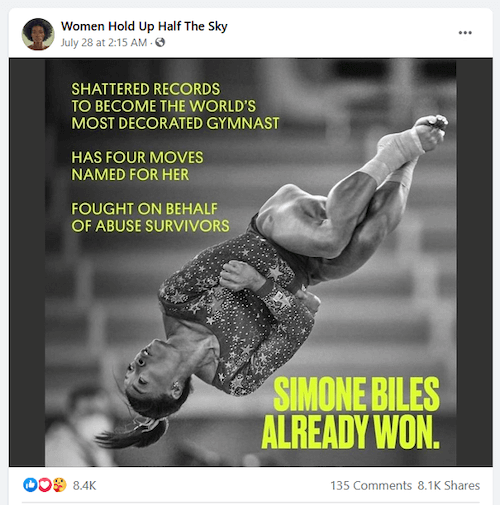
Women Hold Up Half The Sky, a community that empowers women to find their voice and celebrates women in their diversity, shared this powerful post when Simone withdrew:
“Simone Biles already won” and how she has “shattered records to become the world’s most decorated gymnast, has four moves named for her and fought on behalf of abuse survivors.”
Simone is one of many young female gymnasts who were sexually abused by disgraced former USA Gymnastics doctor Larry Nassar. This article in Elle covers her story and goal to be an advocate for other young girls.
We are just as proud of you today as yesterday
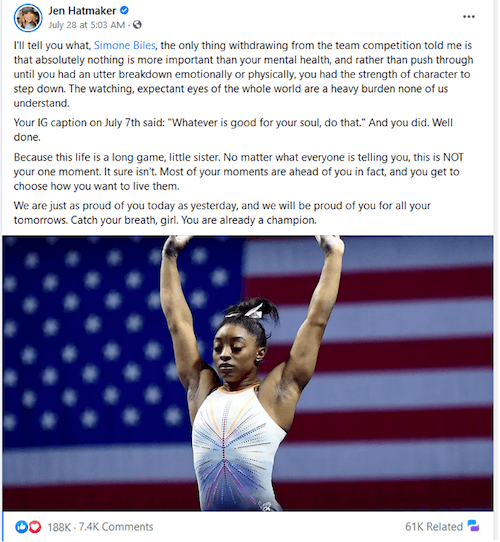
Jen Hatmaker, New York Times bestselling author of “Simple and Free” posts this lovely uplifting message, ending with:
I’ll tell you what, Simone Biles, the only thing withdrawing from the team competition told me is that absolutely nothing is more important than your mental health, and rather than push through until you had an utter breakdown emotionally or physically, you had the strength of character to step down. The watching, expectant eyes of the whole world are a heavy burden none of us understand.
Your IG caption on July 7th said: “Whatever is good for your soul, do that.” And you did. Well done.
Because this life is a long game, little sister. No matter what everyone is telling you, this is NOT your one moment. It sure isn’t. Most of your moments are ahead of you in fact, and you get to choose how you want to live them.
We are just as proud of you today as yesterday, and we will be proud of you for all your tomorrows. Catch your breath, girl. You are already a champion.
I wholeheartedly agree, nothing is more important than her metal health. Too often we put on a brave face and push through. Simone didn’t and for that we are super-proud of her – for her own physical and mental health, and for being a role model to girls and women around the world.
Simone Biles and Naomi Osaka are the role models I want for my girls
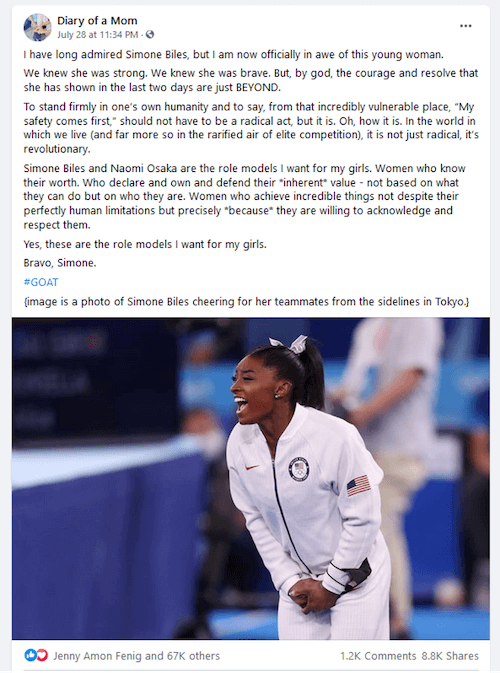
Diary of a Mom, mother, intersectional advocate, believer in the power of community, posted this beautiful message about strength, bravery, vulnerability and Simone and Naomi being role models for her daughters:
I have long admired Simone Biles, but I am now officially in awe of this young woman.
We knew she was strong. We knew she was brave. But, by god, the courage and resolve that she has shown in the last two days are just BEYOND.
To stand firmly in one’s own humanity and to say, from that incredibly vulnerable place, “My safety comes first,” should not have to be a radical act, but it is. Oh, how it is. In the world in which we live (and far more so in the rarified air of elite competition), it is not just radical, it’s revolutionary.
Simone Biles and Naomi Osaka are the role models I want for my girls. Women who know their worth. Who declare and own and defend their *inherent* value – not based on what they can do but on who they are. Women who achieve incredible things not despite their perfectly human limitations but precisely *because* they are willing to acknowledge and respect them.
Yes, these are the role models I want for my girls.
Bravo, Simone.
#GOAT
I applaud this strong woman and amazing athlete
Mary Kay Irving, Therapist/Care Coordinator at Boulder Community Health and Owner at Boulder Center for Health and Nutrition, shares this message.
I applaud this strong woman and amazing athlete for prioritizing her own needs….i.e.. mental health needs. #destigmatizementalhealth #mentalhealthawareness
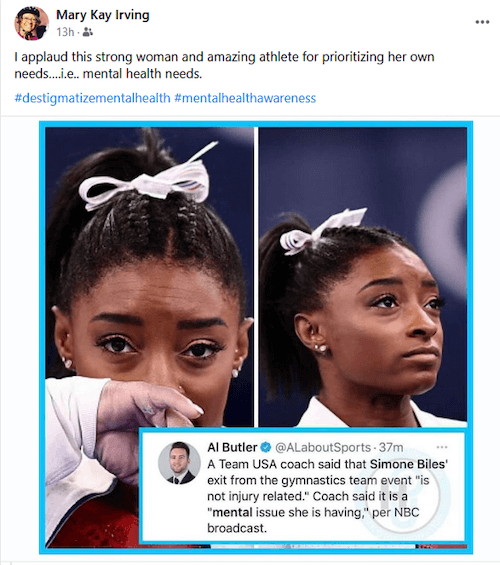
I also applaud Simone and support her decision to take care of her mental health needs no matter how hard it must have been for her!
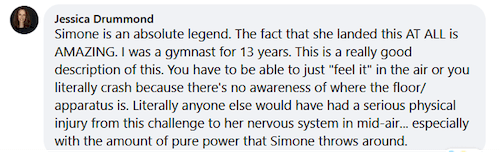
Simone is an absolute legend!
My friend and colleague Dr. Jessica Drummond, a functional nutrition and integrative women’s health expert, and founder of Integrative Women’s Health Institute, says Simone is an absolute legend:
Simone is an absolute legend. The fact that she landed this AT ALL is AMAZING. I was a gymnast for 13 years. You have to be able to just “feel it” in the air or you literally crash because there’s no awareness of where the floor/ apparatus is. Literally anyone else would have had a serious physical injury from this challenge to her nervous system in mid-air… especially with the amount of pure power that Simone throws around.
This is so great for people, especially our youth athletes, to see
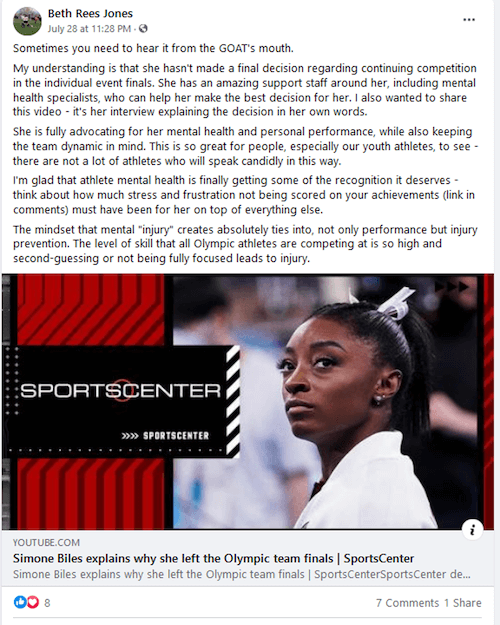
Another friend and colleague, Beth Jones who is a Female/Teen Athlete Wellness & Mindset Coach, posts this.
I’m grateful for athletes like Simone Biles and Naomi Osaka who are coming forward (and professionals as well) to normalize mental health as a key piece of sports training and recovery.
I could not agree more.
In this post, Beth also shares Simone’s press release video where she fully advocates for her mental health and personal performance, keeping the team dynamic in mind, and also sets a wonderful example for young athletes
Sometimes you need to hear it from the GOAT’s mouth.
My understanding is that she hasn’t made a final decision regarding continuing competition in the individual event finals. She has an amazing support staff around her, including mental health specialists, who can help her make the best decision for her. I also wanted to share this video – it’s her interview explaining the decision in her own words.
She is fully advocating for her mental health and personal performance, while also keeping the team dynamic in mind. This is so great for people, especially our youth athletes, to see – there are not a lot of athletes who will speak candidly in this way.
I’m glad that athlete mental health is finally getting some of the recognition it deserves – think about how much stress and frustration not being scored on your achievements (link in comments) must have been for her on top of everything else.
The mindset that mental “injury” creates absolutely ties into, not only performance but injury prevention. The level of skill that all Olympic athletes are competing at is so high and second-guessing or not being fully focused leads to injury.
Thank you for finding your voice and staying true to yourself.
Tyler Gordon, a 14-year old artist who seeks to inspire through the stories of heroes in his work, tweeted this sweet message with his painting of Simone:
Dear Ms. @Simone_Biles Thank you for finding your voice and staying true to yourself. I know it was hard, scary, and you probably felt alone. But you powered through and are still the peoples champion!
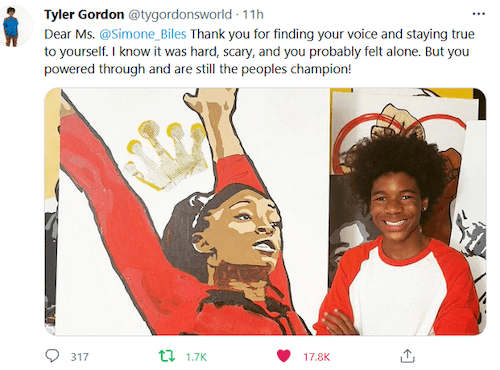
This young man is kind-hearted and has talent! You can actually watch him painting Simone here.
Unfortunately, there have been way too many negative comments. I believe these are people who don’t understand mental health. You don’t have to have broken your back to have compassion for someone who has but there are still too many people who can’t understand mental health or have empathy until they have experienced it or see a loved one experiencing it. I’m hopeful all this media attention will help create more awareness, compassion and kindness.
The twisties and how stress and anxiety can play a role
In case you are new to this term (like I was until this week), this article explains what the twisties are – Simone Biles Mentioned Having ‘the Twisties’ – Here’s What That Means, and Why It Can Be Dangerous in Gymnastics:
The twisties is an informal term used to refer to a certain kind of mental block that a gymnast can experience as they are in the air during a twisting skill. When someone gets the twisties, there is a disconnect between the brain and body, Jamie Shapiro, PhD, a certified mental performance coach who is the co-director of the Masters in Sport and Performance Psychology program at the University of Denver
In this same article, Dr. Shapiro, a former gymnast herself, shares how this loss of control can have both physical and mental implications:
Physically, the twisties can make a gymnast unable to perform the skills as they were previously able to.
Mentally, that inability to perform the skills can cause anxiety, exacerbating the mental block.
Allie Wagener, PhD, a licensed psychologist who specializes in sport and performance psychology at Premier Sports Psychology and is also a former gymnast shares how dangerous this can be in terms of injuring yourself when “you don’t know where you are in the air and you don’t know how to land.” It’s also terrifying for the gymnast and that worry and fear about it happening again can make things worse.
I wanted to understand more about the “twisties” in gymnastics and asked Jessica Drummond how similar are they to the yips, which happen in golf or baseball, and which I know are closely tied to increased anxiety/stress. The stress/anxiety can be a trigger and then having the yips make your anxiety and fears worse. Jessica confirmed this about the twisties:
Yes, it’s sort of a loop that can get stuck – get lost in the air (cognitive, proprioceptive, vestibular) –> realize how dangerous that is/ was/ could be –> fear –> stress –> exacerbates the original brain-based issue.
I encourage you to read the entire article to see how stress and anxiety, racing/negative/distracted thoughts, fear of failure, high expectations and even focal dystonia (involuntary muscle spasms) can play a role.
The experts also mention a number of possible techniques to help (like progression, focusing on a different skill, using simple cue words to “keep you focused on the skill rather than the fear”), speaking with a sports psychologist and taking a break.
There is no mention of “nutritional psychiatry” as a possible solution (and I share more on this below).
What Simone has shared – I’m a little bit more nervous
Right now, we don’t know exactly why Simone experienced the twisties or if any of the above apply to her, but we do know some of what she has shared with the media up until now.
In this article Simone said she wasn’t physically injured but fighting some mental demons and had experienced a little injury to her pride. She said that “after the performance I did I just didn’t want to go on,” saying it was all in her head. Simone also emphasized the need to protect her body and mind, saying “I have to focus on my mental health and not jeopardize my health and well-being.”
An article in Women’s Health Magazine reports her comments at a press conference after the USA team won the Silver medal. Simone shared how she just doesn’t trust herself as much as she used to, wasn’t having as much fun as usual and admitted that “I’m a little bit more nervous when I do gymnastics.”
It was here that she announced that she had the twisties.
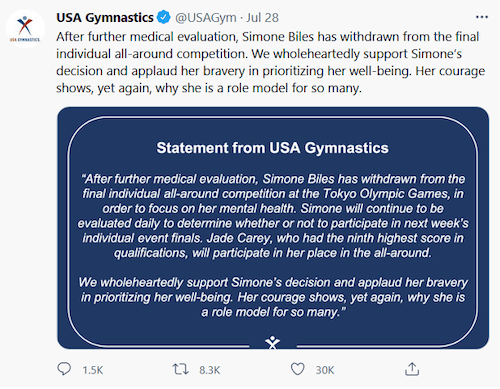
Around this time USA Gymnastics announced Simone had withdrawn to focus on her mental health. They also offered their support:
We wholeheartedly support Simone’s decision and applaud her bravery in prioritizing her well-being. Her courage shows, yet again, why she is a role model for so many.
A place for “nutritional psychiatry” and “anxiety nutrition solutions”
My hope is that more and more “nutritional psychiatry” and “anxiety nutrition solutions” (like the use of GABA, tryptophan and other amino acids) will make it into the world of professional (and recreational) sports. I’d like to see this embraced by athletic coaches, registered dieticians and psychologists working with athletes, and hopefully some of the athletes themselves.
Research shows that elite young athletes have high psychological demands:
Elite young athletes have to cope with multiple psychological demands such as training volume, mental and physical fatigue, spatial separation of family and friends or time management problems may lead to reduced mental and physical recovery.
The paper concludes that:
Future research should focus on sports medical and sports psychiatric interventional approaches with the goal to prevent anxiety and depression as well as teaching coping strategies to young athletes.
I recently blogged about how the amino acid tyrosine erased severe performance anxiety in a female musician – to such an extent that she had no more shaking, sweating, panic attacks or passing out. Much of this could be applied to an athletic performance where low dopamine is a factor.
This recent blog resonated with many in my community: What if overthinking, fear, anxiety and worry (caused by low serotonin) is holding you back instead of low motivation/low dopamine? Much of this could also apply to athletes with the twisties or yips with low serotonin as a root cause.
My book, The Antianxiety Food Solution, is a great place to start with the foundations of eating to reduce anxiety (real whole food, no gluten, no caffeine, no sugar, eating for blood sugar control and gut health) and more advanced interventions (like using the amino acids GABA, tryptophan, 5-HTP, tyrosine, DPA and glutamine for balancing brain chemistry, and addressing low zinc and vitamin B6 for pyroluria/social anxiety.)
All this is clearly very needed, and the research and awareness are growing in leaps and bounds, but as Beth Jones, Female/Teen Athlete Wellness & Mindset Coach, shares, what an amazing shift it would be if we could add more “nutritional psychiatry” into the sports psych training:
Coming from 20 years working in sports med with athletes, I keep coming back to wishing there was a degree that combined sports psychology & nutrition (functional & fueling). I started looking into the more mental aspects of performance and healing and then also bringing in more nutrition aligned with healing needs about 15 years ago, but it was all on my own.
What I’ve been learning from you has given me some new tools to share, but you’re right in that they are not well known. I know our US Olympic Committee has amazing health professionals in all areas that work as a team approach for our athletes, but I wonder how many of the RDs are actually having conversations with the mental health team and collaborating taking all of the athlete-specific nuances into consideration.
I know my own therapist suggested that I not pursue sports psych because of the lack of support among therapists out there, but what an amazing shift it would be if we could add more nutritional psychiatry into the sports psych training? Trying to forge a path in this area on my own, but it’s a lot of bush-whacking and little progress.
Beth raises some excellent points and as I said above, hopefully more and more of the “anxiety nutrition solutions” and “nutritional psychiatry” will make it into professional and recreational sports.
It’s ok to say you’re not ok mentally
Simone has noticed and embraced the love and support she’s been receiving. She tweeted this:
The outpouring [of] love & support I’ve received has made me realize I’m more than my accomplishments and gymnastics which, I never truly believed before
She is way more than her accomplishments and gymnastics.
Naomi Osaka penned an article in Time magazine with this title: ‘It’s O.K. Not to Be O.K.’ She wrote this shortly after she withdrew from the French Open to tend to her own mental health. Naomi’s openness has inspired Simone to speak out.
When athletes like Simone and Naomi prioritize their own mental health and are public about it, they are paving the way for it being ok to say you’re not ok mentally. Through their honesty and vulnerability, they have become role models and mental health advocates, and we applaud them for that.
But most of all we applaud them both for taking care of their mental health!
What love and support can you share for Simone and Naomi? Feel free to post in the comments.
Does this motivate and inspire you to be more open about your own anxiety and mental health challenges (if you have not been open yet)?
If you’re an athlete (professional or recreational), does any of this resonate with you and have the amino acids or diet helped you with your anxiety?
If you work with athletes (professional or recreational), I’d love to hear if this resonates with you and if you’re using nutritional psychiatry approaches with them to help ease their anxiety?
If you have connections to athletes (professional or recreational), or coaches, dieticians or psychologists who work with athletes, please share this blog and my work, so we can get nutritional psychiatry resources and anxiety nutrition solutions into their hands and help more athletes.