• Skip to primary navigation
  • Skip to main content
  • Skip to primary sidebar

everywomanover29 blog

Food, Mood and Women's Health – Be your healthiest, look and feel great!

  • Blog
  • About
  • Services
  • Store
  • Resources
  • Testimonials
  • The Book
  • Contact
  • Search this site

Erin Matlock

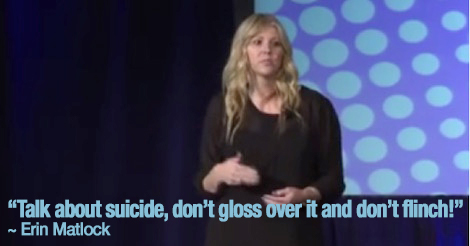
Erin Matlock: talk about suicide, don’t gloss over it and don’t flinch!

September 9, 2016 By Trudy Scott 29 Comments

erin-matlock-talk-suicide

Earlier this week when Erin Matlock shared her “Changing Fate” video from the Superhero You live event she said this:

This is hands down the most personal and most difficult talk I’ve ever given. In it I read from my own suicide note.

Please help us send this video out into the world so that people who are suffering alone can see that they are so very not alone.

I was very moved to share this video and since it’s National Suicide Prevention Week and World Suicide Prevention Day, September 10th, I’ve added to her wonderful message by sharing some powerful nutritional resources too.

You can WATCH the entire 16 minute video from the SuperheroYou live event VIA THIS LINK on the SuperheroYou facebook page. This is what Superhero You founder Jim Kwik shared when posting the video:

If you feel broken, alone, or unhappy, this might be the most important video you watch today.

Most of us think suicide is something that happens to strangers – not to people we know. But someone dies by suicide every 40 seconds. That’s 15,385 people this week and 800,000 people this year. If you have 1,000 Facebook friends, 60 of them have thought about suicide in the past year.

Erin Matlock knows this struggle well. She battled major depression for 15 years and had 4 escalating attempts on her own life. Today, Erin is a mental health advocate and founder of the Brain Summit, an online platform where experts present the latest tools and techniques to upgrade your brain. In the video, Erin shares how neuroscience helped her during this time, the challenges that even the happiest-seeming people might face, and what you can do if you (or someone you love) might be struggling.

Erin also talks about Cynthia Pasquella’s struggles with depression and saying “my brain is trying to murder me.” Here is her powerful blog where she bravely and openly shares: Let’s Talk About Depression – Because Most People Won’t And It’s Killing Us

Here is the resource list Erin shares:

National Suicide Prevention Lifeline (United States 24 hour hotline)
1-800-273-TALK

Samaritans  (United Kingdom and Republic of Ireland 24 hour hotline)
116 123 (UK) and 116 123 (ROI)

Beyond Blue (Australia 24 hour hotline and resources)
1300 22 4636

To Write Love On Her Arms
A nonprofit movement dedicated to presenting hope and finding help for people struggling with depression, addiction, self-injury, and suicide.

Mind
A UK charity with an extensive collection of information about mental health.

HeadsTogether
A UK Mental Health Awareness Campaign spearheaded by The Duke and Duchess of Cambridge and Prince Harry.

PsychologyToday Therapist Directory
Find Help From A licensed Therapist In Your Area

EEG Info Neurofeedback Provider Directory
Find a qualified clinician in your area

Advanced Brain Technologies Provider Directory
Music Listening Therapy

Fisher Wallace Stimulator
FDA approved device for the treatment of depression and anxiety. Stimulates the brain to produce serotonin while lowering cortisol.

You can find more wonderful resources from Erin on the Brain Pages and her website

erin-matlock-search-for-better-brain

In addition to the above resources Erin has so kindly shared I’d like to share some powerful and effective nutritional resources too. Just like anxiety, depression often has a biochemical and nutritional component and getting to the root cause of these imbalances and deficiencies can often completely eliminate the depression and suicidal thinking.

I hear this from Anxiety Summit attendees all the time:

Why has no-one told me that food and nutrients could have such an impact on my anxiety and panic attacks?

The same could be said for depression and suicidal thinking.

I also hear this from many in my community:

My anxiety (or depression) is SO severe there is no way that diet and nutrients could make a difference!

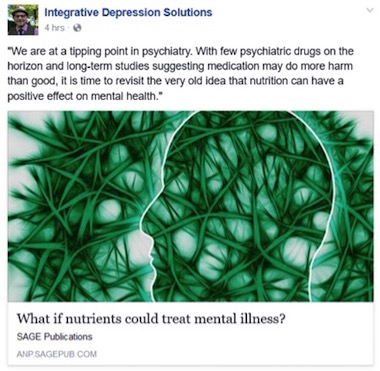
This is not true and I encourage you to have an open mind about this. We now have much research and so many integrative practitioners and nutritionists doing this work and seeing incredible results.  My colleague (and prior Anxiety Summit guest expert) Dr. Josh Friedman is one such practitioner and he has a wealth of information on his facebook page Integrative Depression Solutions. Here is just one example of a post:
nutrienta-and-mental-illness

The article was published in the Australian and New Zealand Journal of Psychiatry: What if nutrients could treat mental illness? and it starts with this sentence:

We are at a tipping point in psychiatry. With few psychiatric drugs on the horizon and long-term studies suggesting medication may do more harm than good, it is time to revisit the very old idea that nutrition can have a positive effect on mental health.

You can hear more about this topic in Julia Rucklidge’s TEDX talk: The surprisingly dramatic role of nutrition in mental health and read more about nutritional medicine in modern psychiatry from the International Society for Nutritional Psychiatry Research/ISNPR, and it’s founder Felice Jacka.

Here are some other nutritional resources for depression. Don’t let the word anxiety deter you – for some people anxiety is their biggest issue, for other it’s depression and the same underlying causes can be factors in both conditions.

60+ Nutritional & Biochemical Causes of Anxiety, a check-list to rule out possible underlying causes

The Anxiety Summit, an online event I host, now in its 4th season and called “a bouquet of hope”

The Depression Sessions, an online event hosted by Sean Croxton

The Mental Wellness Summit, an online event hosted by Dr. John Dempster and Ross McKenzie

The Medicinal Supplements Summit, co-hosted by Wendy Myers, airs next week (I cover both anxiety and depression in my interview)

The Brain Summit, hosted by Erin earlier this year.  I was fortunate enough to get to know Erin earlier this year, both as a speaker (I talked about grass-fed red meat and tryptophan) and by listening to her interview many wonderful brain experts like Alex Doman (who talked about music therapy for vagus nerve rehab).

A Mind of Your Own: The Truth about Depression and How Women Can Heal Their Bodies to Reclaim Their Lives, the wonderful best-selling book by Dr. Kelly Brogan

The Mood Cure: The 4-Step Program to Take Charge of Your Emotions–Today, the excellent book my mentor, Julia Ross

The Antianxiety Food Solution: How the Foods You Eat Can Help You Calm Your Anxious Mind, Improve Your Mood, and End Cravings, my book on anxiety

There is hope and just know there is an answer for you! Start by talking about how you feel, ask for help and work with someone to help you find your underlying cause and solution.

I know Erin’s courage and wisdom will get more people starting the conversation about suicide. And as she so wisely says:

talk about suicide, don’t gloss over it and don’t flinch!

I’d like to challenge you to be a superhero and talk to at least three people about suicide in the next week, whether you’re the one having suicidal thoughts or whether you’re the one concerned about a loved one or friend who may be having suicidal thoughts. Don’t gloss over it and don’t flinch!

 

Filed Under: Depression, Food and mood Tagged With: anxiety, Cynthia Pasquella, depression, Erin Matlock, integrative, nutritional psychiatry, suicide, SuperHero

Tryptophan, red meat and baby steps for anxiety: the Brain Summit

May 1, 2016 By Trudy Scott 18 Comments

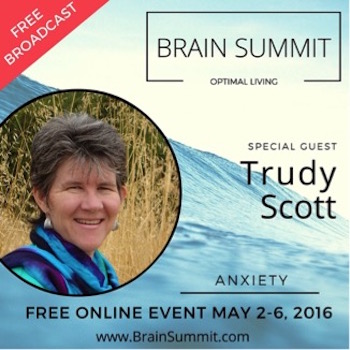
Just a quick reminder that the Brain Summit starts tomorrow, Monday, May 2nd.

brainsummit-trudy

Here are some snippets from my anxiety interview with host Erin Matlock. We started out talking about diet and grass-fed red meat and why it’s so beneficial if you have anxiety (and other mood problems):

…there’s a lot of research showing now that [a Western diet] diet is not good for so many conditions, and mental health is now coming into the research. And we know this, but to see it in the research is really beneficial. Dr. Felice Jacka did a great study in Australia that was one of the first studies that looked at anxiety and depression in women and found that the Western diet was associated with a higher risk for anxiety and depression. And this whole foods, traditional diet, that actually included grass-fed red meat, was more beneficial for anxiety and depression. And in her thesis, they actually looked at red meat thinking that they would find that red meat was actually detrimental. And, lo and behold, they found that grass-fed red meat was one of the most important predictors for good mental health. So a lot of people say, “I don’t eat red meat any more. I’m being healthy.” And in actual fact, not eating it is doing them harm.

So red meat is wonderful! And it needs to be grass fed because then you’re getting the good levels of the Omega-3s. The Omega-3 three profile of grass fed red meat is very similar to what you would find in salmon. Obviously, fish is great, so while fish like salmon or sardines are great as well, the reason I like the red meat is it’s something that most people enjoy eating. And as well as the Omega-3s, we’re getting the iron, and iron is a co-factor for making serotonin and making GABA, and it’s needed for energy and so many other functions in the body.

It’s also got zinc, and zinc is a common deficiency, way more common than we realize. And when you are anxious, you may have high copper level, and low zinc level. So getting those zinc levels up will push the copper down, and that can help with your anxiety, as well.

We also had a long discussion on serotonin and tryptophan/5-HTP:

…we often associate serotonin with depression. And a lot of people don’t realize that it’s very closely tied to anxiety, as well.  So we’ve got two types of anxiety when it comes to the brain chemicals. One is the low-serotonin type, and this is the anxiety in the head, where you’ve got the ruminating thoughts, and the busy mind, and the negative self-talk, and just this monkey mind that you can’t switch off — this worry, and sort of reprocessing things. And then we have the low-GABA kind of anxiety, where it’s in your physical body and you’re feeling stiff and tense, and you can feel it in your body, and you may feel it in your gut….

I have people do a questionnaire, and depending on how you score on that questionnaire, that’s a clue as to whether serotonin may be a factor. So all of those symptoms I’ve just mentioned, you would rate yourself on a scale of one to ten.  And then I use individual, targeted amino acids. So it’s a supplement, and the other things that obviously have an impact are food, and diet, and everything we just talked about. Getting exercise, getting outside in the light, all of those are factors.

But for quick, immediate results, and pretty profound results – people just say to me, “Could this really be happening so quickly?” that’s how quickly we get results, you know, within 30 seconds to two minutes they’re getting results – is to use these individual amino acids as supplements. And the reason they’re called “targeted” is because it’s targeted to your unique needs. Like when you do the questionnaire and it says, yes, you need some serotonin support, and then you would use either tryptophan or 5-HTP as a supplement. And again, targeted, because you need it, but also targeted to your unique biochemistry.

There’s a standard starting dose for tryptophan, which is 500 mg, while 5-HTP is 50 mg.

Be sure to tune into the interview with Debbie Hampton. She is the survivor of an acquired brain injury (from a pill overdose when trying to commit suicide) and the author of the upcoming book, Sex, Suicide, and Serotonin.  Her story and resilience is inspiring!  Here is Debbie’s wonderful answer to Erin’s question: “What advice would you give to someone who feels like it’s too late to do what they want to do? I’m already so deep in, there’s no way that I could possibly have the life that I wanted or do the work that I really wanted to do.”

debbie-hampton

It’s never too late. And those limitations, you’re putting on yourself. Those limitations are in your mind. If you think you can’t, and you think it’s too late, then it is. You’ve got to change your mind first and if your mind thinks you can, you’re halfway there.

My advice would be to start small … I’m not big on long-term plans. I’m big on a long-term bigger goal. But what you’ve got to do is you’ve got to take a little step in the right direction towards that goal, and when you get there, you look around and you say, “Okay, what is my next best step?” And when you get to that next step, there may be opportunities that you can see that you couldn’t even see back here.

So you’ve got to take it one step at a time and get there and assess your opportunities. And then figure out the next best step, and then get there and figure out the next one. And it may be a zigzag path, and you may even have to go back sometimes, regress, but as long as you just keep moving forward and keep positive momentum and positive thoughts and be your own cheerleader, and encourager, and supporter— be your own friend—that is the most important thing.

I could not agree more – there is an answer, you can do whatever you set out to do and just take baby steps!

You can register for the Brain Summit here:
http://www.brainsummit.com?orid=45505&opid=12


Filed Under: Amino Acids, Events, Food and mood, Real whole food, Tryptophan Tagged With: 5-HTP, anxiety, brain summit, Erin Matlock, iron, red meat, serotonin, Trudy Scott, tryptophan, zinc

Music Therapy for Vagus Nerve rehab: on the Brain Summit

April 25, 2016 By Trudy Scott 9 Comments

Just a quick reminder that the Brain Summit airs May 2nd to 6th.

brain-summit

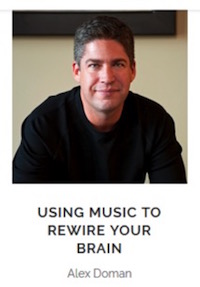
Here is a snippet from the interview with Alex Doman: Using Music to Rewire Your Brain. Alex is CEO of Advanced Brain Technologies, the third generation of a family of pioneers in the field of human brain development, co-founder of Sleep Genius, author of the best-selling book, Healing at the Speed of Sound and co-creator of The Listening Program, a sound therapy program.

alex-dorman

It’s a fascinating topic that I didn’t know much about until I heard this interview. Alex shares some of the basics of sound and sound therapy:

Sound affects us on a myriad of levels, from lower brain centers to the higher brain centers. So bottom-up and top-down processing, emotional regulation, moods. So it has a swath of impact on us as human beings, and, you know, the music that’s in our personal playlist we use, you know, to self-regulate, and, as you said, maybe an up-tempo piece for our cardio; a slow tempo, very calm piece when we’re in a stress state; maybe some baroque music to help focus us.

And the principles of using music and sound for self-regulation, there are a few components, right? One is frequency, which you mentioned, which is a big area of focus for us. Different sound frequencies have a different impact on our functions and performance, right? So we’ve learned that low-frequency sounds have a very calming effect on the nervous system. They have an effect on our motor functions within the brain; fine and gross motor skills, our sense of body and space, our left-right awareness, our coordinated movements, and our vestibular functions, primarily. Whereas, the mid-frequencies are very focusing, as opposed to the low frequencies being grounded, and they are more related to our communication with one another, our ability to receive and express language, both orally and through written communication. And then these high frequencies, which are rather magical, in a way, that are very stimulating and tap into our intuition, our beliefs, our creativity. And actually, in the brain, there’s more neural area for the high frequencies than any other range of sound frequencies.

So we are working with sound and the components of frequency to affect different functions within our lives — from the low to the mid to the high frequencies—in very specific ways, but then there are other features, like the tempo, the pace of the music, right? Slow tempos will entrain our body rhythms and brain waves to lower states, and fast tempos will activate us. So, in way, you can think of high frequencies like sonic caffeine that I have here in my cup, to get me activated, and the low frequencies might be like taking a lavender essential oil to help kind of calm our nervous system. So they affect us across a great range.

Once he started talking about stress, burnout and the vagus nerve, I was even more fascinated and really intrigued:

What’s happening is our stress resilience is getting lower and lower and lower. So what’s interesting is noise is a big contributor to that. But sound is also the antidote. So there was some research that was done in Europe a few years ago with child care workers that experienced burnout symptoms to the magnitude that many would qualify for a depression diagnosis.

So the investigators wanted to research the impact of Music Listening Therapy with a special mode of stimulation that would impact the vagus nerve and the autonomic nervous system with more impact—and we’ll probably talk about bone conduction later—and to use one of our protocols to see if, in fact, symptoms of burnout would be lessened in response to that intervention, compared to the standard care, that standard care being visits to a psychotherapist for these workers.

So they did a controlled study, and one group saw the therapist and one group, their therapist was themselves using sound as the input and to help heal and change their state. And what was miraculous is that those that did the listening had statistically significant improvements going from stress burnout to normal stress resilience, and those getting talk therapy made very little change. They stayed kind of stuck in their pattern of stress response. So it’s really a testament to the power of the right sound done in a very specific manner, right? This isn’t haphazard; this is a very focused, structured program to create a massive change to a very big issue that many of us face.

Later on in the interview, there is more discussion about the vagus nerve. If you’ve been following my blogging recently you’ll be aware of the issues I had with my voice and the breathing and humming work I did for my vagus nerve rehabilitation. Now I have a much better understanding of why it helped so much!  

And what’s interesting is the vagus nerve, which is a cranial nerve, has enervations within the ear, meaning connections, inner connections within the ear. So when we hear or experience sound, that sound carries along the vagus nerve. So it connects our central nervous system and our autonomic nervous system; that’s the main bridge, the main connector that happens. And it’s very important for emotional regulation; it’s the center of emotional regulation.

And what we’ve found with Music Listening Therapy, the observations are that it helps with that homeostatic state, that balance of acceleration when we need it and deceleration in the brake when we need it. So that we can have improved stress resilience and better emotional regulation

Erin Matlock is founder of Brain Summit, a mental health advocate and popular speaker. After overcoming a crippling battle with severe depression, she went on to create an online community where she openly shares her search for a better brain.  

During this interview she shares how much this music therapy helped her to feel joyful and more connected:

erin-matlock

I’d spent four weeks in the high frequency range, and that produced a joy. And I have never described myself as joyful, not since I was a little child, because of the history of depression. And I can’t remember – and I know I wrote about that – a time when I walked around saying, “I feel joy,” for no reason, none at all.

And then the other part was the connection. And this part was interesting. As an introvert, as someone who has always felt very out of place, like I was born in the wrong time, I used to describe myself like that saying, “alone in a crowded room.” That was me. And to feel connected — not to any particular person, just in a general sense— for me it was spiritual; it’s not that way for everyone else. I don’t know where that connection comes from, but it was something that my brain wasn’t giving me before. And that came directly as a result of this training.

Overall it is a fascinating interview and one I know you’ll want to hear! I look forward to checking out other interviews and hope you’ll join me on the Brain Summit. Erin interviews 25 global experts who present cutting edge information on brain health, mental health, peak performance, neurotechnology, nutrition and much more.

You can register here: http://www.brainsummit.com?orid=45505&opid=12

Filed Under: Events, Music Tagged With: Alex Doman, Erin Matlock, vagus nerve

Primary Sidebar

NEW! GABA QuickStart Homestudy (with special intro pricing)

gaba quickstart homestudy

Free Report

9 Great Questions Women Ask about Food, Mood and their Health

You'll also receive a complimentary subscription to my ezine "Food, Mood and Gal Stuff"


Connect with me

Popular Posts

  • Amino Acids Mood Questionnaire from The Antianxiety Food Solution
  • The Antianxiety Food Solution Amino Acid and Pyroluria Supplements
  • Pyroluria Questionnaire from The Antianxiety Food Solution
  • Collagen and gelatin lower serotonin: does this increase your anxiety and depression?
  • Tryptophan for the worry-in-your-head and ruminating type of anxiety
  • GABA for the physical-tension and stiff-and-tense-muscles type of anxiety
  • The Antianxiety Food Solution by Trudy Scott
  • Seriphos Original Formula is back: the best product for anxiety and insomnia caused by high cortisol
  • Am I an anxious introvert because of low zinc and vitamin B6? My response to Huffington Post blog
  • Vagus nerve rehab with GABA, breathing, humming, gargling and key nutrients

Recent Posts

  • What do I use instead of Seriphos to help lower high cortisol that is affecting my sleep and making me anxious at night?
  • BeSerene™ GABA/theanine cream eases severe muscle tension in her neck/shoulders, prevents her bad headaches and quells her anxiety
  • How the correct approach, dose and sublingual use of GABA can be calming and not cause a flushed and itchy face and neck
  • The amino acid glutamine improves low mood by addressing gut health, and it has calming effects too
  • Flight anxiety with heightened breath, physical tension and also fearing the worst (the role of low GABA and low serotonin)

Categories

  • 5-HTP
  • AB575
  • Addiction
  • ADHD
  • Adrenals
  • Alcohol
  • Allergies
  • Alzheimer's disease
  • Amino Acids
  • Anger
  • Antianxiety
  • Antianxiety Food Solution
  • Antidepressants
  • Anxiety
  • Anxiety and panic
  • Autism
  • Autoimmunity
  • benzodiazapines
  • Bipolar disorder
  • Books
  • Caffeine
  • Cancer
  • Candida
  • Children/Teens
  • Collagen
  • Cooking equipment
  • Coronavirus/COVID-19
  • Cravings
  • Depression
  • Detoxification
  • Diabetes
  • Diet
  • DPA/DLPA
  • Drugs
  • EFT/Tapping
  • EMF
  • EMFs
  • Emotional Eating
  • Endorphins
  • Environment
  • Essential oils
  • Events
  • Exercise
  • Fear
  • Fear of public speaking
  • Fertility and Pregnancy
  • Fish
  • Food
  • Food and mood
  • Functional neurology
  • GABA
  • Gene polymorphisms
  • General Health
  • Giving
  • Giving back
  • Glutamine
  • Gluten
  • GMOs
  • Gratitude
  • Gut health
  • Heart health/hypertension
  • Histamine
  • Hormone
  • Hyperparathyroidism
  • Hypoglycemia
  • Immune system
  • Inflammation
  • Insomnia
  • Inspiration
  • Introversion
  • Joy and happiness
  • Ketogenic diet
  • Lithium orotate
  • Looking awesome
  • Lyme disease and co-infections
  • MCAS/histamine
  • Medication
  • Men's health
  • Mental health
  • Mercury
  • Migraine
  • Mold
  • Movie
  • MTHFR
  • Multiple sclerosis
  • Music
  • NANP
  • Nature
  • Nutritional Psychiatry
  • OCD
  • Osteoporosis
  • Oxalates
  • Oxytocin
  • Pain
  • Paleo
  • Parasites
  • Parkinson’s disease
  • PCOS
  • People
  • PMS
  • Postpartum
  • PTSD/Trauma
  • Pyroluria
  • Questionnaires
  • Real whole food
  • Recipes
  • Research
  • Schizophrenia
  • serotonin
  • SIBO
  • Sleep
  • Special diets
  • Sports nutrition
  • Stress
  • Sugar addiction
  • Sugar and mood
  • Supplements
  • Teens
  • Testimonials
  • Testing
  • The Anxiety Summit
  • The Anxiety Summit 2
  • The Anxiety Summit 3
  • The Anxiety Summit 4
  • The Anxiety Summit 5
  • The Anxiety Summit 6
  • Thyroid
  • Thyroid health
  • Toxins
  • Tryptophan
  • Tyrosine
  • Uncategorized
  • Vegan/vegetarian
  • Women's health
  • Yoga

Archives

  • October 2025
  • September 2025
  • August 2025
  • July 2025
  • June 2025
  • May 2025
  • April 2025
  • March 2025
  • February 2025
  • January 2025
  • November 2024
  • October 2024
  • September 2024
  • August 2024
  • July 2024
  • June 2024
  • May 2024
  • April 2024
  • March 2024
  • February 2024
  • January 2024
  • December 2023
  • November 2023
  • October 2023
  • September 2023
  • August 2023
  • July 2023
  • June 2023
  • May 2023
  • April 2023
  • March 2023
  • February 2023
  • January 2023
  • December 2022
  • November 2022
  • October 2022
  • September 2022
  • August 2022
  • July 2022
  • June 2022
  • May 2022
  • April 2022
  • March 2022
  • February 2022
  • January 2022
  • December 2021
  • November 2021
  • October 2021
  • September 2021
  • August 2021
  • July 2021
  • June 2021
  • May 2021
  • April 2021
  • March 2021
  • February 2021
  • January 2021
  • December 2020
  • November 2020
  • October 2020
  • September 2020
  • August 2020
  • July 2020
  • June 2020
  • May 2020
  • April 2020
  • March 2020
  • February 2020
  • January 2020
  • December 2019
  • November 2019
  • October 2019
  • September 2019
  • August 2019
  • July 2019
  • June 2019
  • May 2019
  • April 2019
  • March 2019
  • February 2019
  • January 2019
  • December 2018
  • November 2018
  • October 2018
  • September 2018
  • August 2018
  • July 2018
  • June 2018
  • May 2018
  • April 2018
  • March 2018
  • February 2018
  • January 2018
  • December 2017
  • November 2017
  • October 2017
  • September 2017
  • August 2017
  • July 2017
  • June 2017
  • May 2017
  • April 2017
  • March 2017
  • February 2017
  • January 2017
  • December 2016
  • November 2016
  • October 2016
  • September 2016
  • August 2016
  • July 2016
  • June 2016
  • May 2016
  • April 2016
  • March 2016
  • February 2016
  • January 2016
  • December 2015
  • November 2015
  • October 2015
  • September 2015
  • August 2015
  • July 2015
  • June 2015
  • May 2015
  • April 2015
  • March 2015
  • February 2015
  • January 2015
  • December 2014
  • November 2014
  • October 2014
  • September 2014
  • August 2014
  • July 2014
  • June 2014
  • May 2014
  • April 2014
  • March 2014
  • February 2014
  • January 2014
  • December 2013
  • November 2013
  • October 2013
  • September 2013
  • August 2013
  • July 2013
  • June 2013
  • May 2013
  • April 2013
  • March 2013
  • February 2013
  • January 2013
  • December 2012
  • November 2012
  • October 2012
  • August 2012
  • July 2012
  • June 2012
  • May 2012
  • April 2012
  • March 2012
  • February 2012
  • January 2012
  • December 2011
  • November 2011
  • October 2011
  • September 2011
  • August 2011
  • July 2011
  • June 2011
  • May 2011
  • April 2011
  • March 2011
  • February 2011
  • January 2011
  • December 2010
  • October 2010
  • September 2010
  • July 2010
  • May 2010
  • April 2010
  • March 2010
  • February 2010
  • January 2010
  • November 2009

Share the knowledge!

The above statements have not been evaluated by the Food and Drug Administration. Products listed in this website are not intended to diagnose, treat, cure or prevent any disease.

The information provided on this site is for informational and educational purposes only and is not intended as a substitute for advice from your physician or other health care professional. You should consult with a healthcare professional before starting or modifying any diet, exercise, or supplementation program, before taking or stopping any medication, or if you have or suspect you may have a health problem.


Copyright © 2026 Trudy Scott. All Rights Reserved. | Privacy | Terms and Conditions | Refund Policy | Medical Disclaimer

Free Report

9 Great Questions Women Ask about Food, Mood and their Health

You’ll also receive a complimentary subscription to my ezine “Food, Mood and Gal Stuff”